

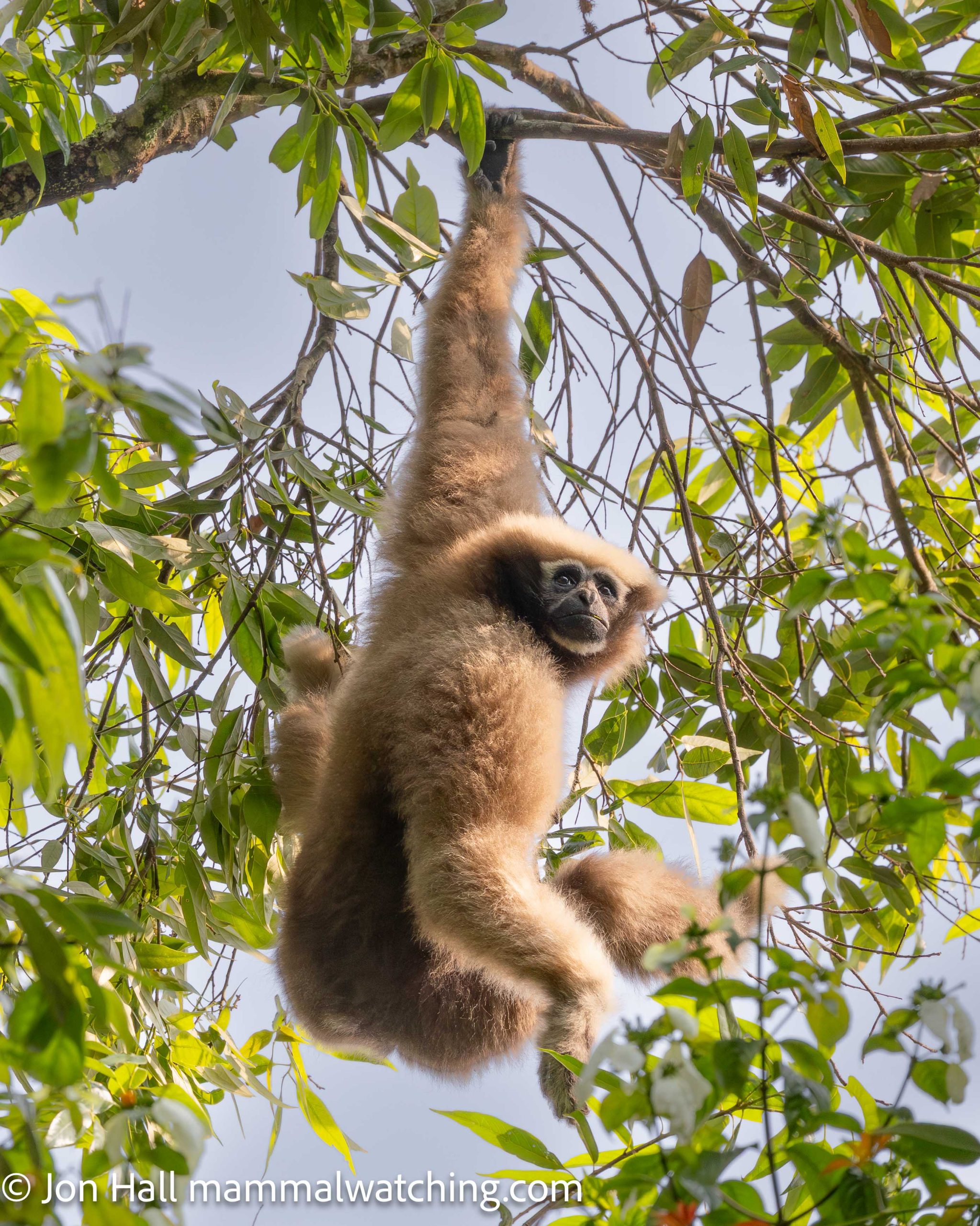
Yunnan, April 2026
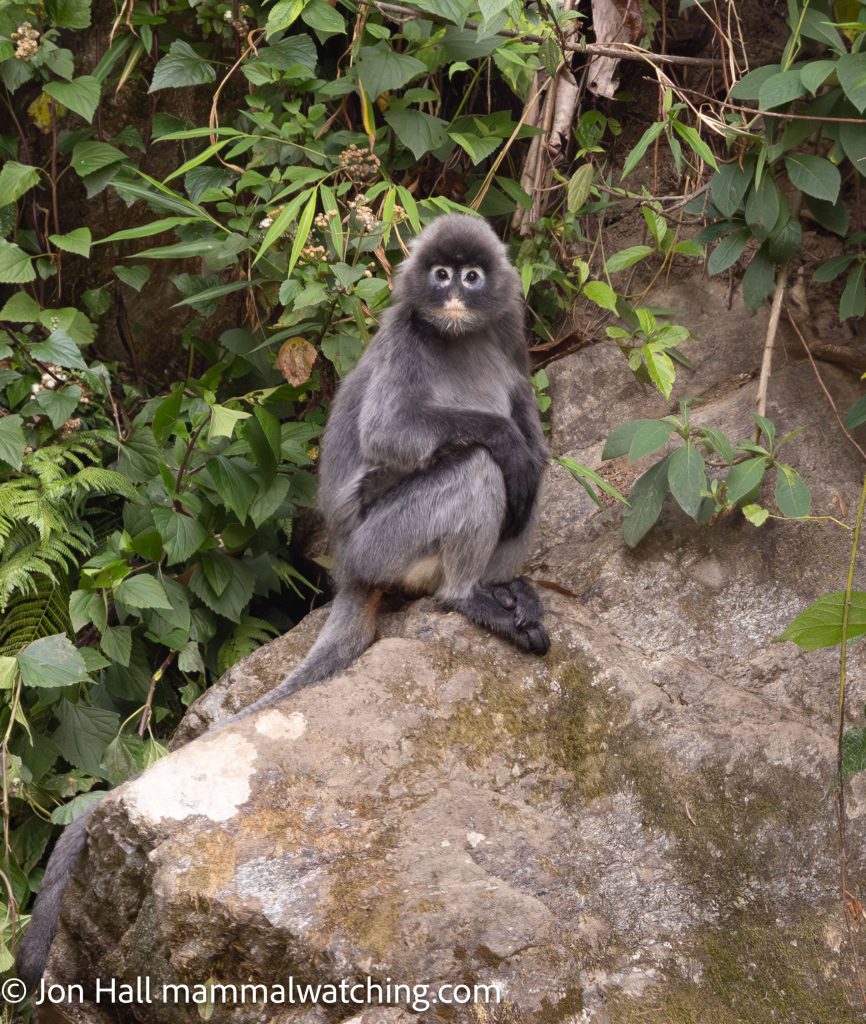
Shan Langur (Trachypithecus melamera)
Ever since I read Sichao Ma’s 2023 report about Yunnan’s primates I had wanted to visit.
I asked around, but I couldn’t figure out how to plan a trip.
Some sites were rumoured to be closed to foreigners. I didn’t know which seasons were reliable for which primates. Nor how to plan a route.
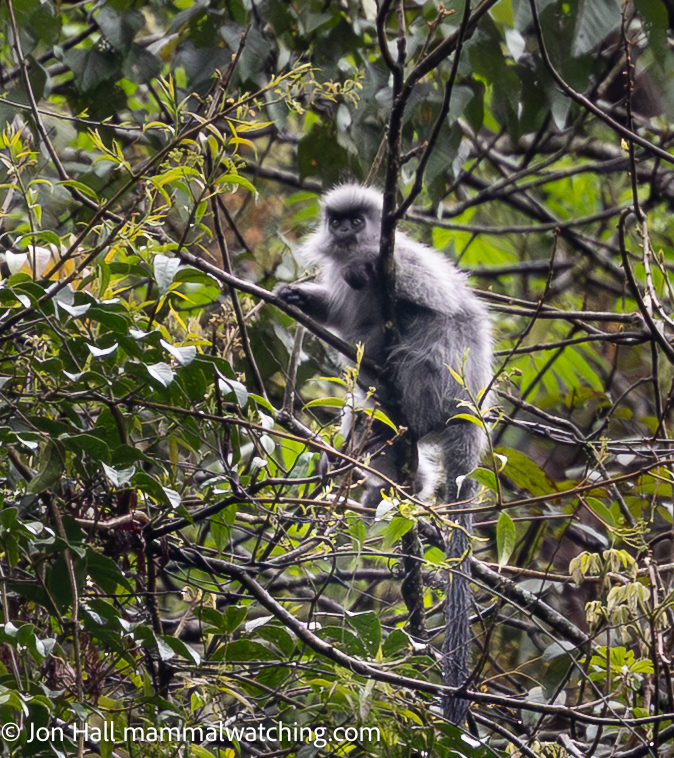
Shortridge’s Langur (Trachypithecus shortridgei)
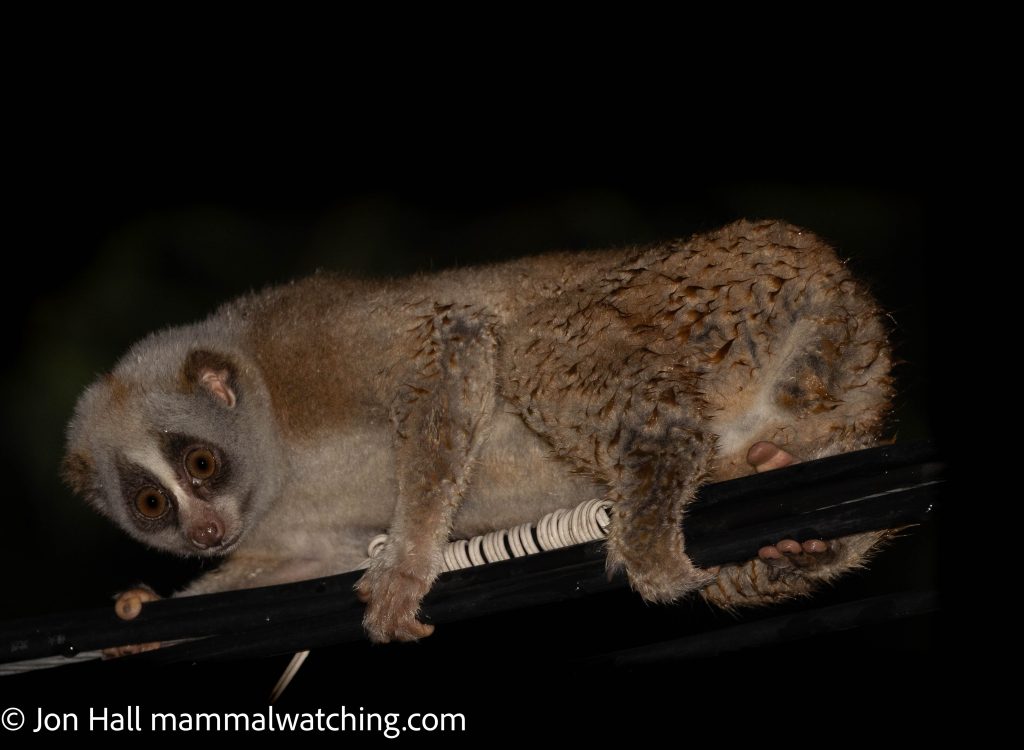
Bengal Slow Loris (Nycticebus bengalensis)
For some trips the only option is to turn up and give it a go so long as I could get some help from a local. Once I’d decided to visit, I started chatting with Yiqian Wu, a young biologist and very keen mammalwatcher, from the north of China.

Yiqian: the mammal and hotpot lord
Yiqian is a long-time follower of this website and has travelled extensively across China to watch mammals. He runs a large mammalwatching group on WeChat and his friend’s call him the ‘Mammal Lord’. Clearly he was the man to talk to! When Yiqian told me he hadn’t spent much time in Yunnan I jumped at the chance to take a trip with him. This turned out to be a very good decision.
This was a recce trip for both of us. Though Yiqian had researched all the sites we visited, he hadn’t been to most of them, so neither of us knew what to expect. He designed a rough itinerary but built in a lot of flexibility in case of rain.
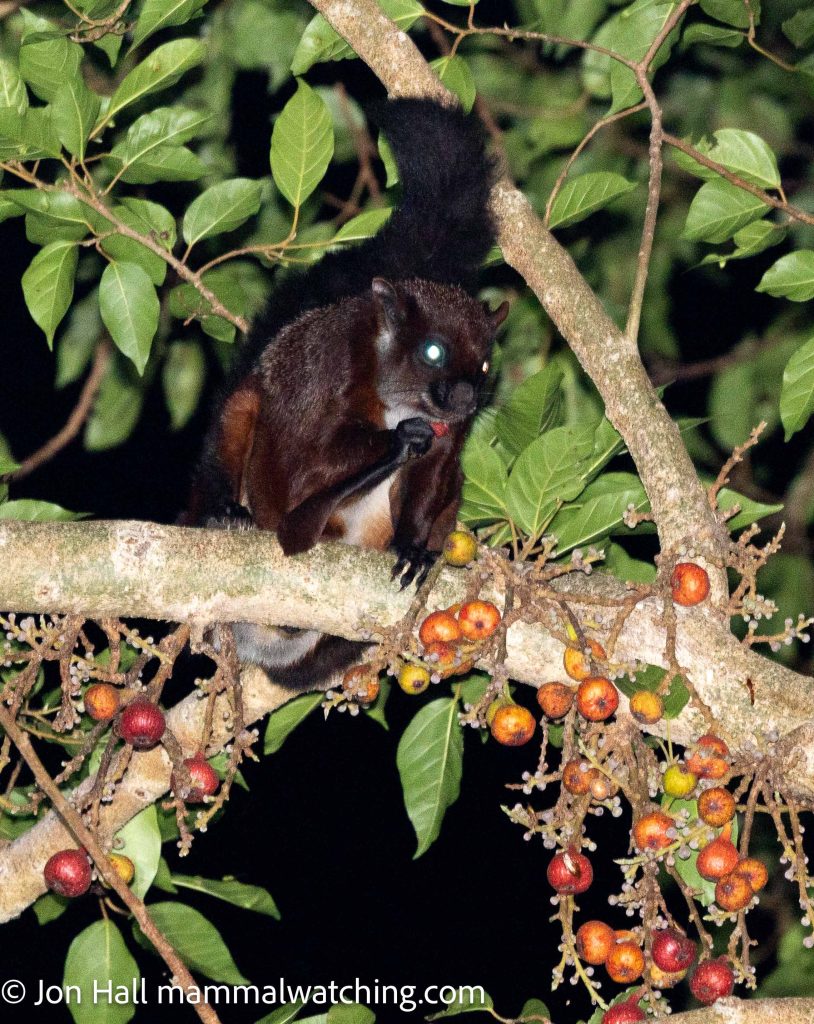
Yunnan Giant Flying Squirrel (Petaurista yunanensis)
I have said it before, but I will say it again. China is a mammalwatcher’s paradise. In fact if I had to design the perfect country to take an exploratory trip like this then that country would look a lot like China.
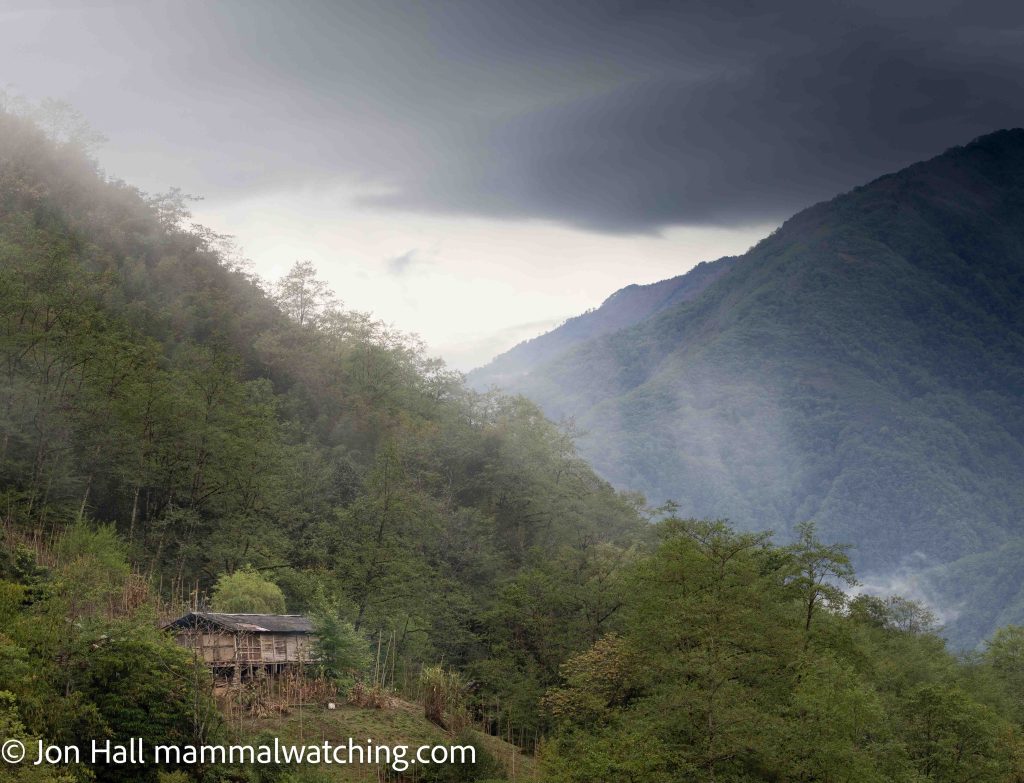
Dulongjiang is peak China
First, you can make plans on the fly. No one seems to book hotels in advance, or even flights until the last minute.
Second, people and businesses are incredibly accommodating. Hotel check out time is usually 2pm and for a few dollars that can be extended if you need a siesta. Restaurants open early and close late, and good food and good lodging is very affordable compared to the West.
Third, it’s an incredibly safe country. And a welcoming one. Western tourists are a novelty – read non-existent – just about everywhere we went. There were many requests for selfies, and offers of beer and snacks. We spent most of our time very close to the Myanmar border and crossed frequent police checkpoints. Each time the cops meticulously checked my passport and politely waved me on my way.
And finally, the mammalwatching is excellent and getting better every year, helped in part by the growing number of Chinese birders and nature lovers sharing intel.
Itinerary
Our Itinerary was built around four key target species: Shortridge’s Langur; Himalayan Takin (both in Dulongjiang); Shan Langur; and Skywalker Gibbons (both close to Mangshi). Depending on our success we might have time to add stops for flying squirrels, bat caves and more during our 10 days in the province.
In the end our trip ran like this.
Sunday April 19: arrive Mangshi in the evening and drive five hours to Menngong near Guanyin Cave.
Monday April 20: Explore Guanyin Cave then drive nine hours north to overnight in Fugong County Town.
Tuesday April 21: all-day drive over the mountains to Maku Village in the heart of Dulongjiang, near Gaoligongshan National Park on the border with Myanmar.
Wednesday April 22: looking for Shortridge’s Langurs around the village, then a two-hour drive back up the mountain to stay in Dulongjiang town.
Thursday April 23: an hour’s drive to the top of the mountain pass to spend the day searching for Himalayan Takin. Then back over the other side of the mountain to overnight in Gongshan County Town.
Friday April 24: all day driving back to Mangshi City.
Saturday April 25: morning watching Shan Langurs (an hour from Mangshi). Lunch back in Mangshi, then a three-hour drive to a village in Yingjiang County.
Sunday April 26: morning watching Skywalker Gibbons next to the village, then a four-hour drive to Hornbill Valley, and a long spotlight drive through the valley. Overnight at Shiti Village.
Monday April 27: morning visit to the bird hides at Shiti Village, then another long spotlight drive back to the start of the valley where we spent the night.
Tuesday April 28: a bonus night which we spent at Baihualing, 2 hours north of Mangshi, to try for Himalayan Long-eared Flying Squirrel.
Wednesday April 29: Return to Mangshi.
When to Go and What to Know
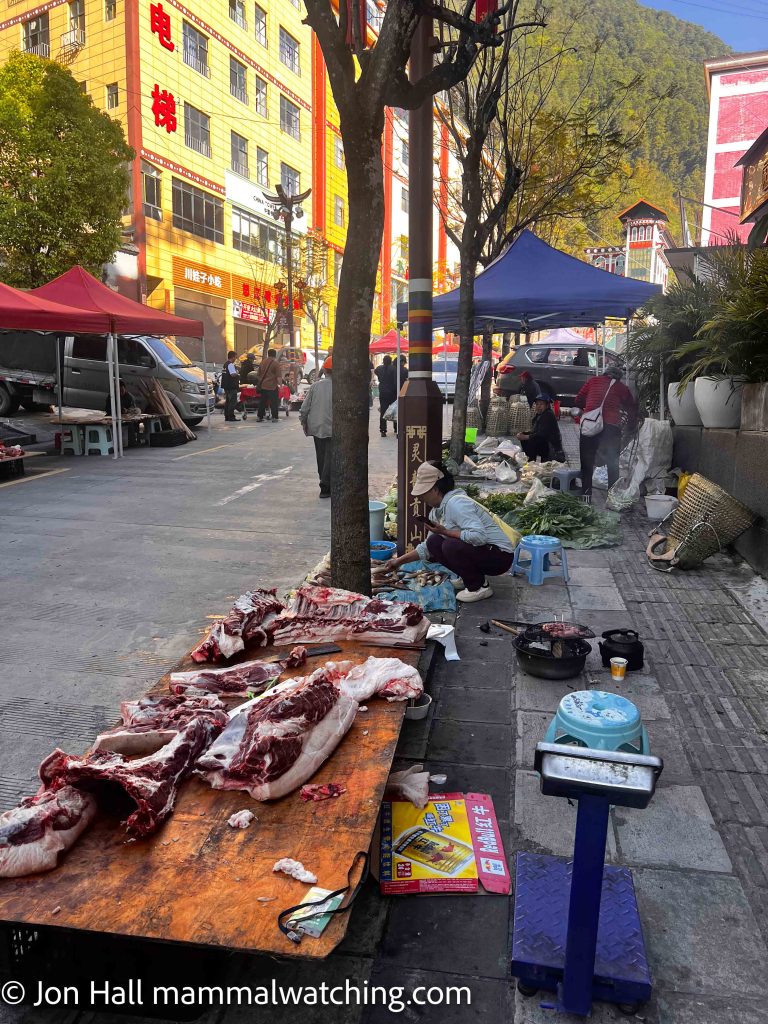
China is a vegan paradise
March might be the very best time to visit these parts of Yunnan for mammalwatching. The rainy season runs May – October (so we were cutting it close in late April). It seems always to be wet in Dulongjiang, but it would be very cold until March.
We didn’t book much of anything in advance. Yiqian rented a hybrid SUV. Although I understand the rules in China are starting to relax around foreigners applying for a driving licence I’m not sure how feasible this trip would be without having a Chinese national with you. Preferably two: we drove a long way and when I say ‘we’ I mean Yiqian. Having two drivers would have made life a lot more comfortable for him.
Driving aside, although many of the younger Chinese speak a little English, the language barrier is as big as it gets still. So even if you were allowed to drive this would be a very difficult trip to navigate without someone who speaks Chinese.
Though rumours abound about places in Yunnan being closed to foreigners – or to everyone – all of the places we visited were open to foreigners and we didn’t have any issues. So far as I can tell, the restricted areas are mainly in the core areas of national parks or some areas very close to the border. We passed through multiple checkpoints close to the border. All of them took a careful interest in my documentation but then waved us on.
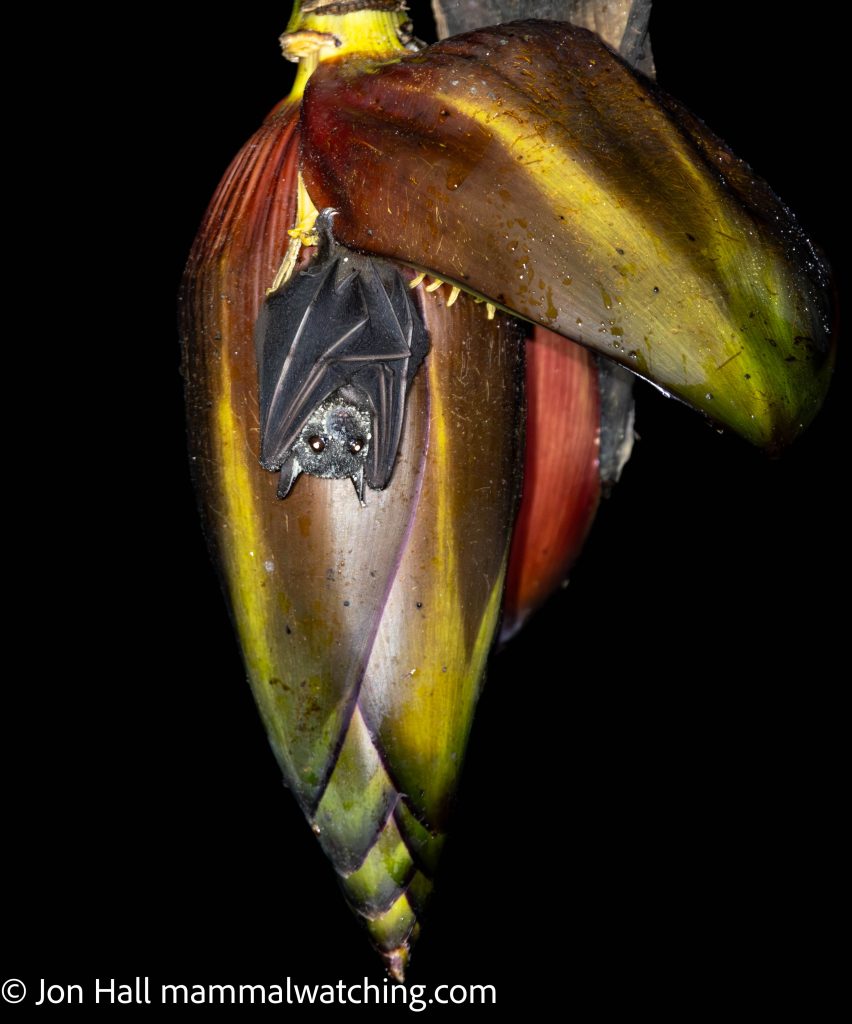
Blanford’s Fruit Bat (Sphaerias blanfordi)
We stayed in spotless, comfortable hotels. Although there is WiFi everywhere, I couldn’t figure out a way to use my VPN to access things like Gmail in most hotels (though Yiqian assures me it’s possible with the right VPN). Nor could I figure out why any hotels required a password to use their WiFi: if the password isn’t 88888888 it’s 12345678. My US phone and data plan, along with an eSim, let me access all of the Internet on my phone at least. We had cell service almost everywhere.
The scenery, the food and the people were spectacular.
Day by Day
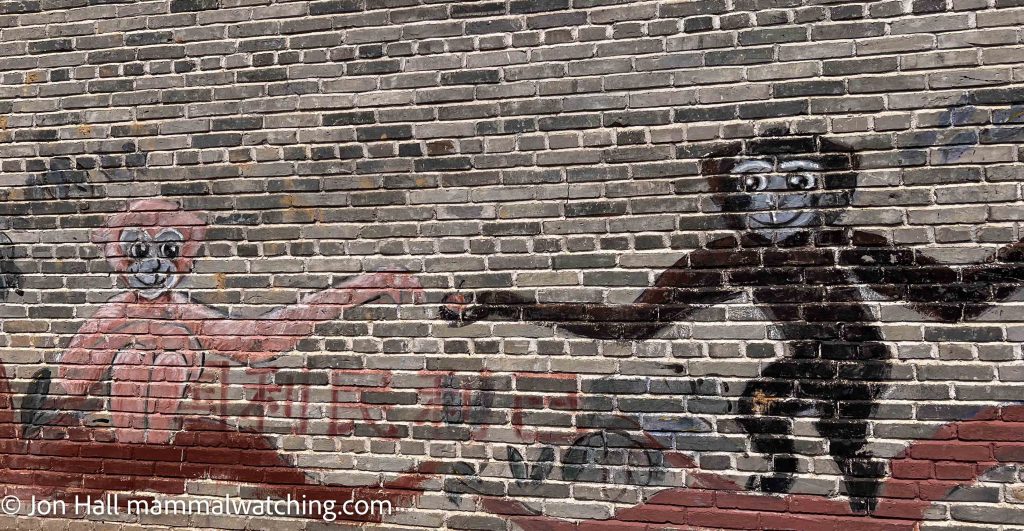
Skywalker Gibbon village
Sunday
I landed in Mangshi at dusk, met Yiqian and after the first of many excellent meals, we drove for at least four hours along steep winding roads to a hotel at Menggong near Guanyin Cave.
Monday
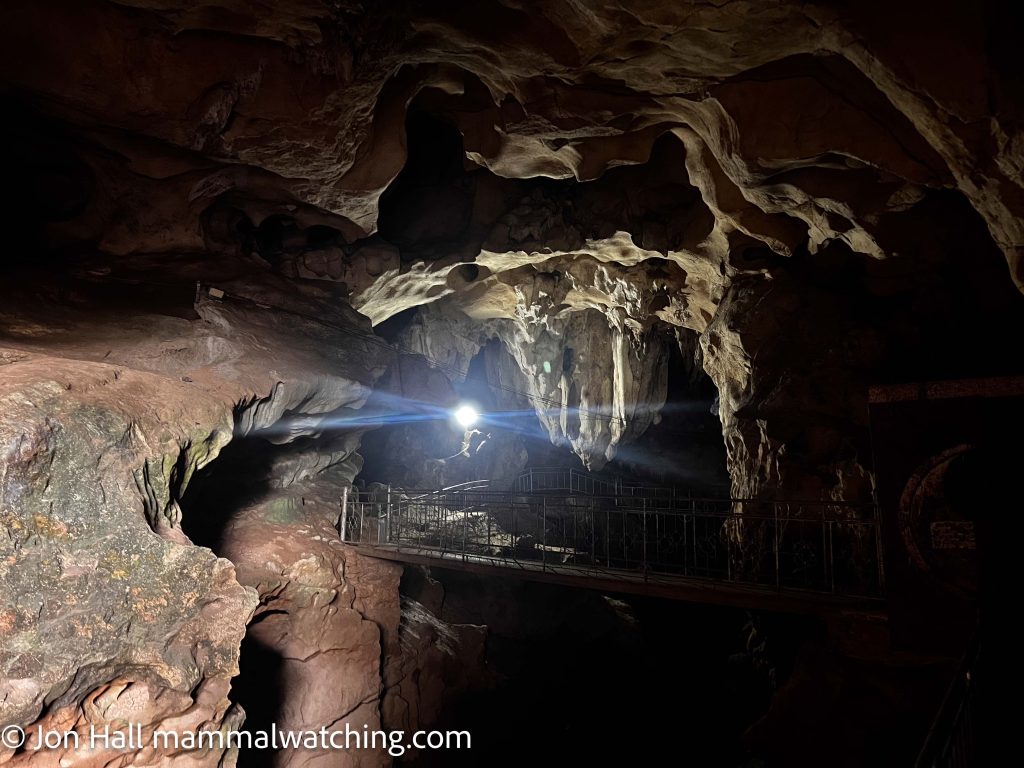
Carlos Bocos and suggested we visit Guanyin Cave, though he warned he had found few bats when he had visited a week earlier.
This very large cave is open to tourists. We were the only visitors. Despite spending two hours inside we saw very few bats, as Carlos had predicted. The few bats we saw were generally hard to photograph as they were hanging 30 metres or more above us. I had dreams of seeing a Great Evening Bat (Ia Io) here but I don’t think we did.
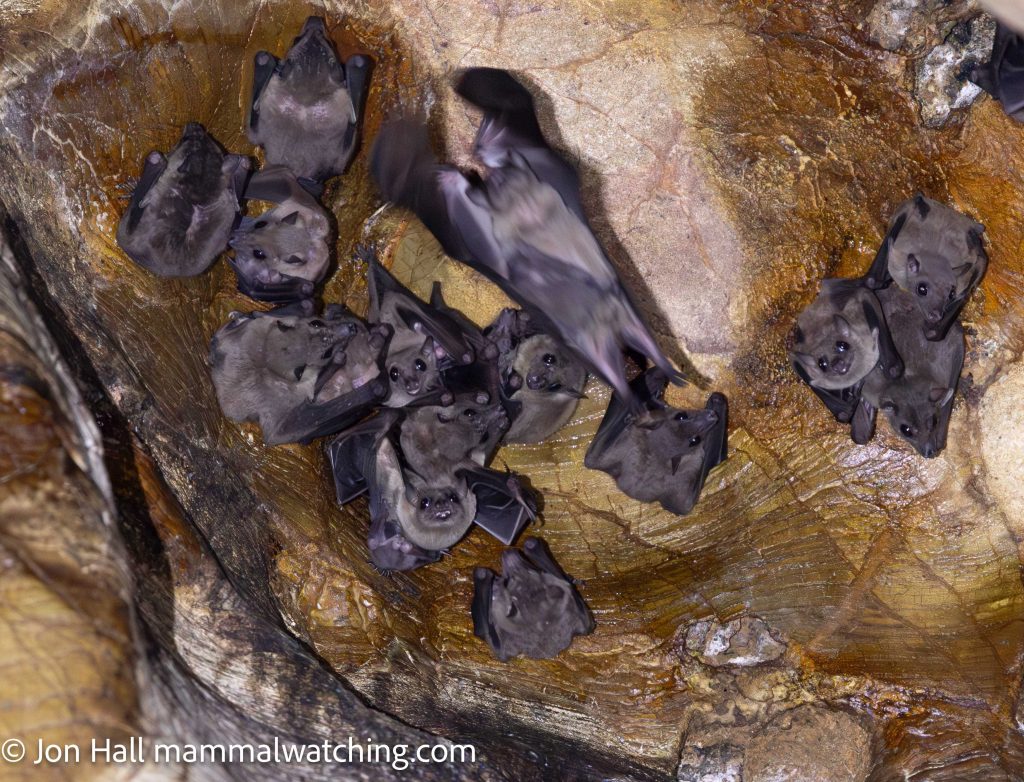
Geoffroy’s Rousette (Rousettus amplexicaudatus)
The only bats we saw were a colony of Rousettus (Goeffroy’s, I think?) at the entrance and a half a dozen horseshoes scattered through the cave. One two were close enough to get reasonable photos of.
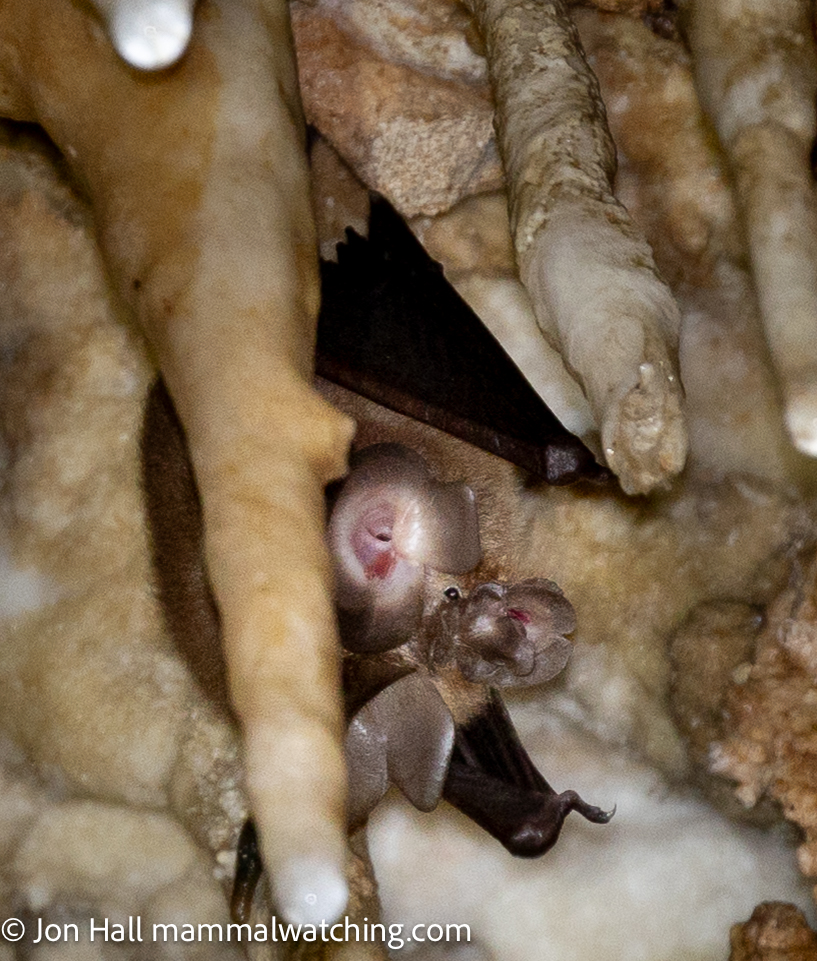
Big-eared Horseshoe Bat (Rhinolophus macrotis)
According to the Inatualist community they were Big-eared Horsehoe Bat and Chinese Rufous Horseshoe Bat.
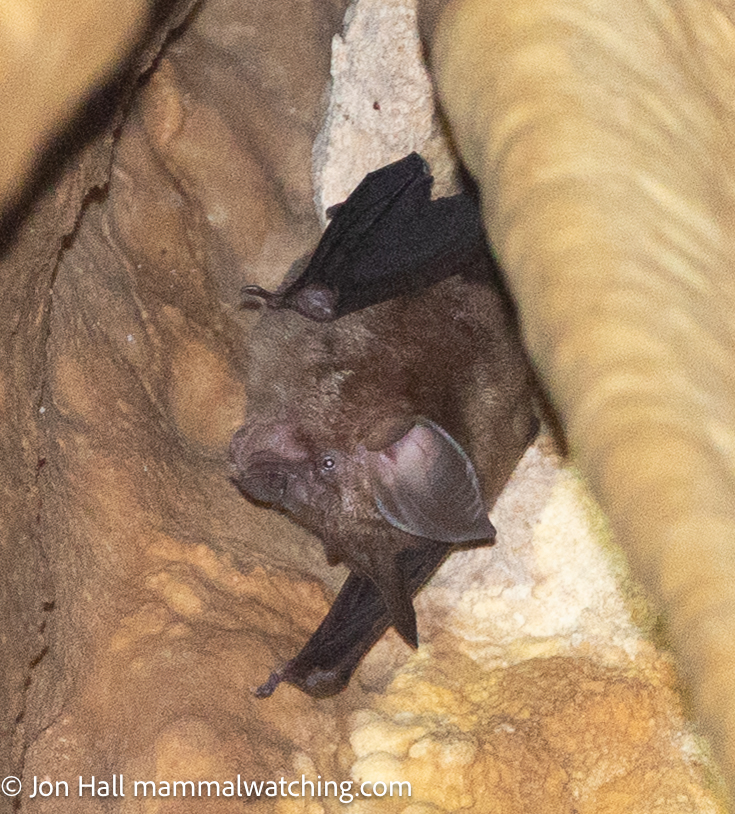
Chinese Rufous Horseshoe Bat (Rhinolophus sinicus)
We left the cave before lunchtime and drove north for 10 hours to Fugong County where we found a hotel which boasted the world’s most inaccessible car park.
Tuesday
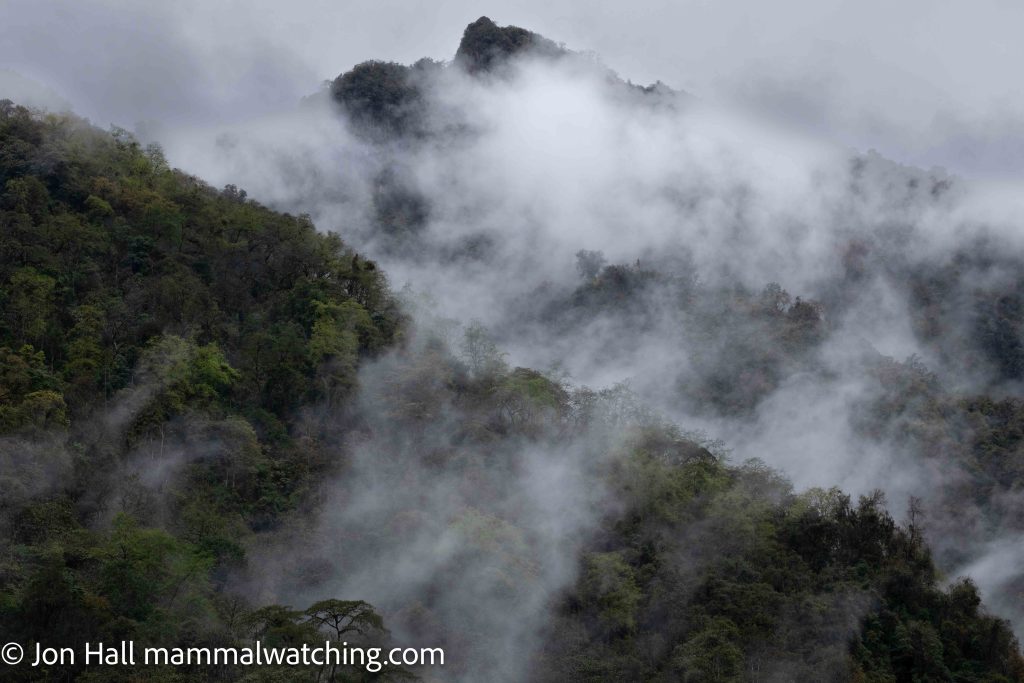
We drove all day to Dulongjian through some spectacular scenery that would have been more spectacular if we could have seen it through the clouds. It was raining heavily and had been for a day or two.
The road was peppered with landslides. We just got through in time. A few hours after we crossed the top of the pass a significant landslide closed the road behind us for 24 hours.
Maku village at the end of the road has recently become popular with Chinese birders as it offers a chance to see birds not found elsewhere in China. The same birders had been regularly posting pictures of Shortridge’s Langurs. Something of a mega primate: until I started planning this trip I thought it was pretty much impossible to see in China or Myanmar.
We arrived at dusk, scanning in the rain for Shortridge’s Langurs carefully along the last 20km or so. The only mammals we saw were a distant troop of Assamese Macaques.
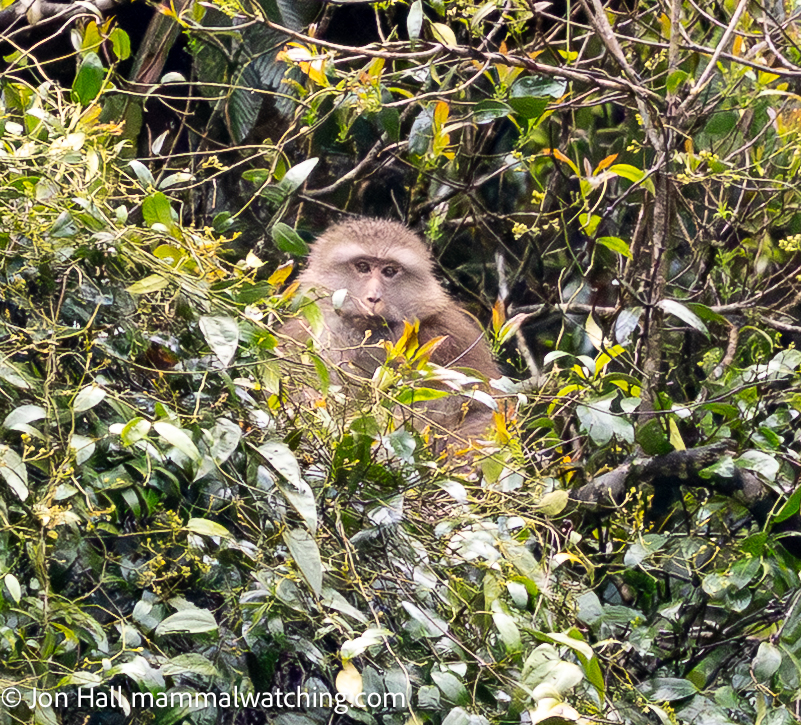
Assamese Macaque (Macaca assamensis)
After dinner in the cosy birding hotel (here), a rainy night drive gave me my first Blanford’s Fruit Bat and my first good look at a Particoloured Squirrel. The rain went from bad to worse and we returned to the hotel after an hour.
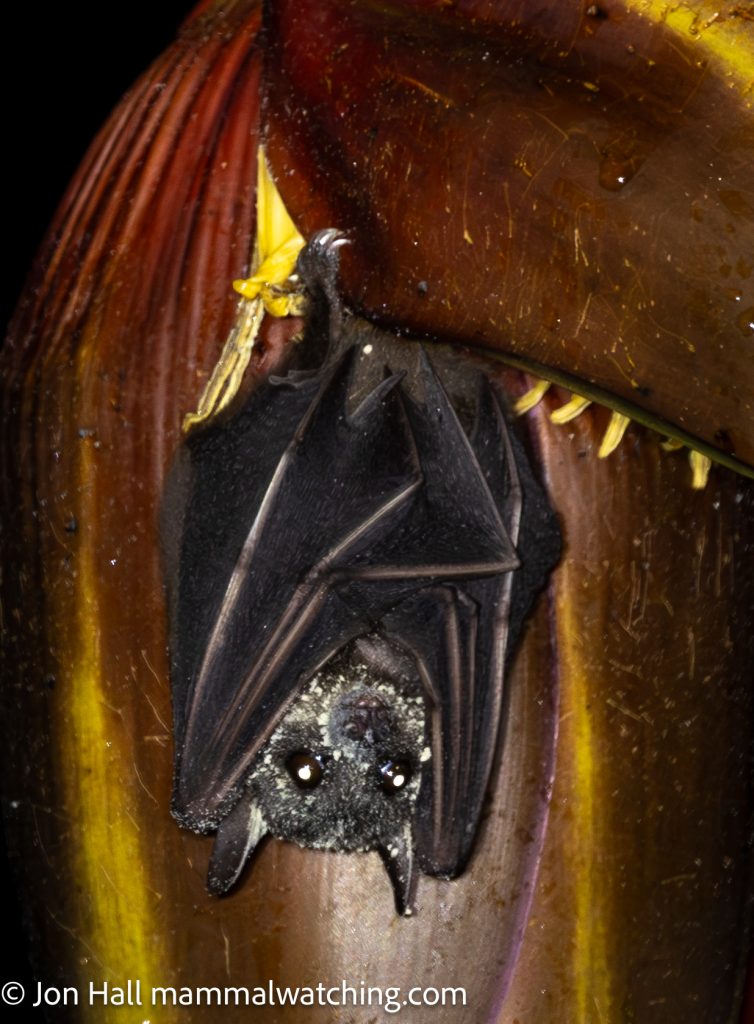
Blanford’s Fruit Bat (Sphaerias blanfordi)
A key species to search for here is Gongshan Muntjac. They are seen very occasionally on the road, but you would need to be lucky. The forest is thick, and the road runs along a steep mountain side, so there is no way to search for the deer other than hope one is on the road.
Wednesday
It was raining heavily still in the morning. The hotel owner predicted it would ease by lunchtime. And if it did, he was optimistic about our chances of seeing the Shortridge’s Langurs. They had been seen several times earlier in the week next to the village.
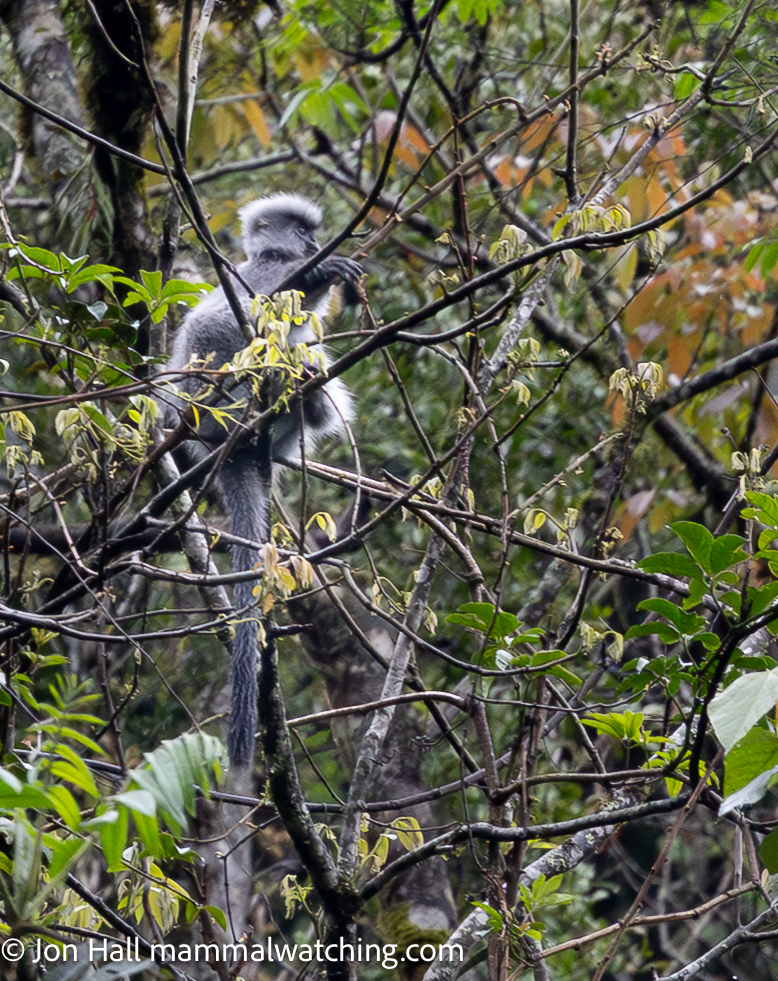
Shortridge’s Langur (Trachypithecus shortridgei)
Sure enough, the rain stopped about midday. We drove to the end of the village and within 20 seconds I’d found half a dozen langurs using my Thermal Master DV2 Camera. The monkeys were several hundred metres away. They showed clearly in the thermal but were much harder to find in our bins. After ten minutes of scanning, two animals emerged from the foliage and showed well for an hour.
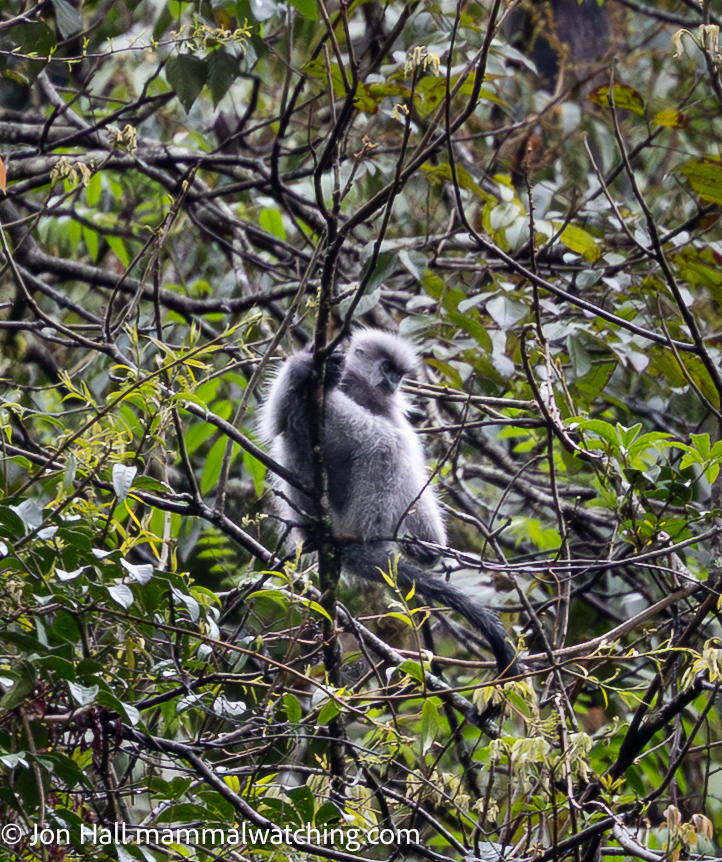
Shortridge’s Langur (Trachypithecus shortridgei)
Side note: in Yunnan on this trip, with temperatures fairly cool, I found my Thermal Master DV2 far more effective at picking up mammals – near and especially far – than my Zeiss DTI scope. That said, once you have discovered a heat signature, the better image quality on the Zeiss makes it far easier to work out where the animals are.
After lunch we drove back along the valley to Dulongjian Town, which would be a convenient starting point for tomorrow’s search for Himalayan Takins.
We saw more Assamese Macaques en route.
It was raining heavily that night and we didn’t go out.
Thursday
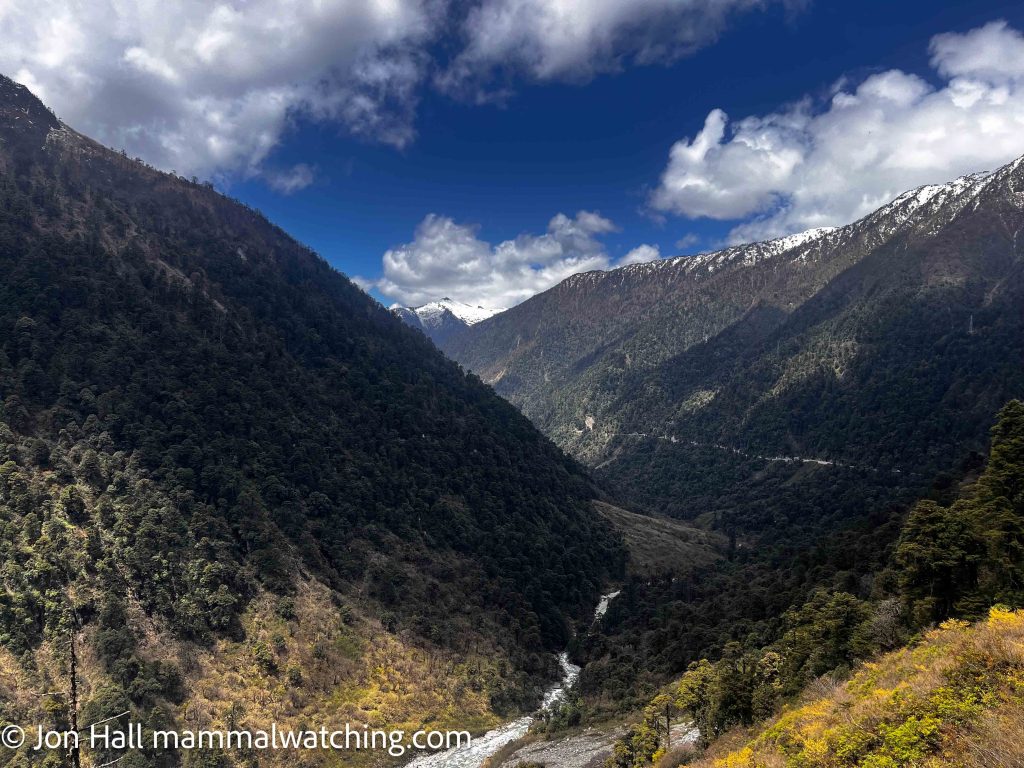
Many of Yiqian’s friends had reported seeing Himalayan Takin along the river close to the Dujuanwang Tunnel (here) at the top of the mountain pass between Dulongjianshan and Baoshan.
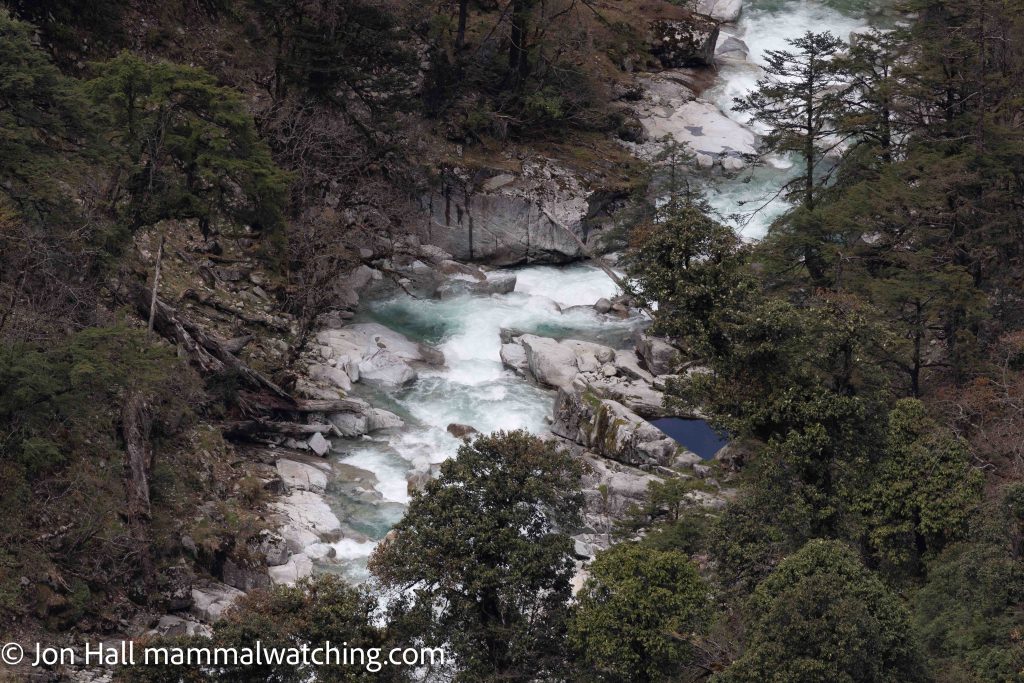 They are sometimes seen next to the road on the south side of the tunnel, but the best area is along stretch of road (closed to traffic) that leads into the core area of a national park and starts at the tunnel’s southern entrance. There is even a takin viewing area, complete with high power binoculars, 3km down the road.
In an ideal world we would have arrived in the early morning. But the landslide we had just missed two days ago meant the road between us and the tunnel was shut. It reopened at 11am.
We got to the tunnel – and the takin zone – at about 1pm and walked along the road to search for the takin.
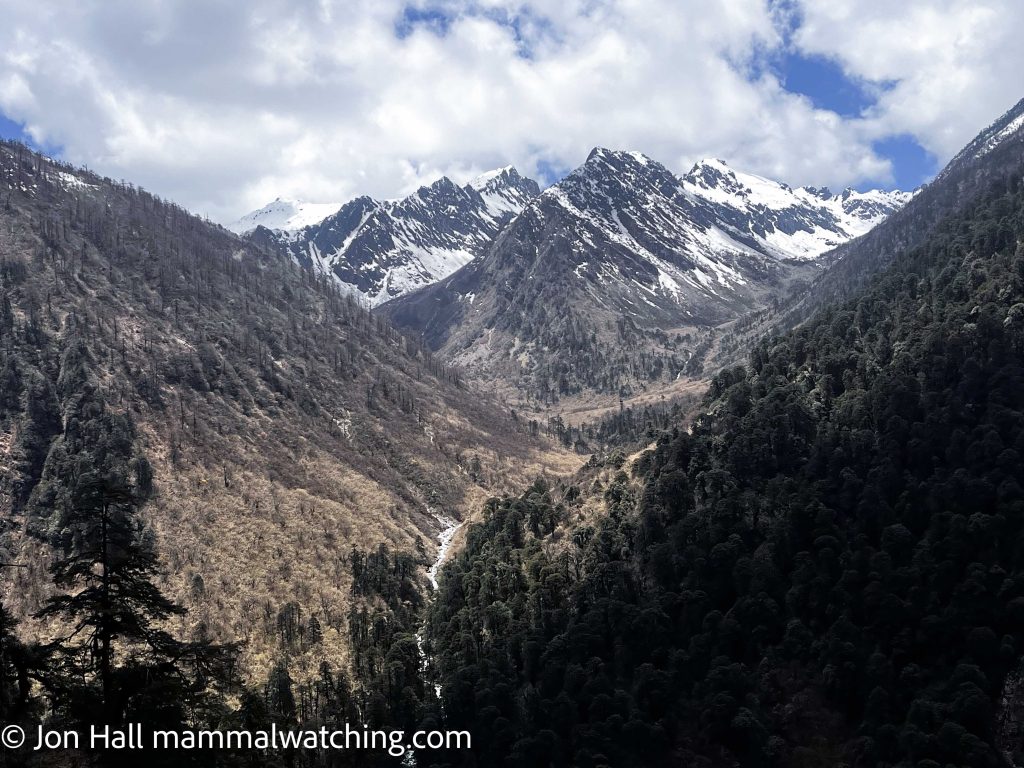
It’s a beautiful area. The valley is thickly forested and there is little chance of seeing a takin unless they come down to the river to drink or wander through one of the few clearings. We didn’t see any mammals and decided to continue looking in the late afternoon.
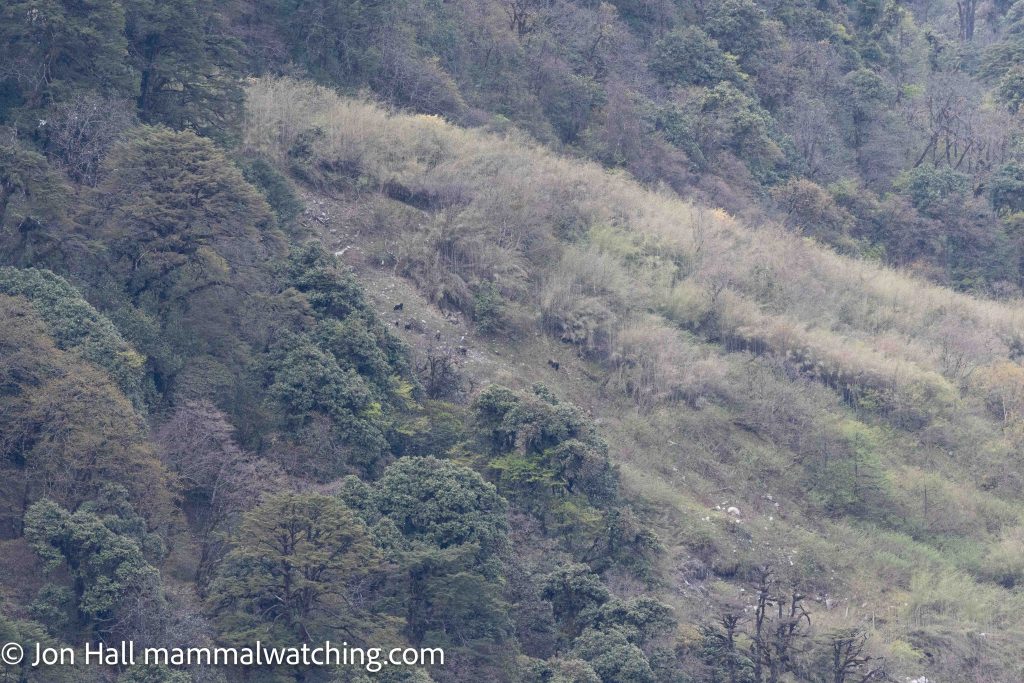
Distant Himalayan Takin (Budorcas taxicolor)
With no action by 7pm we were talking about giving up, but decided to give it another 15 minutes. At 7:10, just as the sun dipped behind the mountains, I saw a very distant herd of Himalayan Takin in a clearing above the river.
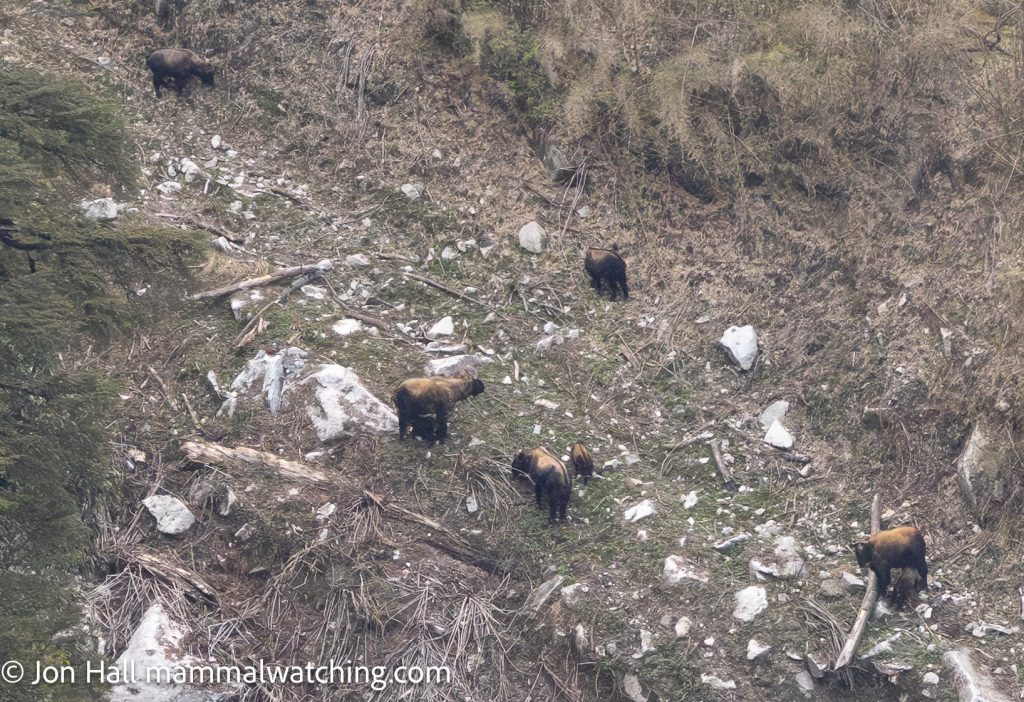
Himalayan Takin (Budorcas taxicolor)
We walked back along the road and got to within a few hundred metres of the herd as the light was fading.
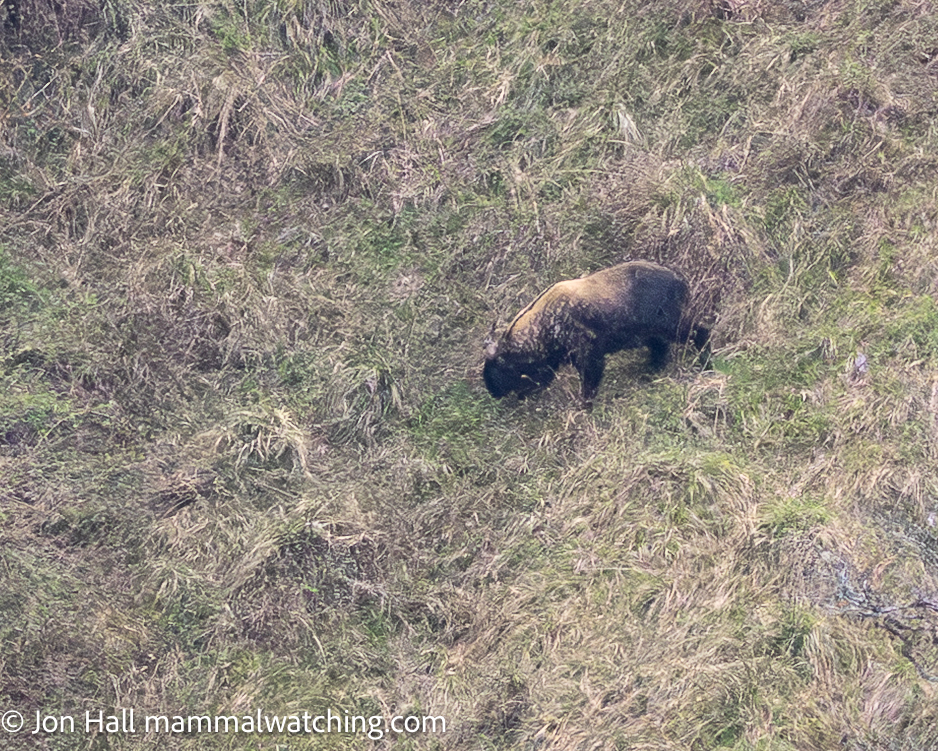
Himalayan Takin (Budorcas taxicolor)
Himalayan Takins are much darker than the Chinese Takins in Tangjiahe and some have a striking golden back.
We walked back to the tunnel in twilight looking for flying squirrels. We didn’t say any. One of Yiqian’s friends photographed a Yunnan Woolly Flying squirrel on the rocks right next to the road at the tunnel’s southern entrance (this section of road is up at 3000 metres). Others have seen Red Panda here during the day.
If our hotel that night (in Gongshan – an hour away) had been closer I would have tried harder for the Woolly Flying Squirrel.
We spent the night at Gongshan County Town.
Friday
Another long driving day: it took 10 hours to get back to Mangshi.
Saturday
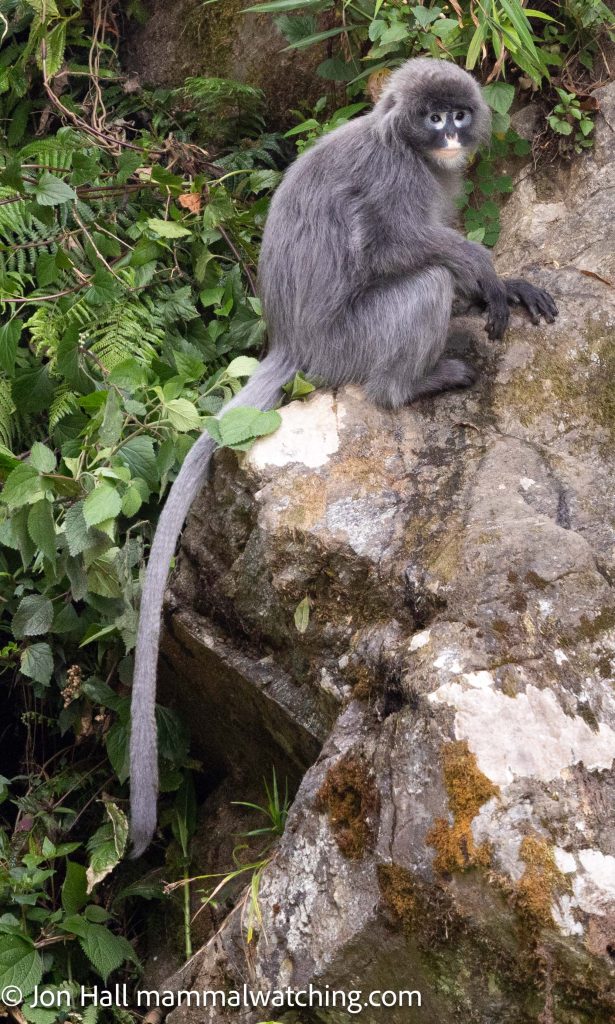
Shan Langur (Trachypithecus melamera)
The second part of the trip comprised a circuit of Mangshi in search of Shan Langurs, Skywalker Gibbons and multiple squirrels in Hornbill Valley.
Shan Langurs are easy to see in a small village just an hour from Mangshi. We are not sure of the village’s name but it is here.
A community reserve has been protecting the monkeys and showing them to tourists for several years. Yiqian arranged to meet our guide there at 10am. About 30 people were waiting to join the day’s langur watching.
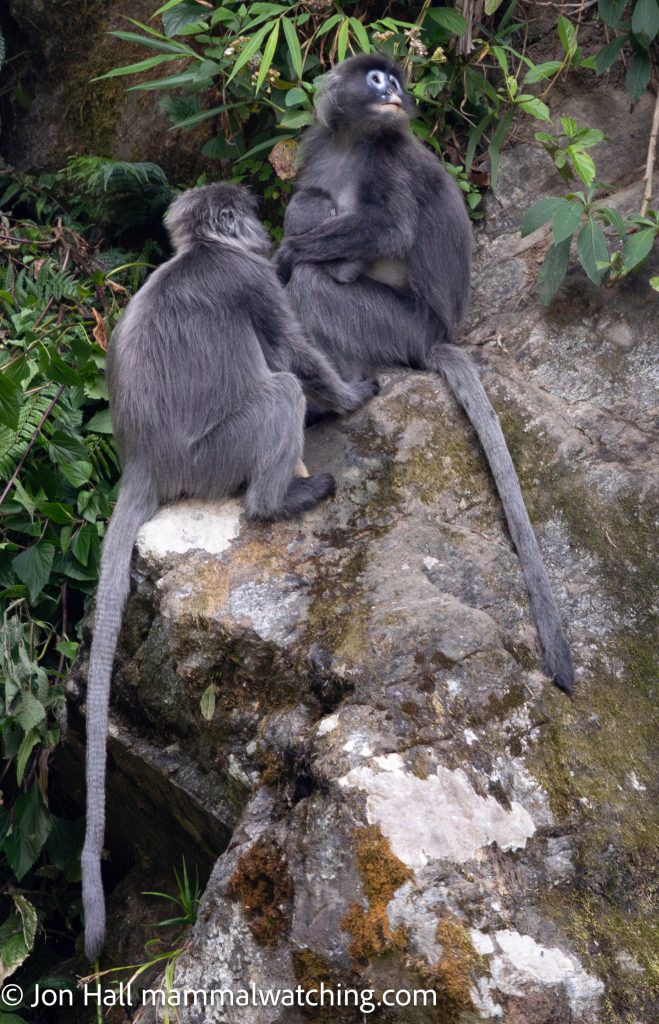
Shan Langur (Trachypithecus melamera)
We walked a few hundred metres into the forest and then climbed a few hundred steps up to a platform overlooking a waterfall. The langurs were waiting for us: they have been using the waterfall area for as long as anyone in the village could remember.
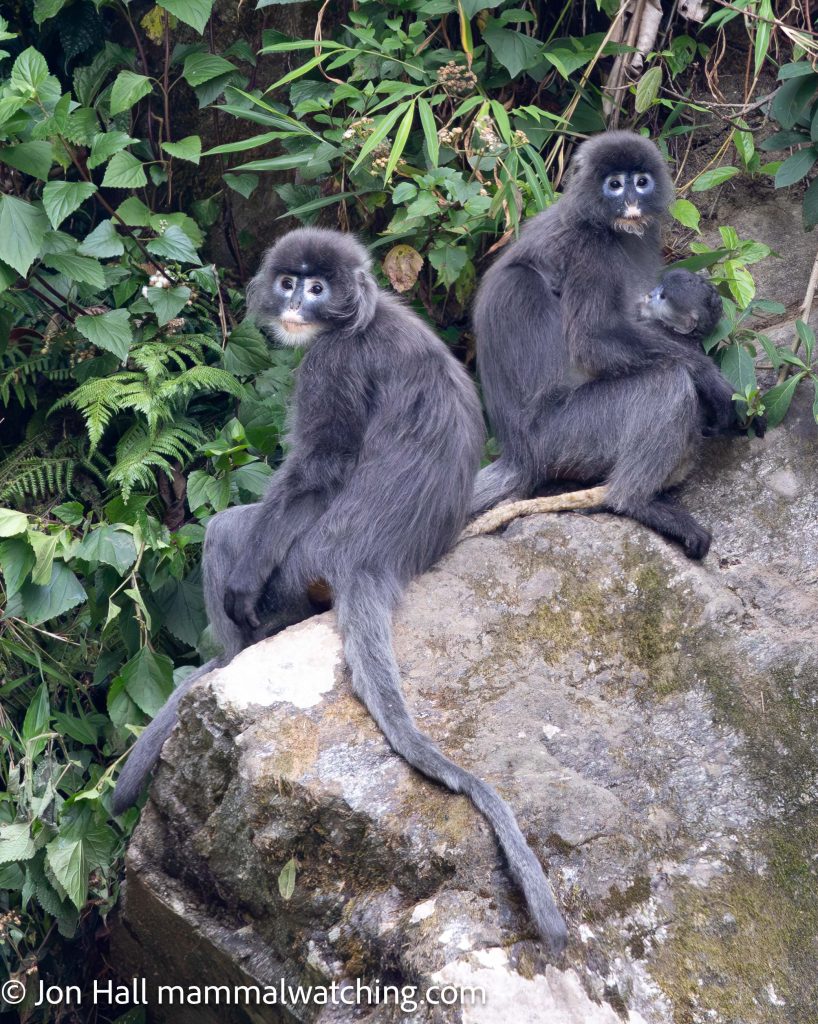
Shan Langur (Trachypithecus melamera)
We spent an hour enjoying the monkeys and their muti-coloured offspring.
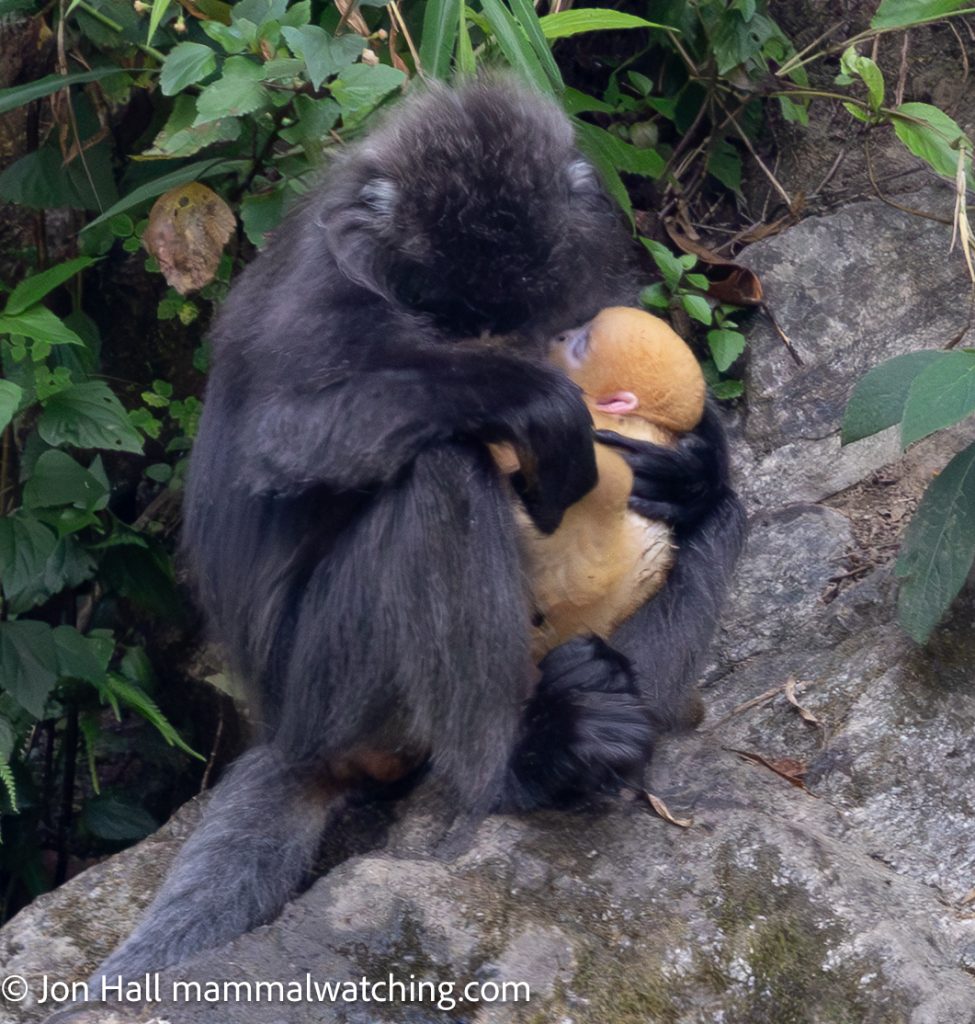
Shan Langur (Trachypithecus melamera)
The visitor centre displays camera trap photos of some interesting species from the forest including Spotted Linsang, Marbled Cat and Chinese Pangolin. All are very rare. We took a brief drive to look for Black Giant Squirrels in the forest with our guide but saw only nests.
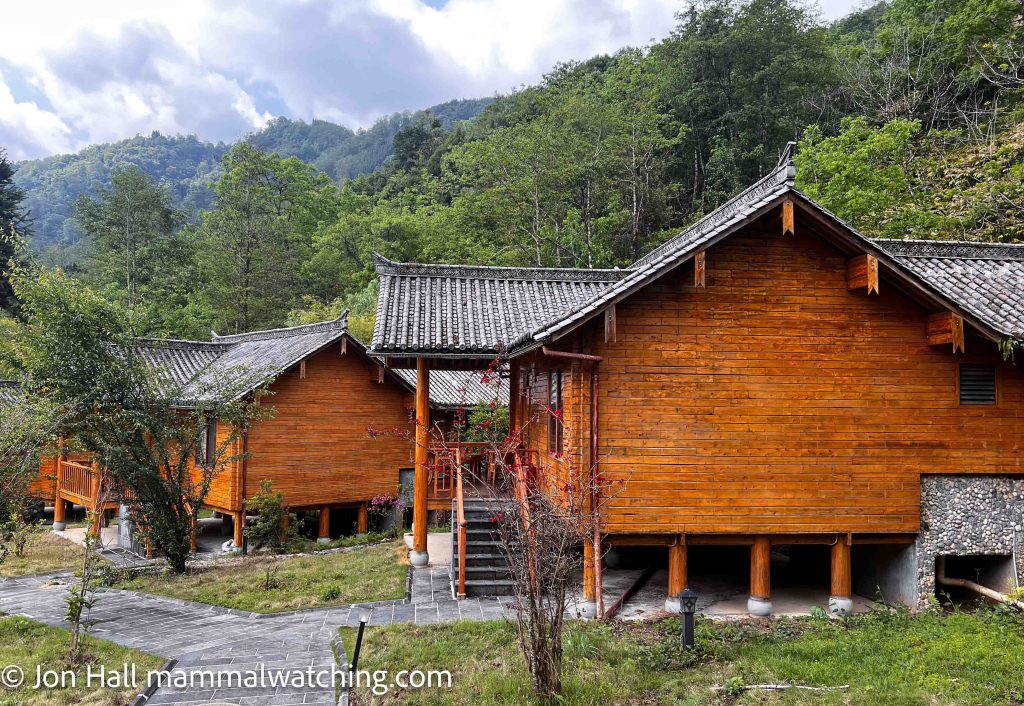
The Hoolock Hotel
After lunch and a rest in Mangshi we drove three hours to a village that might have been this one, home to Skywalker Gibbons. We were expecting a tiny village with very basic accommodation. We were delighted to find a tiny village with a luxury onsen set among hot springs. Each cabin had a private hot tub.
Sunday
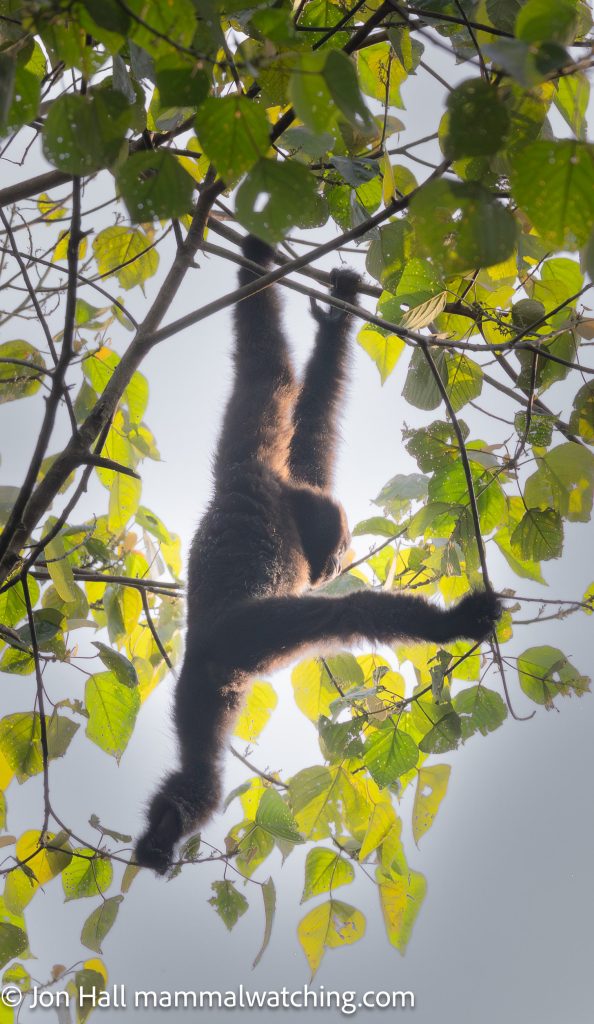
Skywalker Hoolock Gibbon (Hoolock tianxing)
The guide from the village told us there was no need to get up early, which was music to my ears. He would leave at 7am to scout for the gibbons and we could meet him at 8am a couple of kilometers up the road. When we arrived he’d found the gibbons – right next to where he had arranged to meet us – and we spent a couple of hours with a family of three.
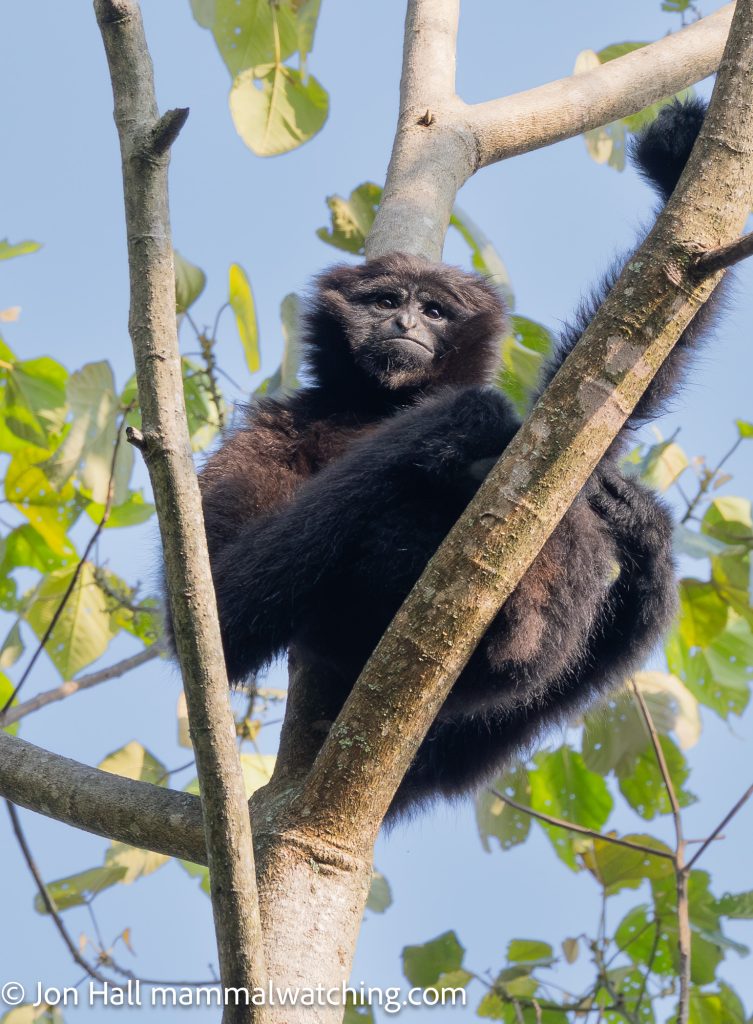
Skywalker Hoolock Gibbon (Hoolock tianxing)
The animals were habituated and were three of 13 gibbons that inhabit this patch of forest. We were quite lucky to find them so close to the village. The forest here is very steep and the gibbon watching could have turned into a slippery hike. But the locals, who have been showing the Skywalkers to people for a decade, are proficient in finding the animals.
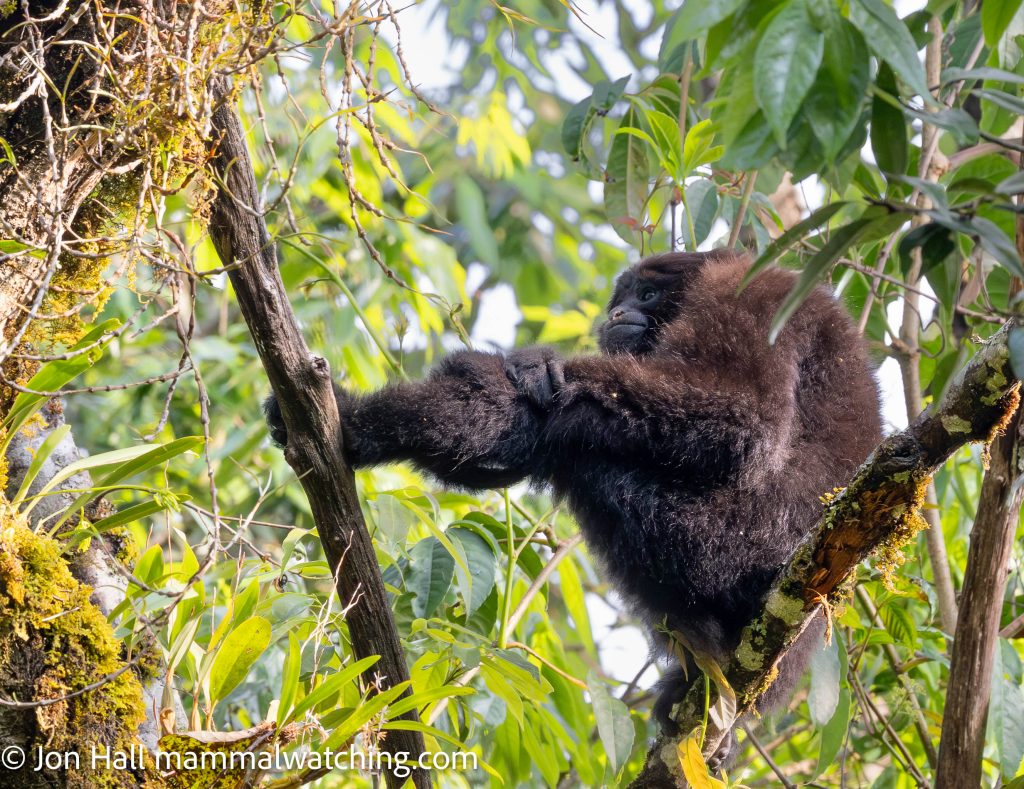
Skywalker Hoolock Gibbon (Hoolock tianxing)
Just as with the other places we visited in Yunnan, this site is open to Chinese and foreign tourists alike. I’ve heard stories about people visiting a national park to search for Skywalkers and being refused entry or, worse, getting arrested. So this place is a better option. Surprising how news of this site had not percolated through to the mammalwatching world given the interest in Skywalkers. But China is full of surprises.
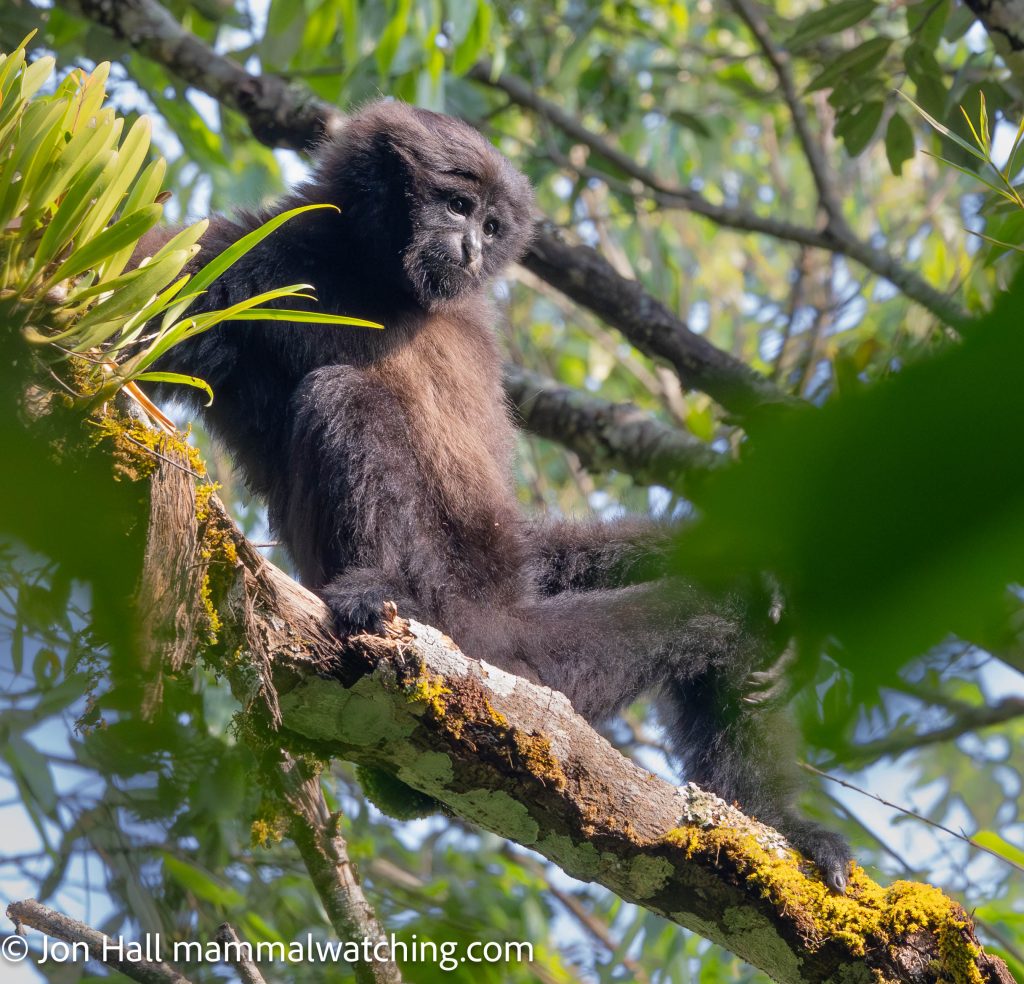
Skywalker Hoolock Gibbon (Hoolock tianxing)
We left the village at midday and it took four hours to reach the entrance to Hornbill Valley, an area well-known to birders, including expats, along the border with Myanmar.
Yiqian had visited in 2025 and had a good feel of where to search for nocturnal mammals. He recommended we focus on the stretch of road that runs along the valley floor next to the river that forms the Myanmar border (the Myanamar side of the road has a high security fence, much loved by rats we discovered).
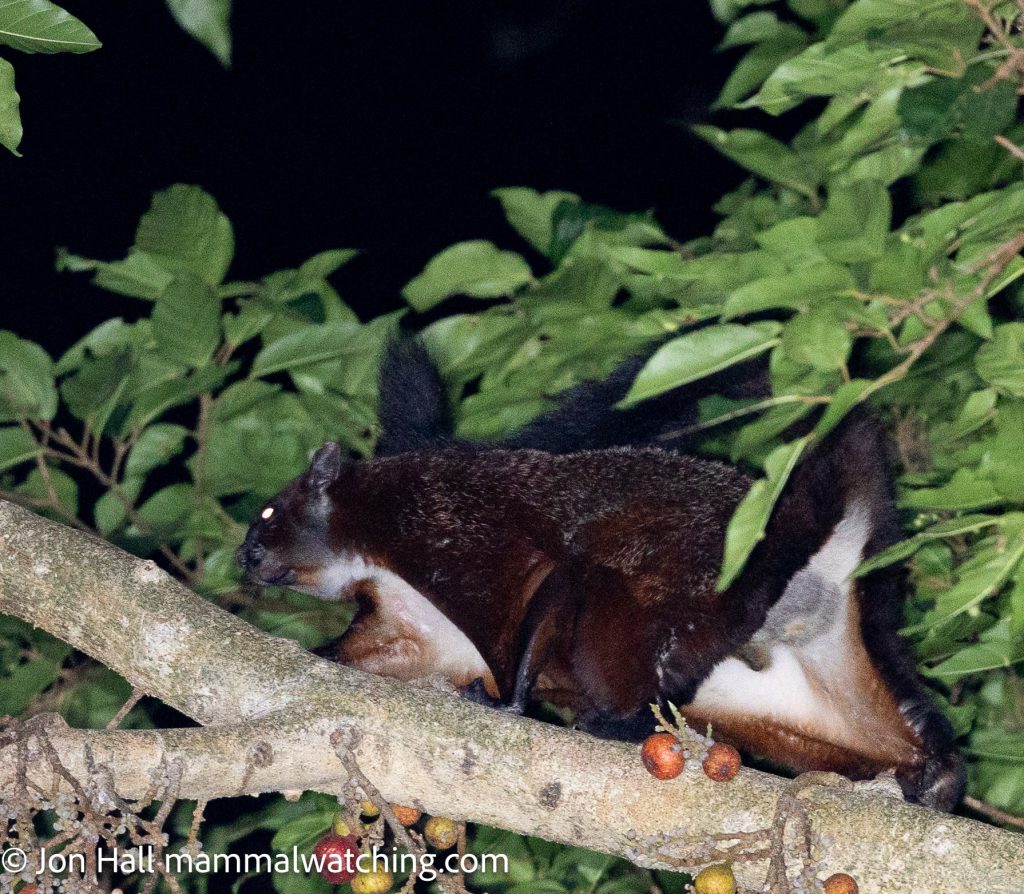
Yunnan Giant Flying Squirrel (Petaurista yunanensis)
We spent five hours driving the deserted road very, very slowly scanning for mammals with our thermal scopes.
It was a productive night.
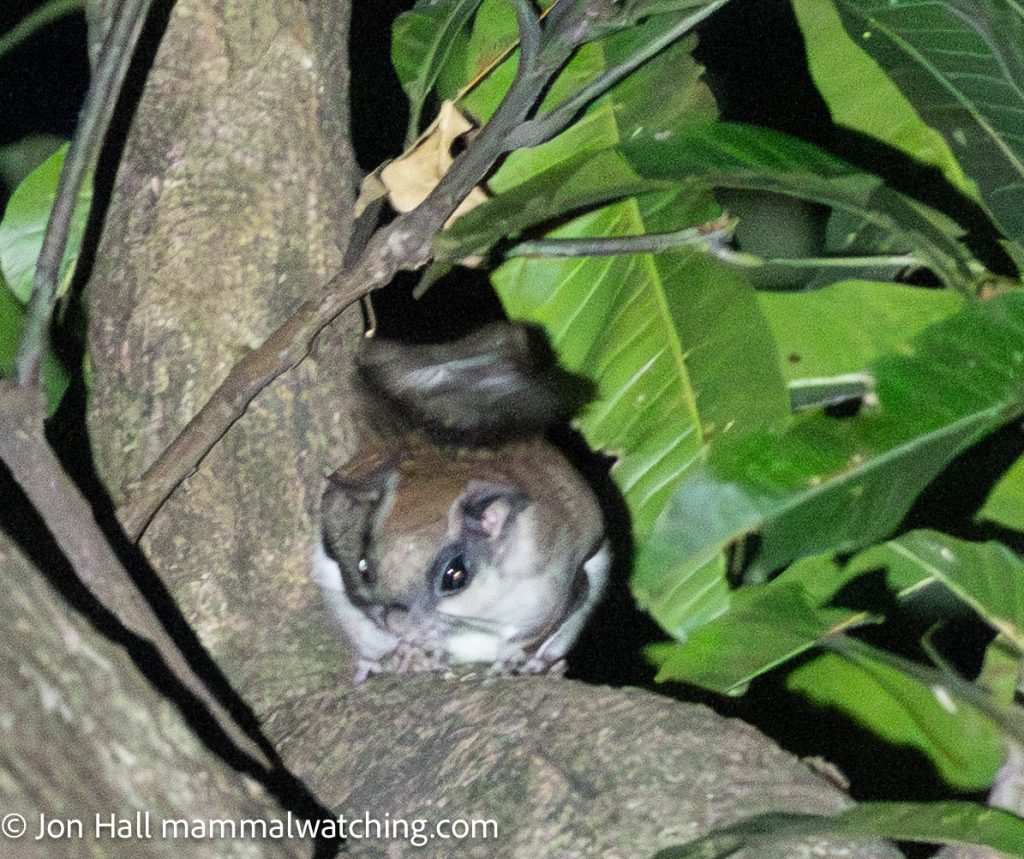
Particolored Flying Squirrel (Hylopetes alboniger)
Our first mammal was this small flying squirrel. We were expecting to see Hairy-footed Flying Squirrels in the valley: Yiqian had seen many during his night here in 2025. But this looks to be a Particolored Flying Squirrel.
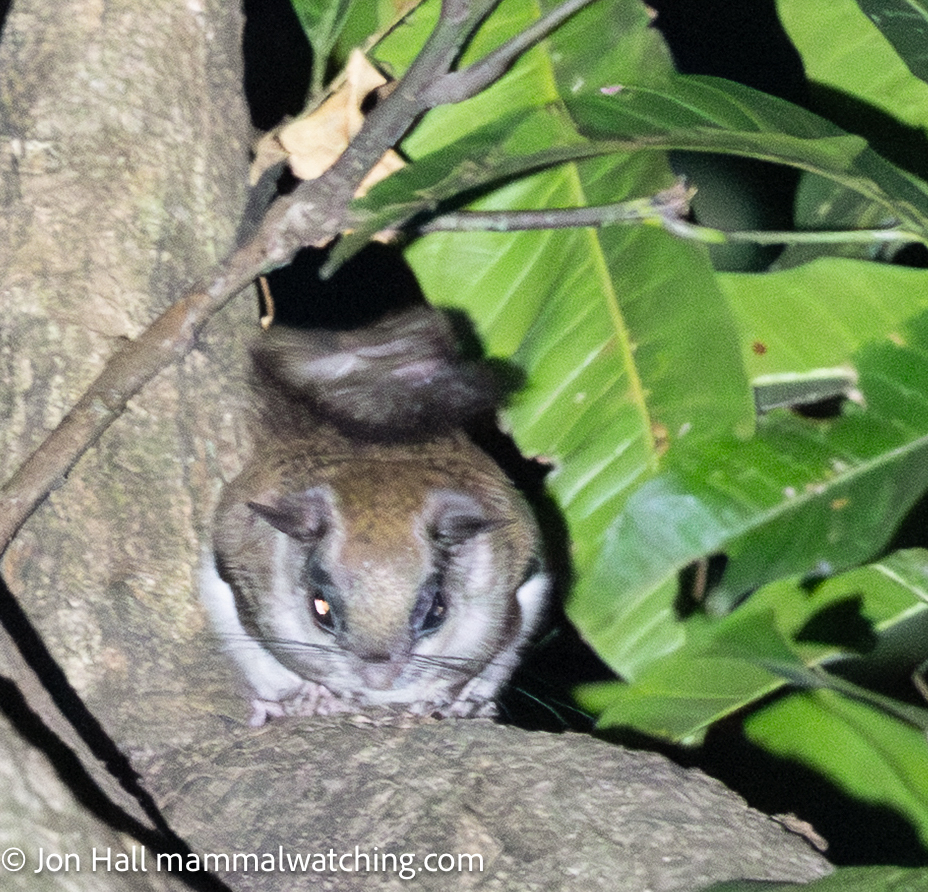
Particolored Flying Squirrel (Hylopetes alboniger)
We also saw a pair of Yunnan Giant Flying Squirrels, a species which Yiqian had heard may turn out to be a subspecies of Hodgson’s Flying Squirrel. Either way a lifer for me.
We saw two Northern Palm Civets, two rats on the border fence that looked like Niviventers to me but which we couldn’t photograph. Along with a Bengal Loris, numerous medium sized fruit bats that I think were one of the Rousettus species and a Northern Red Muntjac.
Continuing out of the valley the road climbs a few more kilometres to Shiti, a birding village, with several hotels and many hides. (Please note that I avoided making a cheap joke about Shiti birders.)
Just before our hotel Yiqian spotted a mouse climbing in a bush. Impossible to photograph, but its bright orange-brown fur, small size and very long tail suggests it ought to be an Asiatic Climbing Mouse (Vandeleuria oleraceus).
Monday
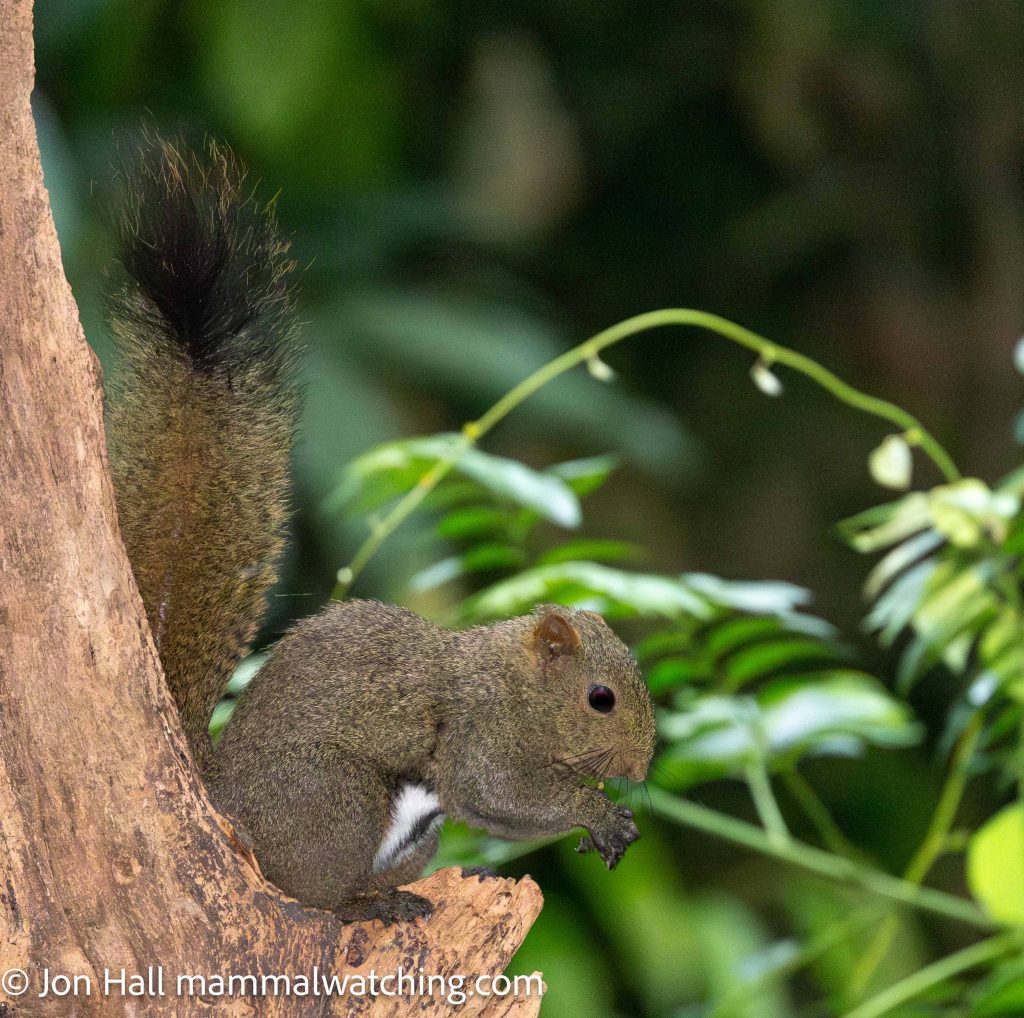
Anderson’s Squirrel (Callosciurus quinquestriatus)
There are many bird hides around the village. The only reason to visit one is for the squirrels of course. At 8am I was in Bird Hide No 2 waiting for the partridges and peacock pheasants to move out of the way so I could photograph the rodents.
Within 90 minutes I’d seen Asian Red-cheeked Squirrel,
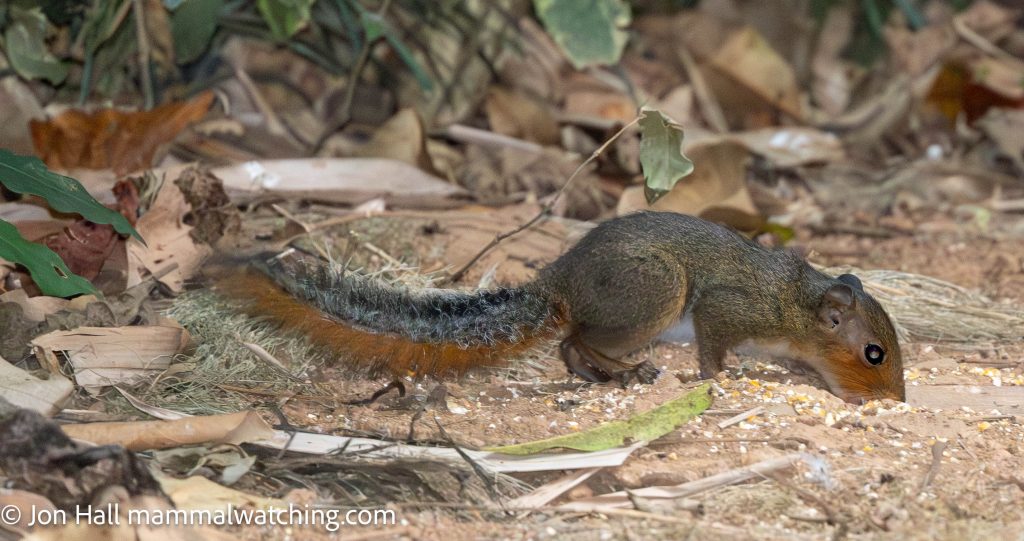
Asian Red-cheeked Squirrel (Dremomys rufigenis)
Himalayan Striped Squirrel,
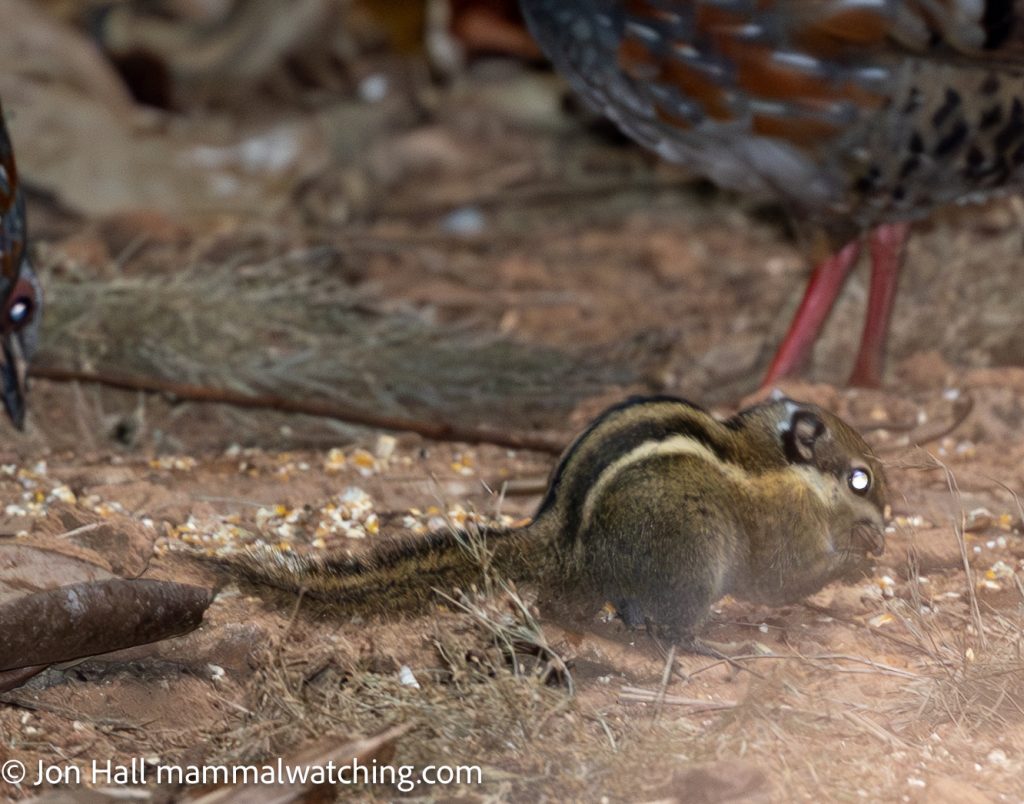
Himalayan Striped Squirrel (Tamiops mcclellandii)
and Anderson’s Squirrel.
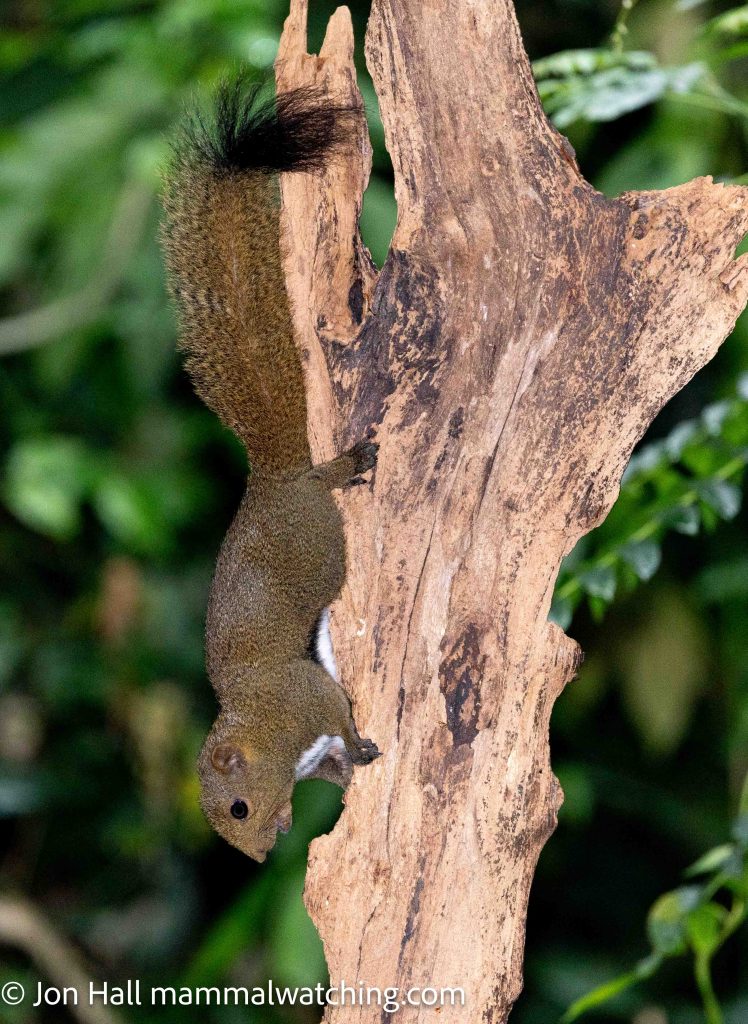
Anderson’s Squirrel (Callosciurus quinquestriatus)
The latter two were lifers for me.
A Northern Treeshrew was also active.
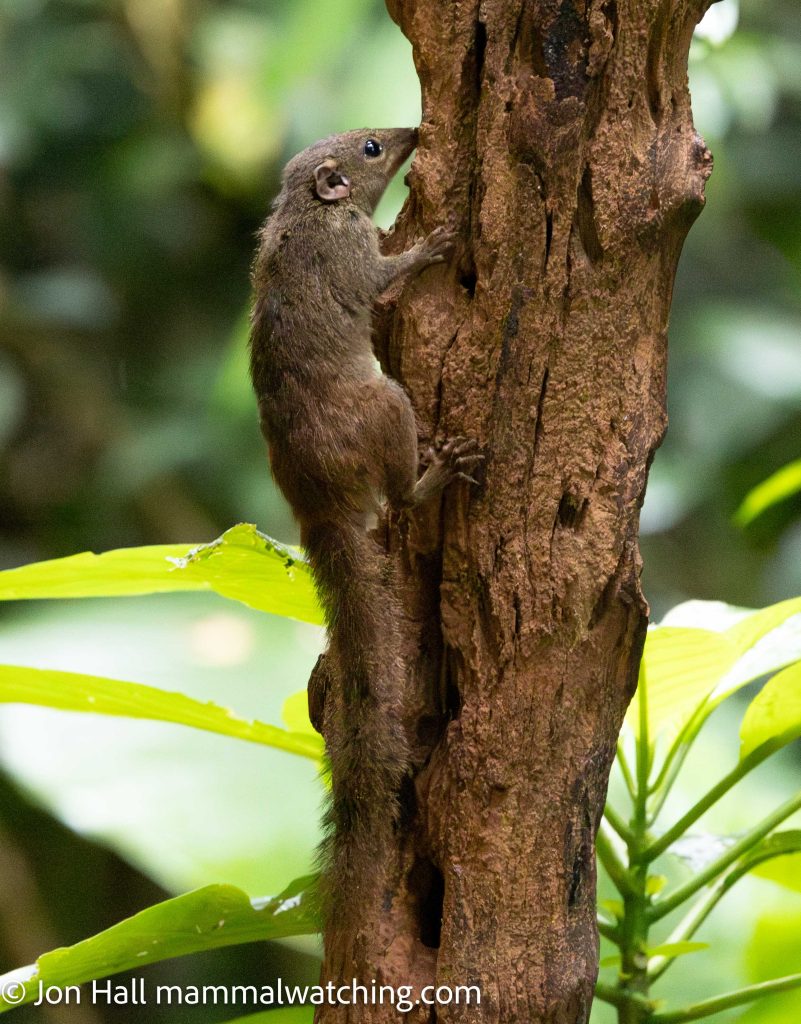
Northern Treeshrew (Tupaia belangeri)
The only diurnal squirrel I’d missed at the hide was the beautiful Phayre’s Squirrel, so we set our sights on that in the late afternoon.
Yiqian called about 50 people trying to find a reliable hide for the species. He didn’t get any useful information.
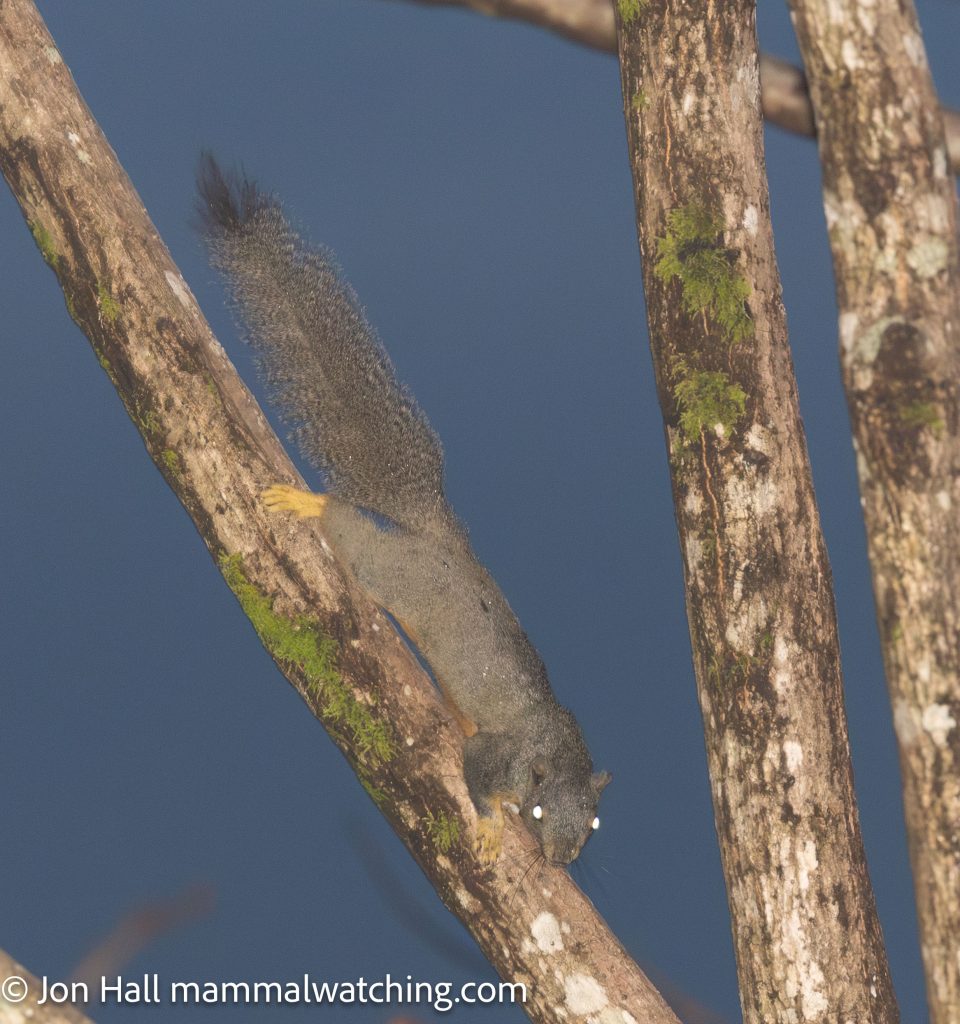
Phayre’s Squirrel (Callosciurus phayrei)
But 15 minutes back down the road from the village we met a guide – a guide Yiqian had called earlier – who told us he’d just seen a Phayre’s Squirrel.
I saw one as soon as the rain stopped. Yiqian saw a pair in forest close by. We saw another at dusk as it returned for the night to a hole in the tree we’d been staking out.
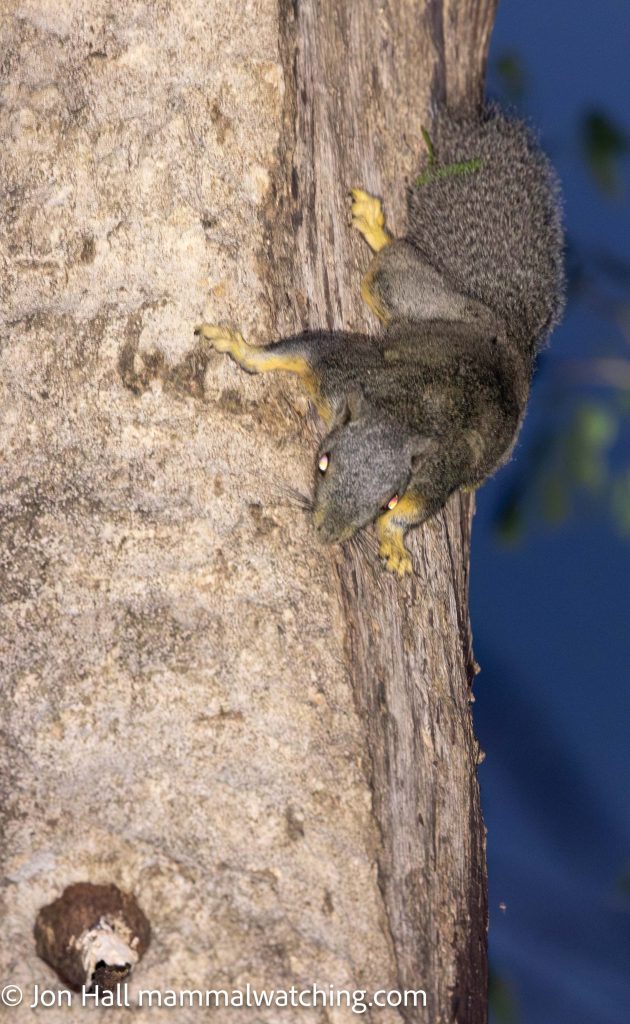
Phayre’s Squirrel (Callosciurus phayrei)
To find this squirrel spot you should follow the road down the hill from the village. About 15 minutes down the hill you reach a sharp bend next to a large concrete building that may be be a power station (it is the only large building you will see). A track leads off to the left next to – and just before – the building. Park here and look down the valley. A couple of large dead trees are right in front of you and at least one Phayre’s Squirrel was living in a hollow in one tree. This should be the GPS on Google Maps.
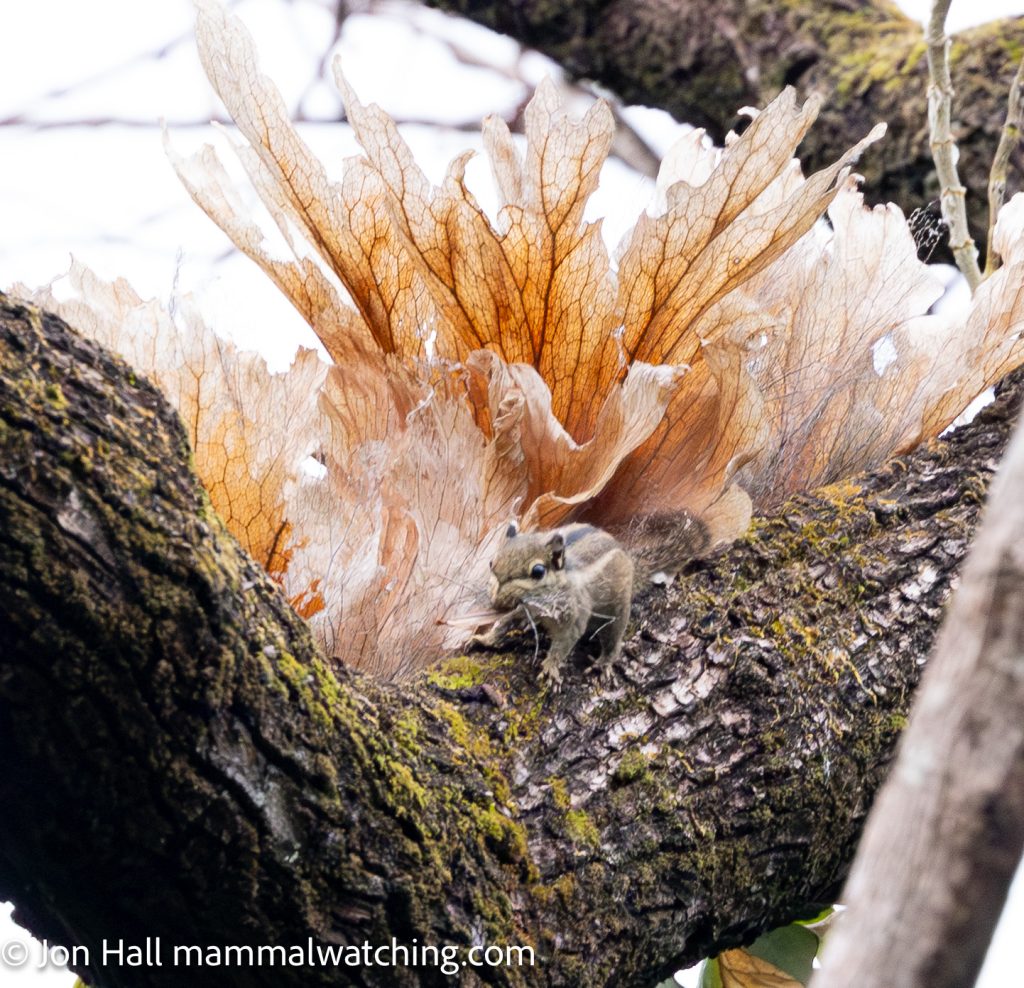
Himalayan Striped Squirrel (Tamiops mcclellandii)
There were several Himalayan Striped Squirrels here too.
This is a popular spot for birders as it gives commanding views across the canopy. We saw several hornbills.
The rest of the evening was spent driving and spotlighting back down the road and along the valley floor.
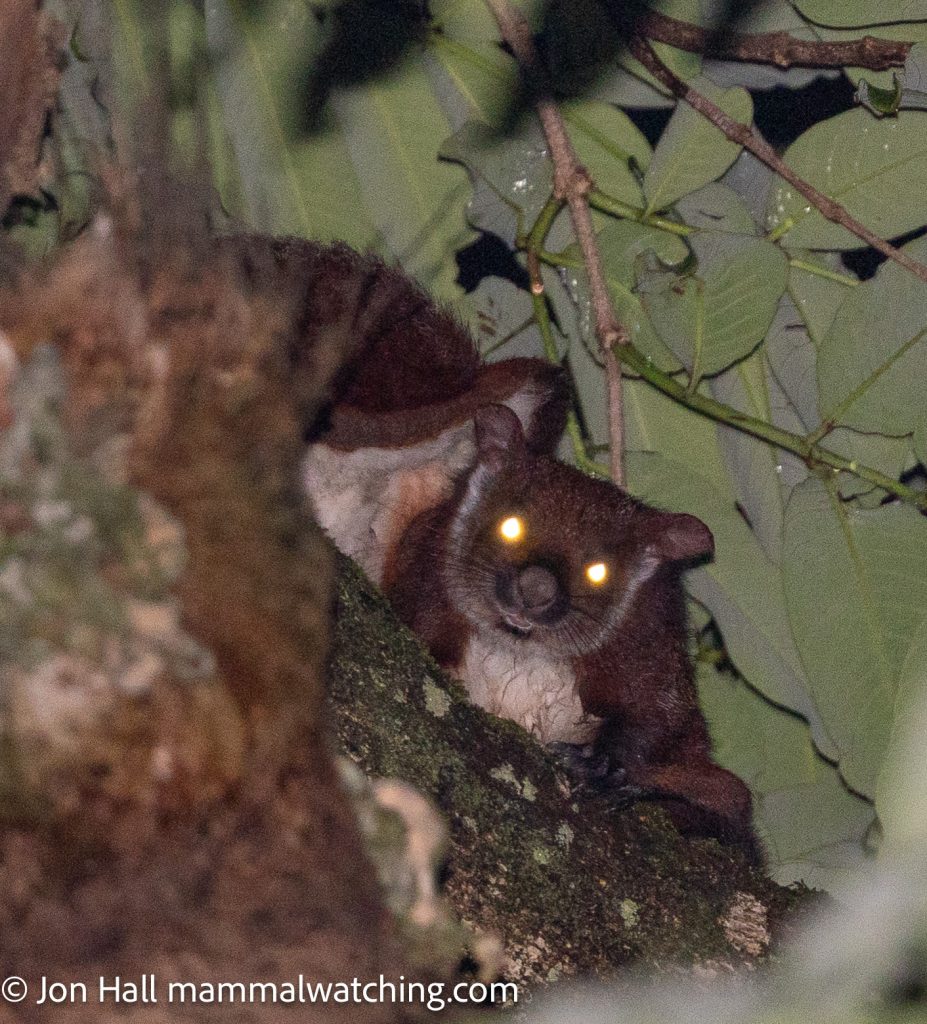
Yunnan Giant Flying Squirrel (Petaurista yunanensis)
The night drive produced several more Yunan Giant Flying Squirrels, and a great view of a Bengal Slow Loris next to the road on a cable.
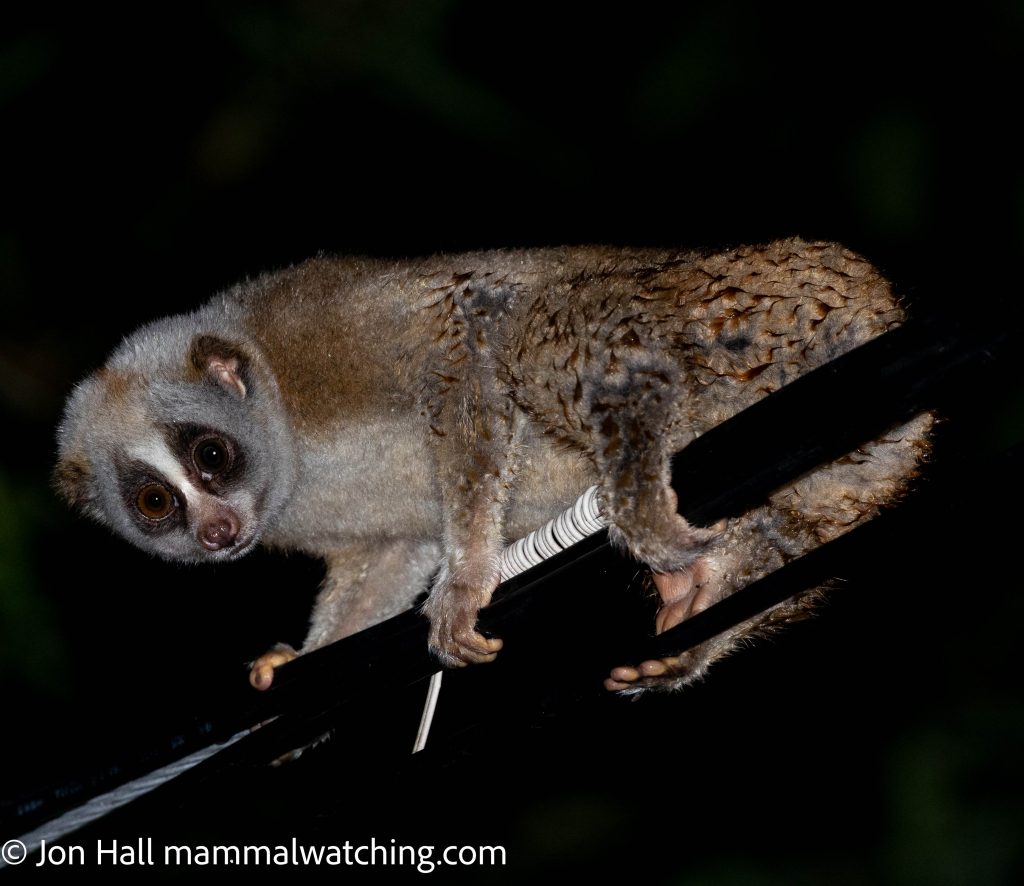
Bengal Slow Loris (Nycticebus bengalensis)
Two interesting bats put in an appearance. A large grey horseshoe was hanging from a branch. It flew before we could photograph it, but I think it must have been a Northern Woolly Horsehshoe Bat.
We had a longer look at this hipposideros species hanging from a branch.
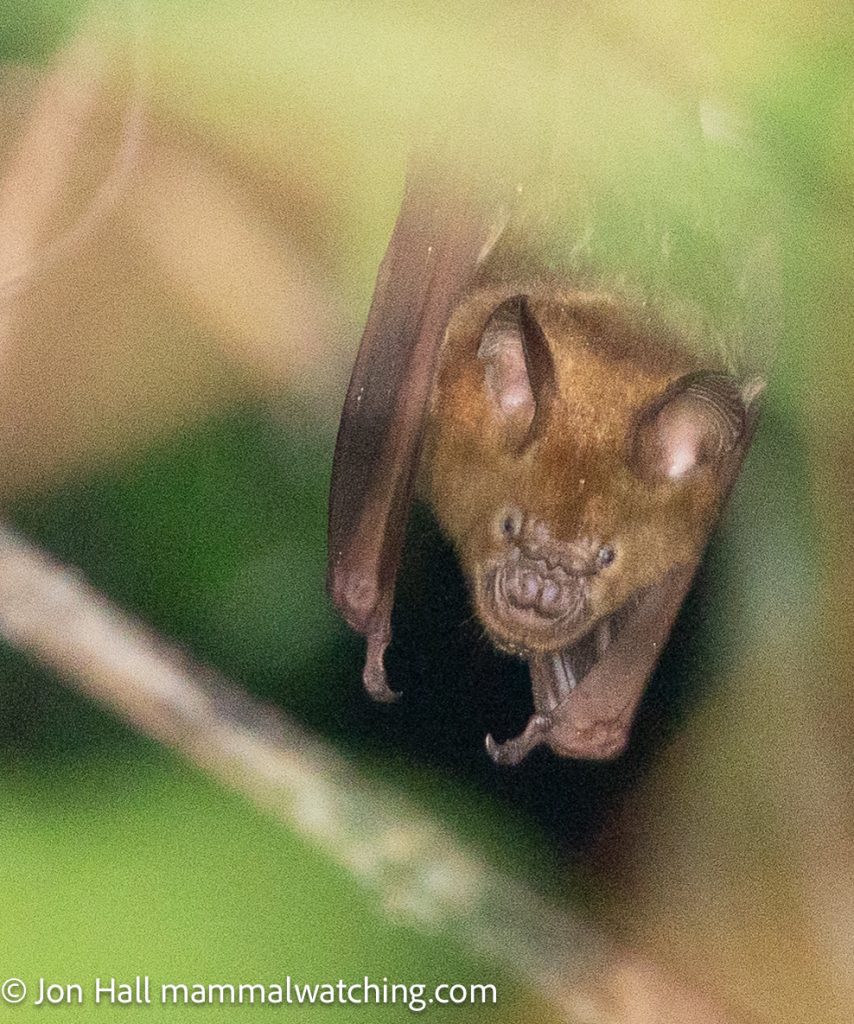
Indian Roundleaf Bat (Hipposideros lankadiva)
At first I thought it was strange-coloured Great Roundleaf Bat, though it didn’t seem large enough. After examining the photos and sharing with some Asian bat experts, the feeling is that this may be an Indian Roundleaf Bat. It certainly looks like one. This species was recently confirmed from western Myanmar, but if the ID is correct this seems to be a major range extension and a first record for China. To be continued.
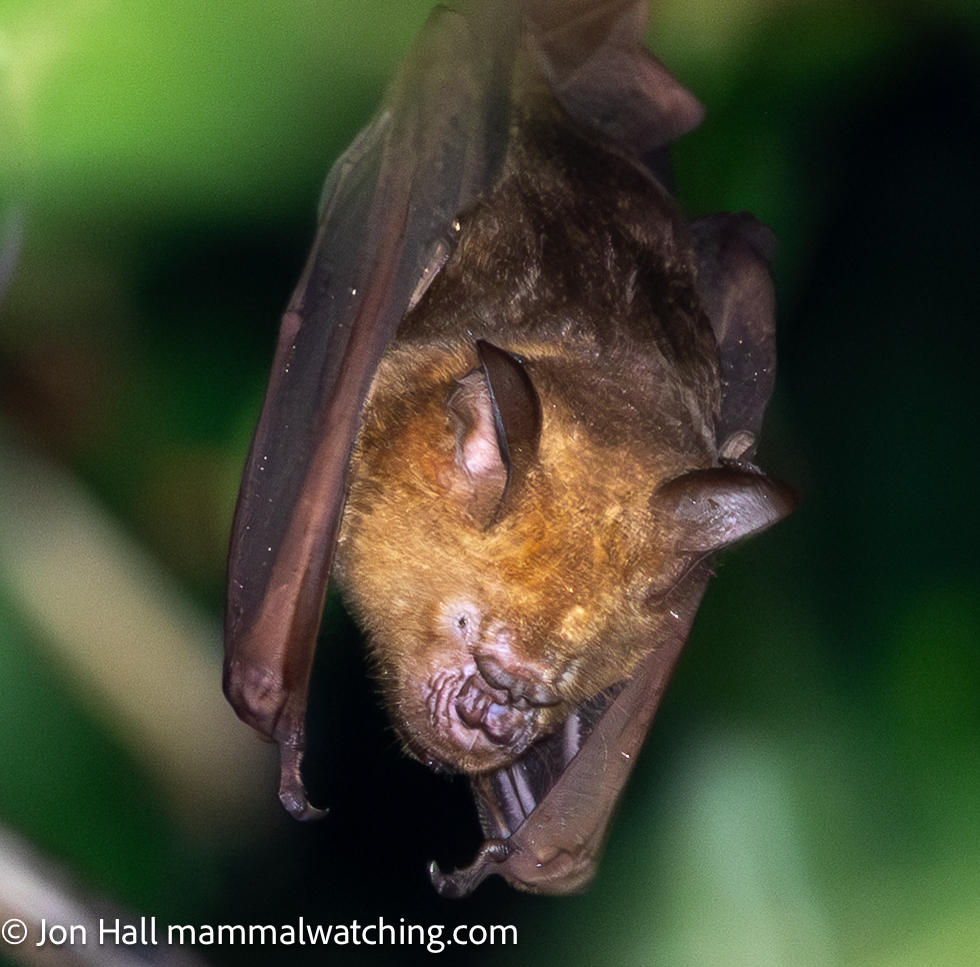
Indian Roundleaf Bat (Hipposideros lankadiva)
Much to Yiqian’s suprise we didn’t see any Hairy-footed Flying Squirrels on our second night either.
We spent the night at a hotel just before the Hornbill Valley exit gate.
Tuesday
Today was a bonus day: a day we had kept in reserve in case we got skunked by the weather. We decided to visit Baihualing Village, two hours north of Mangshi.
This is another popular birding spot. We were there because people had reported seeing Himalayan Long-eared Flying Squirrels in trees near the hotel.
It had been raining all day. The rain cleared after dark and we spent three hours patrolling the four very large – flying squirrel – trees next to the road directly above the hotel.
We saw only one flying squirrel: living in a hole in the massive fig tree. We couldn’t photograph it. But based on what we saw of its grey back it looked more like another Particoloured Squirrel than the browner Himalayan Long-eared Squirrel we were hoping for.
Wednesday
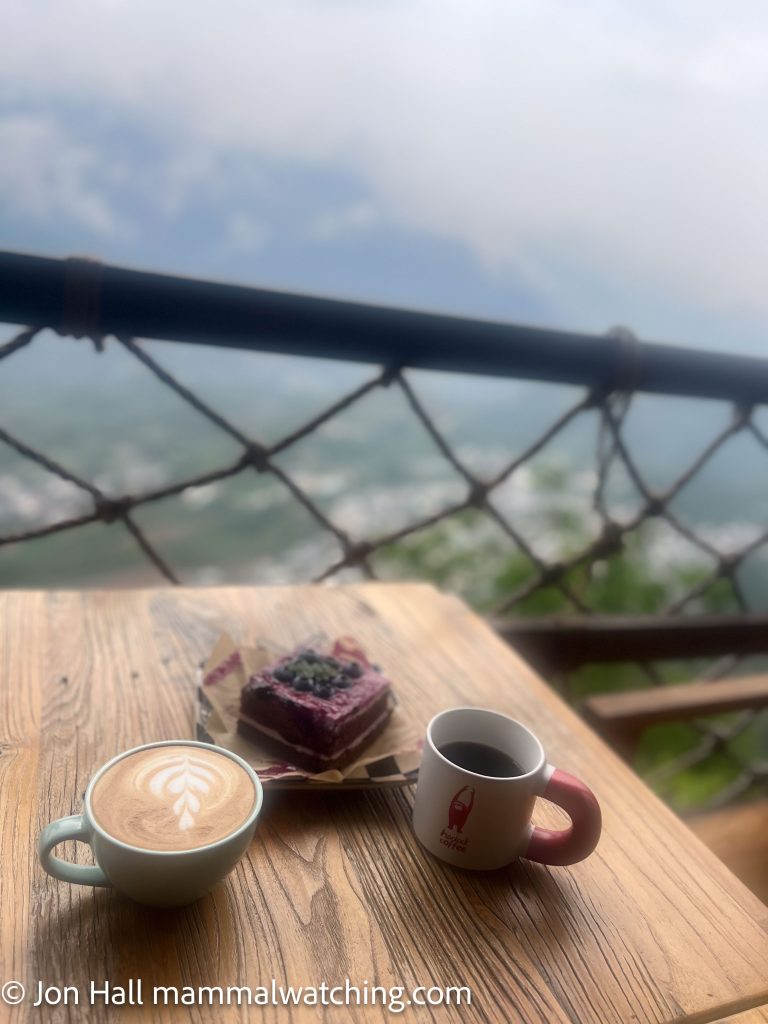
We drove back to Mangshi, via the wonderful Hooliock Coffee Estate and Coffee Shop, and spent the afternoon catching up on life. We would fly to Xining and the Tibetan Plateau early the following morning.
Stuff We Missed
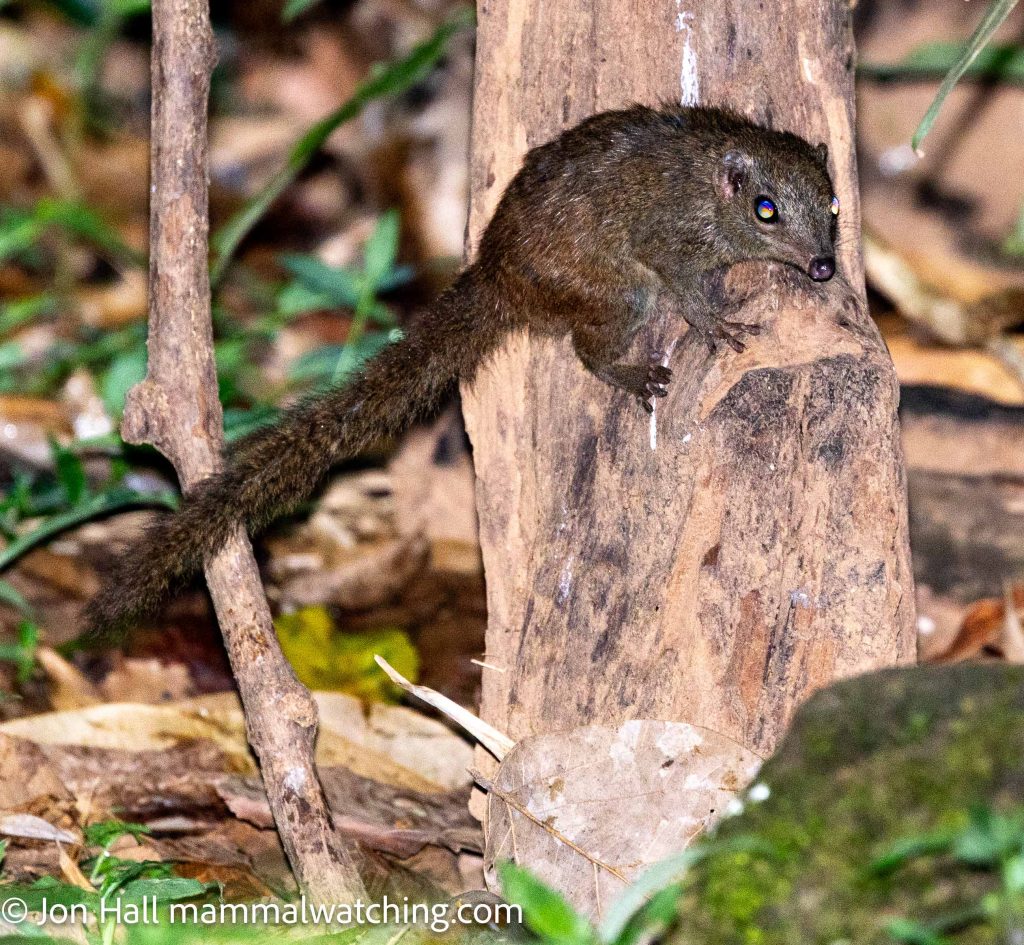
Northern Treeshrew (Tupaia belangeri)
We saw all four of our major targets. The only two species we actively searched for and missed were the Hairy-footed Flying Squirrels in Hornbill Valley (a surprising dip) and the Long-eared Himalayan Flying Squirrels on our last night.
Gongshan Muntjacs are probably not uncommon in Dulongjiang but they are very hard to spot in the thick forest there. If I returned I would try for these and Yunnan Woolly Flying Squirrel near the tunnel though they are likely very rare there.
There was always a chance of running across a Yellow-bellied Weasel (not uncommon but hard to predict) or rare species including Marbled Cat, Spotted Linsang and Chinese Pangolin but neither of us were counting on miracles.
Final Thoughts and Visiting These Areas
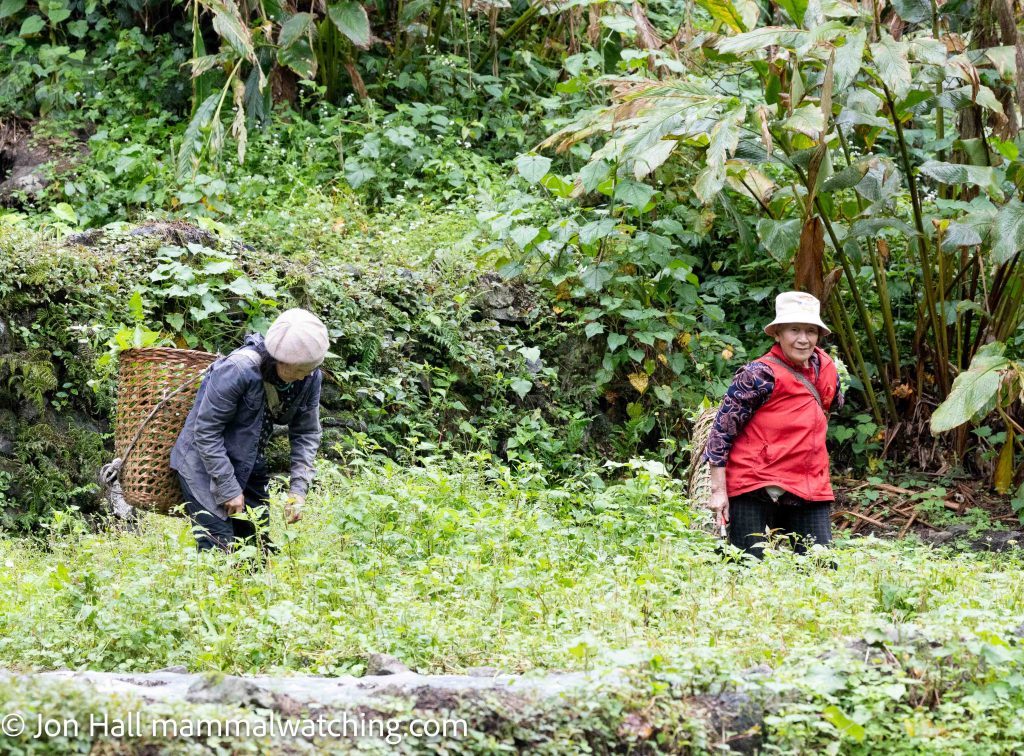
Dulongjiang harvest
I knew Yunnan could be good but I didn’t realise how good it could be. It was a matter of showing up with the right companion –Yiqian – and giving it a go.
I love exploratory trips like this. Both for the trip itself but also for the chance to share that information with others. Open-source mammalwatching – promoting new areas for ecotourism – is one of the most important roles this website has played. And it has helped both our mammal lists and conservation.
All the places we visited in Yunnan are already benefitting from the growing numbers of Chinese wildlife watchers and I hope this report will also send a few foreigners to Yunnan to join them. Although there are areas of Yunnan that are off-limits to foreigners, we didn’t get a hint of that in the places we visited. Perhaps as more international visitors travel to look for mammals it will encourage the authorities to open up new sites to tourism in this fabulous country. Good for the economy, conservation and diplomacy!
When I started this website in 2005 I wanted to make mammalwatching easier by providing the kind of information that birders had access to when planning a trip. Before I left I was sure Yunnan is a place people would want to visit if they have that sort of information. I hope this trip report will help.
Having said all that, this is not the sort of trip that most people – at least those who are not Chinese – can take independently. I haven’t included the name and contact details of the hotels we stayed in, or even some of the names of the villages we visited, simply because I don’t know them (and nor does Yiqian!). I also discovered I dcould not extract GPS coordinates from photos here in China, which is my usual strategy for pinpointing a spot. This didn’t seem to work when I was back in the USA either, but a few months later in July I had some luck and have updated some of the locations as best I can.
That said, even if you knew the location I’m not sure it would help without having a Chinese companion. I hope, at least, that this report will encourage others to want to visit after learning how much good stuff you can see here in 10 days.
Carlos Bocos – from the new Mammalia Tour Company – was in Yunnan just before me scouting out a trip. He’s now in the very early stages of planning a tour here to see some of these species. So if you want to visit that will hopefully be an option. You can contact Carlos to be added to a list to receive more information when he has it.
Thank You
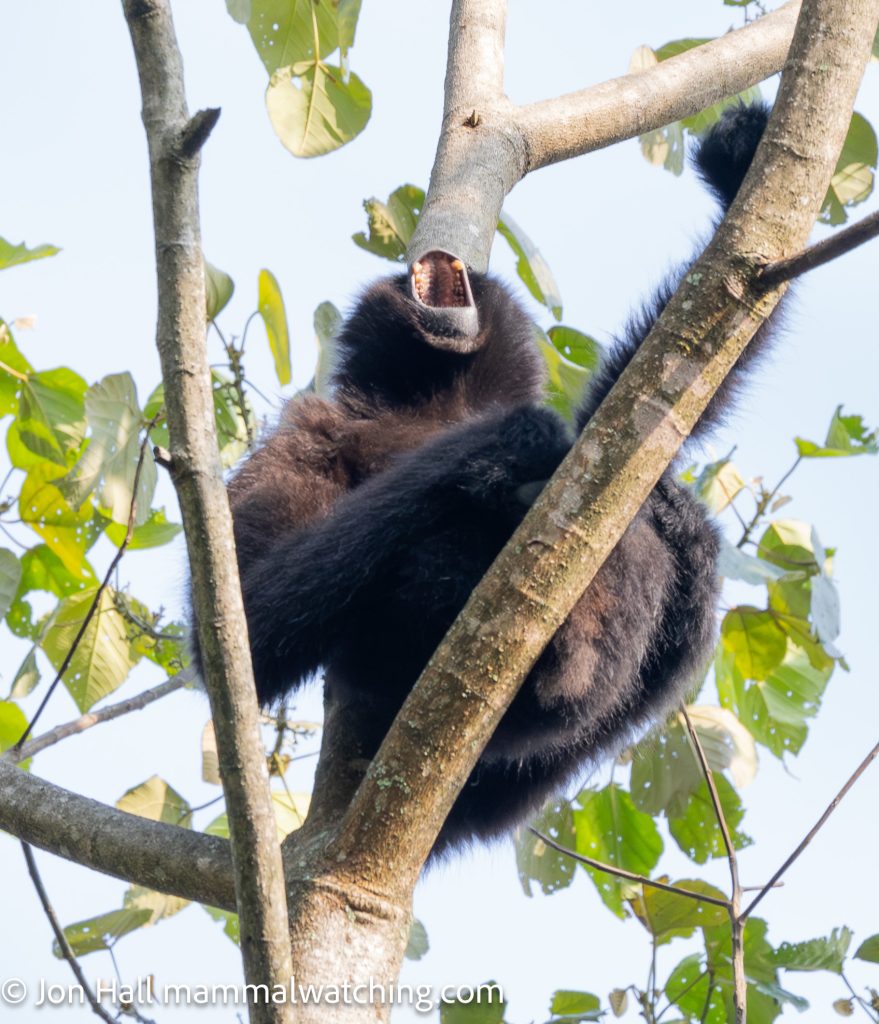
Skywalker Hoolock Gibbon (Hoolock tianxing)
A massive thank you to Yiqian Wu for organizing the trip so carefully and taking time out of his schedule to accompany me. He’s a great guy and he would make an excellent mammal guide: he has boundless enthusiasm, tremendous knowledge and has a very wide network of mammalwatching friends right across China, as you would expect from a Mammal Lord!
I felt guilty Yiqian had to do all the driving: and there was a lot of driving to do. I felt even more guilty that he felt he need to pay for so much as I was his guest. Chinese culture is wonderfully hospitable but also financially painful if you have a ‘guest’ show up for a two week vacation.
We also laughed a lot. Yiqian taught me some choice Chinese words that have already proved useful for commenting on some of the more ‘interesting’ driving maneuvers we crossed paths with.
Mammals aside he taught me a great deal the local culture, the history and especially the food, which is second to mammals on Yiqian’s list of passions.
We are already making plans for a trip next year, so I guess he also enjoyed himself.
Trip List
Northern Treeshrew (Tupaia belangeri)
Assamese Macaque (Macaca assamensis)
Shan Langur (Trachypithecus melamera)
Shortridge’s Langur (T.shortridgei)
Skywalker Hoolock Gibbon (Hoolock tianxing)
Bengal Slow Loris (Nycticebus bengalensis)
Phayre’s Squirrel (Callosciurus phayrei)
Anderson’s Squirrel (C.quinquestriatus)
Asian Red-cheeked Squirrel (Dremomys rufigenis)
Himalayan Striped Squirrel (Tamiops mcclellandii)
Particolored Flying Squirrel (Hylopetes alboniger)
Yunnan Giant Flying Squirrel (Petaurista yunanensis)
Indomalayan Long-tailed Climbing Mouse (Vandeleuria oleraceus)
Blanford’s Fruit Bat (Sphaerias blanfordi)
Geoffroy’s Rousette (Rousettus amplexicaudatus)
Indian Roundleaf Bat (Hipposideros lankadiva)
Big-eared Horseshoe Bat (Rhinolophus macrotis)
Chinese Rufous Horseshoe Bat (R.sinicus)
Northern Woolly Horseshoe Bat (R.perniger)
Northern Palm Civet (Paradoxurus hermaphroditus)
Northern Red Muntjac (Muntiacus vaginalis)
Himalayan Takin (Budorcas taxicolor)
21 species – 10 lifers in bold. Some of the bat IDs are provisional and may be updated.

Post author
13 Comments
-
-
-
-
-
Rob Jansen
Amazing mammals and sightings! “Surprising how news of this site had not percolated through to the mammalwatching world given the interest in Skywalkers”, but then not being sure about the village is not helping though haha. I definitally recommend using observation.org and their app, so that you can actually very quickly (in seconds!) log your sighting into your personal database. Even if you just do one mammal per spot, it will lock down those crucial details like date, time and coordinates 🙂
-
Ralf Bürglin
And I just came across this one: Myanmar snub-nosed monkey (Rhinopithecus strykeri) is a critically endangered species of colobine monkey described in 2010 in northern Myanmar … In 2011, a population was discovered in Pianma, Lushui County, Yunnan, China … On the morning of 16 October 2011, a forest guard at Gaoligongshan National Nature Reserve in China took photos of a group of snub-nosed monkeys which were later identified as R. strykeri. This made a breaking headline in China especially on the urgent need for a conservation programme (source: English wikipedia).


Leave a Reply
You must be logged in to post a comment.
Ralf Bürglin
Great trip, great report!