

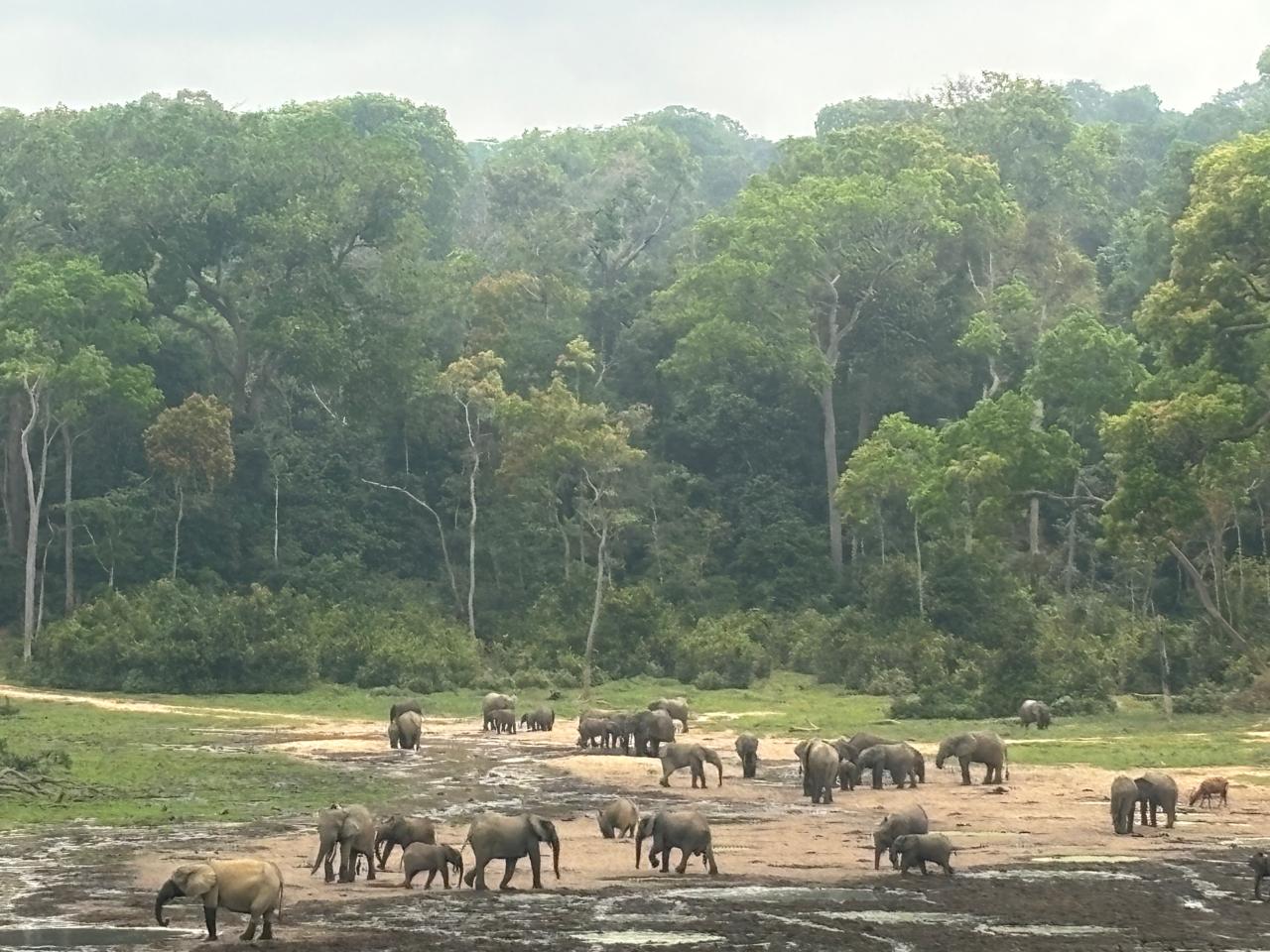
Sangha Lodge, Dzangha-Sangha Special Reserve , Central African Republic.
This was a big bucket list trip to visit the Congo Basin and hopefully see forest elephants. Remarkably, forest elephants were only officially declared a separate species from savannah elephants as recently as 2021 and sadly are deemed Critically Endangered.
We flew from Johannesburg via Addis to Central Africa Republic’s capital city Bangui, where we overnighted, whilst our passports did their own little welcome tour. Visas sorted, the following morning we flew to Bayanga, in the far south-west of CAR, wedged between the Republic of Congo and Cameroon.
Our base for the next 7 nights was Sangha Lodge, spectacularly sited in its own private concession in the rainforest overlooking the wide Sangha River. The lodge borders the immense Dzangha-Sangha Special Reserve – a 45 minute drive along forest tracks through a tunnel of towering trees.
On our very first morning, a small group of forest elephants crossed the track far ahead of us. For a split second, the bull turned to face us. What a thrilling start to our trip!
Dzangha Sangha Reserve is world renowned for its “bai” – a large clearing in the middle of the rainforest, with mineral-rich muddy pools and wallows. As we hiked through the thick forest we knew we must be getting close, as we could suddenly hear trumpeting, rumbles and splashing. Emerging from the forest I don’t think anything prepared us for the incredible spectacle of seeing nearly 100 forest elephants gathered in front of us in the open. We spent the day on the platform, watching the elephants coming and going and their social interactions. Some elephants appeared almost golden from the clay.
Forest buffalos, bongo antelopes and western giant hogs also visit the bai, mixed in with the elephants. Later on in the week, we also got to spend the night camping out on the platform (additional charge). What a memorable experience – a still, moonless night, with the splashing, shrieking and roaring amplified in the darkness.
Dzangha Sangha also offers the opportunity to track western lowland gorillas. These are more closely related to the Cross-River gorillas in Nigeria / Cameroon, than the eastern lowland (Grauer’s) gorillas (which we had seen previously in Kahuzi Biega NP in DRC) which are more closely related to their neighbouring mountain gorillas in Uganda & Rwanda.
The gorilla tracking at Dzangha Sangha has only just resumed, as unfortunately the silverbacks in the three previously habituated families had all died of natural causes fairly recently. So a new habituation programme has recently commenced with up-and-coming silverback, Limu. With Covid tests completed and masks on, we spent a thrilling hour with Limu and his family. However, he made sure he always kept between us and his females and kept moving through thick forest – making photography somewhat challenging.
Another excursion on offer at Dzhanga Sangha Reserve is a guided walk to The Salines – open grassy, swampy clearings in the forest. Here we were lucky to see a sitatunga -which we accidentally flushed as we walked across the saline. We also got the chance to visit the habituated large group of agile mangabeys. Maybe it was just our bad luck on the day, but like the gorillas, the mangabeys also kept moving though thick forest, so hard to photograph. The other monkey species we saw during the week were (i) the moustached monkeys (high in the canopy as we walked to Sangha bai) and De Brazza’s monkey – thanks to the very handsome and semi-habituated individual male, that can be seen around camp in the early mornings.
The pioneering founders of Sangha Lodge are Rod and Tamar Cassidy, and Rod is an exceptional naturalist. He took us on a number of short nature walks around camp, and on boat trips along the river. Mammals seen with Rod included cyclops roundleaf bat (roosting in a hollow tree trunk) and Noack’s round leaf bats (roosting in the caves at the nesting site of the Picathartes / rockfowl nest). Thanks to Rod, we also squeezed into a hollow tree for a special sighting of the Lord Derby’s anomalure (a sort of flying squirrel). We saw a number of squirrels around camp, but the only species I could confidently identify on my own was the giant forest squirrel. Sitting on my chalet deck one afternoon I was also privileged to glimpse a long-nosed mongoose, that I heard rustling around in the undergrowth outside.
Our most magical and unexpected sighting happened from the vehicle as we returned back to camp. Unbelievably, we spotted a pangolin on the track ahead! We immediately jumped out as the pangolin curled into a protective ball. So we retreated to the vehicle where we sat quietly and waited. Within 10 minutes the pangolin uncurled and remarkably started trundling towards us. Holding our breaths we watched as it moved into a shaft of sunlight, before quickly disappearing into the thick forest. This was a black-bellied, or long-tailed, pangolin – an arboreal species very rarely seen on the ground.
Even more amazing that same night, back at camp one of the staff spotted a white- bellied pangolin high in a tree above the lodge (sadly cameras back in our room). Two species of pangolin in less than12 hours! On our final night, the nightwatchman also managed to find a Milne-Edwards potto for us – again high in a tree in camp at night. A thrilling finale to our trip.
This was a truly epic and memorable adventure in a wild part of Africa. Enormous respect and admiration to Sangha Lodge founders and owners, Rod and Tamar Cassidy for their vision, determination and tenacity, operating in this remote location.
www.sanghalodge.com
Mammal List
| Species | Photograph |
| Western lowland gorilla | Y |
| Agile mangabey | Y |
| De Brazza’s monkey | Y |
| Moustached monkey | N |
| Milne-Edwards potto | Y (fuzzy phone snap) |
| Cyclops roundleaf bat | N |
| Noack’s roundleaf bat | N |
| Giant forest squirrel | N |
| Lord Derby’s anomalure | Y |
| Long nosed mongoose | N |
| Black bellied pangolin | Y |
| White bellied pangolin | Y (fuzzy phone snap) |
| Forest elephant | Y |
| Western giant hog | Y |
| Forest buffalo | Y |
| Bongo | Y |
| Sitatunga | N |
| TOTAL 17 |

Post author
1 Comment
Leave a Reply
You must be logged in to post a comment.
Harriet Nimmo
For photos, see our blog:
https://mikekendrick.exposure.co/into-the-forest-dzangasangha