

Sulawesi Expedition, 2025
Introduction
Our group comprised Stuart Chapman, Nick Cox, Charles Foley, János Oláh, Martin Royle and Ian Thompson. Carlos of course was guiding and Professor Juliana Senawi came along as our resident bat guru.
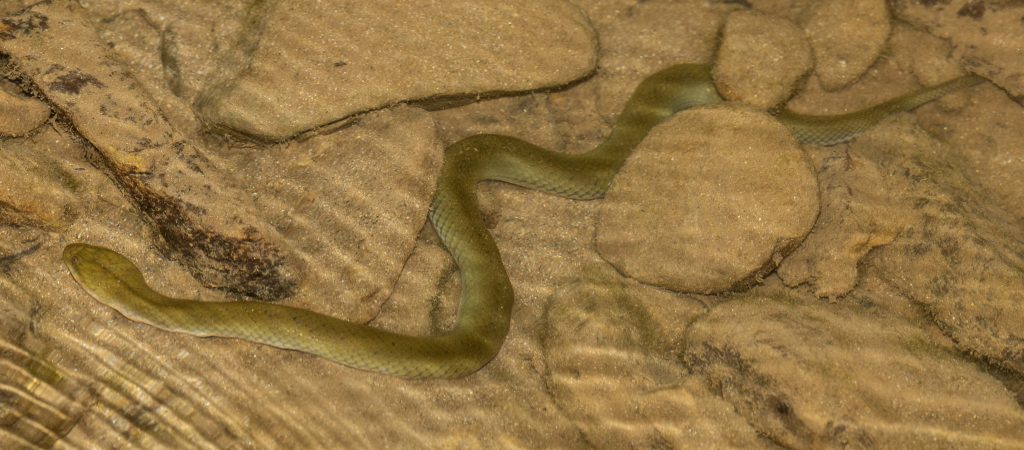
The little known Matana Mud Snake (Hypsiscopus matannensis)
Sulawesi: Why, Where, When an How to go?
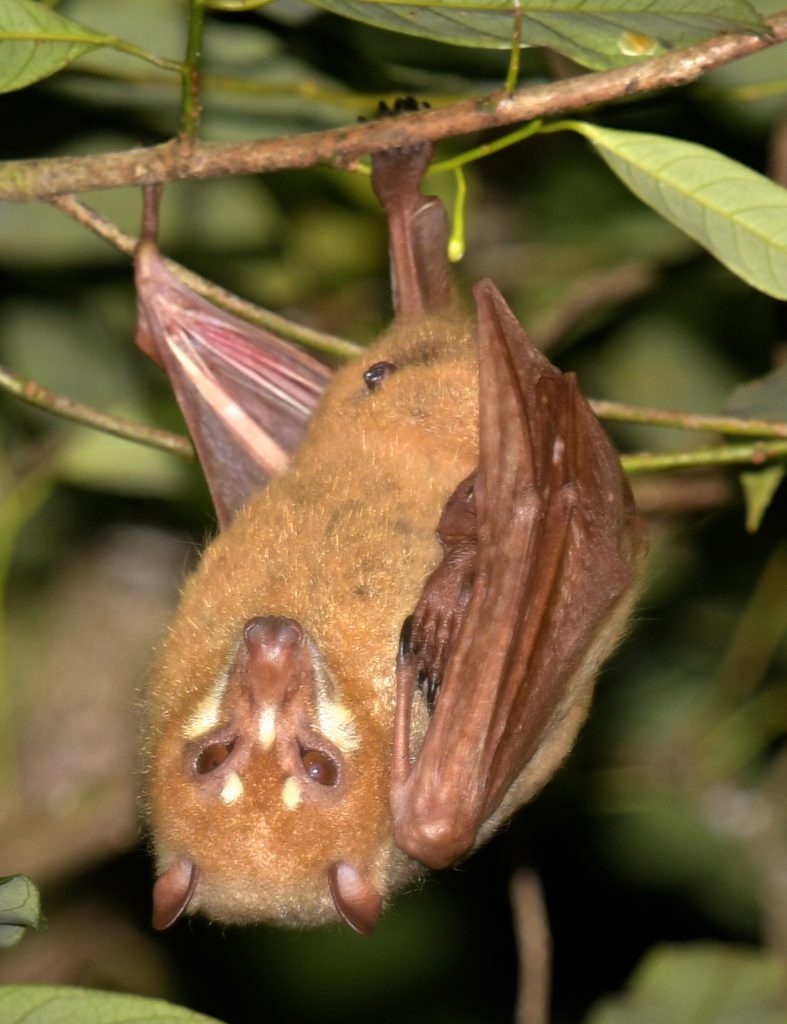
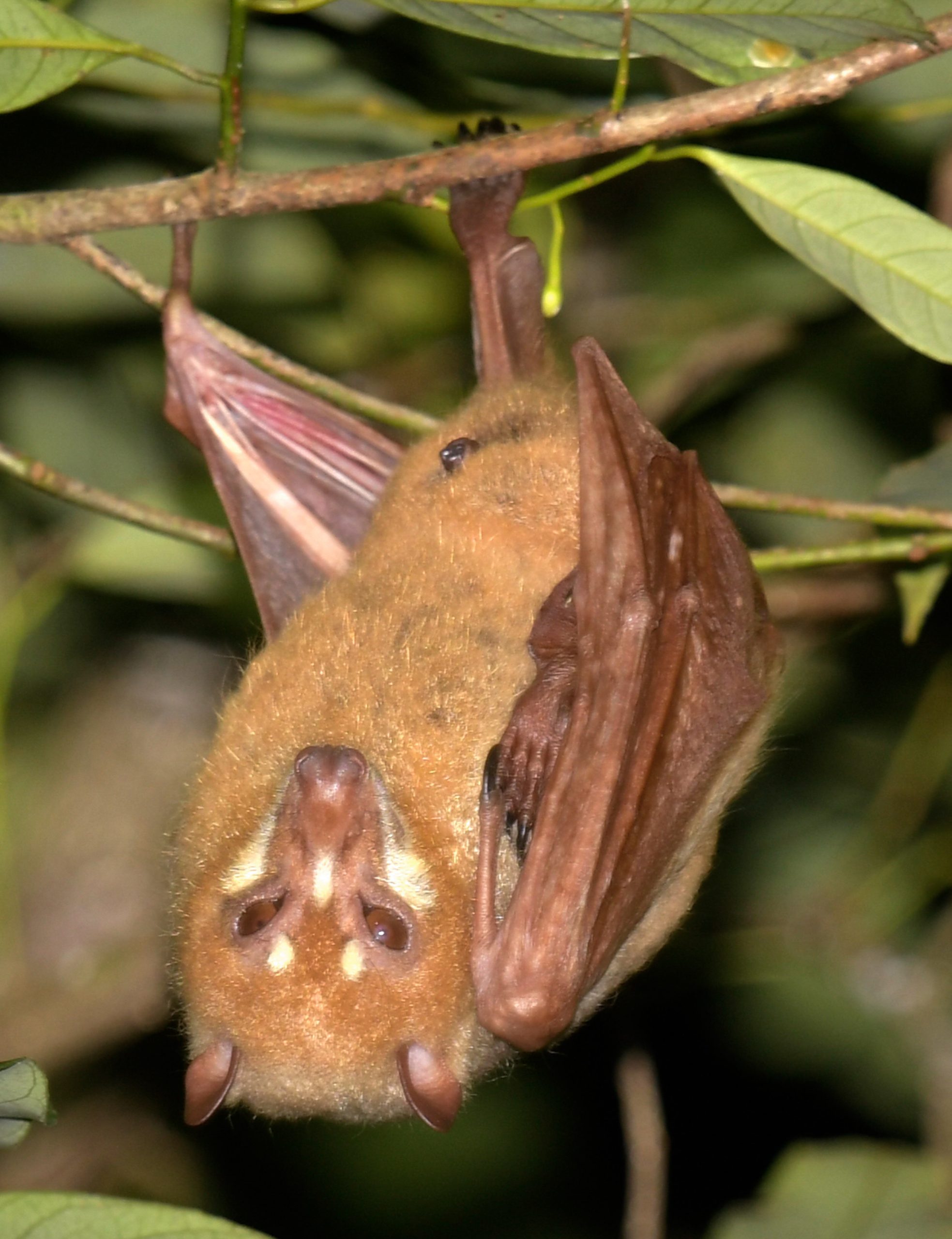
A spectacular Wallace’s Stripe-faced Fruit Bat (Styloctenium wallacei) from Peneng. Photo Juliana Senawi
Itinerary

Martin and the Sulawesi Mammal Tour staple diet
Site Descriptions
Many of these sites were discovered by Carlos and I won’t give detailed information about them. Carlos will be running this tour again soon: it should be a flagship offering of his new company Mammalia.
Kendari
We spent two days exploring a nice slab of lowland forest less than an hour from the city centre. Major targets here were Booted Macaques (Macaca ochreata) (quite shy but we saw several groups) and an undescribed tarsier species, which we missed much to Carlos’s surprise; one of the only dips of the trip.
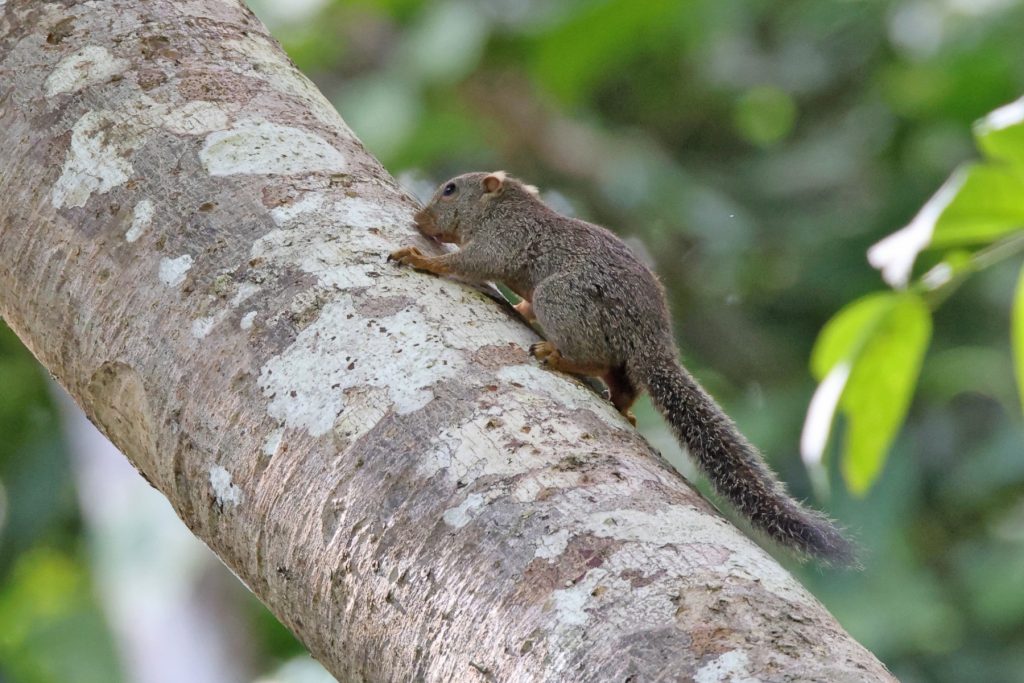
Alston’s Squirrel (Prosciurillus alstoni). Photo János Oláh
The forest was great for rodents with Alston’s Squirrel (Prosciurillus alstoni) during the day, and 4 murid rodents at night. One of them may turn out to be a brand new species of ranee mouse (see the discussion in the species by species account for haeromys cf. minahassae), another appears to be the long lost Southeastern Xanthurus Rat (Rattus salocco) that hasn’t been seen by sicentists for 100 years (see below for more details on that too); as well as Hoffmann’s Sulawesi Rat (Rattus hoffmanni); and Giant Sulawesi Rats (Taeromys dominator) (aka ‘The Dominator!’)
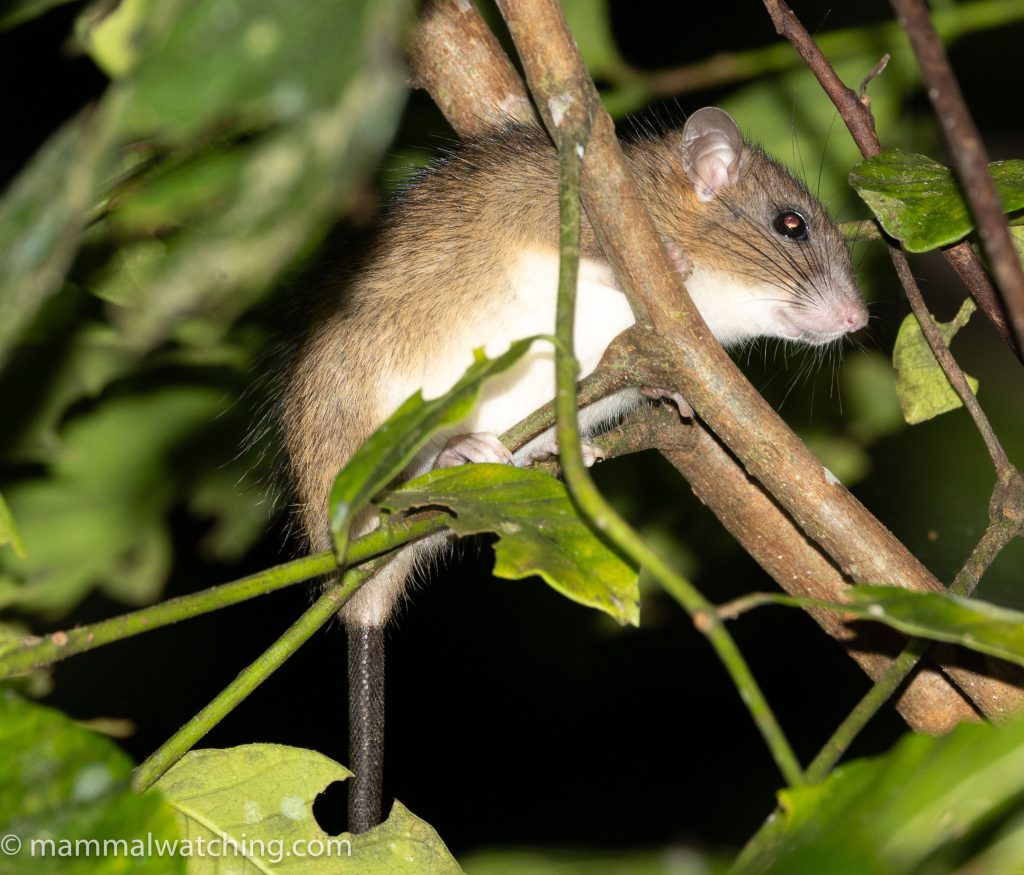
Southeastern Xanthurus Rat (Rattus salocco). Photo Nick Cox
There were plenty of bats in both the forest and the ‘Japanese’ cave (named after Japanese soldiers hid there at the end of WWII).
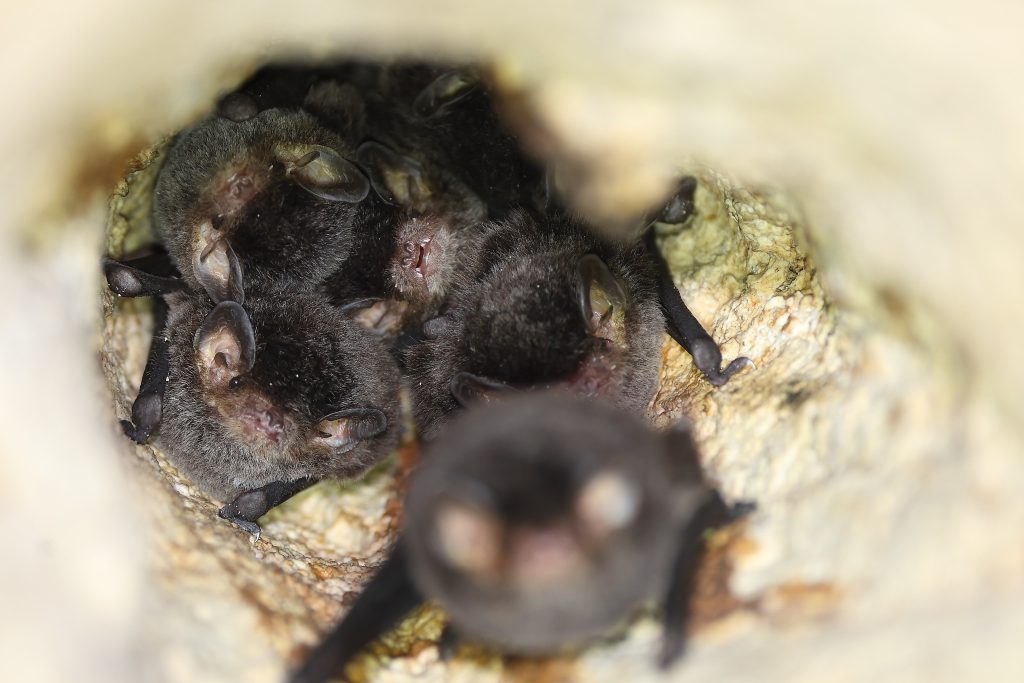
Philippine Long-fingered Bat (Miniopterus paululus). Photo Carlos Bocos
In the forest we saw Dark Sheath-tailed Bats (Mosia nigrescens); Diadem Roundleaf Bats (Hipposideros diadema); Sulawesi Horseshoe Bats (Rhinolophus celebensis); Minute Short-nosed Bats (Cynopterus minutus); and Sulawesi Fruit Bats (Pilonycteris celebensis).
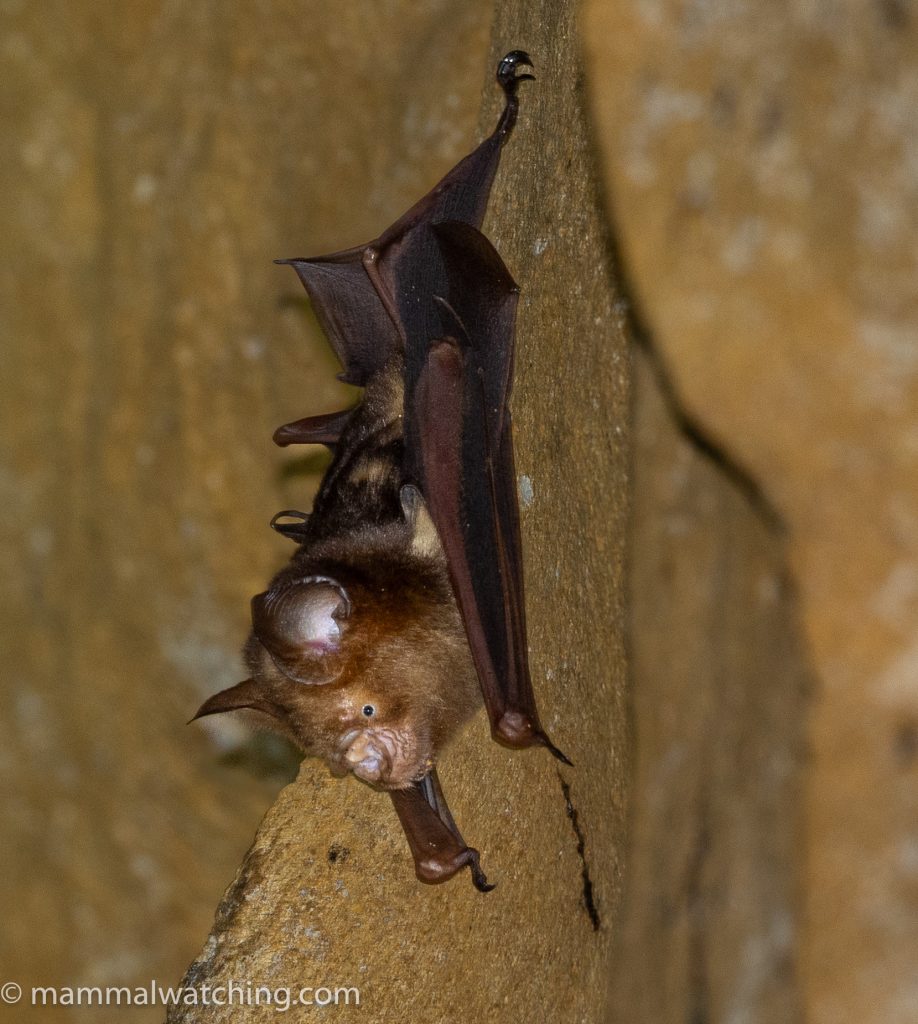
Peleng Roundleaf Bat (Hipposideros pelingensis)
In the cave we added Black-bearded Tomb Bats (Taphozous melanopogon); Philippine Long-fingered Bats (Miniopterus paululus); Geoffroy’s Rousette (Rousettus amplexicaudatus); and the Sulawesi endemics Boeadi’s (Hipposideros boeadii) and Peleng Roundleaf Bats (H.pelingensis).
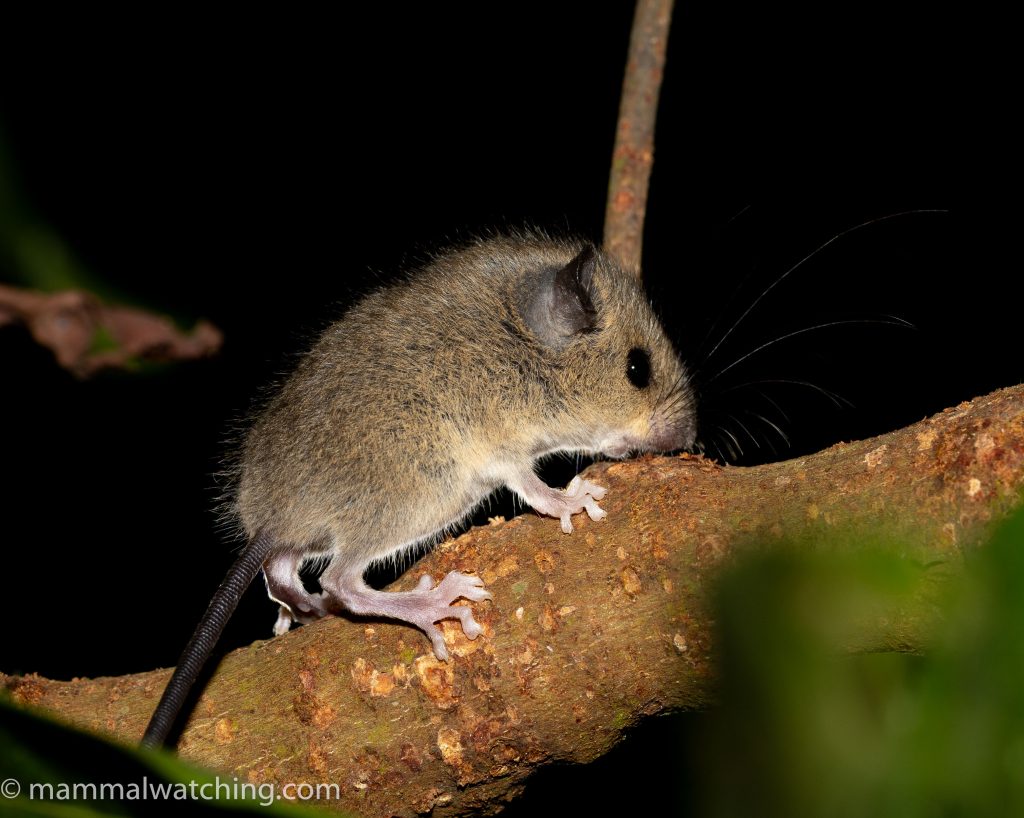
‘Southwest’ (Lowland) Ranee Mouse (Haeromys cf. minahassae)
The highlight of our second night was a lengthy photoshoot with this pretty little ranee mouse. Although we don’t have enough evidence to claim it as a species new to science it would not surprise any of us if turns out to be one. (See the discussion below about ‘Southwest’ Ranee Mouse (Haeromys cf. minahassae)).
The mammalwatching was mainly undertaken along a shallow river: a river we walked in rather than alongside. Had I realised we would be wading through knee deep water I would have packed a pair of Tevas. The walking was fine. The wet boots were not.
Leaving those boots in the hotel to dry the next day and exploring a bat cave in flip-flops was a major tactical error. The floor was thick with guano sludge. It was so slippery that both Carlos (also of course in flip-flops) and I ended up barefoot. This was not on my list of trip highlights even though the three lifer bats – and no signs yet of blood poisoning – made it all worthwhile.
Makassar
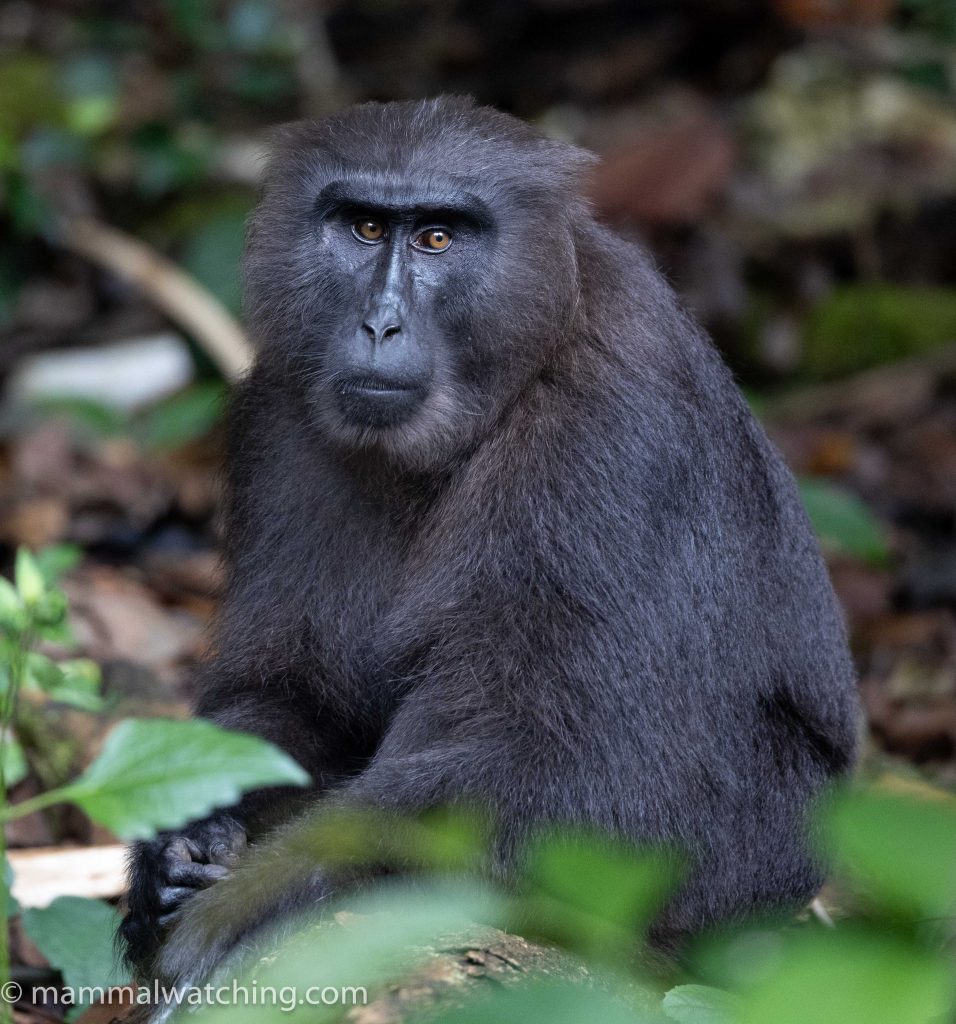
Moor Macaque (Macaca maura)
We spent a day around Makassar in Bantimurung Bulusaraung National Park. A very busy, trash-littered road runs through the park. Not the most aesthetic mammal viewing but the striking Moor Macaques (Macaca maura) were easy to find along the road where they scavenge for trash and snacks from passing cars.
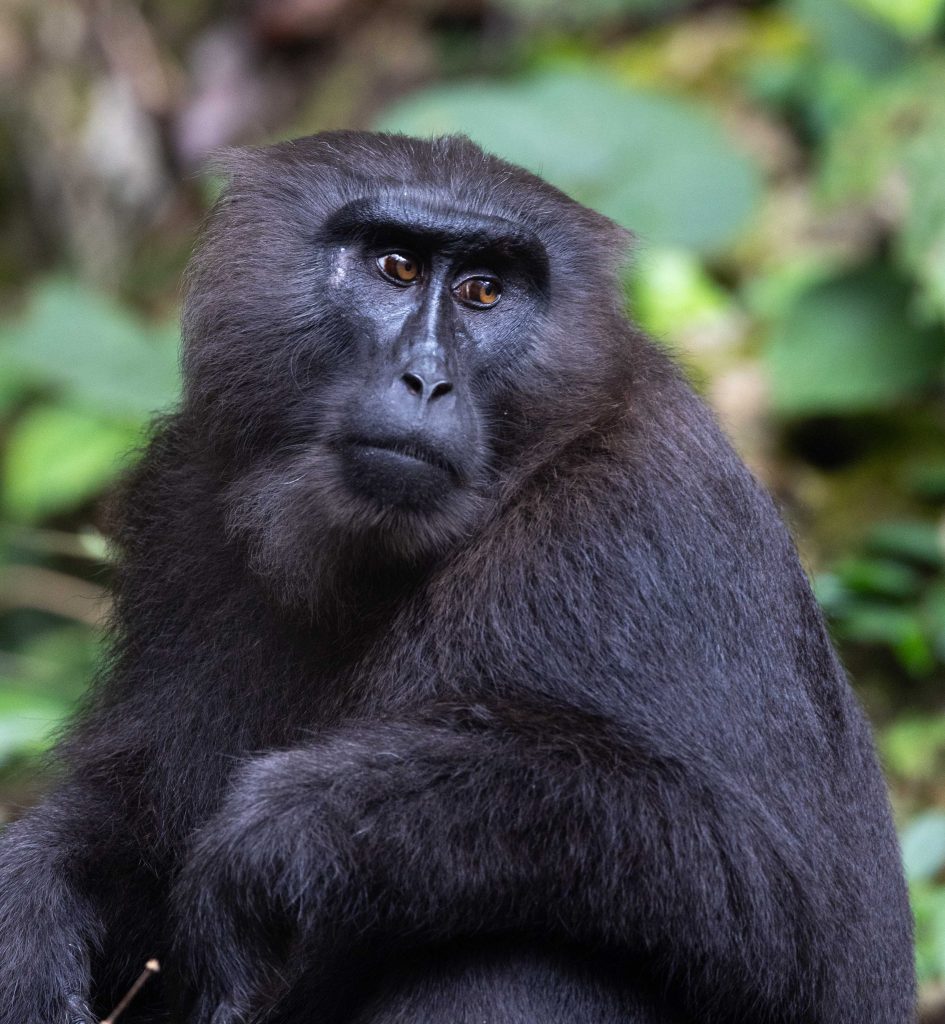
Moor Macaque (Macaca maura)
The macaque was Stuart’s 1000th mammal species.
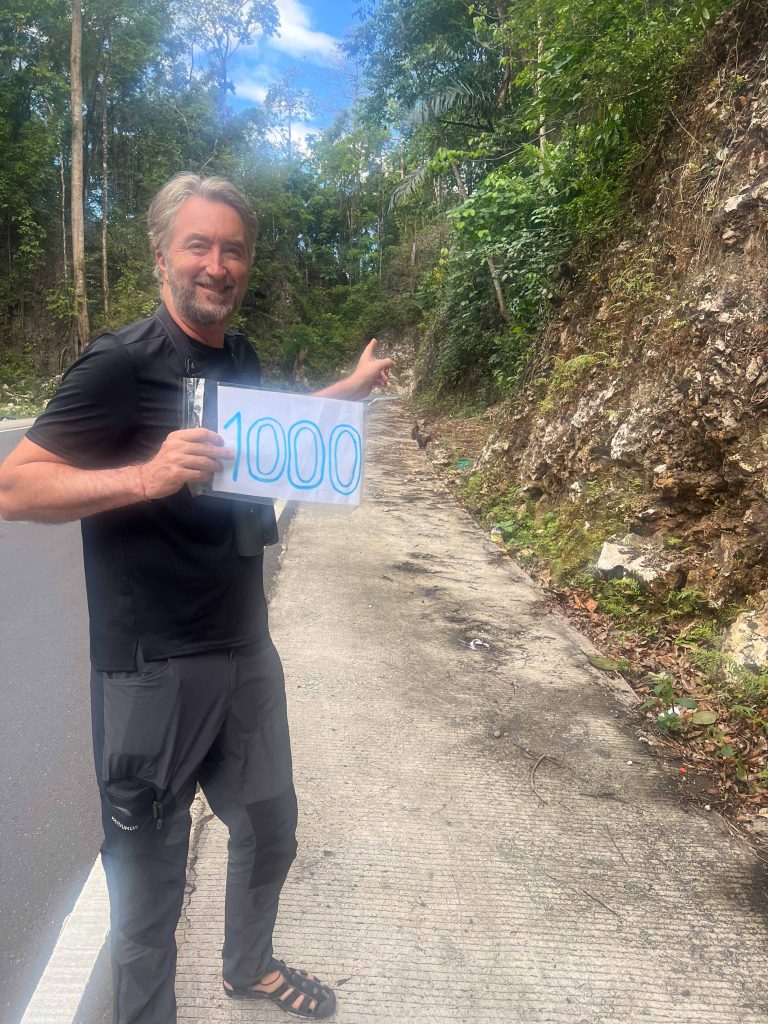
Weber’s Dwarf Squirrel (Prosciurillus weberi) took a bit more time to track down but we finally found one on our second morning.
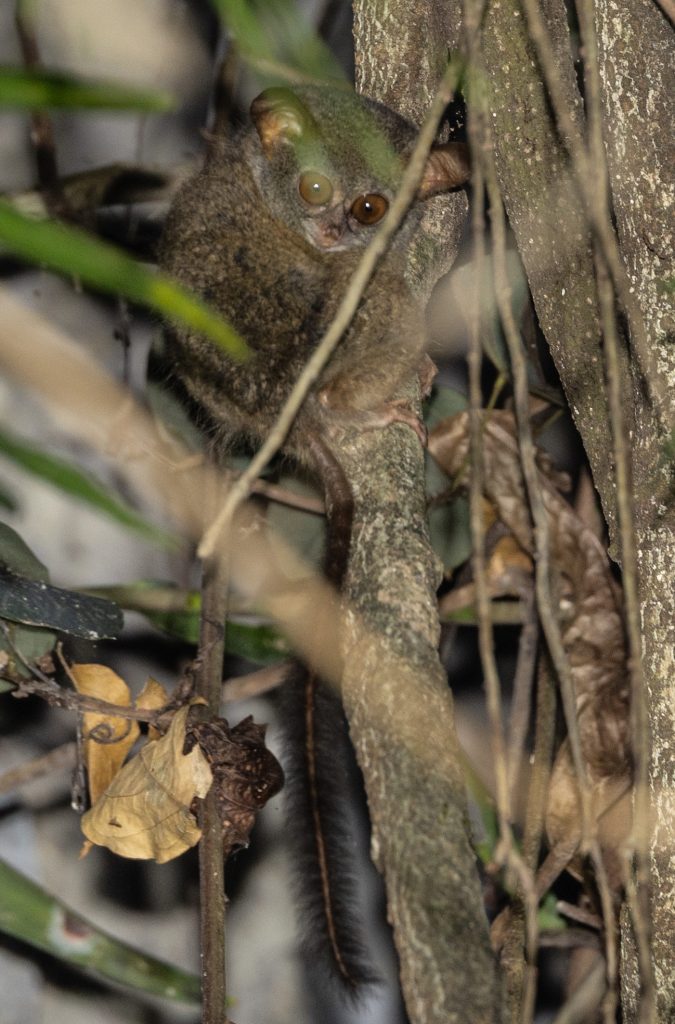
Makassar Tarsier (Tarsius fuscus)
A local guide took us to a Makassar Tarsier (Tarsius fuscus) roost next to the road. It was impossible to hear them calling over the roar of passing trucks but bang on sunset we had reasonable views of one animal as it left its den site in limestone karst.
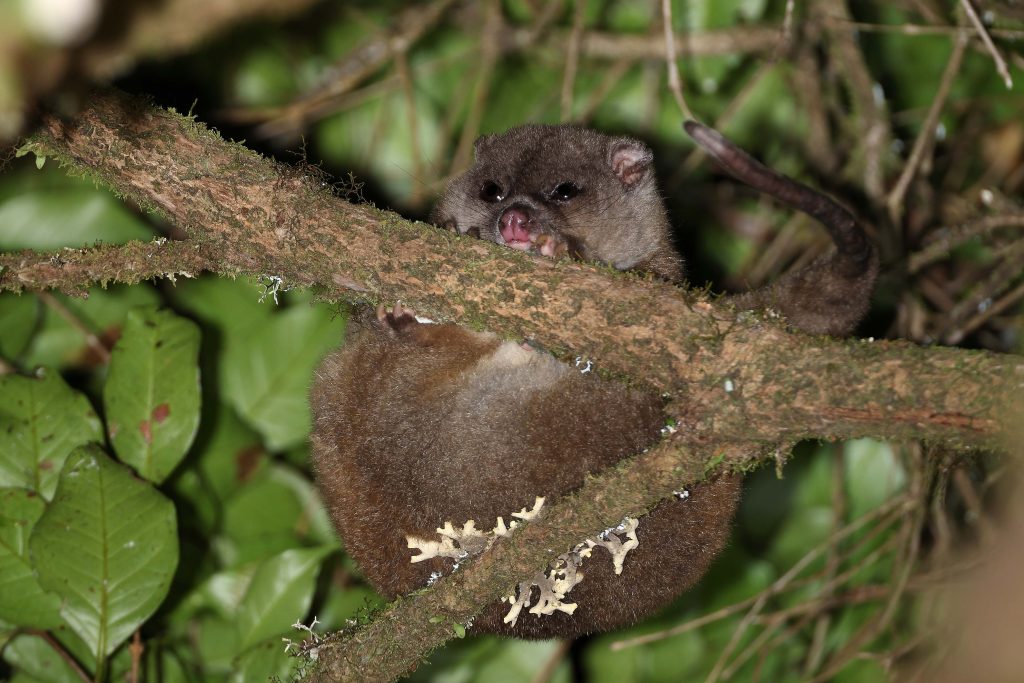
Small Sulawesi Cuscus (Strigocuscus celebensis). Photo Carlos Bocos
A night walk close to the tarsier roost was productive with Sulawesi Dwarf Cuscus (Strigocuscus celebensis); Hoffman’s Sulawesi Rat (Rattus hoffmanni); Black Rat (Rattus rattus); Celebes Rat (Taeromys celebensis); Sulawesi Flying Fox (Acerodon celebensis); and Sulawesi Horseshoe Bat (Rhinolophus celebensis).
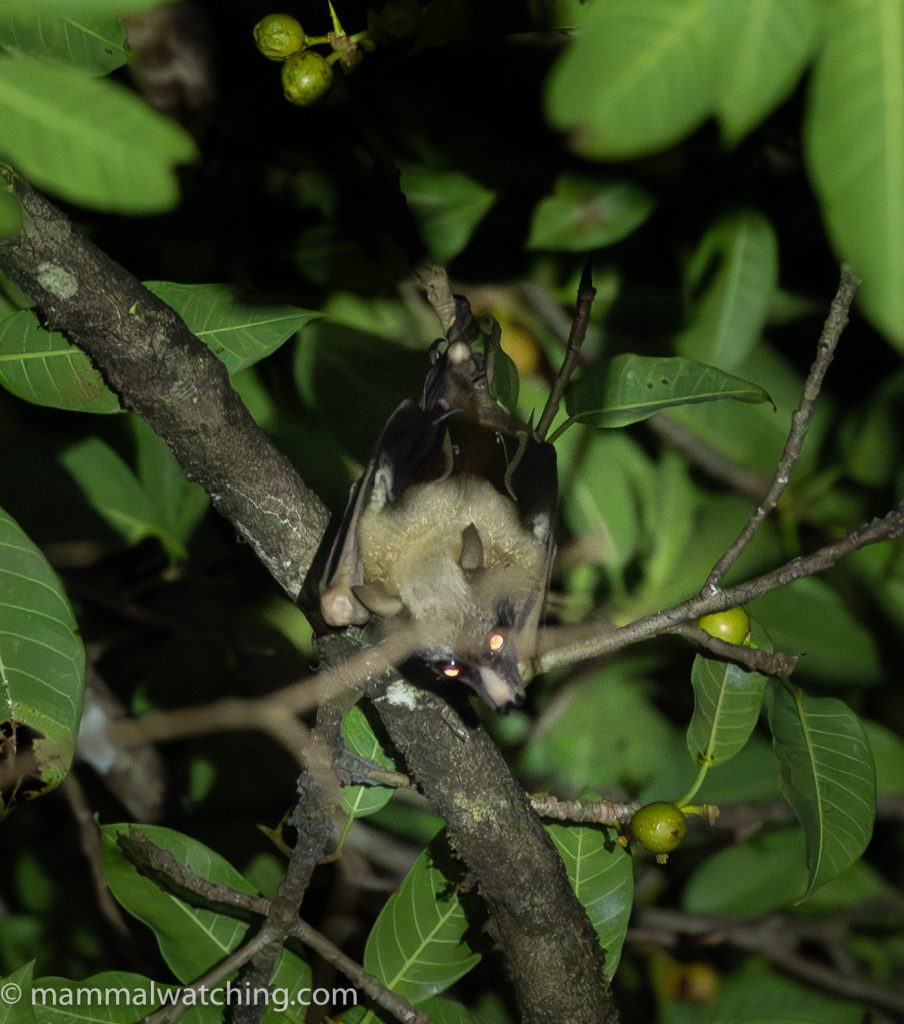
Sulawesi Flying Fox (Acerodon celebensis)
A small vespertilionid bat hanging from a twig gave cause for excitement: it posed wonderfully for photos, spinning from its perch and displaying a balding head. Juliana eventually decided it was likely a Javan Pipistrelle (Alionoctula javanica). Apparently bat alopecia is unusual.
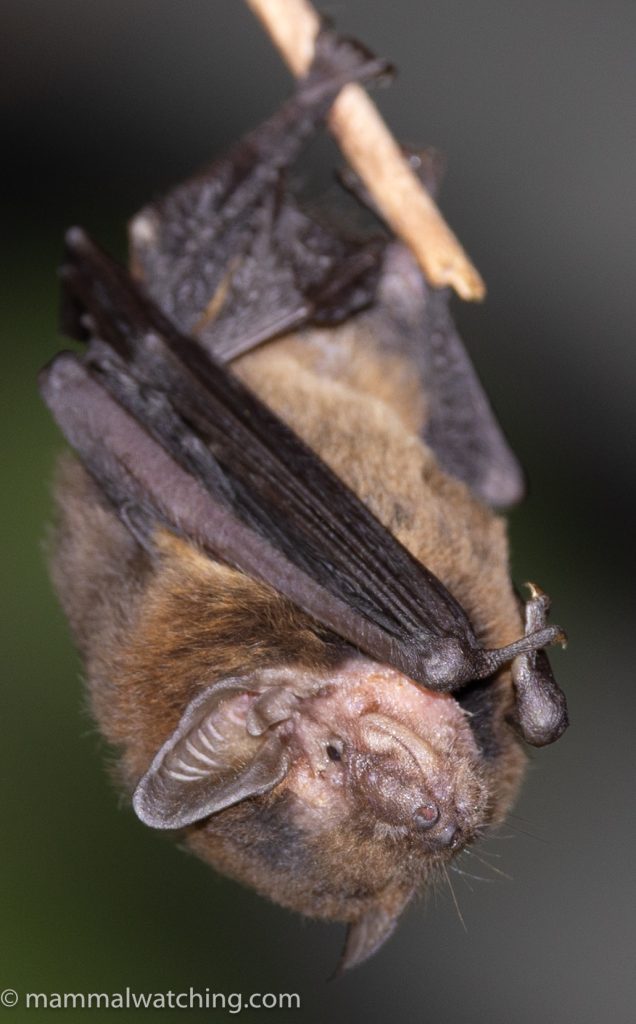
Javan Pipistrelle (Alionoctula javanica)
Mount Lompobattang
We spent an evening on the slopes of Mount Lompobattang in wonderful mossy montane forest at around 2000 metres. Carlos was excited about the place. He had visited a few months earlier on a birding trip and it was “tripping with mammals”. We’d talked about camping up here but in the end decided to stay in a small hotel half an hour’s drive from the start of the trail up the mountain.
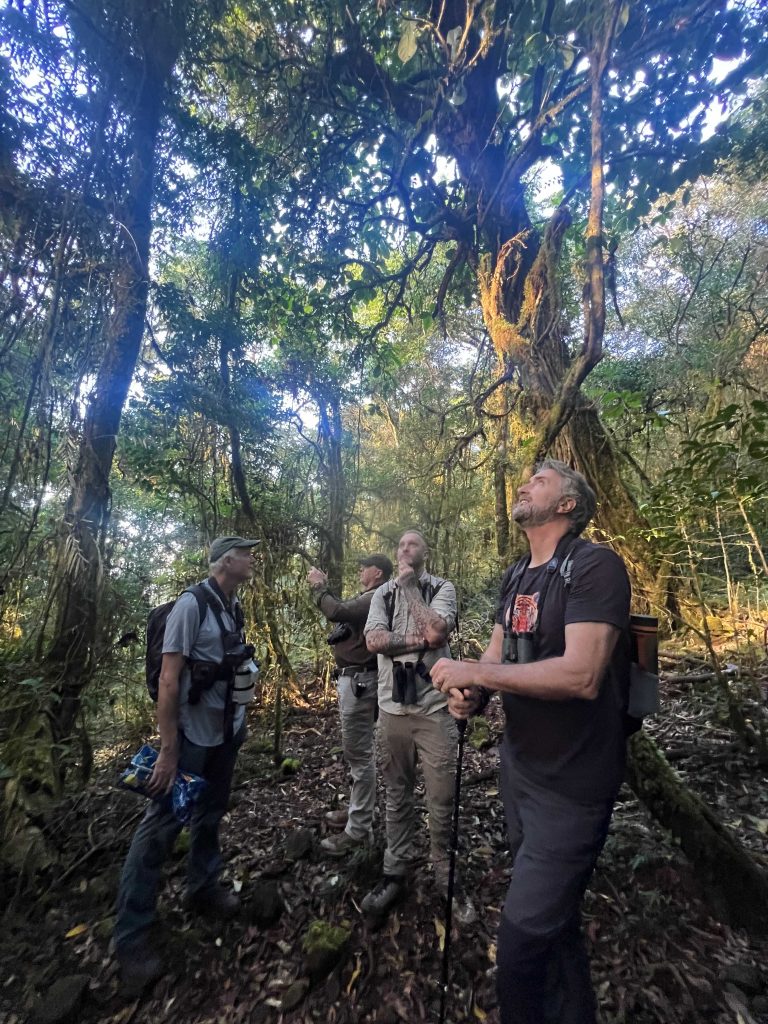
It took about an hour to walk up to the forest. As soon as it got dark the mammals were out in force.
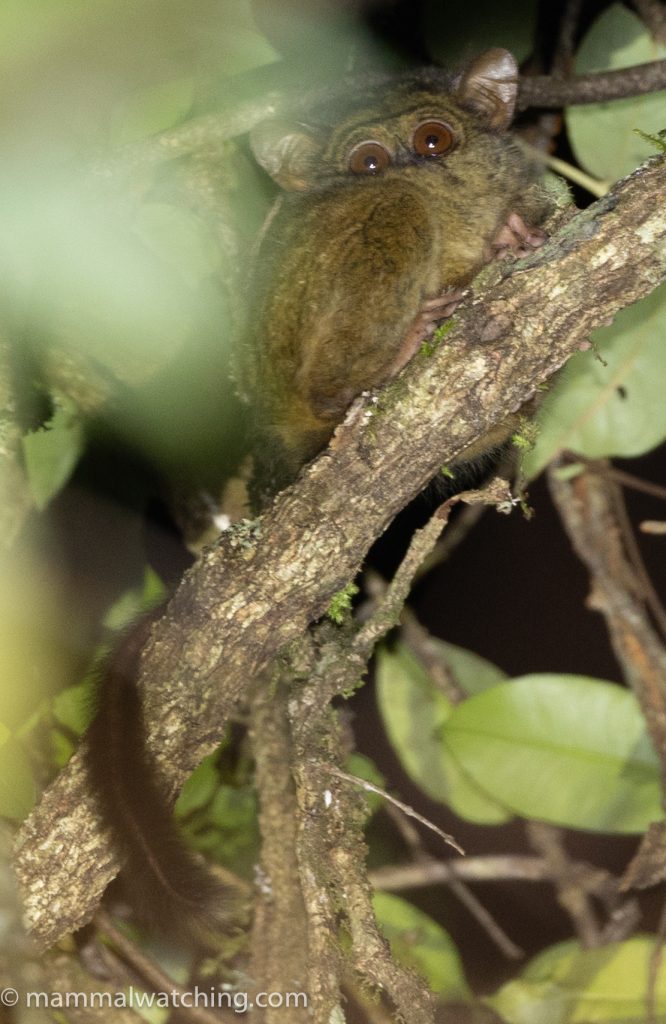
The seemingly unknown ‘Lompobattang Tarsier (Tarsius sp.nov.B)
The first mammal was a tarsier that appears to be new to science, although it is impossible to say for certain until animals are captured by scientists or they get good recordings of the calls. But Carlos is convinced the tarsiers up here look and sound different to the Makassar Tarsier from the lowlands. Given Carlos’s almost supernatural ability to ID bird and squirrel calls I defer to him on all audible identification and he is confident this species is different. So we have decided to include these animals as the ‘Lompobattang’ Tarsier and hope scientists will soon be able to confirm that this is indeed a new species.
Sulawesi Dwarf Cuscuses (Strigocuscus celebensis) were common up here. And there were rodents everywhere, most spectacular of which were Meyer’s Giant Rats (Lenomys meyeri), beautiful and the size of a small cat.
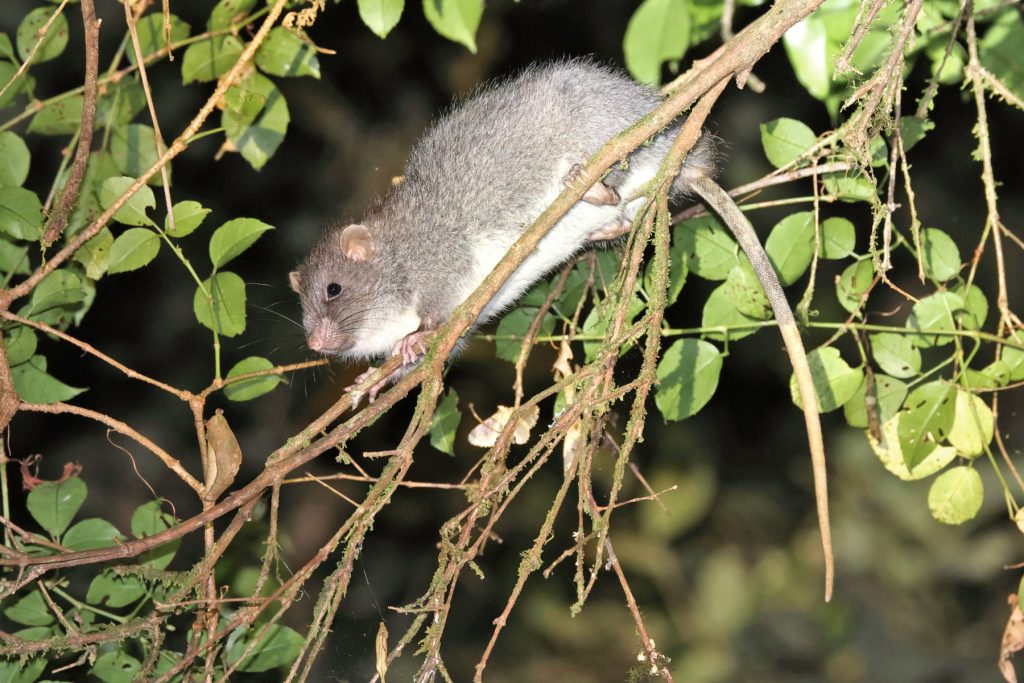
Meyer’s Giant Rat (Lenomys meyeri)
We saw three rattus species: Southwestern Xanthurus Rat (Rattus bontanus); Hoffmann’s Sulawesi Rat (R.hoffmanni); and Lompobatang Sulawesi Rat (R.mollicomulus) along with several Celebes Rats (Taeromys celebensis) and a pretty little margeratamys rat, a genus with a distinctive face and tufted tail. The species up here is also undescribed but known to scientists. Sulawesi rodent expert Dr Kevin Rowe is aware of it and we refer to it below as the ‘Lompobattang’ Margareta Mouse (Margaretamys sp.nov.A).
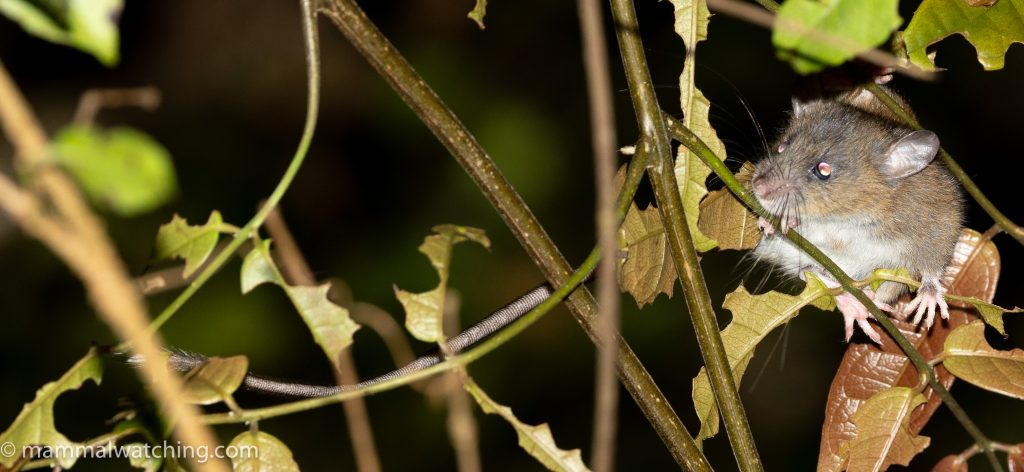
‘Lompobattang’ Margareta Mouse (Margaretamys sp.nov.A)
We found Common Swift Fruit Bats (Thoopterus nigrescens) and Sulawesi Harpy Fruit Bats (Harpyionycteris celebensis) and another Javan Pipistrelle type bat (Alionoctula cf. javanica) that may be the same javanica species we saw the night before, but looked different enough to potentially be something else according to Juliana. She recommended we record it as Alionoctula cf. javanica for the time being. We include it on the list but don’t count it is as a separate species (see the discussion in the species by species account below).
One of the night’s highlights was a bird! Yes, you read that right. An extremely rare bird.
Ironically I was the first to identify it after taking what appears to be the first ever handheld photo of this species. Sorry birders! It may be some consolation to know this was almost certainly the only bird on Sulawesi I could have identified.
A couple of days earlier Carlos and János had been chatting about the birds János might see. Carlos rattled off a few species and János asked “But what about the woodcock?”. Carlos laughed. This was the only bird on Sulawesi he hadn’t seen.
Many have tried and failed. So far as I can gather the Sulawesi Woodcock has barely been seen since it was described in 1921. A few birders have reported it but none had been able to photograph one (a woodcock was recently caught on a camera trap in Tangkoko National Park on the northern peninsula).
When my thermal picked up a heat blob up the tree I couldn’t figure out what we were looking at. I fired off a photo and zoomed in …”its a cuscus, not its a squirrel.” Zooming in further I saw a long pointed beak attached to the mammal’s head. “It’s a f*cking woodcock”.
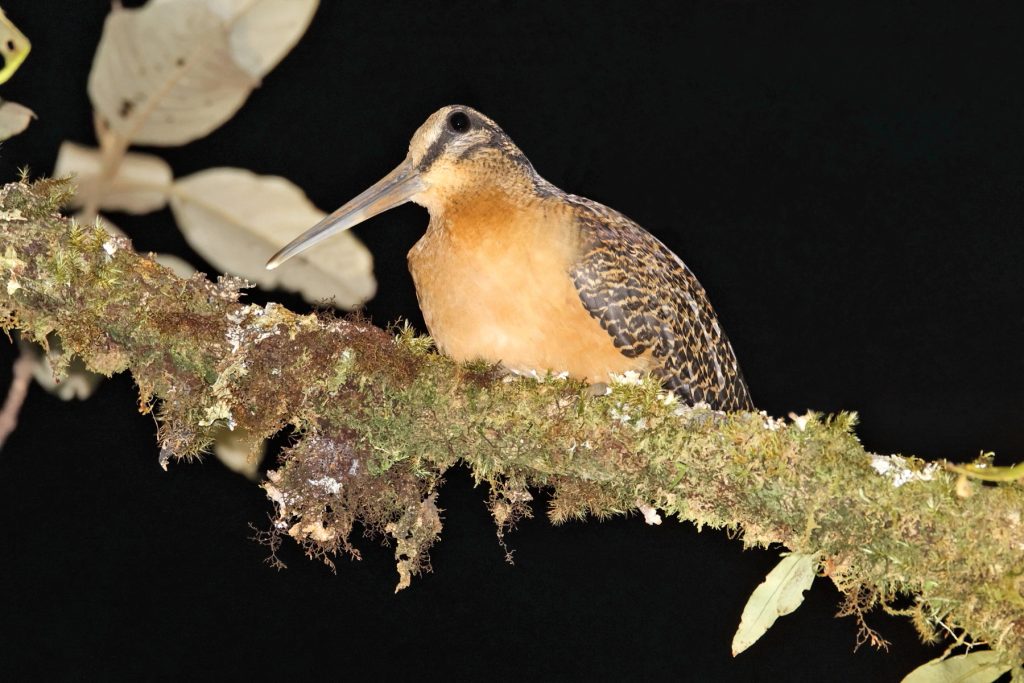
Sulawesi Woodcock. Photo János Oláh
János and Carlos were shaking with excitement. Excitement they tried to keep under control by letting out a string of expletives. Both the excitement and the expletives were infectious. They got great photos of the bird.
I hoped this sighting would give me closure on a litany of resentments that fester inside me from every picture of a Bush Dog I have seen taken by a birder. It hasn’t.
Several people claimed the bird as “an honourable mammal”. I dislike this phrase. This was a dishonorable mammal … so much excitement when we saw it that left me feeling soiled and ashamed. How could I have been so aroused by a bird?
Lore Lindu
We spent four nights around Lore Lindu National Park in a simple hotel close to the park, the longest we spent in any one place. The park – four hours south of Palu in the Central Peninsula – is a nice chunk of mountain forest and is well-known to birders. When we arrived I discovered my camera lens was broken beyond repair.
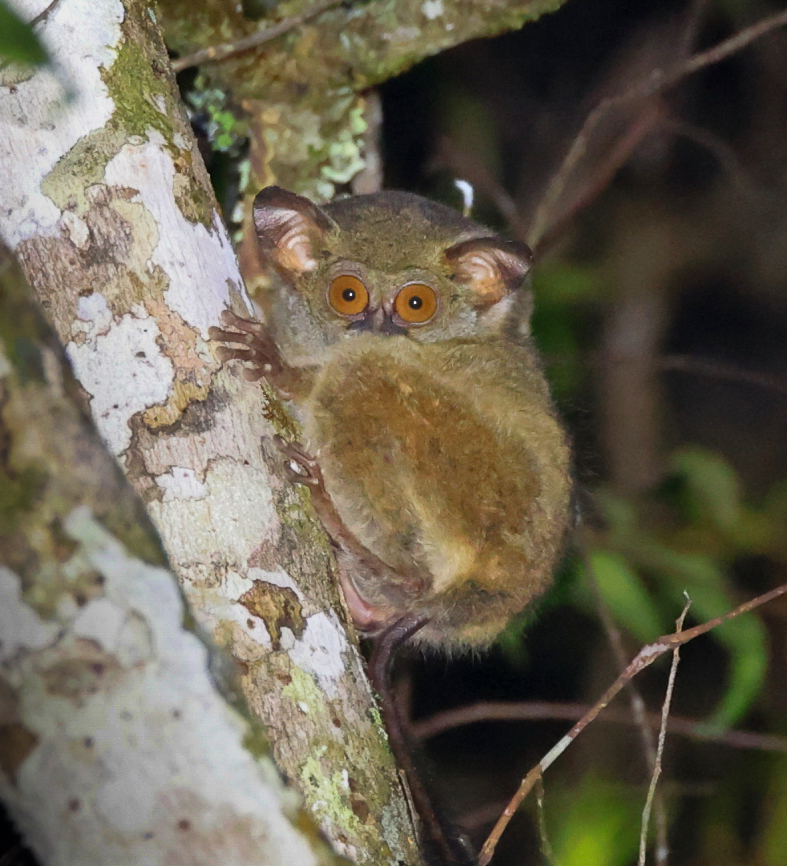
Dian’s Tarsier (Tarsius dentatus). Photo János Oláh
Three of our four nights were spent exploring the forest along the road. We saw Small Sulawesi Cuscus (Strigocuscus celebensis); Dian’s Tarsier (Tarsius dentatus); Lowland Ranee Mouse (Haeromys minahassae) (see the notes below about the status of the animals here); Sulawesi Soft-furred Rat (Eropeplus canus); Sulawesi Montane Rat (Taeromys hamatus); Common Hill Rat (Bunomys chrysocomus); Elegant Margareta Rat (Margaretamys elegans); Lore Lindu Xanthurus Rat (Rattus facetus); Peters’s Myotis (Myotis ater); Common Swift Fruit Bat (Thoopterus nigrescens); Suhaniah’s Swift Fruit Bat (T.suhaniahae); and Lesser Long-tongued Blossom Bat (Macroglossus minimus).
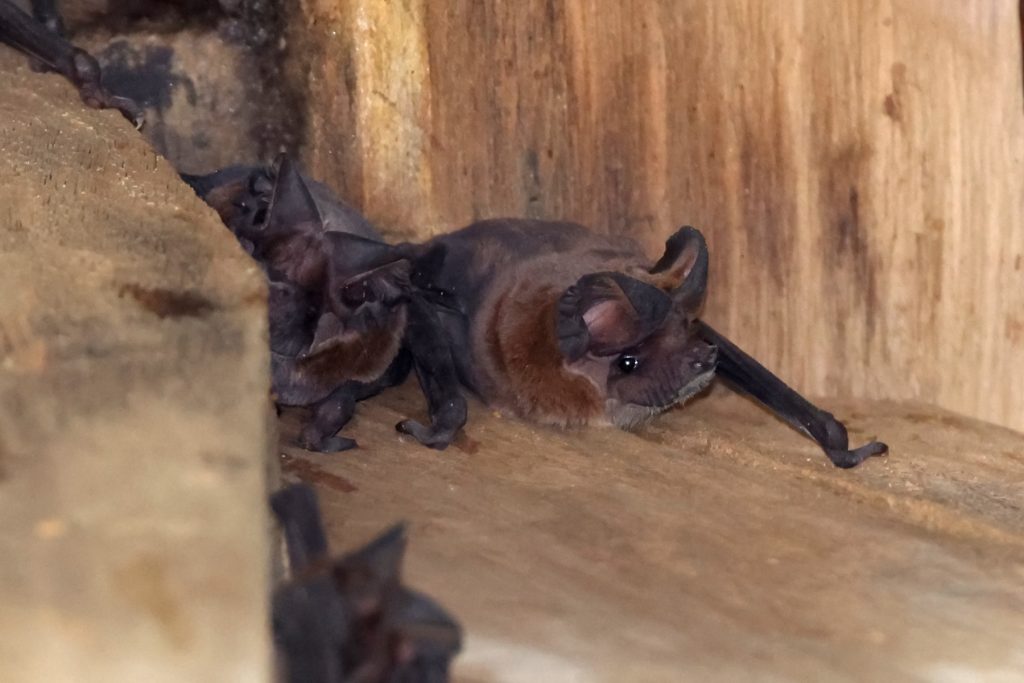
Sulawesian Free-tailed Bats (Mops sarasinorum). Photo János Oláh
During the day we searched for bats in buildings, and with help from Carlos’s friends found a roost of Sulawesian Free-tailed Bats (Mops sarasinorum) and a single bat which may be a Minahassa Pipistrelle (Alionoctula minahassae) or may be something new to science according to Juliana.
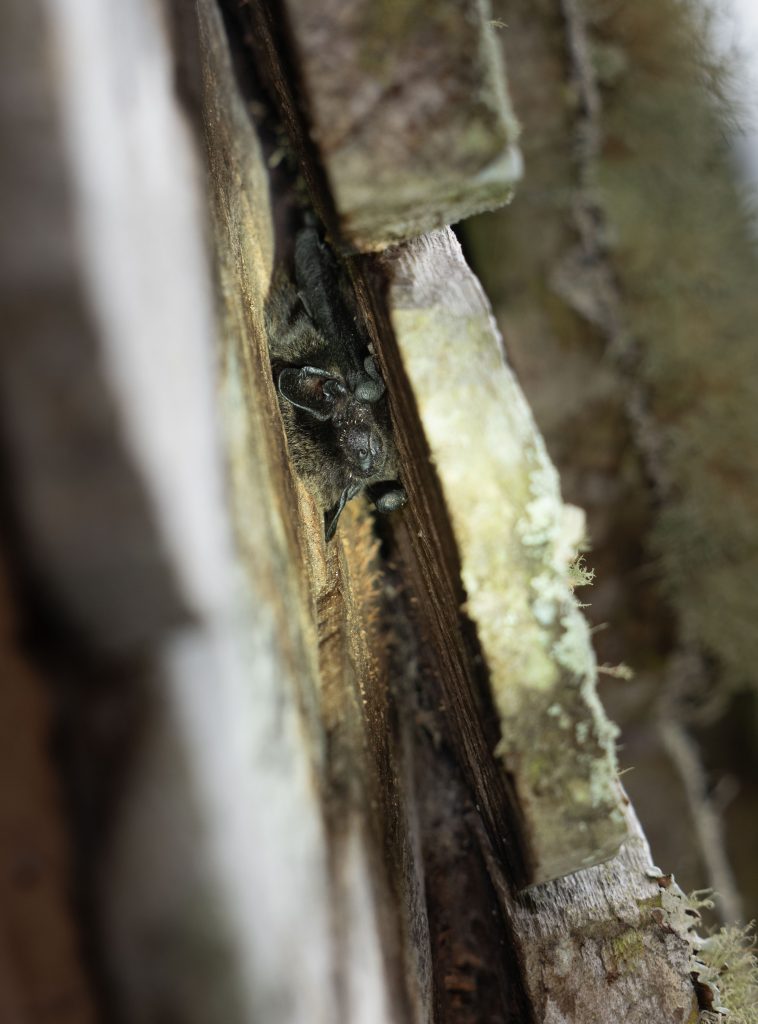
Probable Minahassa Pipistrelle (Alionoctula cf. minahassae). Photo Nick Cox
We also searched for four squirrel species: Sulawesi Giant, Celebes Dwarf, Montane Long-nosed and Mount Topapu Squirrels. We saw the Celebes Dwarf Squirrels (Prosciurillus murinus) close to the road and along the Anaso Track where we also saw a Mount Topapu Squirrel (P. topapuensis). Montane Long-nosed (Hyosciurus heinrichii) are commonly seen along the Anaso Track, usually dashing across it and seldom stopping for long enough for photographs. We didn’t see one though Juliana did catch a glimpse one afternoon from the back of a motorbike on her way up the track.
A small enclosure at the Lore Lindu visitor centre held several Mountain Anoas. Smaller than I expected and more beautiful. They are tragically on the edge of extinction from hunting pressure.
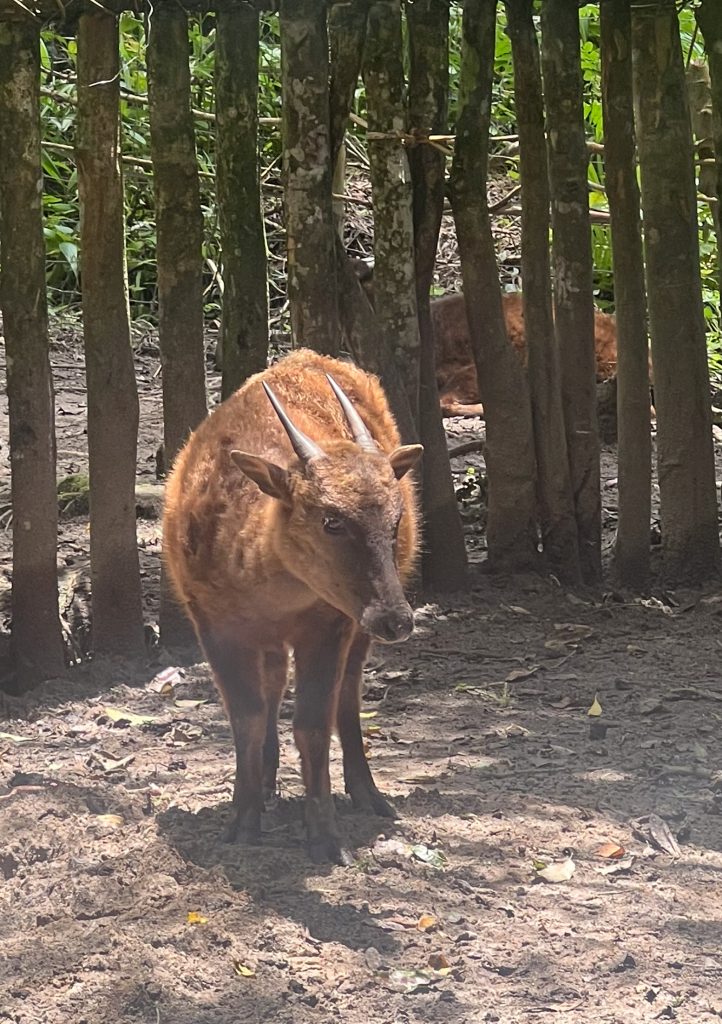
Captive Mountain Anoa (Bubalus quarlesi)
The Anaso Track
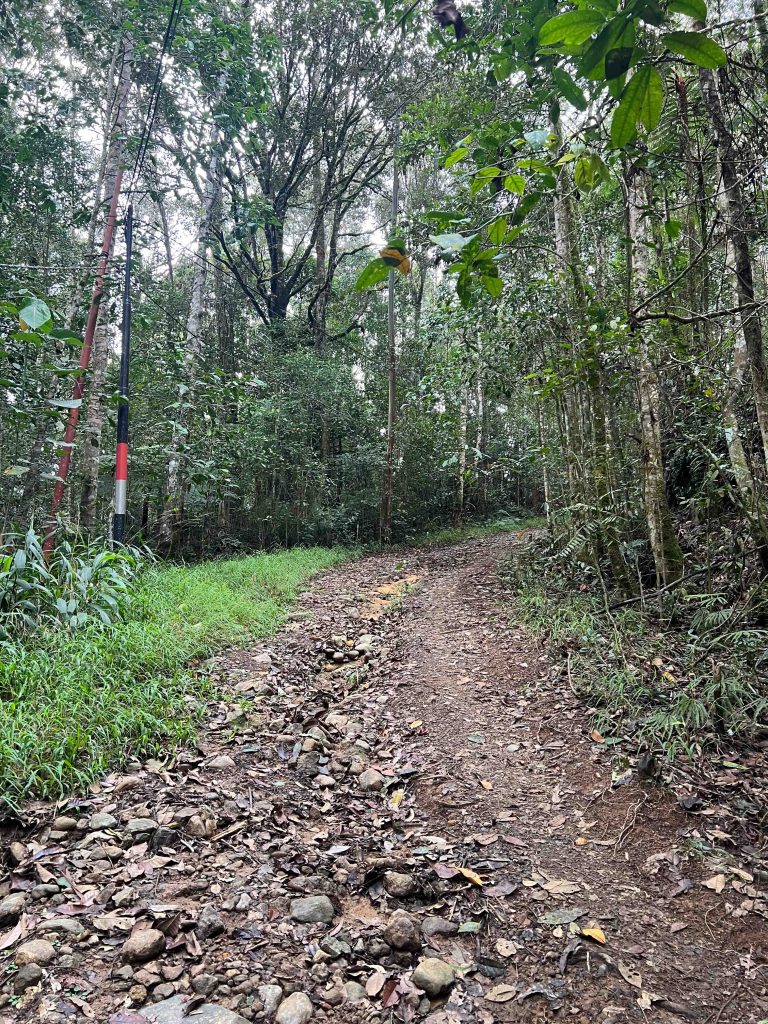
We spent one night higher up the mountain along the famous Anaso Track, primarily search for the almost unknown Pygmy Tarsier. It took about three hours to walk the gentle climb up to 2000 metres altitude and tarsier habitat.
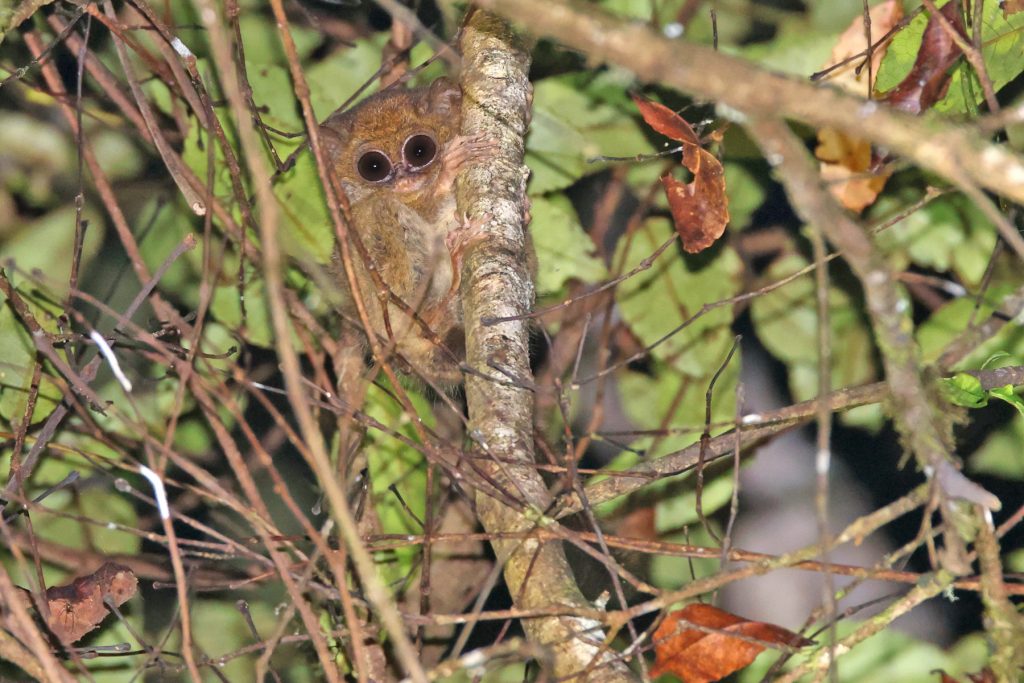
Pygmy Tarsier (Tarsius pumilus). Photo János Oláh
We found the Pygmy Tarsier (Tarsius pumilus) quickly, in almost exactly the same spot that Carlos had seen one a year earlier on a trip with Fiona Reid. But despite searching for several more hours it was the only one we saw.
We saw more margeratamys rats up here which don’t match any of the known species and appear to be new to science. I decided to temporarily name them Guzman’s Margareta Mouse (Margaretamys sp.nov.B). I explain the ‘Guzman’s’ in the species account below.
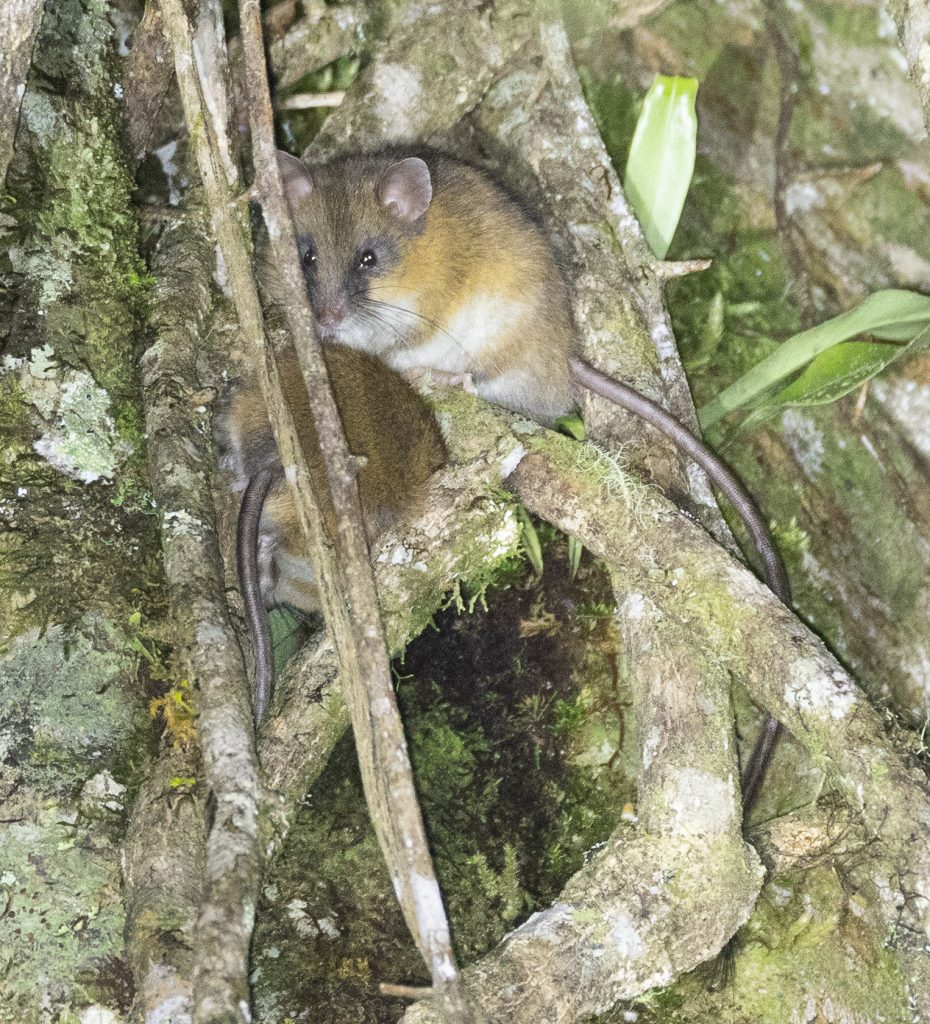
‘Guzman’s’ Margareta Mouse (Margaretamys sp.nov.B). Photo János Oláh
We found a haeromys mouse (recorded for now as H. minahassae), several of the truly spectacular Wallace’s Striped-faced Fruit Bats (Styloctenium wallacei); and a smaller fruit bat deep in the branches that was either Sulawesi Harpy Fruit Bat (Harpyionycteris celebensis), Manado Fruit Bat (Boneia bidens) or a Swift Fruit Bat species (Thoopterus species).
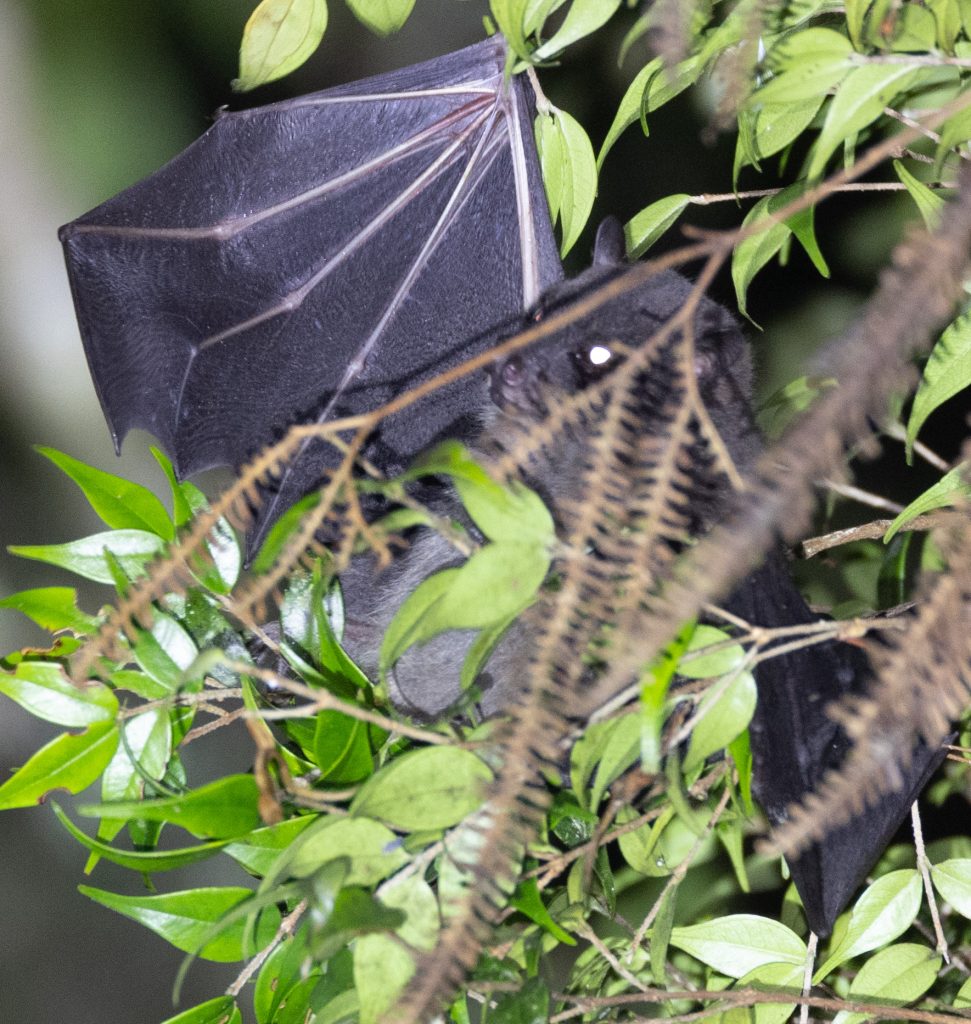
Mystery fruit bat. Photo János Oláh
Two different woolly (kerivoula) bats hanging from twigs in the same area were exciting. There was some debate that night on whether the two sightings – one on the way up the track and one on the way down – were of the same animal. It pays to check carefully: Juliana confirmed the species were different. One appears to be from the hardwickii complex, the taxonomy of which is unresolved especially in Sulawesi. The other appears to be new to science and we call it the Lore Lindu Woolly Bat for now.
We had dipped on both the Long-nosed and Giant Squirrels, but our biggest dip here was Mountain Bear Cuscus, a species which does not seem uncommon around Lore Lindu as it is fairly often seen by birders.
Poso
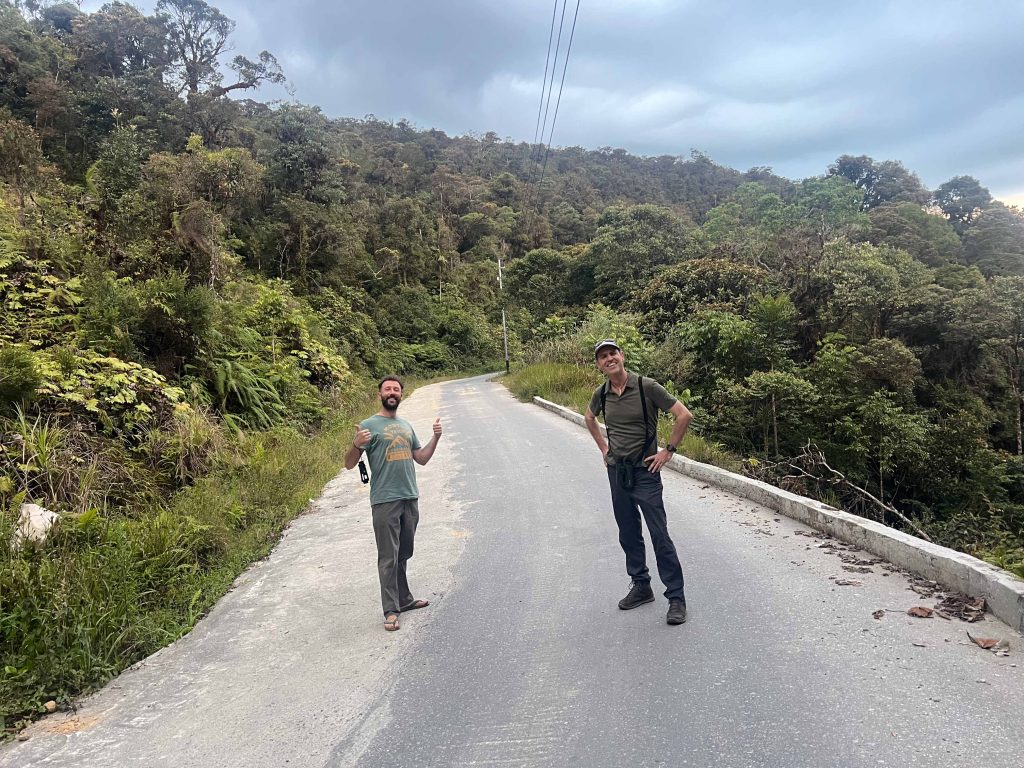
Carlos and Charles hit the road above Poso
We spent a night at a simple hotel in Poso en route to Malenge Island. Carlos had tracked down a cave in town. We had high expectations but it contained only a few Lesser Sheath-tailed Bats (Emballonura monticola).
The road into the mountains above town climbs to at least 2000m. The forest looked good up here and it could be worth spending more time exploring it. In the late afternoon we heard the calls of distant Tonkean Macaques (Macaca tonkeana) – our target species – but only saw several Small Sulawesi Cuscus (Strigocuscus celebensis) at dusk.
Malenge Island
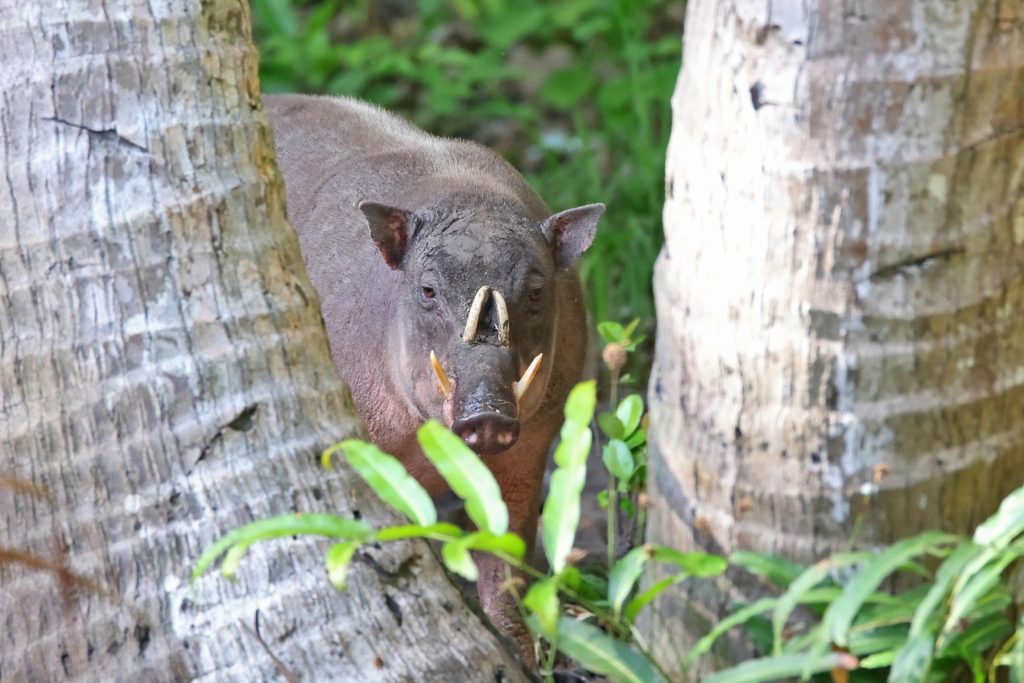
Togian Babirusa (Babyrousa togeanensis). Photo János Oláh
A private speedboat took us to Malenge Island. At least it did once the captain had found enough fuel to depart, and after we stopped again to buy more. But the island itself was worth the wait: this was the ultimate tropical island paradise.
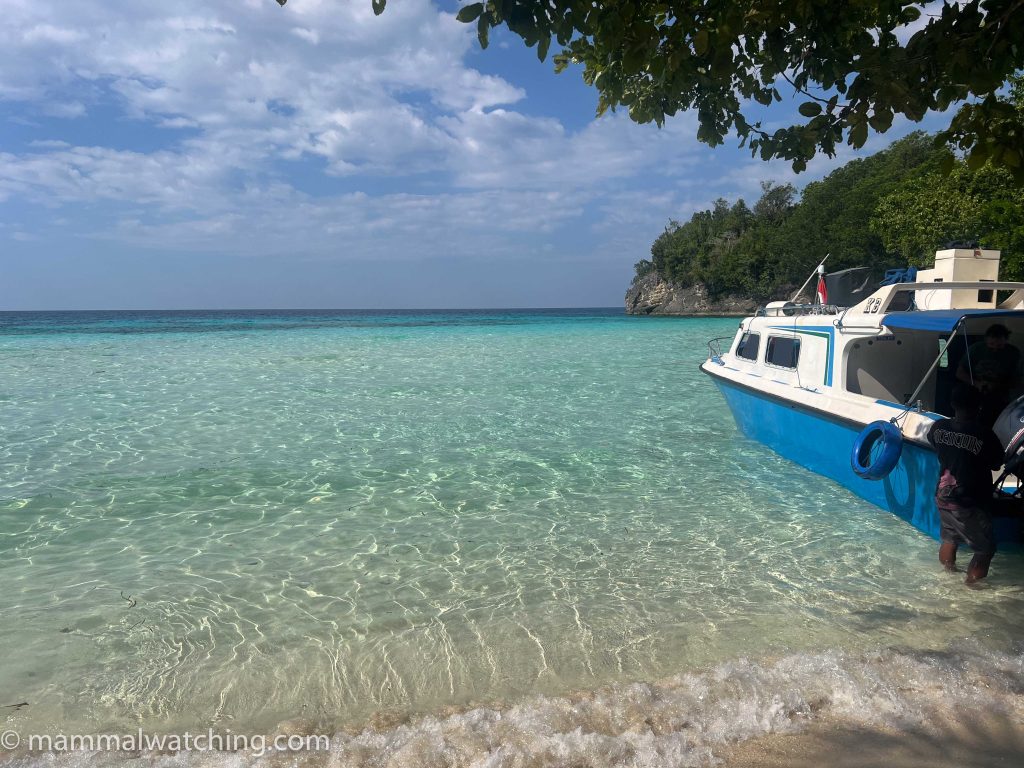
We stayed at a low key dive resort where we successfully lowered both the tone and the hygiene. The other guests comprised a few divers and a couple whose days revolved around her dancing along the beach in a bikini while he flew a drone to take photos. And they say mammalwatchers are strange.
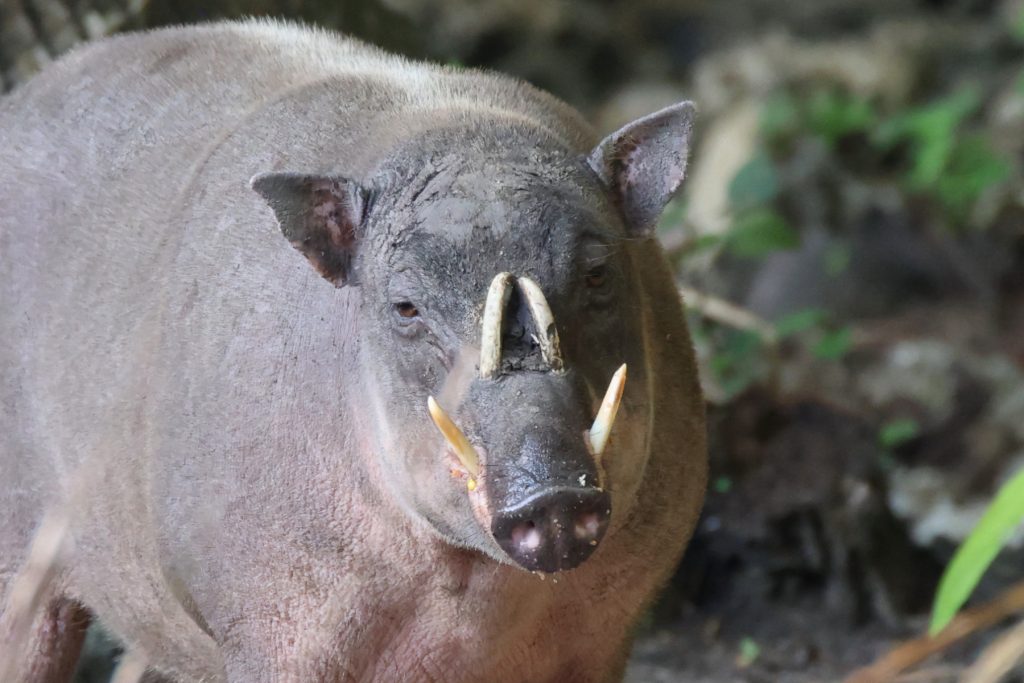
Togian Babirusa (Babyrousa togeanensis). Photo János Oláh
Our top target here was the endangered Togian Babirusa (Babyrousa togeanensis) which now – after the ravages of Asian Swine Flu – seem the easiest of the three babirusas to actually see, despite there being only a few hundred left. It took us about 30 minutes to see a mother and piglet wander through the rubbish pit behind our resort. A male appeared later that afternoon.
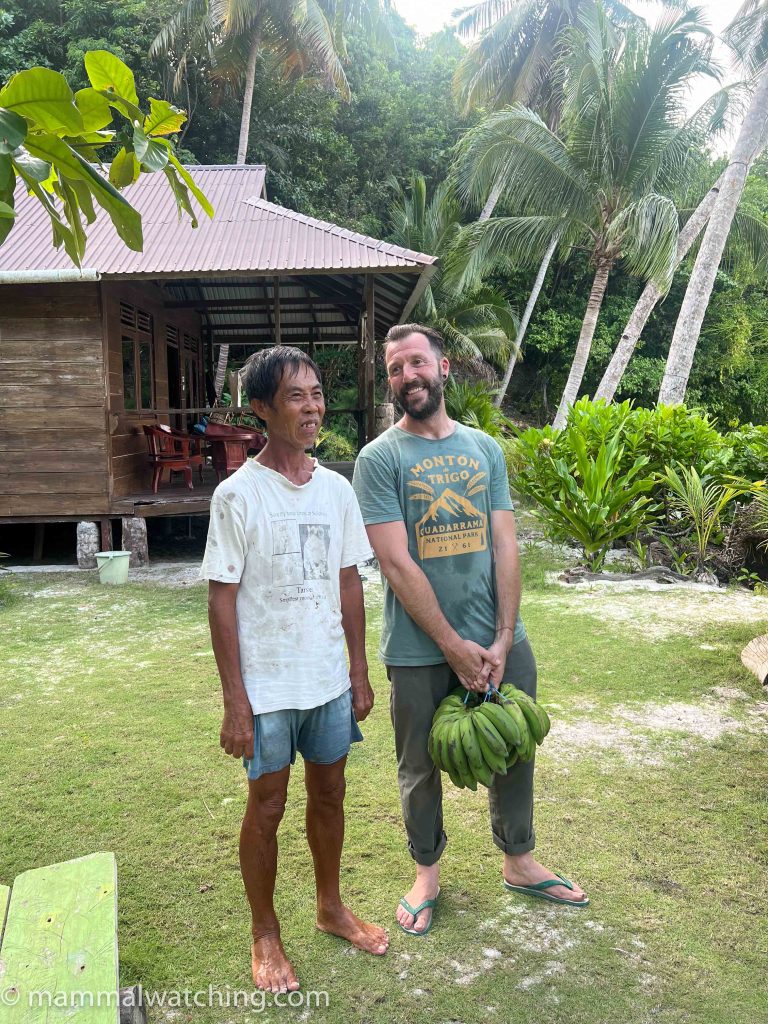
Ating and Carlos
Malenge’s babirusas are an interesting case study in mammalwatching and conservation.
Until recently they were extremely difficult to see. Though not hunted for food – at least not in the muslim areas of the island – they were persecuted for raiding crops and were feared by the locals.
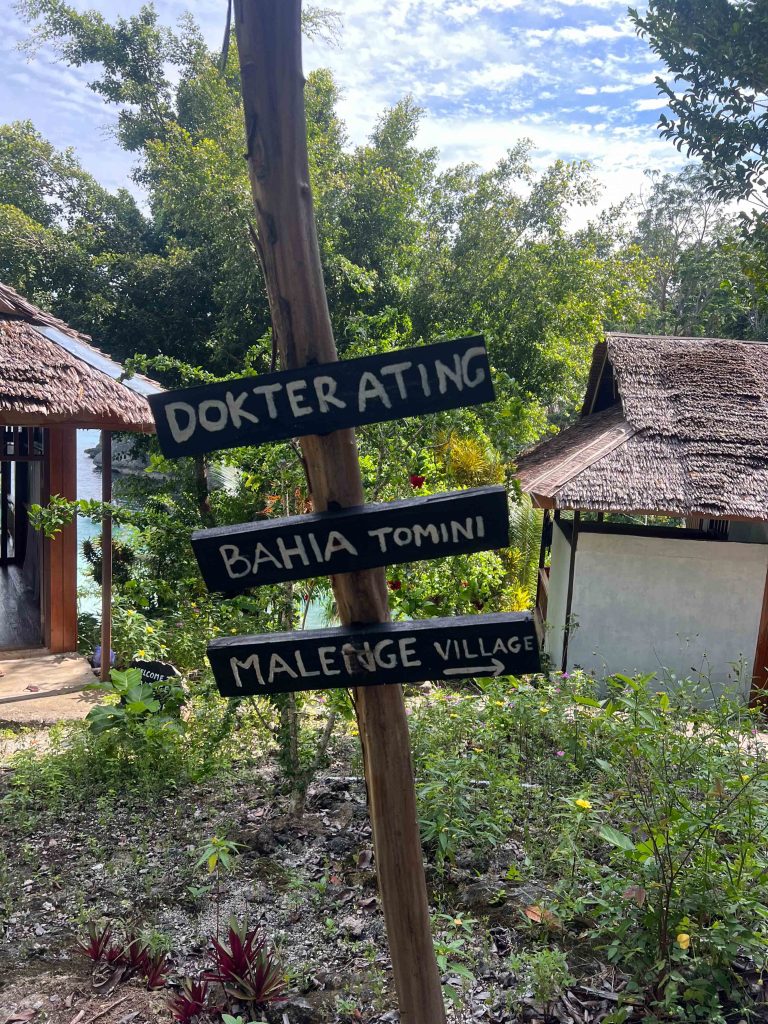
Enter Dr Ating Solihin, a nature lover who lives next to the dive resort.
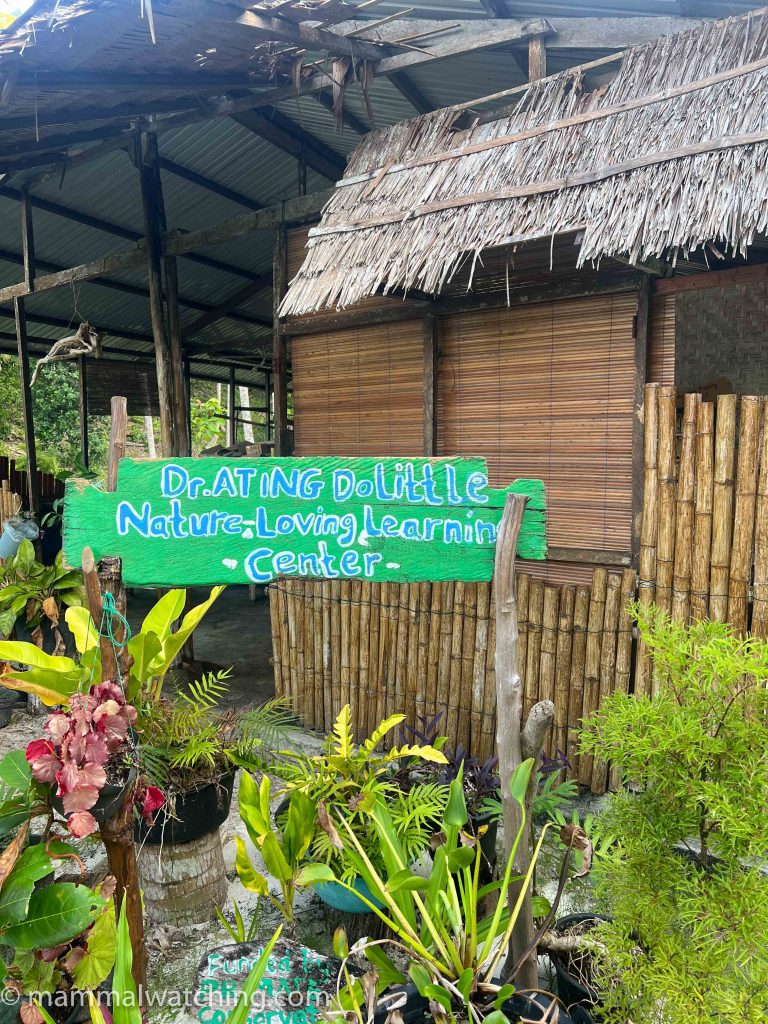
He had become curious. His camera traps showed babirusas in the forest behind his place and he decided to try to habituate the animals to feed on coconuts that he placed closer and closer to his house. One animal – ‘Coco’ – became so tame that she would allow people to scratch her belly. The story spread on social media. Coco was a celebrity.
Local attitudes changed. Coco showed the locals they had no reason to fear babirusas. Quite the opposite: when tourists began chartering boats to visit Coco – including a whole Heritage Expeditions cruise ship that stopped especially to see her – local people saw how valuable the species could be. All thanks to Ating’s perseverance and love of nature.
Coco died, but other babirusas visit Ating’s place as well now as some of the Malenge resorts. And so long as Malenge remains free of Asian Swine Flu there is more hope for the survival of this species than a few years earlier.
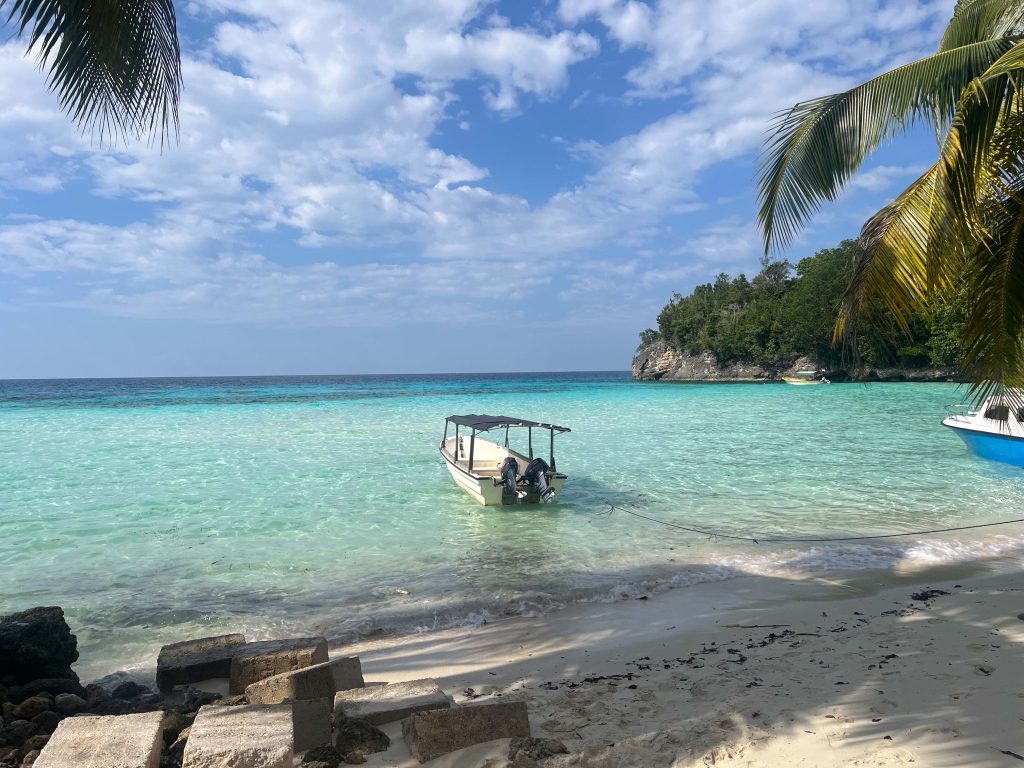
We spent two nights on Malenge. Apart from the Togean Babirusa we looked for Niemitz’s Tarsier (Tarsius niemitzi) which we found in forest just above Ating’s house.
We also looked for bats around his place. We saw Dark Sheath-tailed Bat (Mosia nigrescens); Intermediate Long-fingered Bat (Miniopterus medius); Peters’s Short-nosed Fruit Bat (Cynopterus luzoniensis); and Sulawesi Broad-eared Horseshoe Bat (Rhinolophus tatar).
We had hoped to see Tonkean Macaques on the island. They usually visit Ating’s garden each day, but we were not lucky. Perhaps just as well as there is, I understand, an ongoing discussion about whether the macaques on the island are native or introduced from the mainland. If we had seen one I would have yet one more reason to lie awake at night stressing about a sighting’s legitimacy!
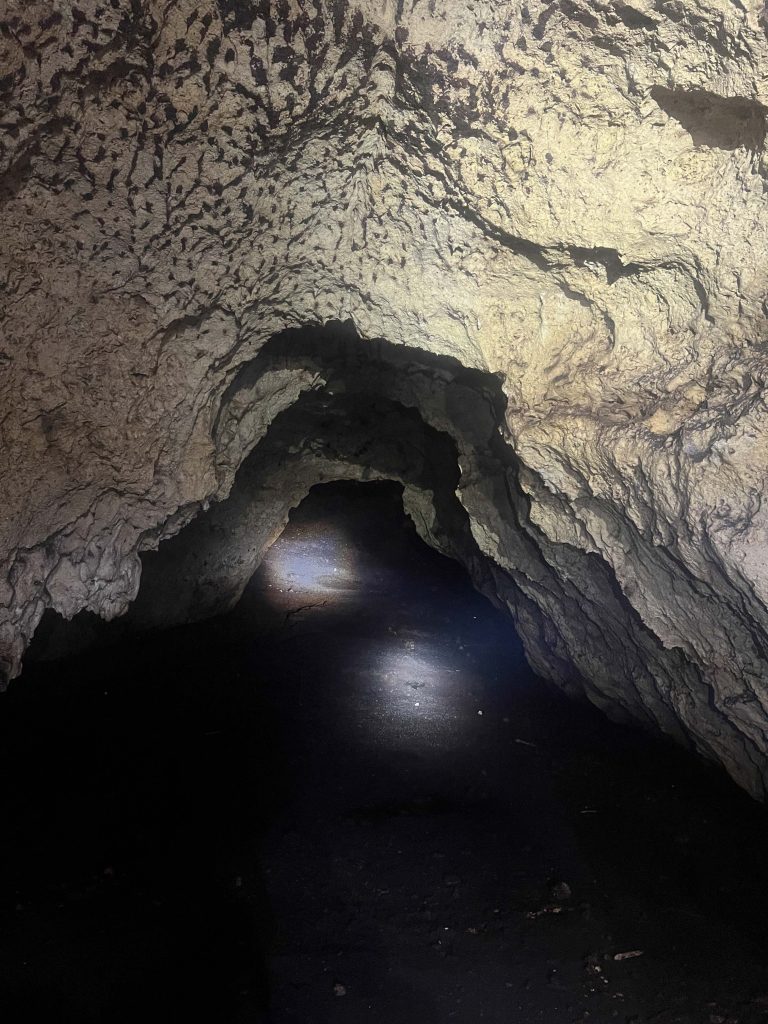
A visit to a particularly intense bat cave the next day was a test of courage: how much risk of histoplasmosis would we tolerate in the hope for a new species? Quite a lot apparently.
Despite the cascade of bat pee and excrement we stuck around long enough to see Lesser Dawn Bats (Eonycteris spelaea); Geoffroy’s Rousette (Rousettus amplexicaudatus); Sulawesi Naked-backed Fruit Bats (Dobsonia exoleta); Common Dusky Roundleaf Bats (Hipposideros ater); and the little known Crested Roundleaf Bats (H.inexpectatus).
The cave is well-known. A paved trail – now slowly disintegrating – had been built from the beach to the cave in the hope it would become a tourist attraction. Why anyone other than mammalwatchers would want to visit is a mystery.
The crossing to and from Malenge can be good for cetaceans. Conditions were not ideal and we saw only Spinner and Risso’s Dolphins.
Luwuk
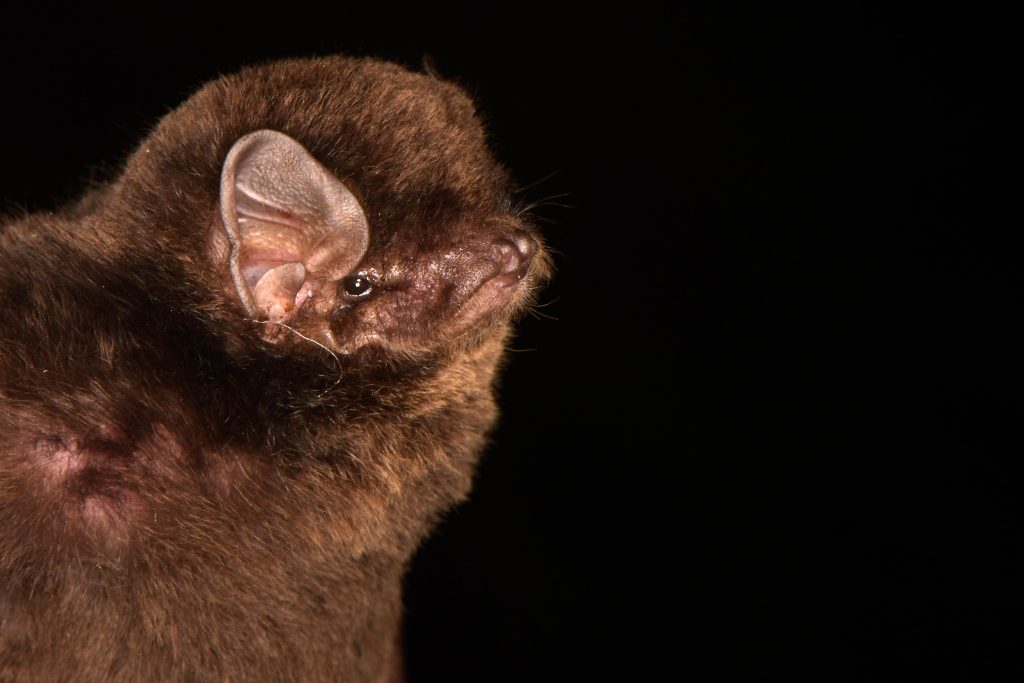
Great Long-fingered Bat (Miniopterus tristis). Photo Juliana Senawi
Our penultimate stop was a fancy hotel in the city of Luwuk at the west end of the central peninsula. Carlos’s friend Pian – who would be guiding us on Peleng Island the next day – led us to a spot 30 minutes from the city where we saw distant Tonkean Macaques (Macaca tonkeana), the species we had missed at Lore Lindu, Poso and on Malenge.
At night we saw a tarsier which is in the process of being described. There is no decision yet on a name so we refer to it below as the ‘Tompotika’ Tarsier. We also saw a rat that looked like the Lore Lindu Rat (Rattus facetus) but which might end up being something else.
Juliana was able to find us our first Great Long-fingered Bat (Miniopterus tristis) here, along with a few Minute Short-nosed Fruit Bats (Cynopterus minutus); and Geoffroy’s Rousettes (Rousettus amplexicaudatus).
Peleng
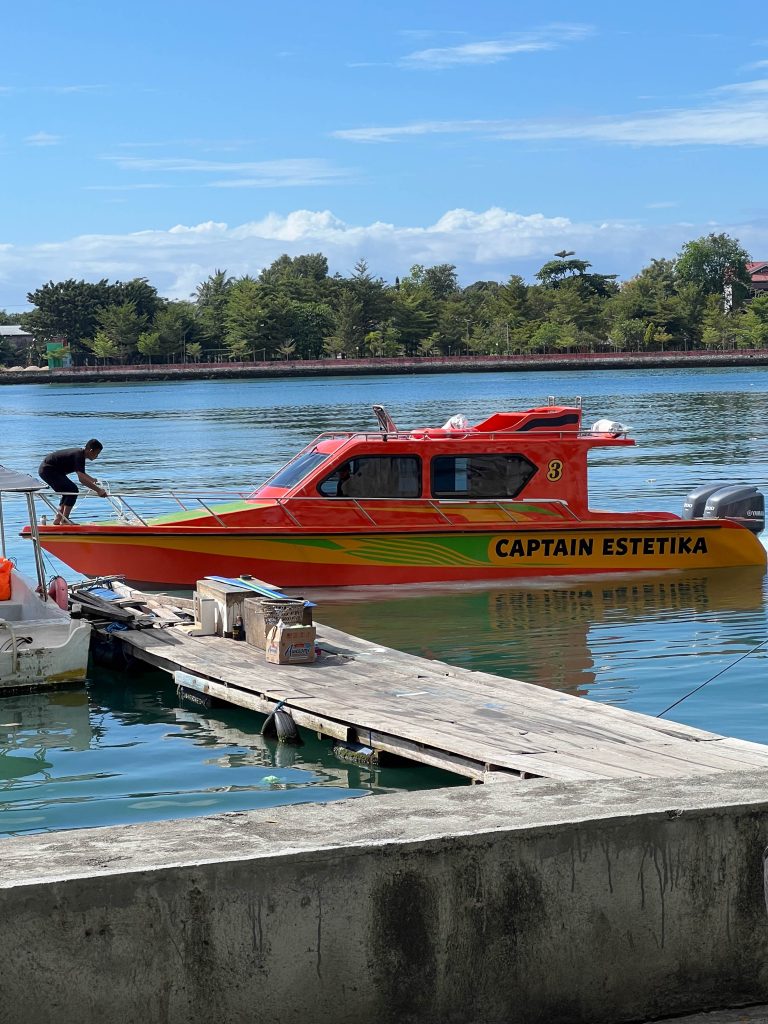
Our last stop was the island of Peleng, a short speedboat ride from Luwuk and home to an endemic tarsier, cuscus and more. Carlos had planned to spend our final three nights here, but after an exhausting and very successful second night we returned to the luxuries of Luwuk a day early.
We had thought we would have had to camp on the island for our entire stay, but a small hotel had just opened at the port. Some of our rooms had AC. Some did not. As news spread among the group of this injustice our esprit de corps was on shaky ground.
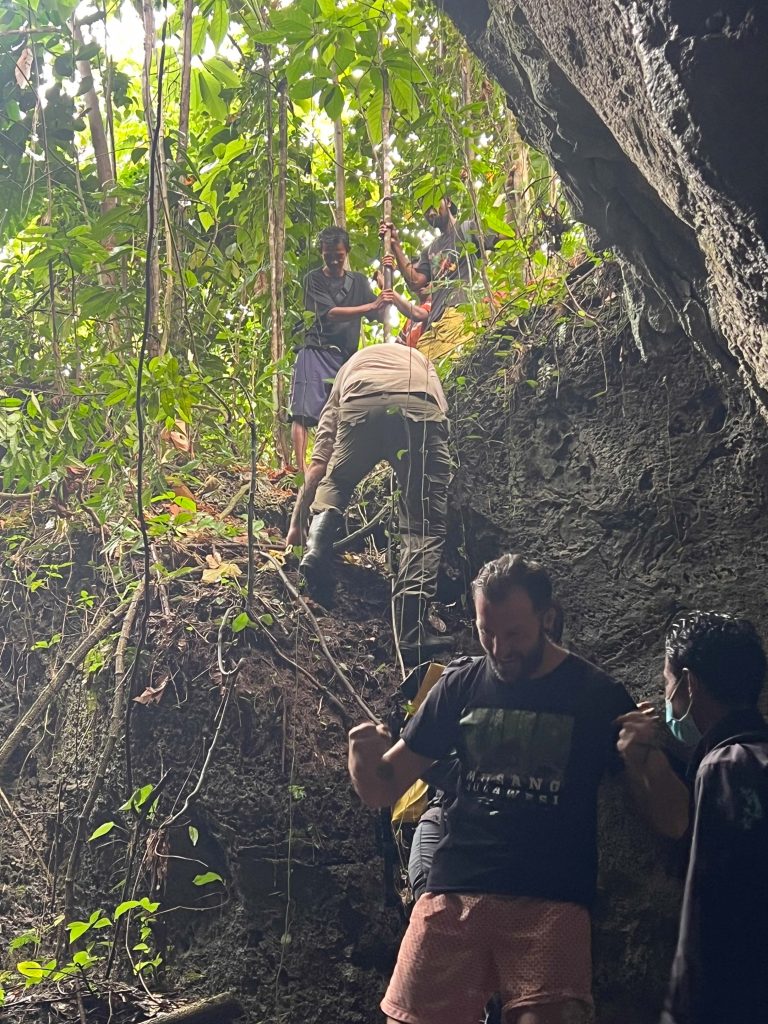
Guided by Pian, we visited two bat caves. Entry to both was a little tricky but once inside they were easy to navigate. The first held Lesser Asian False-vampires (Megaderma spasma), Geoffroy’s Rousette (Rousettus amplexicaudatus) and Lesser Sheath-tailed Bats (Emballonura monticola).
The second cave was utterly spectacular. I think it might be my favourite bat cave of all time. Carlos would agree.
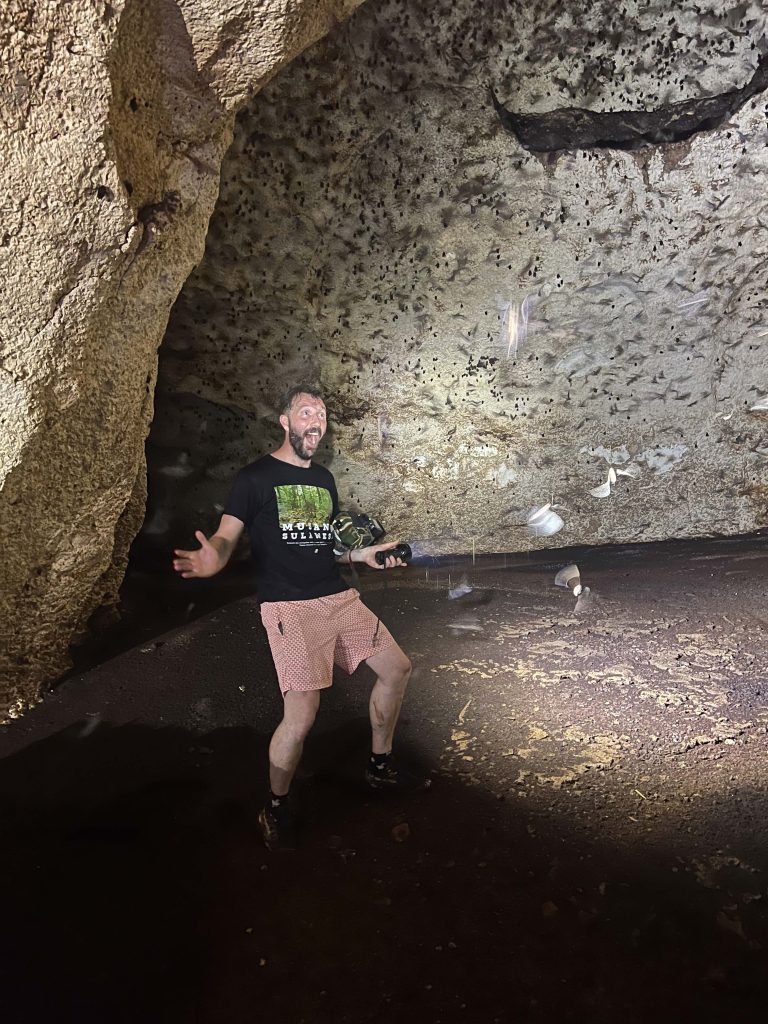
It was packed with bats of multiple species, including Large-eared Horseshoe Bats (Rhinolophus philippinensis), a species I had been searching for for 20 years. But photographing anything was extremely hard. Our lenses fogged up within a few seconds from the humidity.
But, photography aside, if I was asked to design a perfect bat cave then I would have built this one. It comprised a set of room-sized chambers, interconnected by short passageways, so it felt as if we were exploring a house. There was no need to crouch, but the ceilings were low enough to be able to see all the bats clearly. True, the air was a maelstrom of bat shit. But then who cares when every cloud of poop hid a sliver lifer-lining.
We were able identify several other species here including probable Great Long-fingered Bats (Miniopterus tristis); more Lesser Asian False-vampires (Megaderma spasma) and more Geoffroy’s Rousettes (Rousettus amplexicaudatus). Other bats included Fawn-colored Roundleaf Bats (Hipposideros cervinus); Sulawesi Horseshoe Bats (Rhinolophus celebensis); and – best of all – what appears to be Poso Horseshoe Bat (Rhinolophus belligerator). A species for which very few – perhaps no – photographs exist. A chunky Asian House Shrew (Suncus murinus) was a nice surprise, as was the large goanna waddling aound snatching bats off of the walls. What a place!
During our first evening we took the coast road to see what we could find.
A short walk through the forest produced Koopman’s Peleng Island Rat (Rattus koopmani) and Pallas’s Tube-nosed Fruit Bat (Nyctimene cephalotes). We eventually found the endemic Peleng Tarsier (Tarsius pelengensis) at Pian’s house.
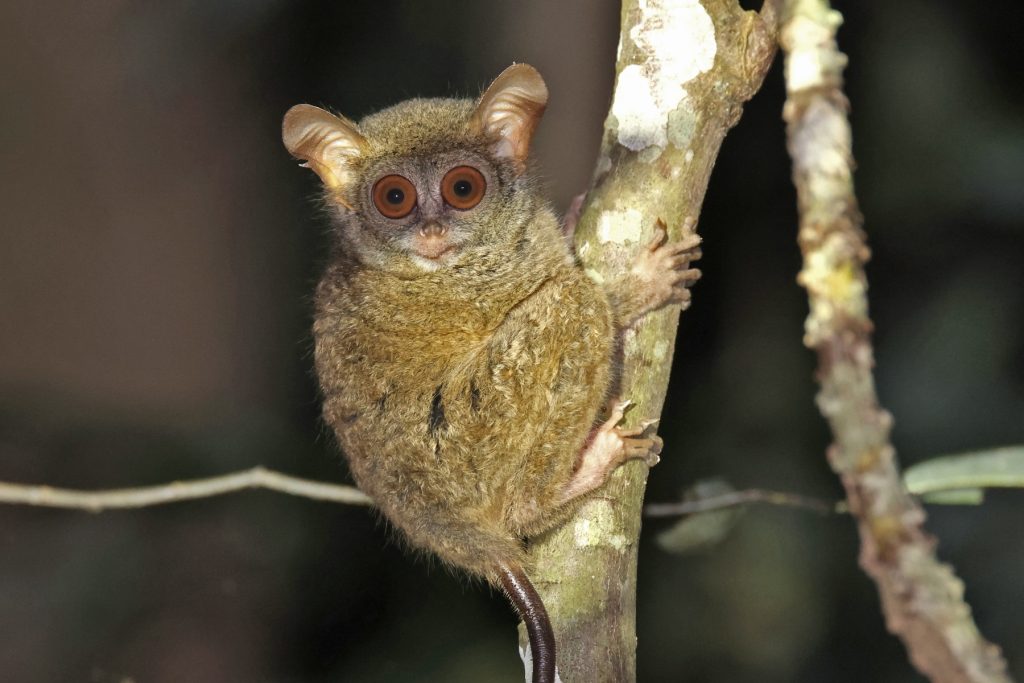
Peleng Tarsier – (Tarsius pelengensis). Photo János Oláh
With the tarsier under our belts, our other major target on the island was the endemic Peleng Cuscus, a species Carlos warned would be quite tricky to find. We had to get up into higher forest to find it. So the next day we headed up to a camp site – described on google maps as ‘Peleng Birding Lodge’.
I think ‘lodge’ was a bit of a stretch but it was better equipped than we had feared. At least it gave that impression until we tried to sleep.
Before leaving Luwuk Carlos asked whether we needed to buy anything to make camping more comfortable. A few of us requested sleeping mats. Carlos discussed this with Pian and they decided that there was no need: there were mats at Pian’s camp.
Pian had failed to mention that these mats were simply decorative. They had no other purpose, certainly not as a cushion against the wooden planks we would be sleeping on. The first thing I bought when I got home was a small thermarest just like the one a very smug János displayed to his crippled companions the next morning.
Our hike that evening was the hardest of the trip. It took two hours of walking up often steep trails from camp to reach the forest above Kokolomboi village. We started searching at dusk and continued climbing.
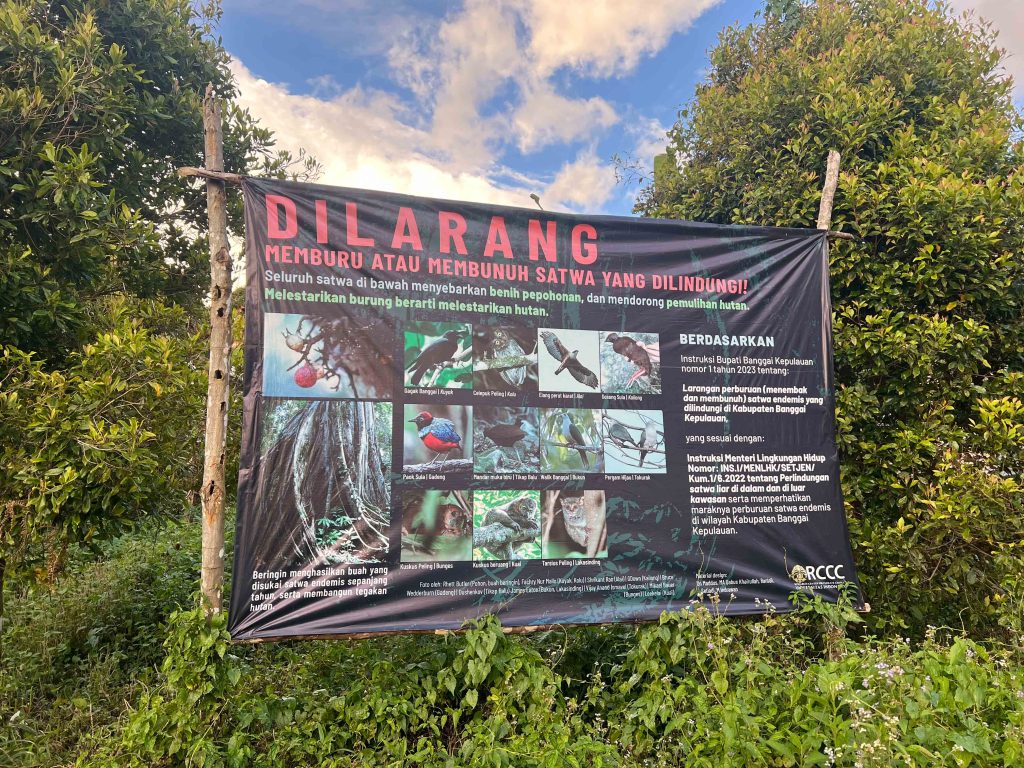
An hour later we had seen only Pallas’s Tube-nosed Fruit Bat (Nyctimene cephalotes); Wallace’s Stripe-faced Fruit Bat (Styloctenium wallacei) and Koopman’s Peleng Island Rat (Rattus koopmani). With no hint of a Peleng Cuscus, Carlos decided we should try to search lower down the slope.
As soon as we were back below Kokolomboi more mammals started appearing.
We had excellent views of another Peleng Tarsier and ten minutes later we saw a distant cuscus. It took several minutes to realise that we were not looking at a Peleng Cusucs. This was a Common (Lowland) Bear Cuscus (Ailurops ursinus) the lowland relative of the Mountain Bear Cuscus we had missed in Lore Lindu.
Pian led us along some treacherous trails following creeks deeper into the forest and we saw Dark Sheath-tailed Bat (Mosia nigrescens); our first Peleng Island Xanthurus Rat (Rattus pelurus); and a roosting Woolly Bat (most likely Kerivoula hardwickkii).
And then Carlos spotted a beautiful Peleng Cuscus (Phalanger pelengensis) just above us on the trail. Close but difficult to photograph. A great mammal to end the trip with.
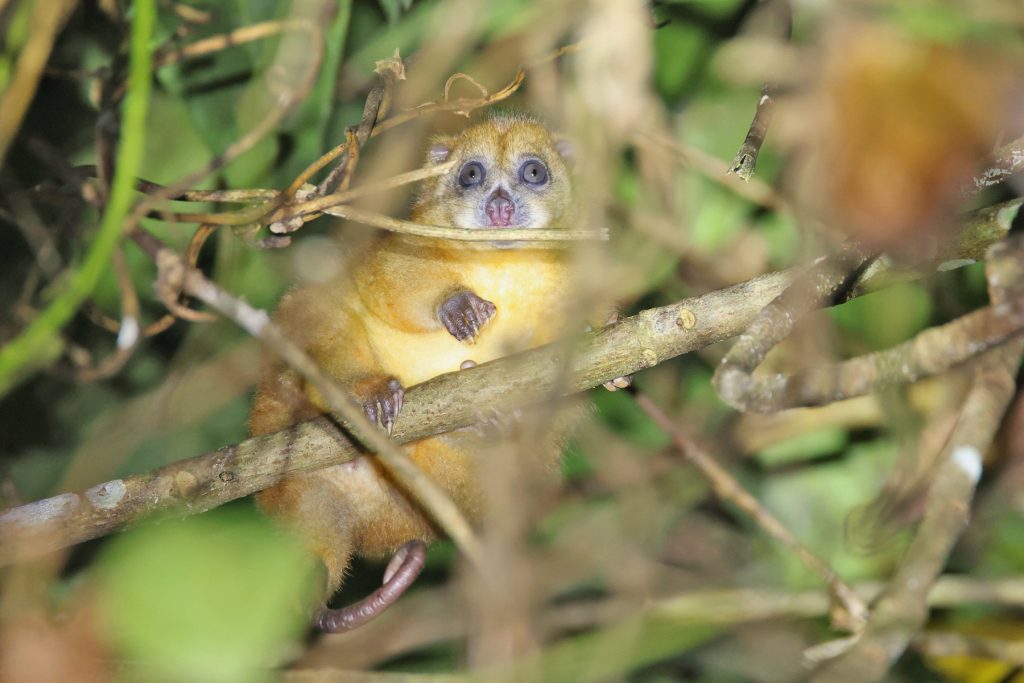
The walk back down was difficult. When Pian announced he knew a short cut I groaned inside. Most of us fell at least once. It was midnight when we got back to camp.
Juliana had been looking for bats and had found Short-nosed Fruit Bats (Cynopterus cf. minutus): their faces were different to the regular Minute Short-nosed Fruit Bats we had seen elsewhere and they may represent another new species in waiting. She had also found Sulawesi Harpy Fruit Bat (Harpyionycteris celebensis); Common Swift Fruit Bats (Thoopterus nigrescens) and Lesser Long-tongued Blossom Bat (Macroglossus minimus).
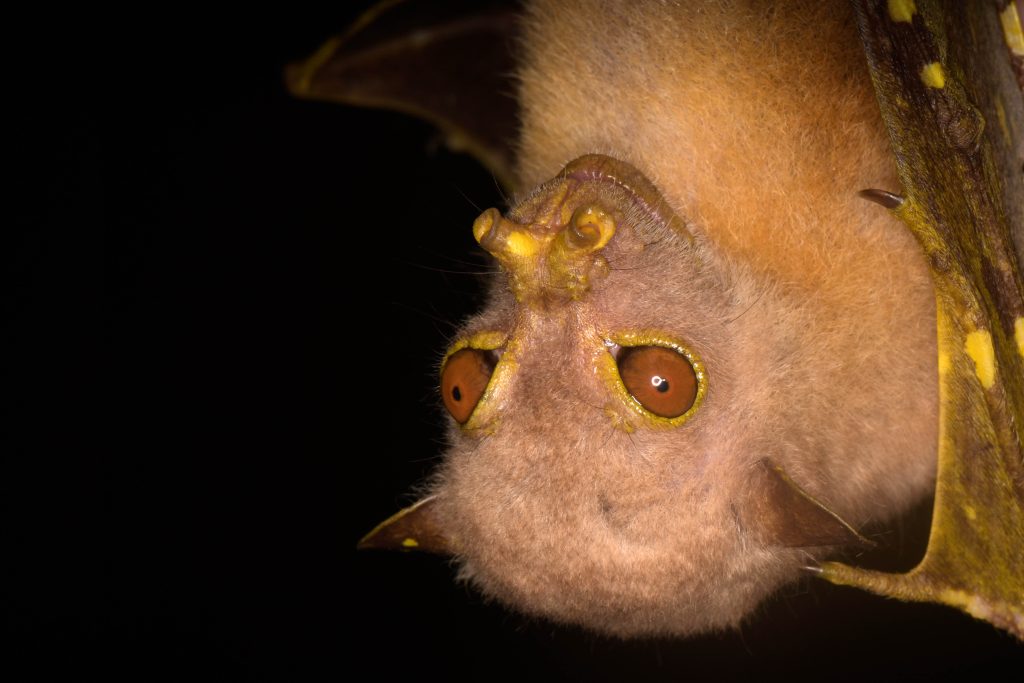
Pallas’s Tube-nosed Fruit Bat (Nyctimene cephalotes). Photo Juliana Senawi
When we left camp that afternoon our kitchen was full of bottled water, instant coffee and chocolate chip cookies. By midnight all that was left was a six pack of warm beer that had made the journey all the way from Poso. In some circumstances this would be an acceptable trade. But tonight was not one of those circumstances!
I was dehydrated, hungry and on a 1mm rubber mattress being serenaded by snoring mammalwatchers. Sleep didn’t come easily. So when discussion the next morning turned to leaving Peleng 24 hours ahead of schedule for a hotel in Luwuk I did not object.
The next day we left Luwuk on a flight to Makassar and our group travelled home in different directions.
Species by Species
This trip report has been the most difficult I’ve ever written. The sheer number of species and the difficulty in identifying many of them, combined with me not having many photos of my own has been a complicated puzzle to untangle. A lot of these species are not particularly well known and the report relied on Juliana for many bat IDs. Kevin Rowe from Museums Victoria – and Sulawesi rodent expert – was also very helpful in suggesting IDs for some of the rats and mice.
That said, there is clearly a great deal still to be discovered about the mammals of Sulawesi. And making rock solid IDs for many of these animals is extremely difficult without a DNA kit or a specimen, so in many cases these are our best guesses. I’ve explained below the various caveats we have on several of our IDs and have tried to be conservative in claiming new species or padding our list.
Those that we are pretty confident about are not caveated. Those that we are less certain about but still feel we have enough evidence to identify (or claim as new) are flagged ‘probable’. And those that need further work are flagged ‘potential’ but not included on the trip list.
Yes, I am making this more complicate than it needs to be. Basically I’d be willing to put money – not very much it is true – on all of our IDs other than those flagged as possible.
I hope some of these sightings and images will encourage other mammalwatchers to visit to try to get more photographs and – even better – scientists to investigate more thoroughly than we were able to. In the meantime we will continue to revisit and correct the report as more information becomes available. All mistakes are my own.
1. Common Bear Cuscus (Ailurops ursinus)
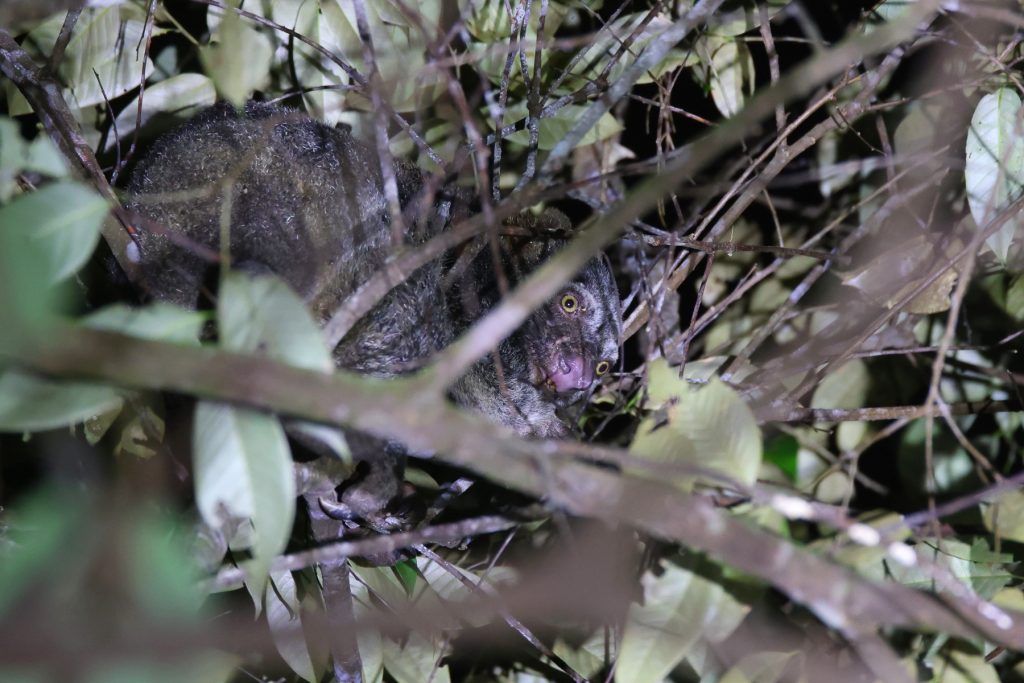
Photo János Oláh
Just one animal on Peleng Island on our last night. In forest a few hundred meters ASL.
2. Small Sulawesi Cuscus (Strigocuscus celebensis)
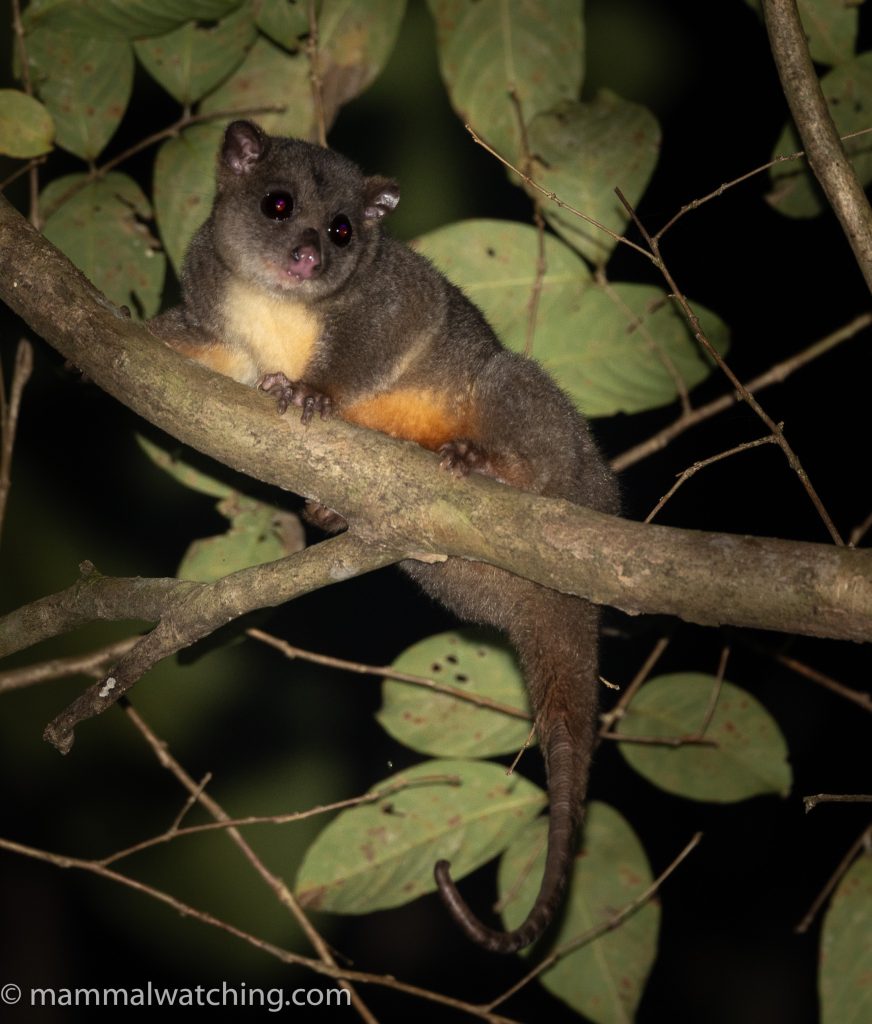
Seen well and often. We recorded the species at Makassar, Lompobattang, Lore Lindu (every day) and Poso. I had seen the species once before in Tangkoko where they are considered rare.
3. Peleng Cuscus (Phalanger pelengensis) – Lifer
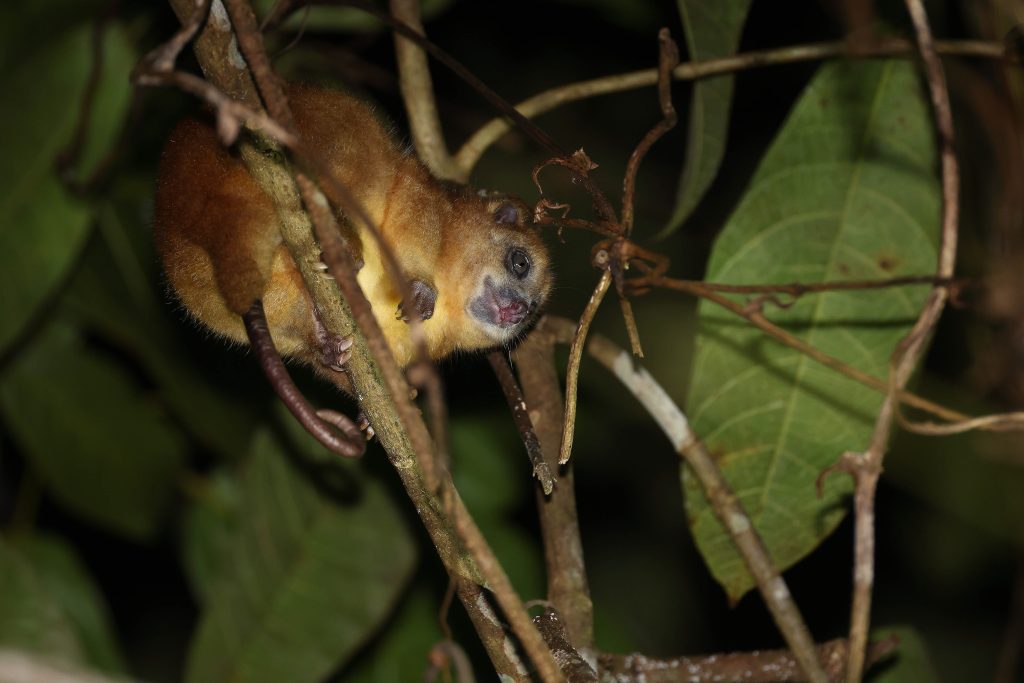
Photo Carlos Bocos
A key target on Peleng Island that Carlos finally found after considerable effort. Cuscuses – I have come to realize – are a great group of animals!
4. Moor Macaque (Macaca maura) – Lifer
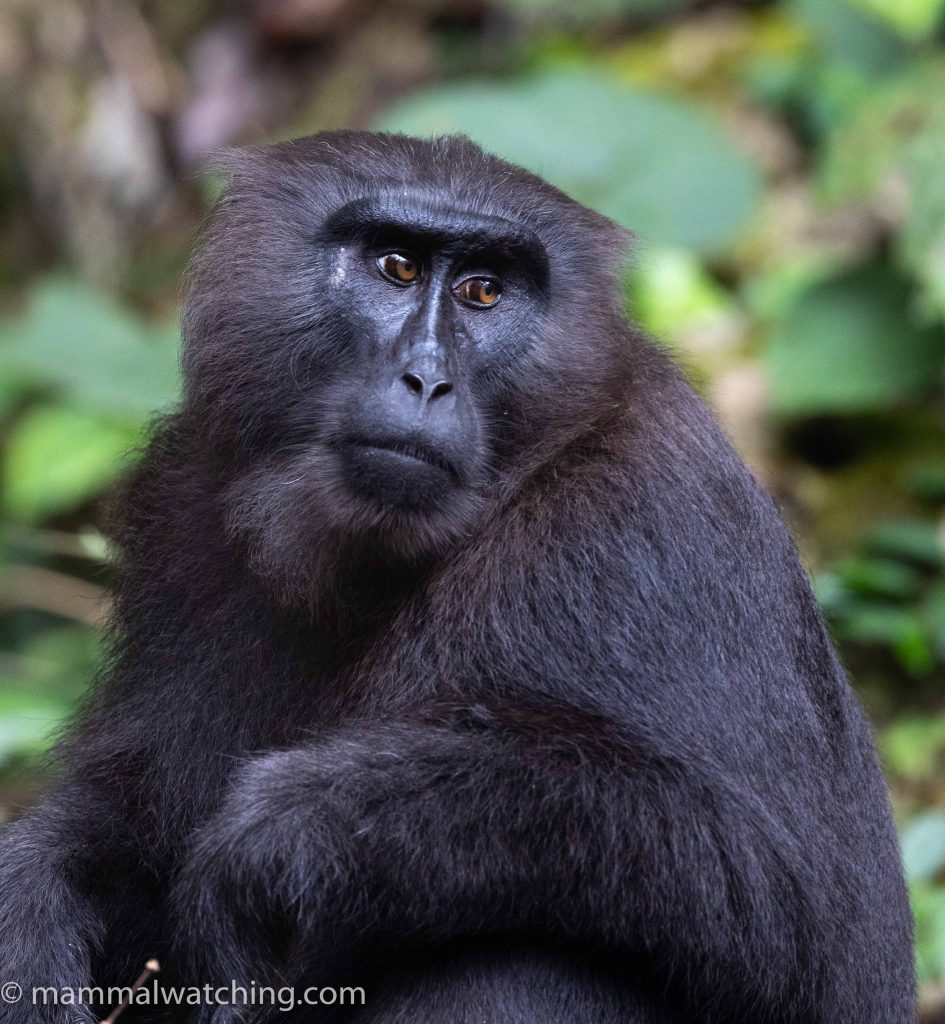
Easy to see along the main road through Bantimurung Bulusaraung National Park near Makassar where they feed on rubbish and wait for handouts. A nice looking monkey in an unattractive setting.
5. Booted Macaque (Macaca ochreata) – Lifer
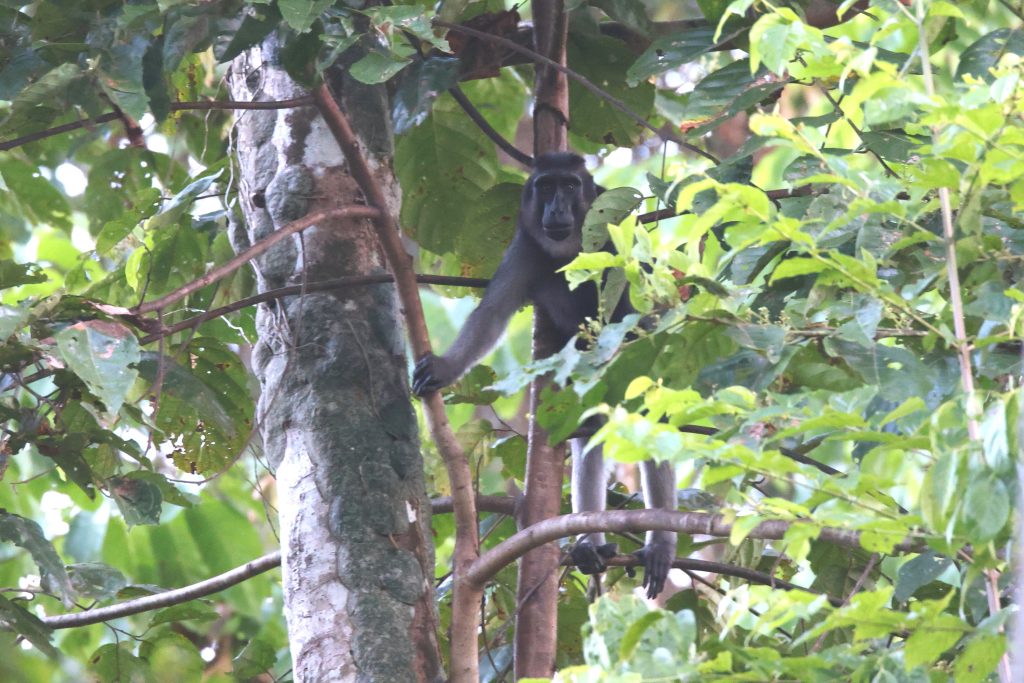
Photo János Oláh
Three troops near Kendari. Skittish and hard to photograph.
6. Tonkean Macaque (Macaca tonkeana) – Lifer
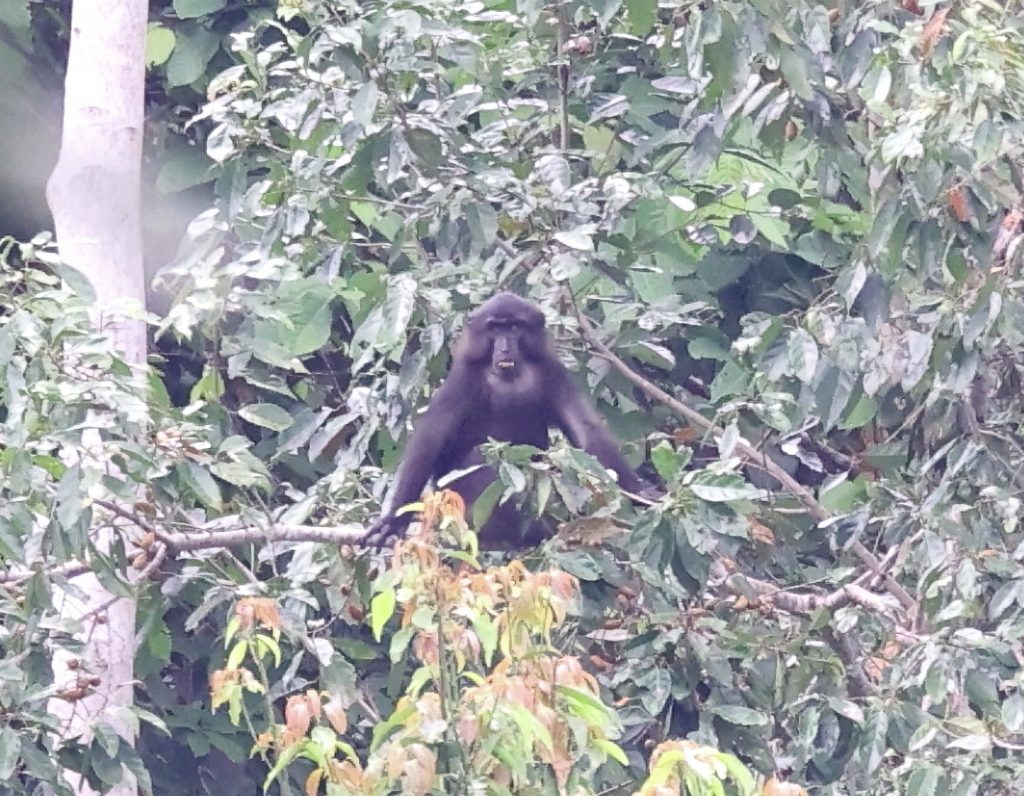
Photo Janos Olah
We struggled to find this species, eventually getting lucky with distant view of a troop outside of Luwuk. We had hoped also to see them on Lore Lindu where they are shy (Carlos heard them one day); on Togean Island where they visit Ating’s garden almost daily (though there seems to be some doubt about whether the species occurs naturally on the island or was introduced – it was once thought to be a different species altogether here); and in the forest above Poso where we heard – but couldn’t see – distant animals.
7. Dian’s Tarsier (Tarsius dentatus) – Lifer
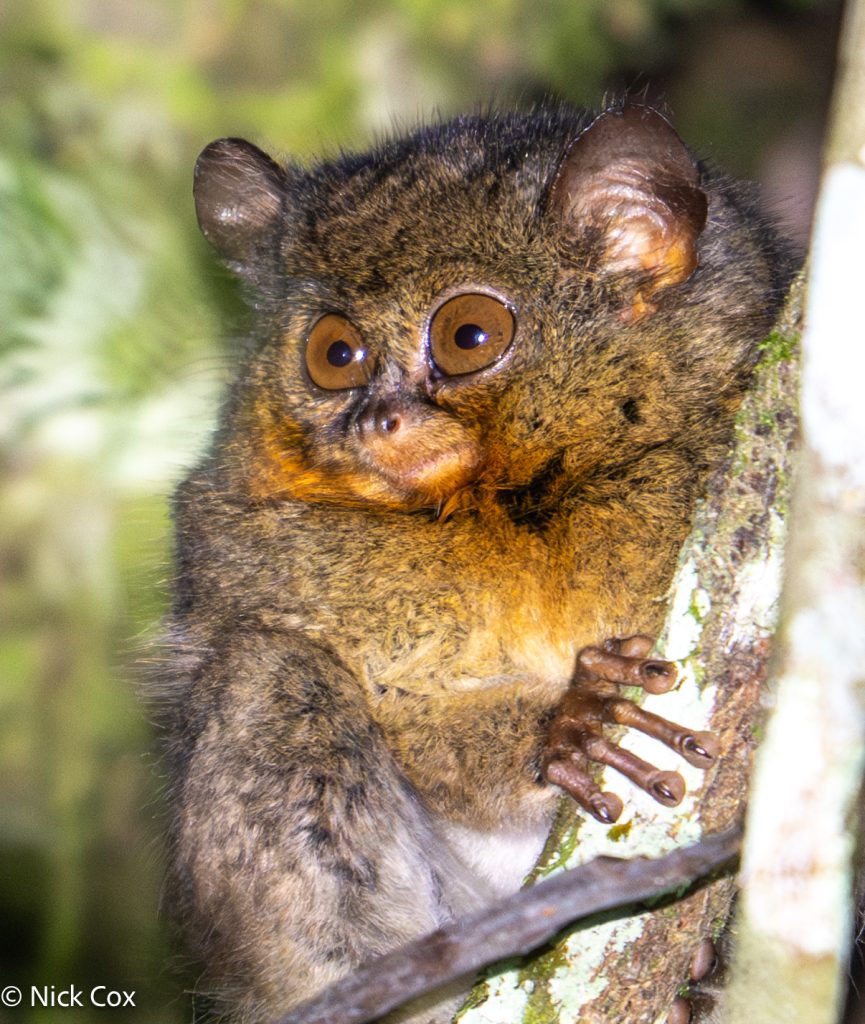
Seen well on two of our four nights at Lore Lindu close to the road.
8. Makassar Tarsier (Tarsius fuscus) – Lifer
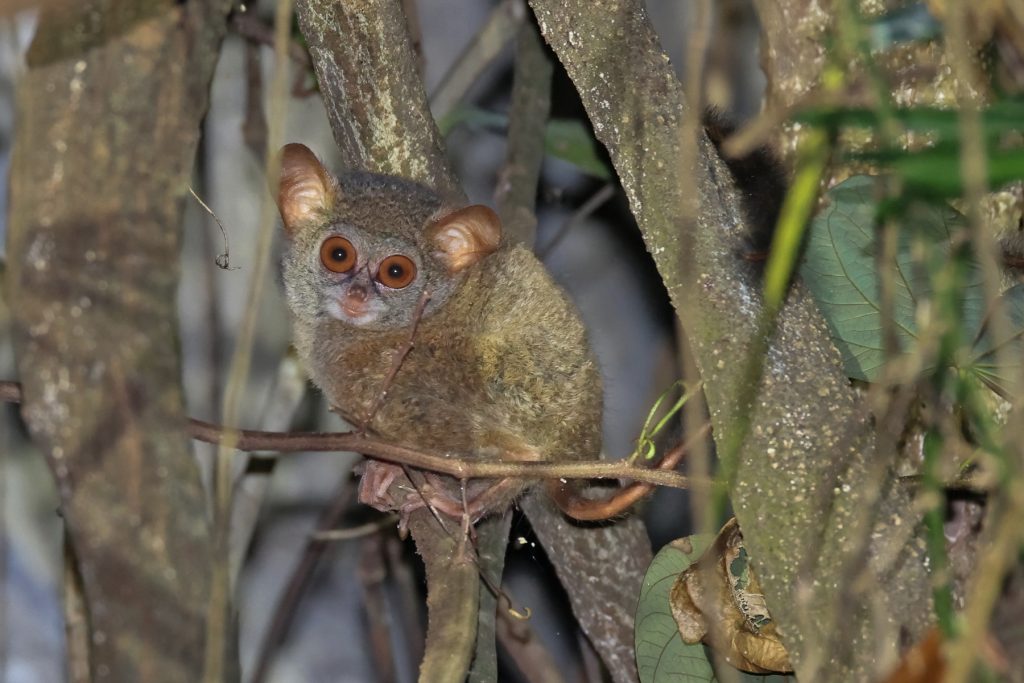
Photo János Oláh
Bantimurung Bulusaraung National Park near Makassar. Easy to see emerging at dusk at a known roost site next to the main road.
9. Niemitz’s Tarsier (Tarsius niemitzi) – Lifer
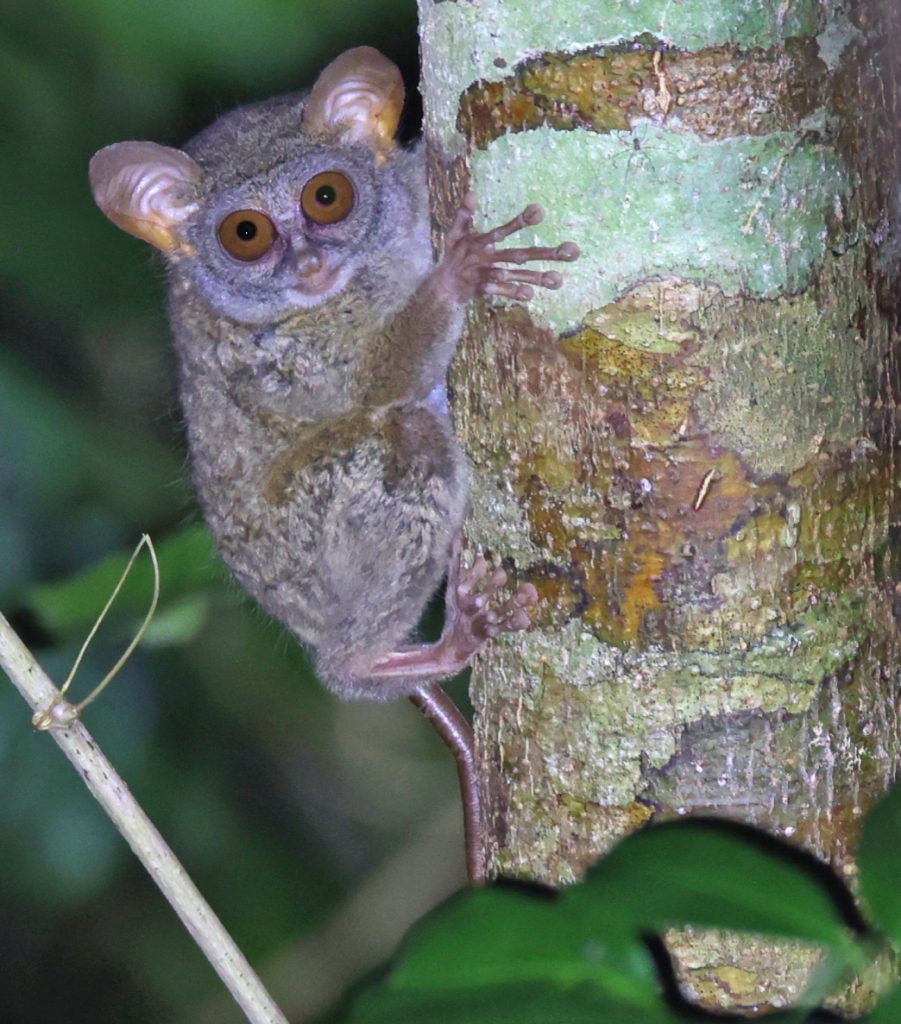
Photo János Oláh
Carlos tracked an animal down just above Ating’s house after hearing it call at dusk. János Oláh found one the following evening in the same area.
10 . Peleng Tarsier (Tarsius pelengensis) – Lifer
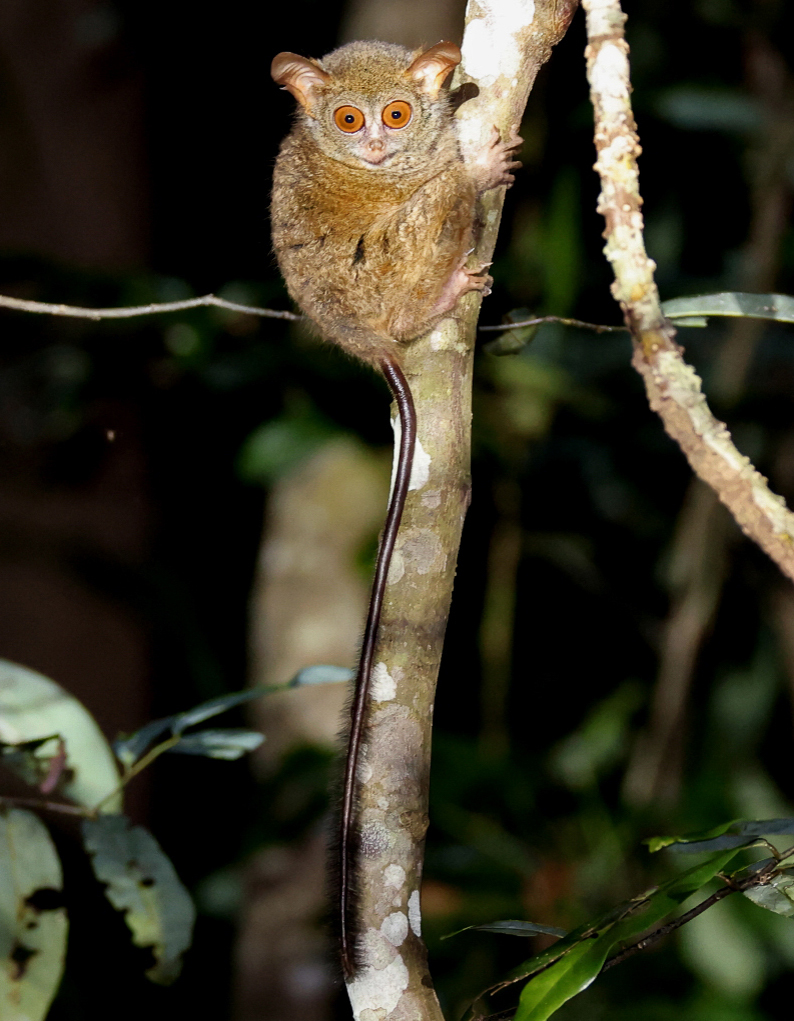
Photo János Oláh
We searched the lowland forest on Peleng Island without success for this species, before having great views of an animal outside our local guide Pian’s house at about 11pm. We also saw one very well in the highlands the following night.
11. Pygmy Tarsier (Tarsius pumilus) – Lifer
Photo János Oláh
The Pygmy Tarsier was a key target. One of the world’s most endangered and mysterious primates, “until the new millennium, this species was known by only two specimens, one collected on New Year’s Eve 1917 by American Henry Raven, and the second collected on 17 June 1930 by German Dr. G. Heinrich (Musser and Dagosto 1987). After a gap of nearly seventy years, a third specimen was found in May 2000.” Even then “Of more than 240 taxa of primates in The Pictorial Guide to the Living Primates (Rowe 1996) Tarsius pumilus is is unique in that, not only has this animal never been photographed, there is no evidence that it has even been seen alive by a scientist who recognized it for what it was.” (from Shekelle, Myron. (2008). The History and Mystery of the Mountain Tarsier, Tarsius pumilus. Primate Conservation 23: 121-124.)
In August 2008 Dr Sharon Gursky led a team of researchers into the mountains of Lore Lindu and caught three.
As far as we know no one saw one again until Carlos led a trip up here in 2024 and photographed an animal.
We found a single animal an hour after dark, in almost exactly the same spot Carlos had found it a year earlier (right by the Pygmy Tarsier information sign!). But despite looking for several more hours we did not see any more.
12. Undescribed ‘Tompotika’ Tarsier (Tarsius sp.nov.A) – Lifer
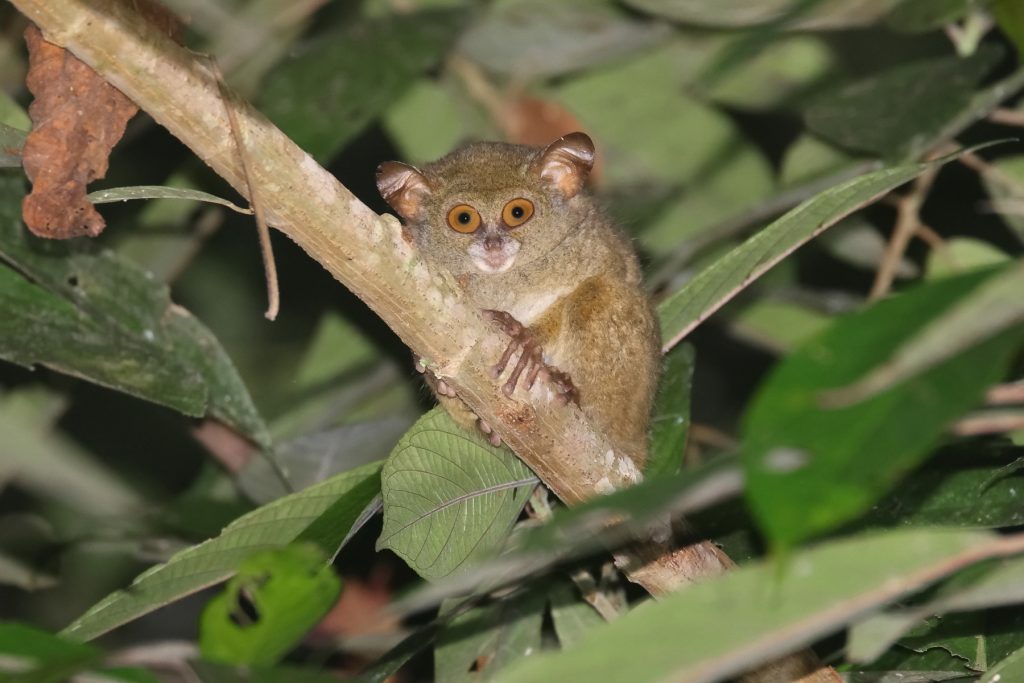
Photo János Oláh
We saw at least two animals in a couple of hours at night near Luwuk. This tarsier is still undescribed but well known to scientists who are in the process of describing it.
13. (Probably a new species) undescribed ‘Lompobattang Tarsier (Tarsius sp.nov.B) – Lifer
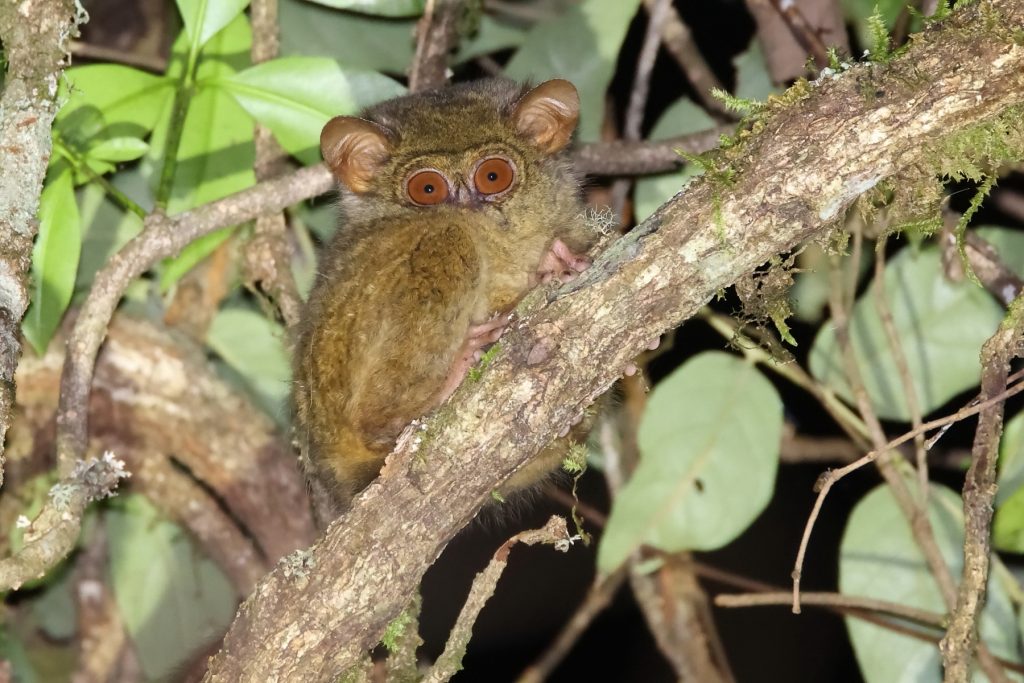
Photo Carlos Bocos
We found a tarsier 2000 meters ASL on Lompobattang that appears to be unknown to scientists.
The tarsier researchers I contacted were not sure about the identity of the species we saw and could not rule out Tarsius fuscus known from nearby lowland forest.
But Carlos is familiar with that species and has recorded the calls of the animals on Lompobattang. He is confident they are not T. fuscus. Given’s Carlos’s knowledge of Sulawesi’s tarsiers and his mastery of bird and mammal vocalizations he is convinced that this is an undescribed species and so we have included it on our list, with working name ‘Lompobattang’ Tasier (Tarsius sp.nov.B). Hopefully scientists will look into these animals soon and prove us right.
14. Alston’s Squirrel (Prosciurillus alstoni) – Lifer
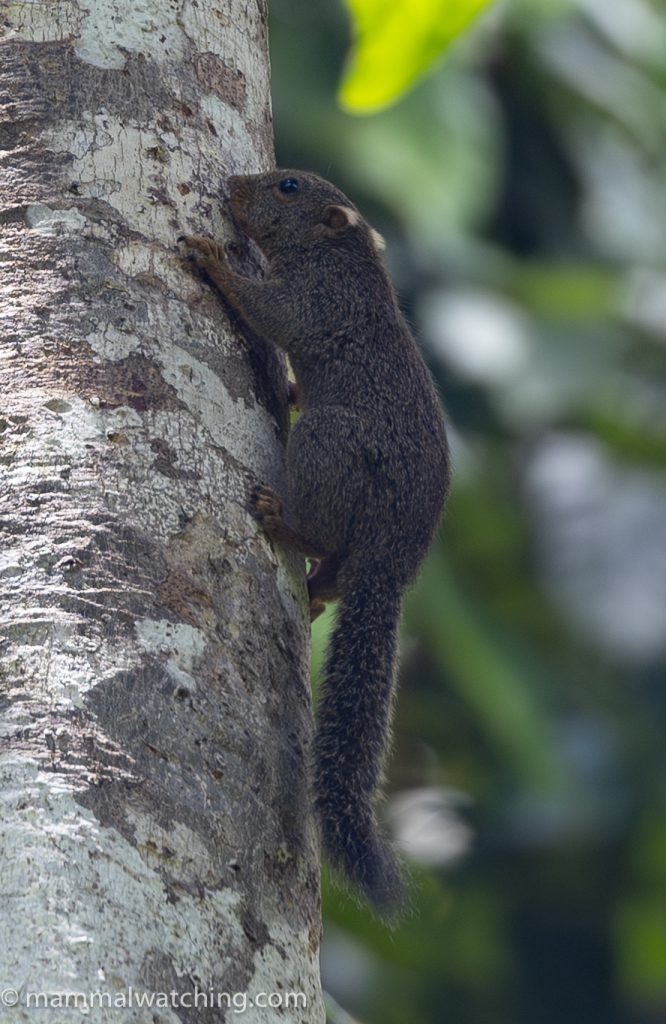
One near Kendari after Carlos heard it calling.
15. Celebes Dwarf Squirrel (Prosciurillus murinus)
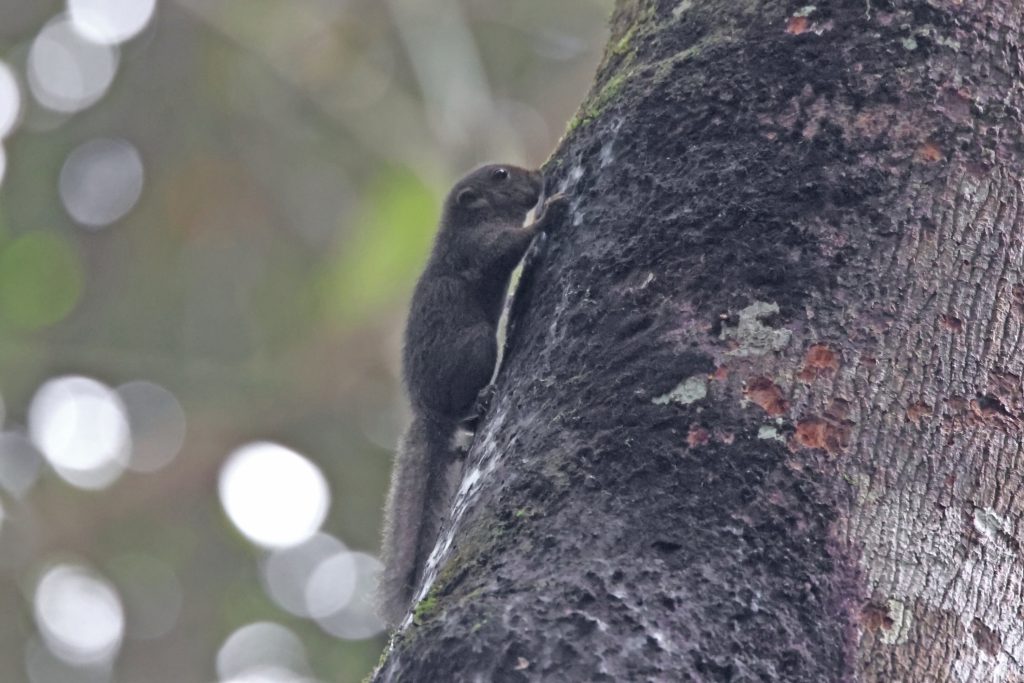
Photo János Oláh
Seen a couple of times around Lore Lindu. This species also occurs at Tangkoko.
16. Mount Topapu Squirrel (Prosciurillus topapuensis) – Lifer.
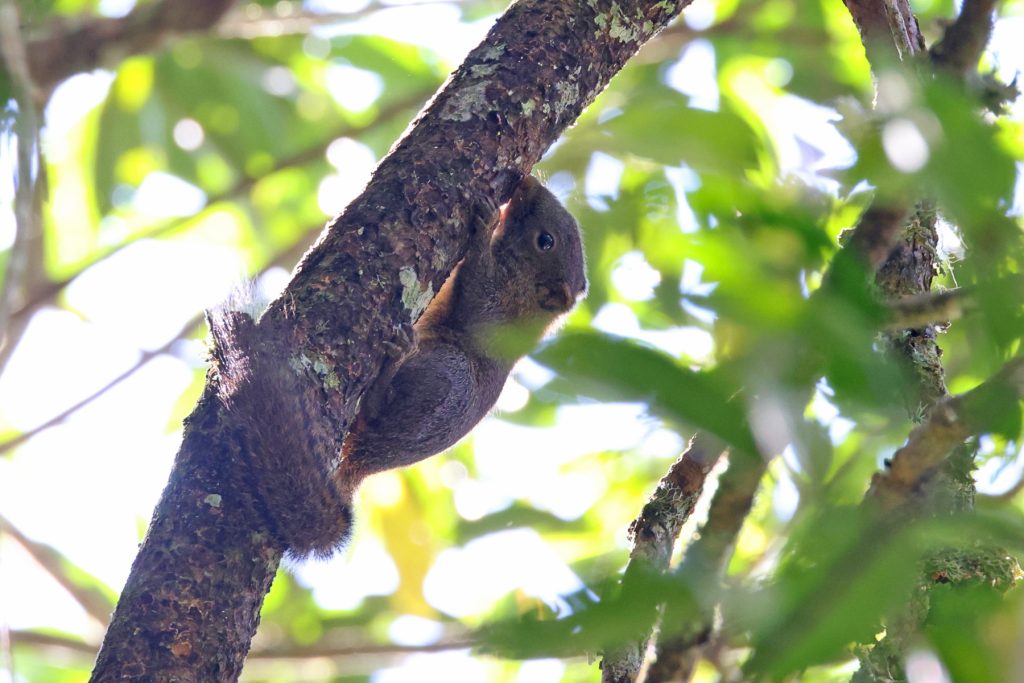
Photo János Oláh
Easier to hear than see along the Anaso Track at Lore Lindu. We eventually saw two.
17. Weber’s Dwarf Squirrel (Prosciurillus weberi) – Lifer
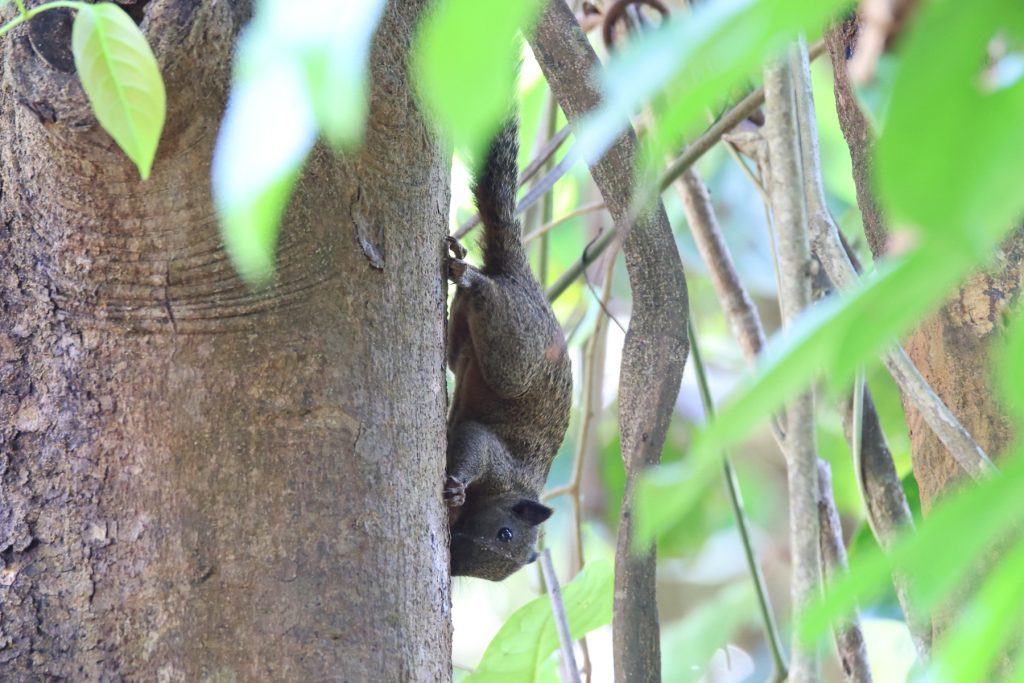
Photo János Oláh
Ian spotted one as we were walking the noisy road through Bantimurung Bulusaraung National Park near Makassar. The constant roar of trucks meant their calls were hard to notice.
18. Lowland Sulawesi Ranee Mouse (Haeromys minahassae) – Lifer
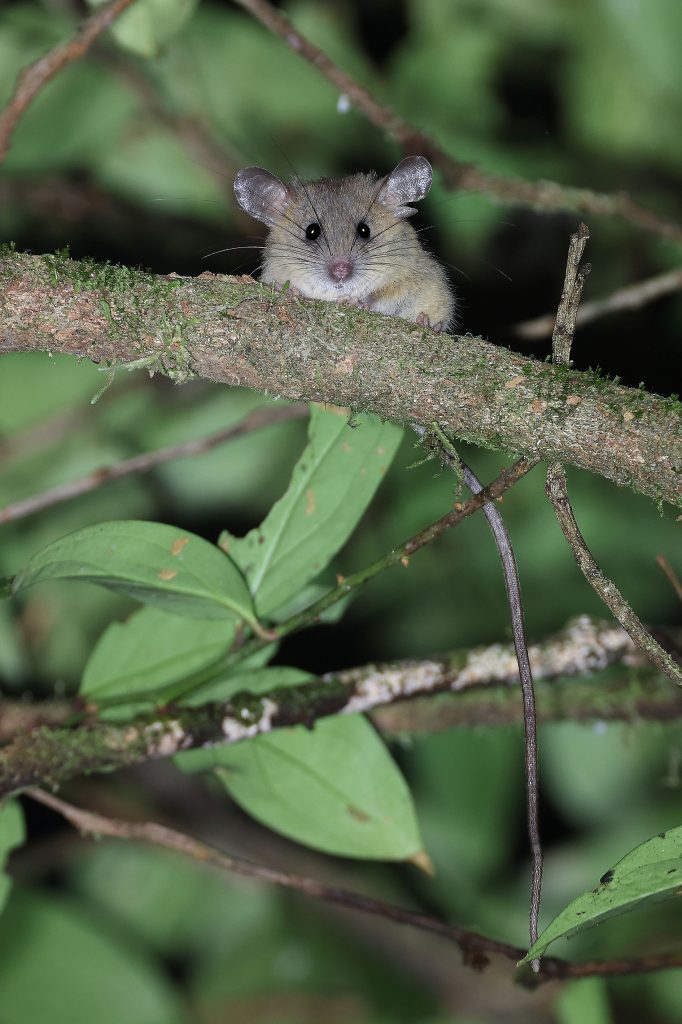
Photo Carlos Bocos
We saw small haeromys mice twice at Lore Lindu.
Carlos had heard that the late Guy Musser was working on a manuscript describing a new highland species of haeromys before he died. However, Kevin Rowe explained that preliminary analysis of genetic data suggests that these highland haeromys might simply be H. minahassae, the species known from elsewhere in Sulawesi. He qualified his answer to note that this is a poorly studied species and warrants further work. We have recorded the animals here as minahassae for the time being.
(Possibly a new species) ‘Southwest’ (Lowland) Sulawesi Ranee Mouse (Haeromys cf. minahassae)
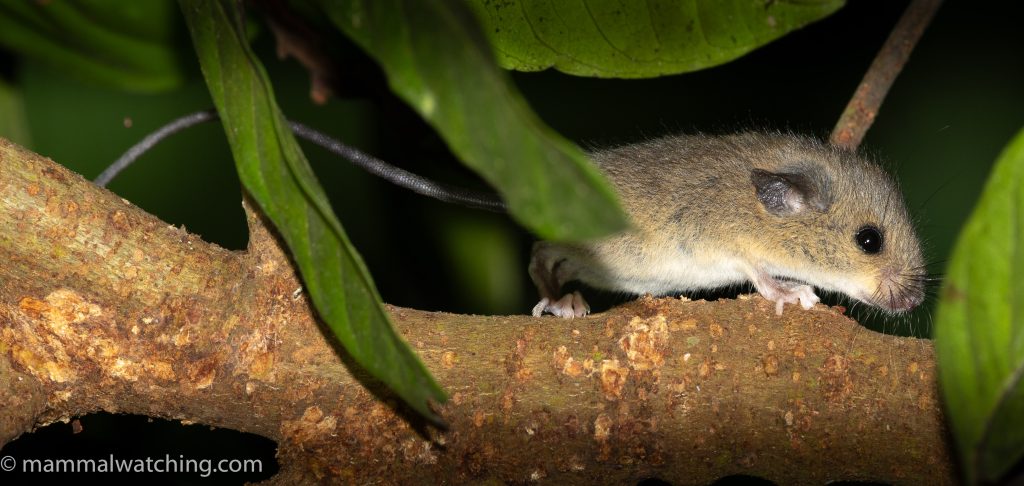
We had a prolonged photo session with an haeromys mouse near Kendari on our second night. So far as we know this is the first record of the genus on the southwest peninsula. It also looks somewhat different to the only haeromys known from Sulawesi, H. minahassae. We flag the animal here as potentially new to science, though we don’t have enough evidence yet to count it as such. But it seems to warrant further investigation by scientists.
19. Common Hill Rat (Bunomys chrysocomus) – Lifer
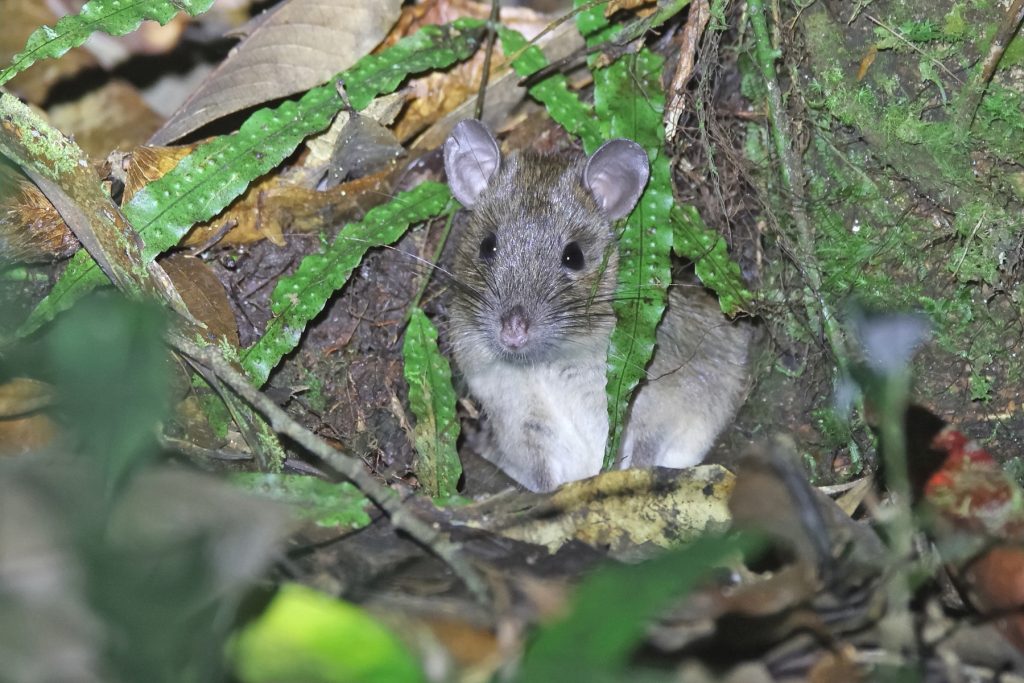
Photo János Oláh
We saw two or three of these terrestrial rodents along the edge of the road through Lore Lindu but only János had one pose long enough for photos.
20. Sulawesi Soft-furred Rat (Eropeplus canus) – Lifer
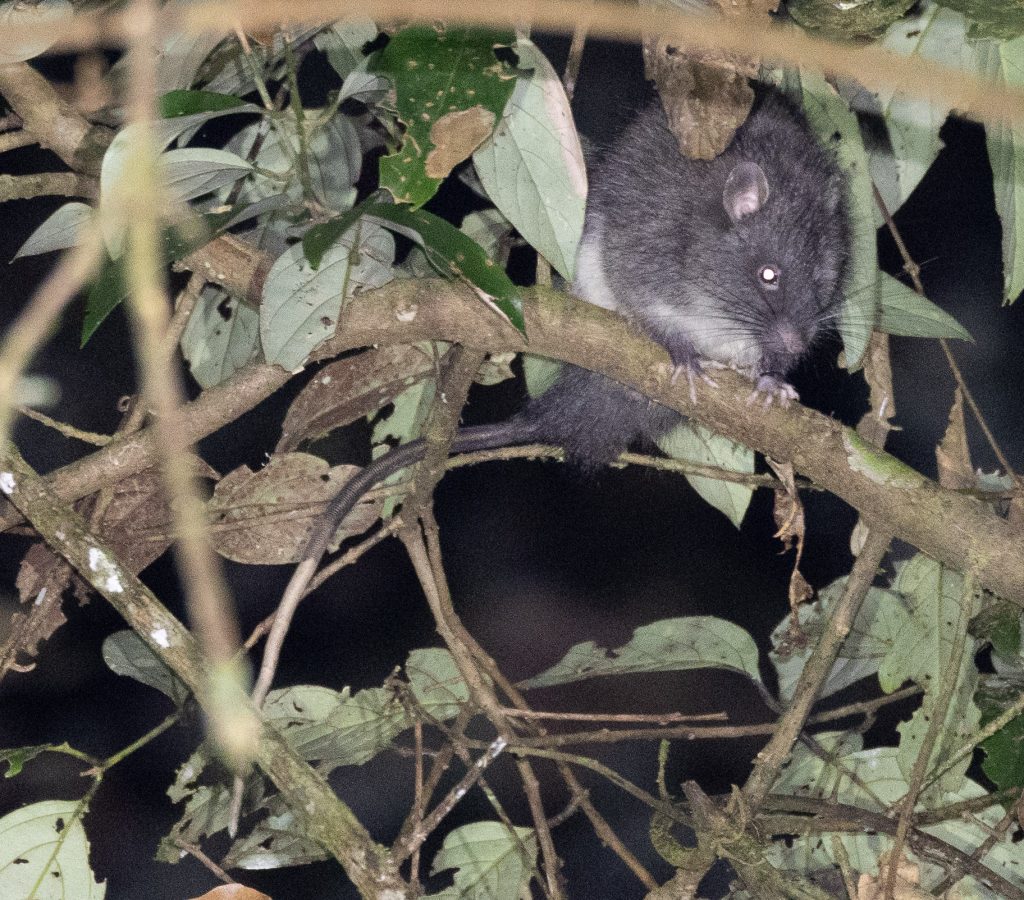
Photo János Oláh
János and I saw this very cool rat during our last night at Lore Lindu. We weren’t sure of its identity at the time and Kevin Rowe identified it from our photos. A lifer for Carlos too.
21. Meyer’s Giant Rat (Lenomys meyeri) – Lifer
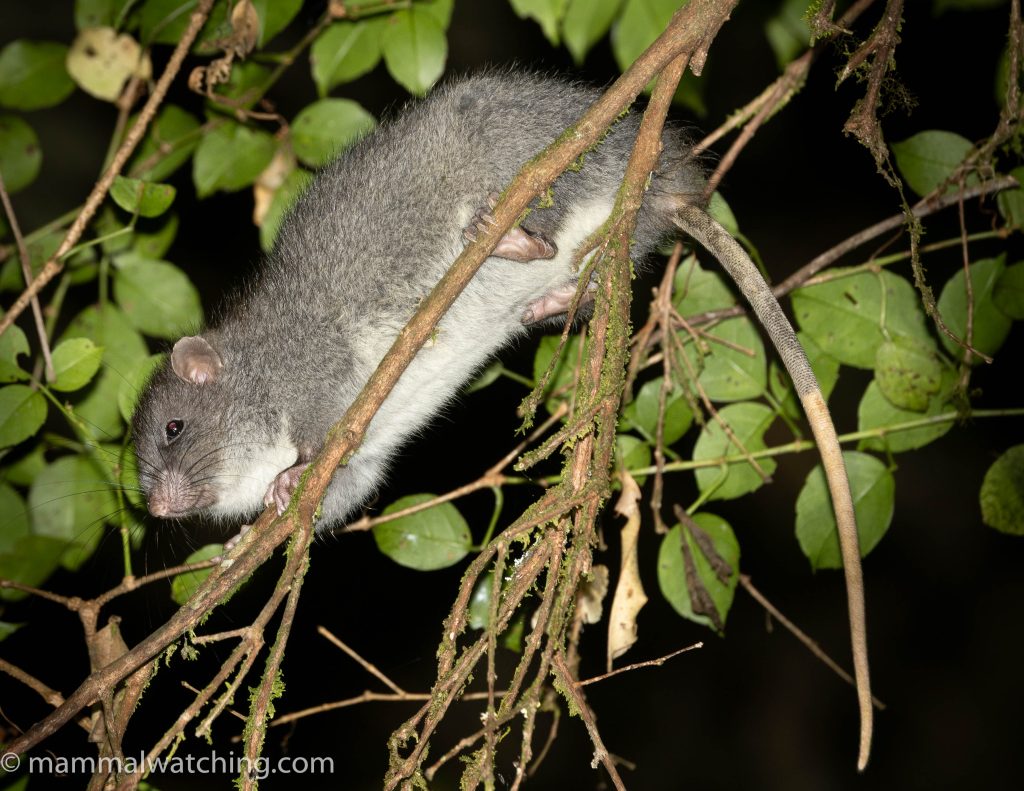
We saw several of these impressive giant rats on Lompobattang.
22. Elegant Margareta Rat (Margaretamys elegans) – Lifer
We saw at least one of these next to the road at Lore Lindu but apparently didn’t get a photograph. These are relatively large margaretamys mice with a pronounced white brush at the ends of their tails.
23. Undescribed ‘Lompobattang’ Margareta Rat (Margaretamys sp.nov.A ) – Lifer
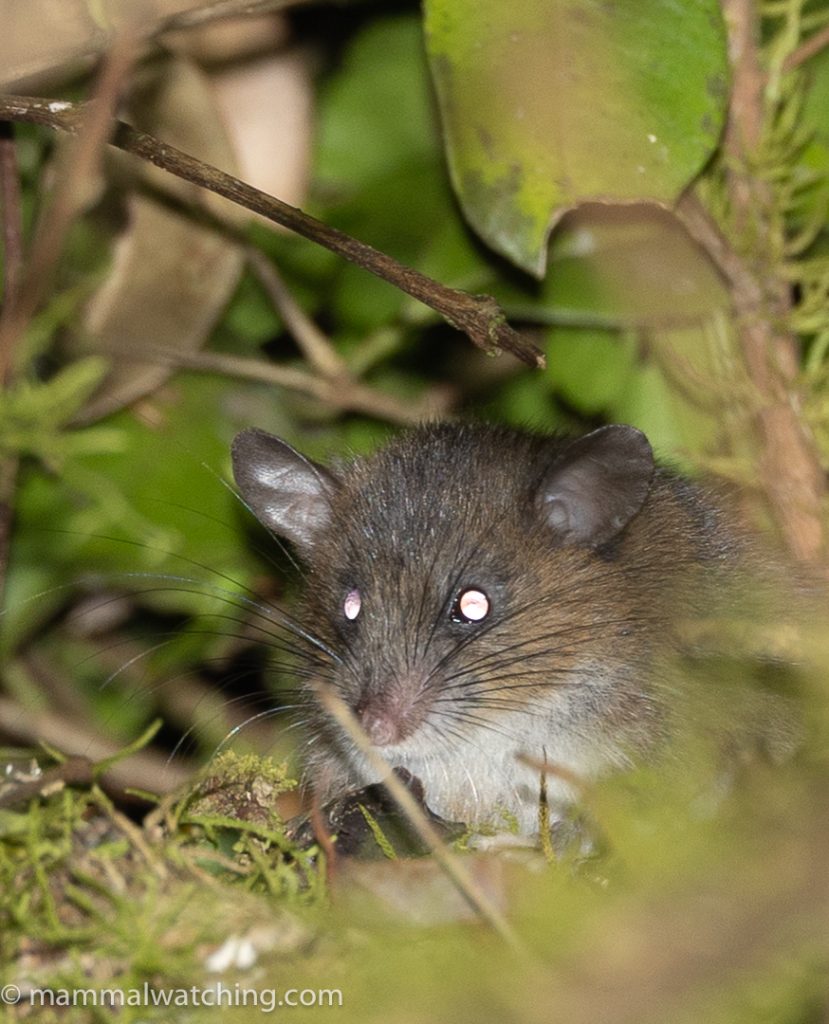
We saw several on Lompobattang. This still undescribed species is known to scientists and will presumably be recognized officially one day. It resembles the Little Margareta Mouse (M. parvus) but DNA confirms it is a different species.
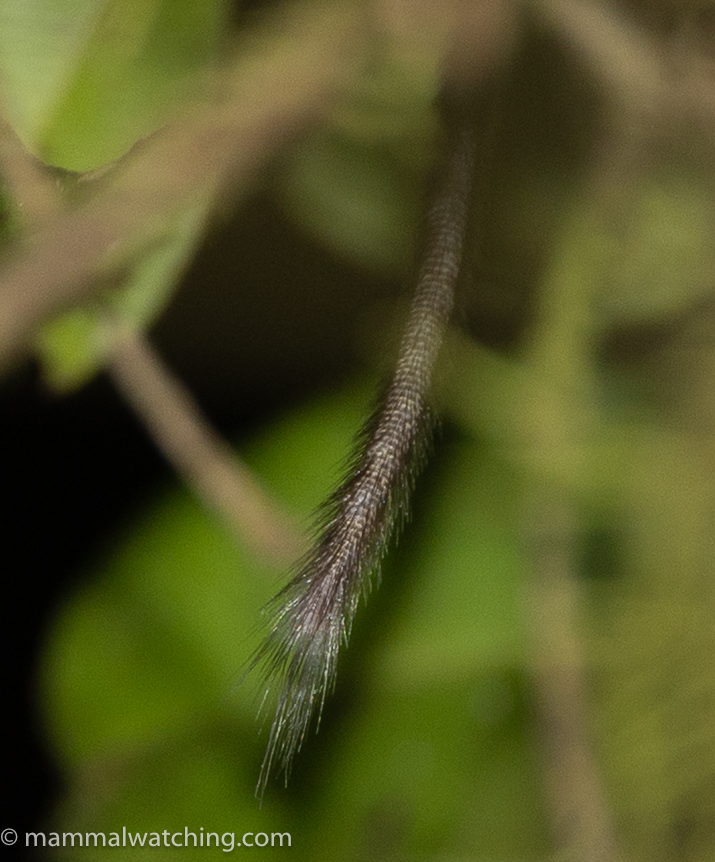
24. (Probably a new species) undescribed ‘Guzman’s’ Margareta Mouse (Margaretamys sp.nov.B) – Lifer
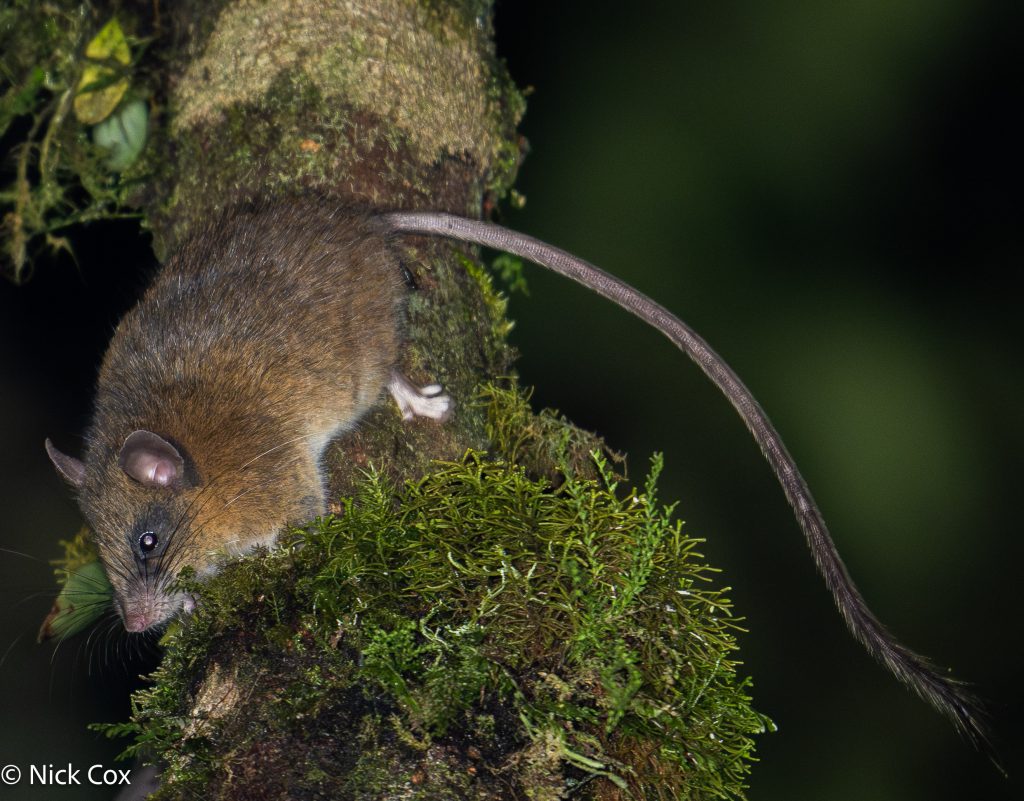
We saw several margareta mice at 2000m ASL on Lore Lindu during our search for the Pygmy Tarsier. They were considerably larger than the ‘Lompobattang’ margaretamys we had seen well a couple of days earlier: although size estimates varied across the group we all agreed these were a robust animal and much larger than a house mouse. I estimated the head-body length to be close to 20cm. Kevin Rowe noted they resemble the little Margareta Mouse in looks but that that species is much smaller.
The Elegant Margareta Mouse would be a closer match for size but has a white tail tuft.
Given how little studied the area is, and how difficult these arboreal mice are to capture, it would not be particularly surprising to anyone if we had discovered a new species and so on that basis we will list it here as a newly discovered, undescribed mouse and give it a temporary name Guzman’s Margaretamys.
Why Guzman’s? Guzman Bocos, Carlos’s son, was born just a few days after he got back from Sulawesi. Like the mouse he is robust, attractive and prone to keeping people awake at night (though in my case it was from the stress of trying to identify the mouse). So the name seems apt.
25. Southwestern Xanthurus Rat (Rattus bontanus) – Lifer
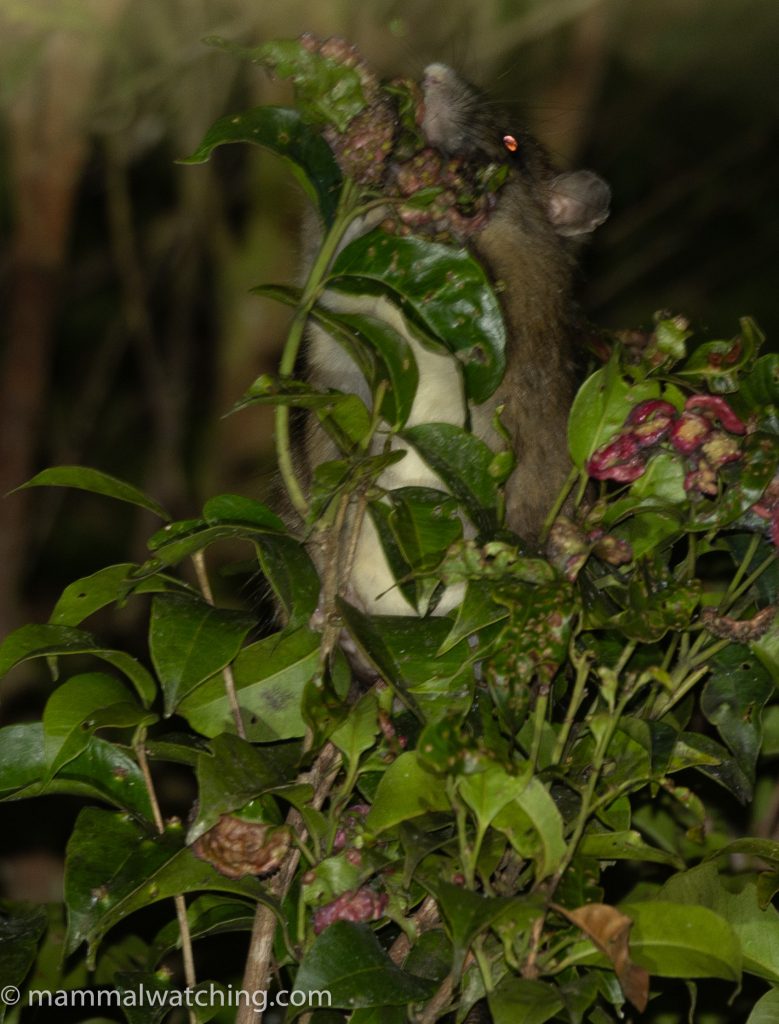
One on Lompobattang feeding in flowers.
26. Lore Lindu Xanthurus Rat (Rattus facetus) – Lifer
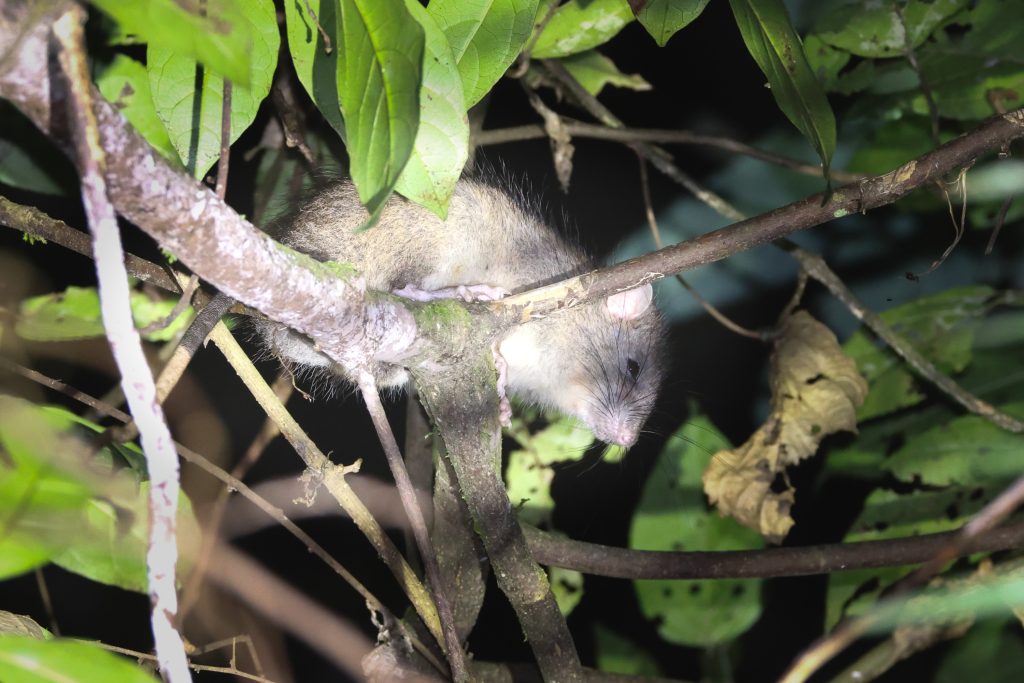
Photo János Oláh
Several at Lore Lindu close to the road and one in the forest near Luwuk (which might potentially be a different species).
27. Hoffmann’s Sulawesi Rat (Rattus hoffmanni) – Lifer
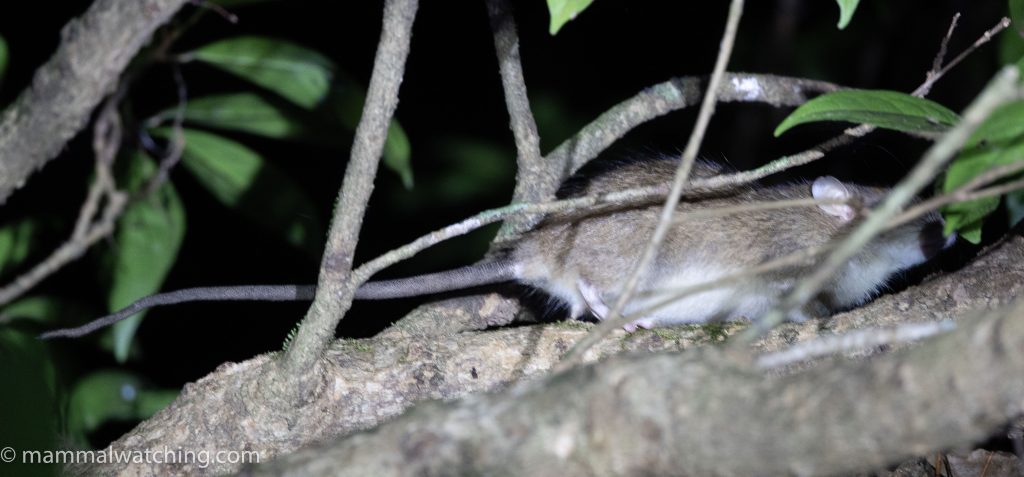
Several in Kendari, at least one in Makassar and another in Lompobattang.
28. Koopman’s Peleng Island Rat (Rattus koopmani) – Lifer
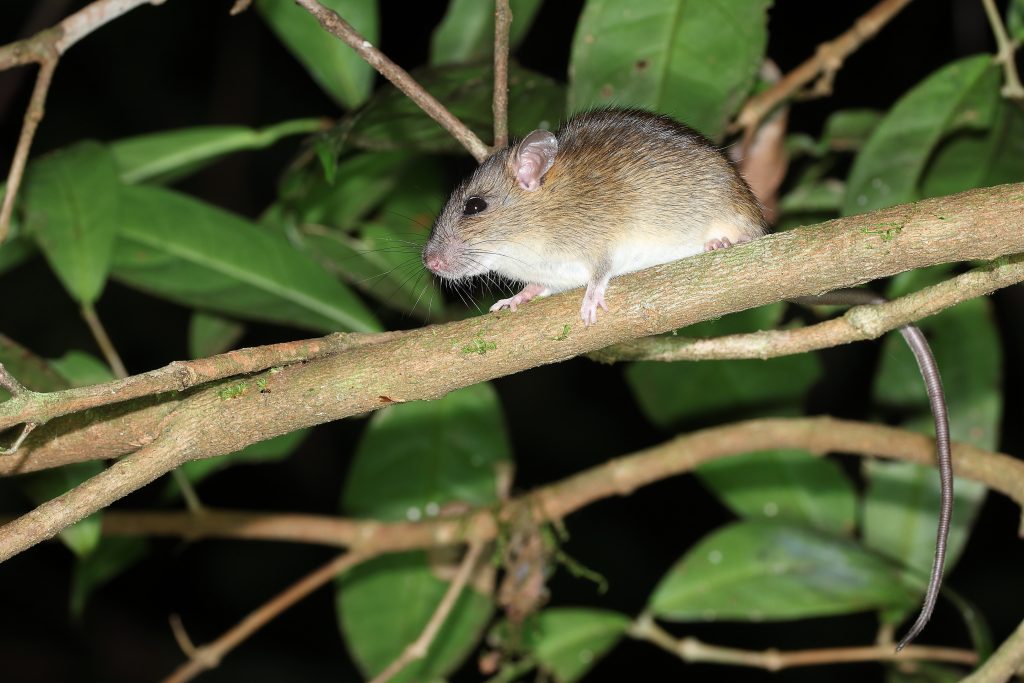
Photo Carlos Bocos
Seen on both nights in Peleng, in both lowland and higher forest.
29. Lompobatang Sulawesi Rat (Rattus mollicomulus) – Lifer
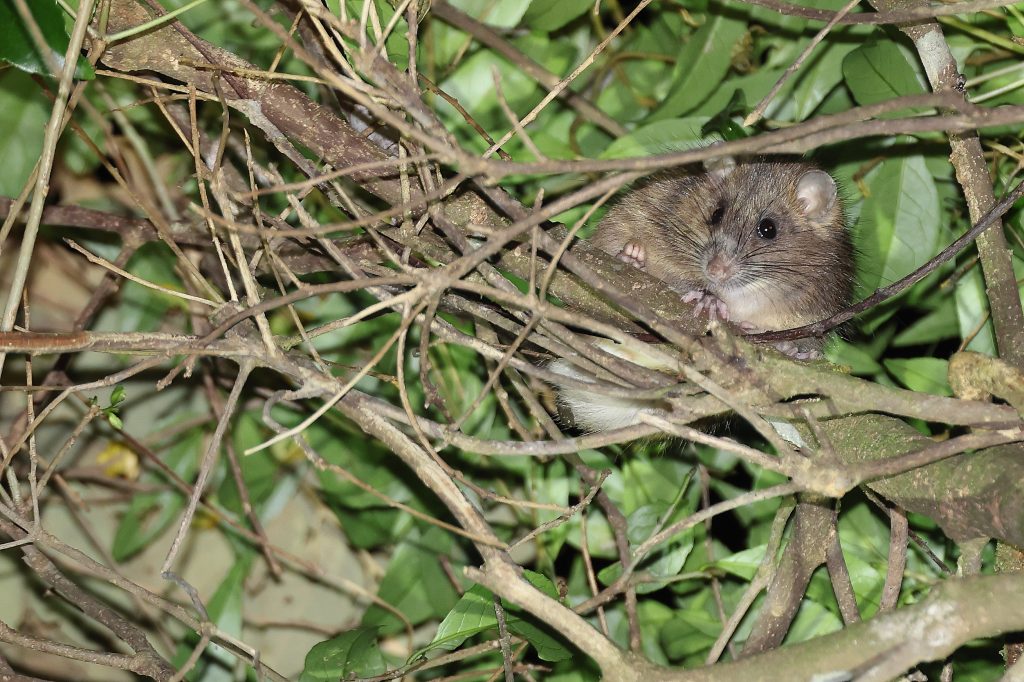
Photo Carlos Bocos
We saw at least one on Lompobattang.
30. Peleng Island Xanthurus Rat (Rattus pelurus) – Lifer
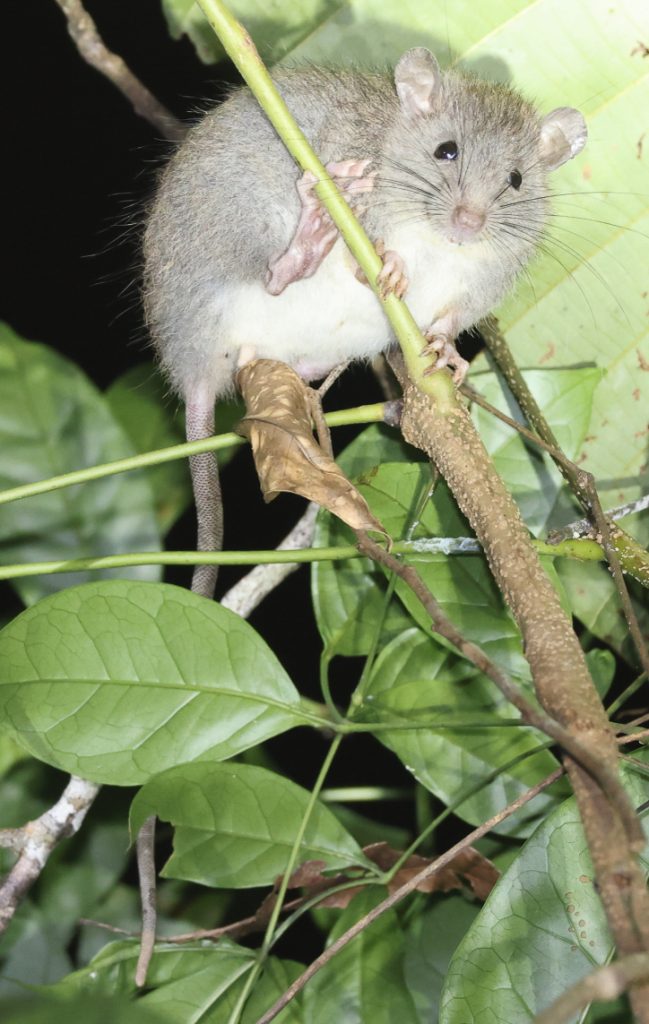
Photo János Oláh
We eventually tracked down one of these large rats on Peleng Island in the last hour of our final night. Their tails are white on their terminal section, unlike Rattus koopmani.
31. Roof Rat (Rattus rattus) – introduced
One in the forest at Makassar.
32. Southeastern Xanthurus Rat (Rattus salocco) – Lifer
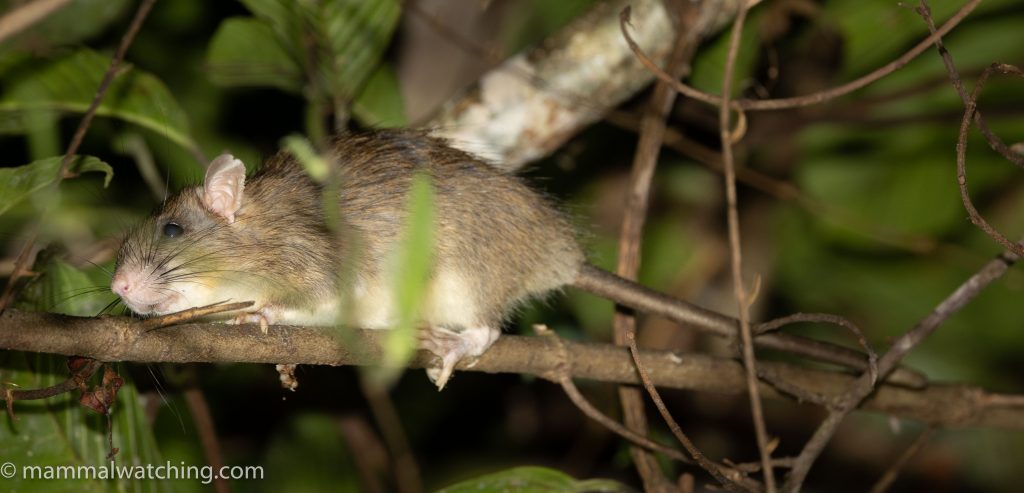
Another exciting discovery. We saw several rats in Kendari and initially recorded them as Rattus marmosurus. When I first contacted Kevin Rowe – who happened to be in Kendari the day I sent the email – he explained that marmosurus was not known from the south-east and our rats looked like the long lost Rattus salocco, only known from specimens collected over 100 years ago. A PhD student will visit the area next year to confirm our finding but there is every reason to believe these are the first photos ever taken of the species.
33. Celebes Rat (Taeromys celebensis) – Lifer
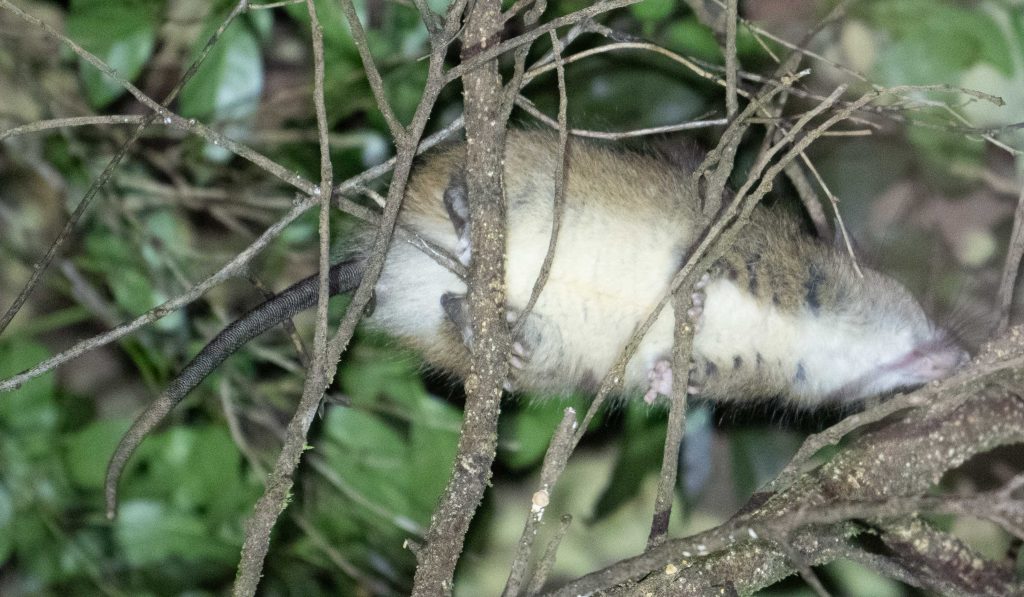
Photo Nick Cox
We saw a few on Lompobattang and in Makassar. Smaller than Taeromys dominator. This species also occurs in Tangkoko.
34. Giant Sulawesi Rat (Taeromys dominator)
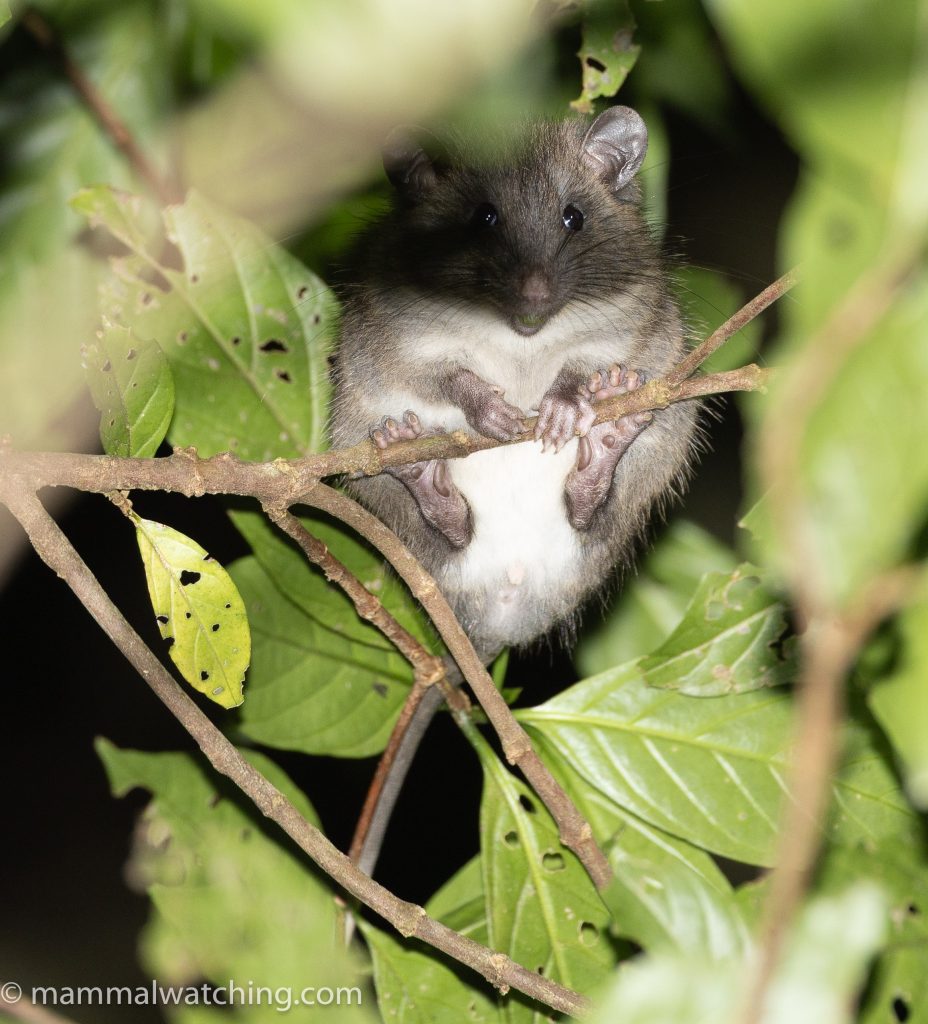
Young taeromys, probably T. dominator.
We saw several of these large rats – which Nick named ‘The Dominator’ – in Kendari but couldn’t get photographs. We also photographed what appears to be a young taeromys (photo above) on Lompobattang which may be this species.
35. Sulawesi Montane Rat (Taeromys hamatus) – Lifer
Carlos and I saw a smallish soft-furred taeromys rat on our first night at Lore Lindu. We are confident in the ID but were unable to photograph it.
36. Asian House Shrew (Suncus murinus)
A large house shrew made a brief appearance in the fabulous bat cave on Peleng.
37. Lesser Sheath-tailed Bat (Emballonura monticola)
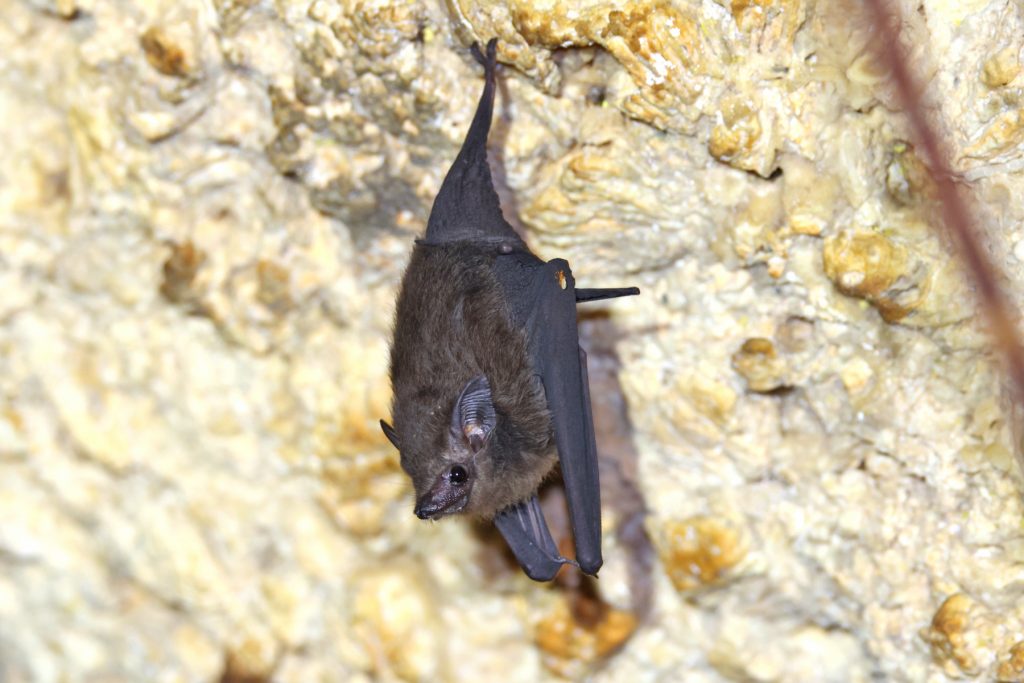
Photo János Oláh
A few in caves at Poso and Peleng.
38. Dark Sheath-tailed Bat (Mosia nigrescens)
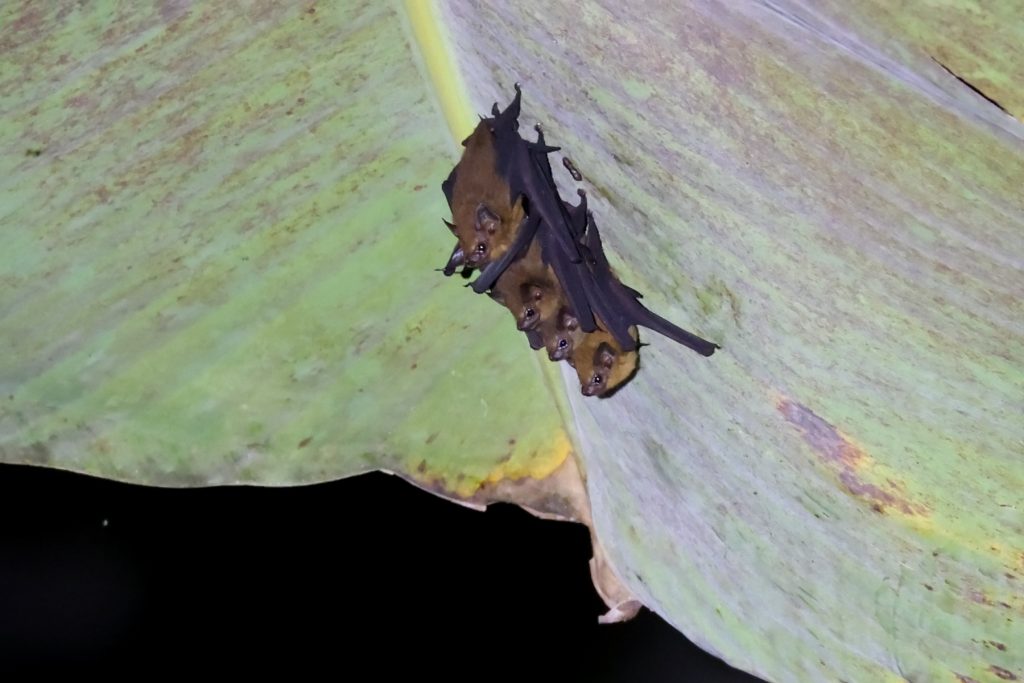
Photo János Oláh
One of a few species on Sulawesi that you can identify in flight, we saw them flying in Kendari and some groups resting night – in their characteristic conga line – in Malenge and Peleng.
39. Black-bearded Tomb Bat (Taphozous melanopogon)
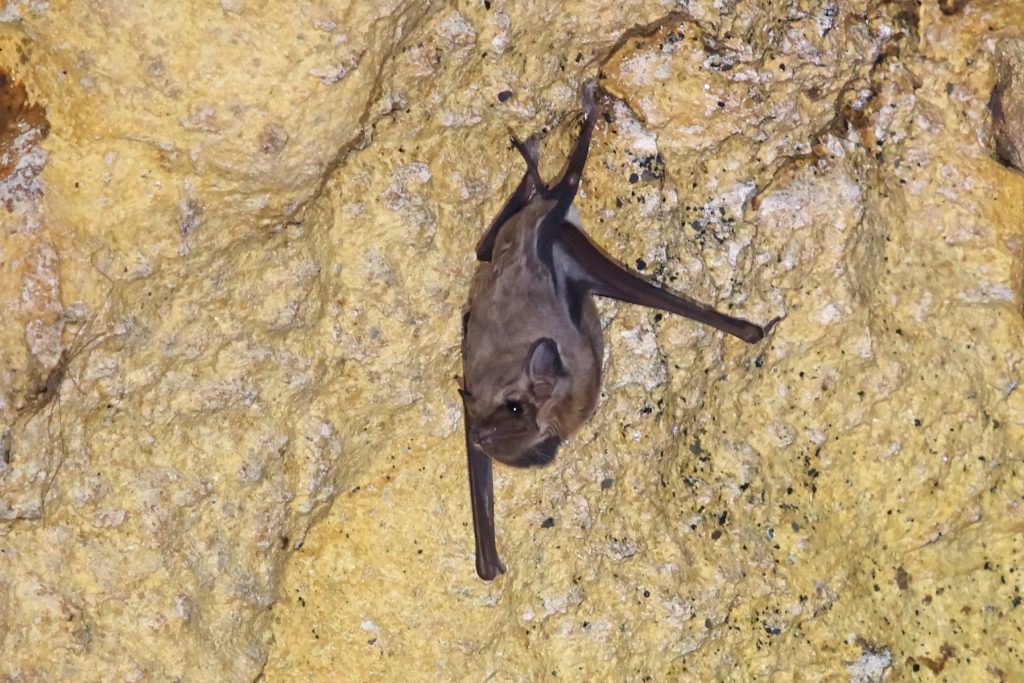
Photo János Oláh
A few in the ‘Japanese’ Cave at Kendari.
40. (Probably) Intermediate Long-fingered Bat (Miniopterus medius)
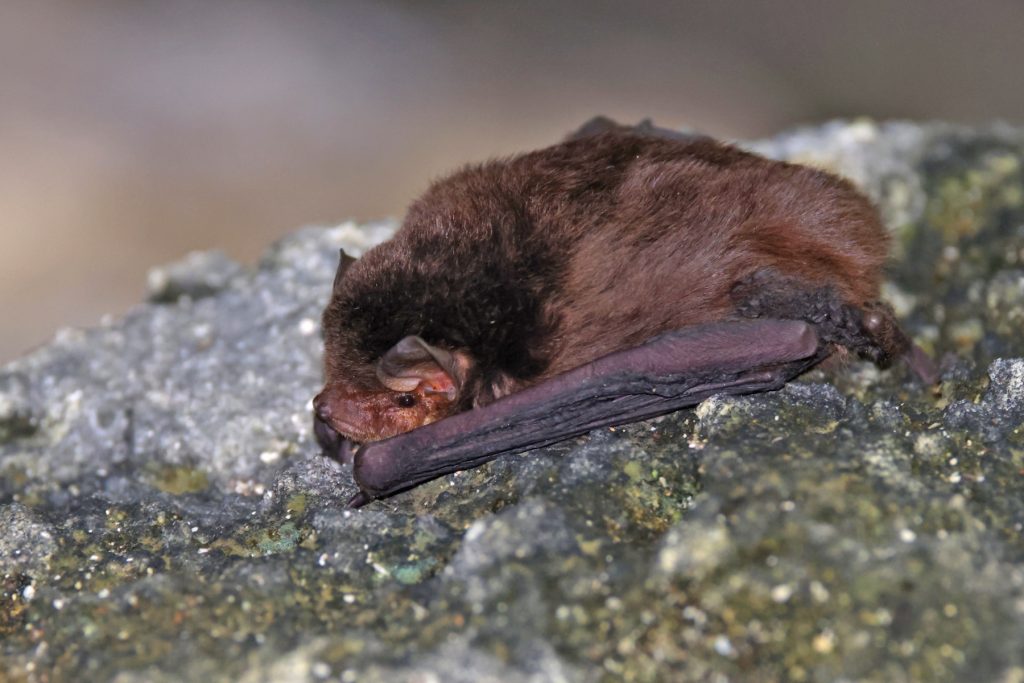
Photo János Oláh
Bentwing bats are hard to tell apart without measurements but Juliana was able to tentatively identify this species on Malenge Island.
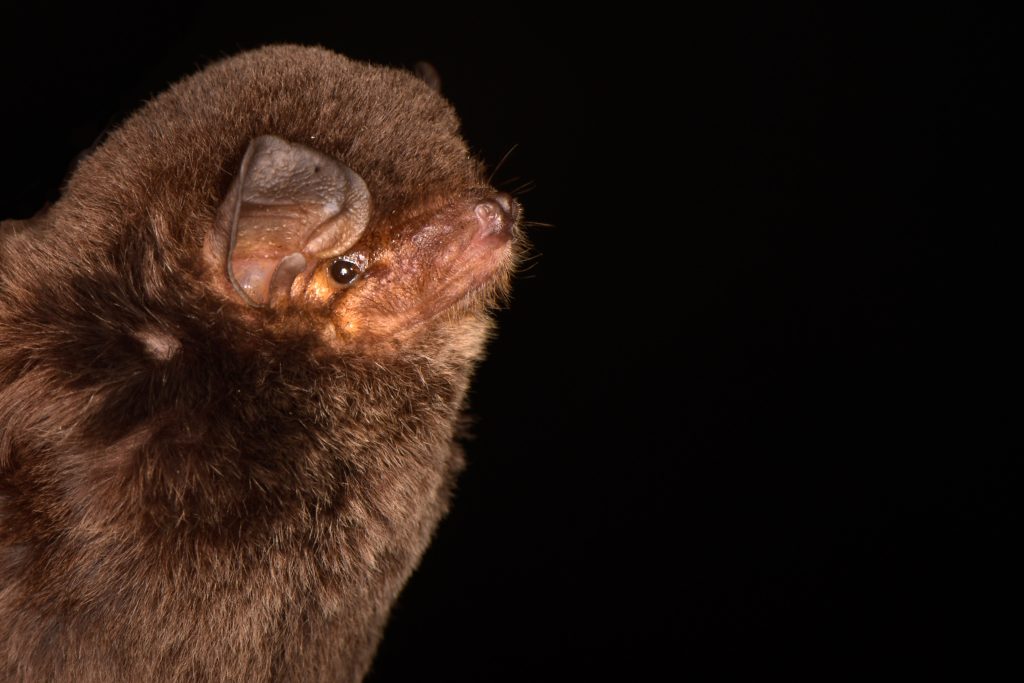
Photo Juliana Senawi
She noted that “Miniopterus has an extremely wide distribution, and most species within the genus are highly cryptic. Size is often the only reliable distinguishing feature, though even that is not always sufficient to separate them. There are nine Miniopterus species recorded throughout Indonesia. For this particular individual, the measurements overlap between M. fuliginosus and M. medius. I’ve seen both species before (which, admittedly, doesn’t help much), but I’m leaning towards M. medius.”
41. (Probably) Philippine Long-fingered Bat (Miniopterus paululus) – Lifer
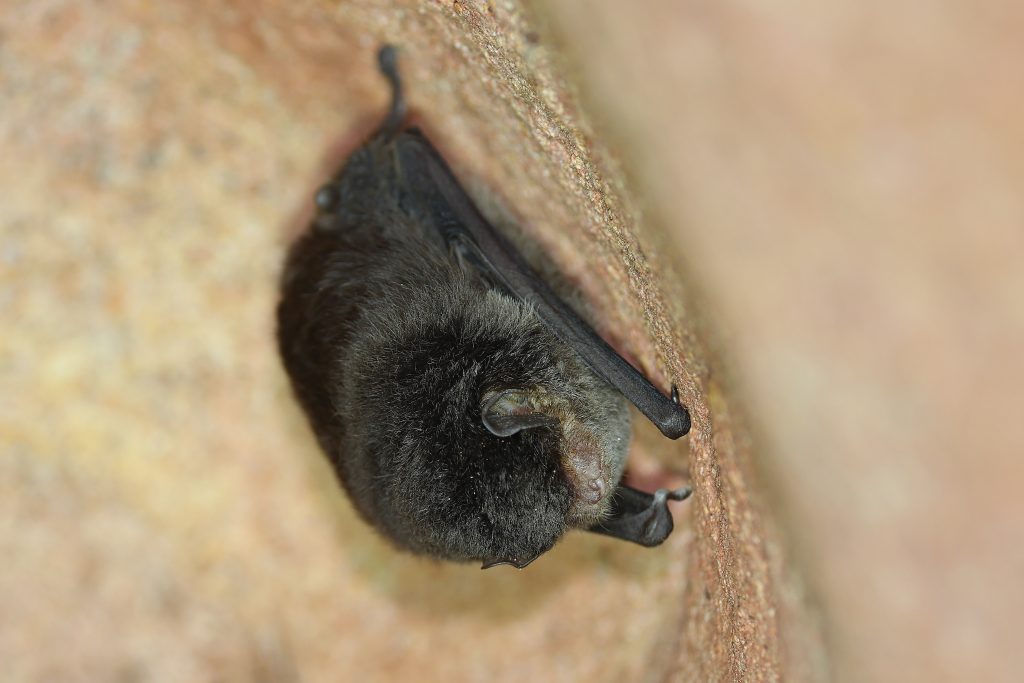
Photo Carlos Bocos
Juliana worked on the ID of the small bentwings we saw very well in the ‘Japanese’ Cave in Kendari. She noted that “Species of Miniopterus are notoriously difficult to distinguish morphologically, as size is often the only reliable diagnostic character. In practice, I usually categorize them into three broad size groups (small, medium, and large). Both M. paululus and M. pusillus fall within the “small” Miniopterus category. However, based on biogeographic considerations, particularly known distributions and type localities, I consider M. paululus to be the more likely identification. The type locality of M. paululus is the Philippines, whereas that of M. pusillus is Nicobar Island, India.”
42. Great Long-fingered Bat (Miniopterus tristis) – Lifer
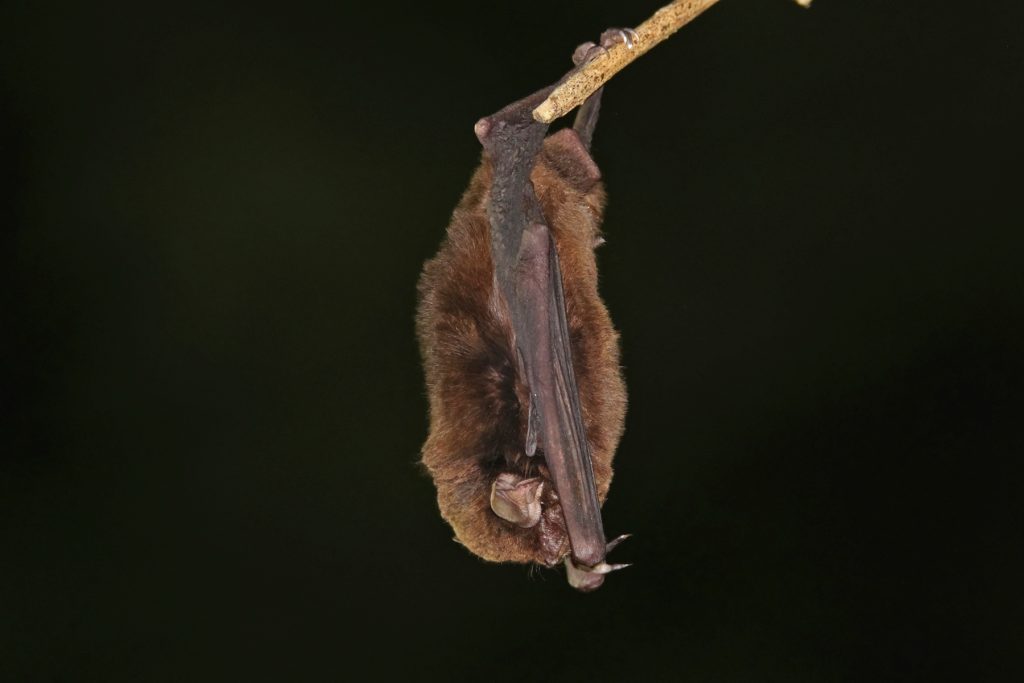
Photo János Oláh
The locals caught this bat at Luwuk. We may also have seen some in the bat cave on Peleng.
43. Sulawesian Free-tailed Bat (Mops sarasinorum) – Lifer
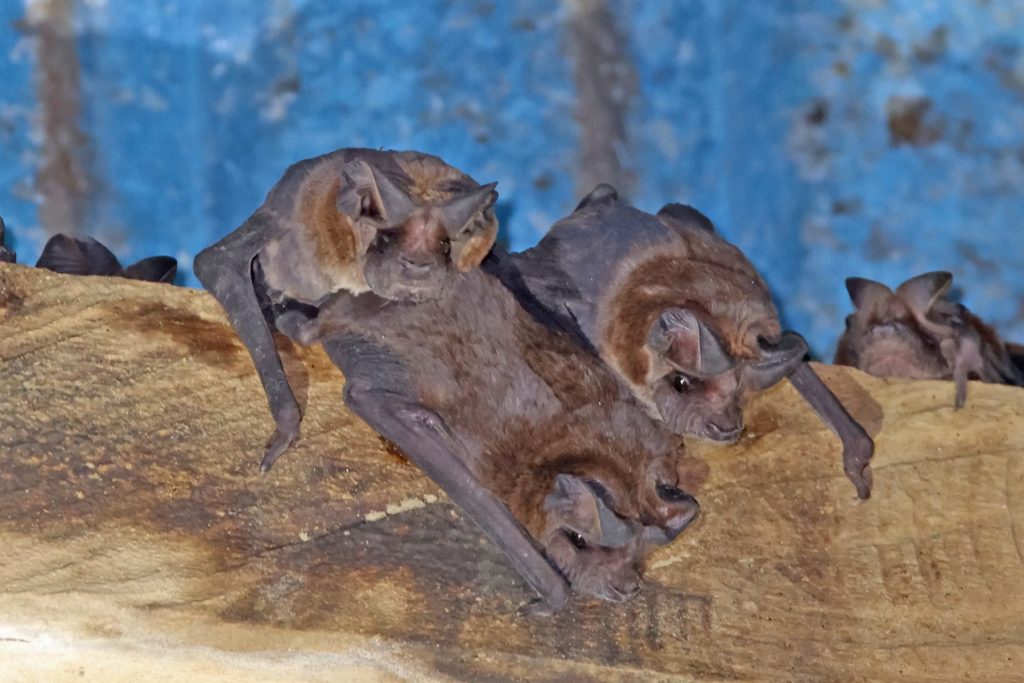
Photo János Oláh
Carlos had challenged our local guides to find a roost for this species, the only molossid on Sulawesi. They discovered a roost in an abandoned building near Lore Lindu. A lifer even for Carlos.
44. Hardwicke’s Wooly Bat (Kerivoula cf. hardwickii) [Kerivoula hardwickii – Complex]
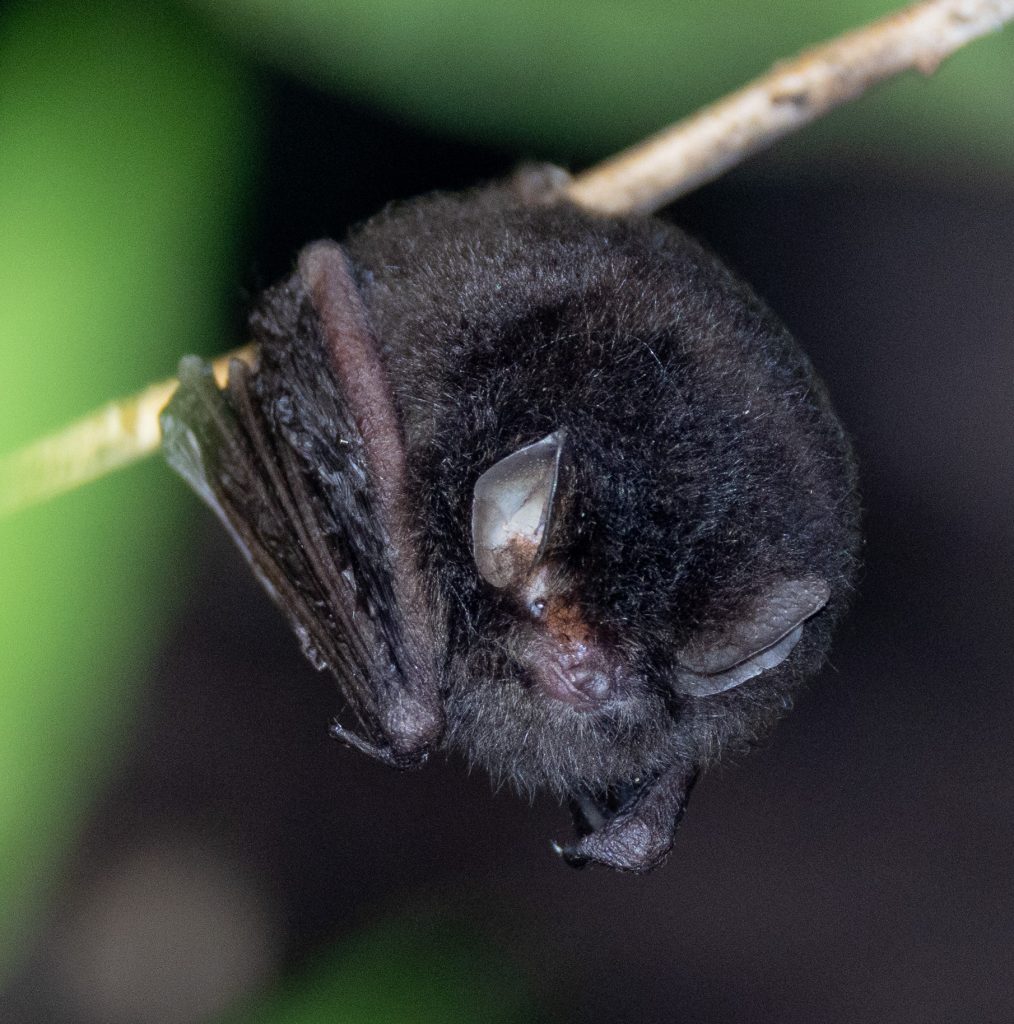
Photo János Oláh
We saw two kerivoula bats in the same area of the track up Lore Lindu. One on the way up and one as we walked back down. This first individual was well photographed but in all the excitement that night we didn’t pay much attention to the second, and many of us assumed it was the same animal. I was not convinced about that but didn’t have a camera.
Juliana studied the photos and believes they are different species. Here is her reasoning on this animal.
“In my opinion, this bat falls within the Kerivoula hardwickii – complex. There are still many ongoing studies and discussions regarding this species complex across Southeast Asia. Some countries, such as Vietnam, Laos, Cambodia and The Philippines, have made significant progress in resolving parts of this complex. However, for Indonesia, particularly Sulawesi, the taxonomy remains under discussion.
It should be emphasized that the type specimen of Kerivoula hardwickii remains uncertain, although some reports indicate it originated from Java, Indonesia. Because of this uncertainty, the true identity of K. hardwickii remains unclear. Therefore, I think it’s best to refer to this specimen as Kerivoula cf. hardwickii.
P/S – I understand that coloration, especially in flash photography, is not always reliable, but I’ve never seen K. hardwickii this dark in color before.”
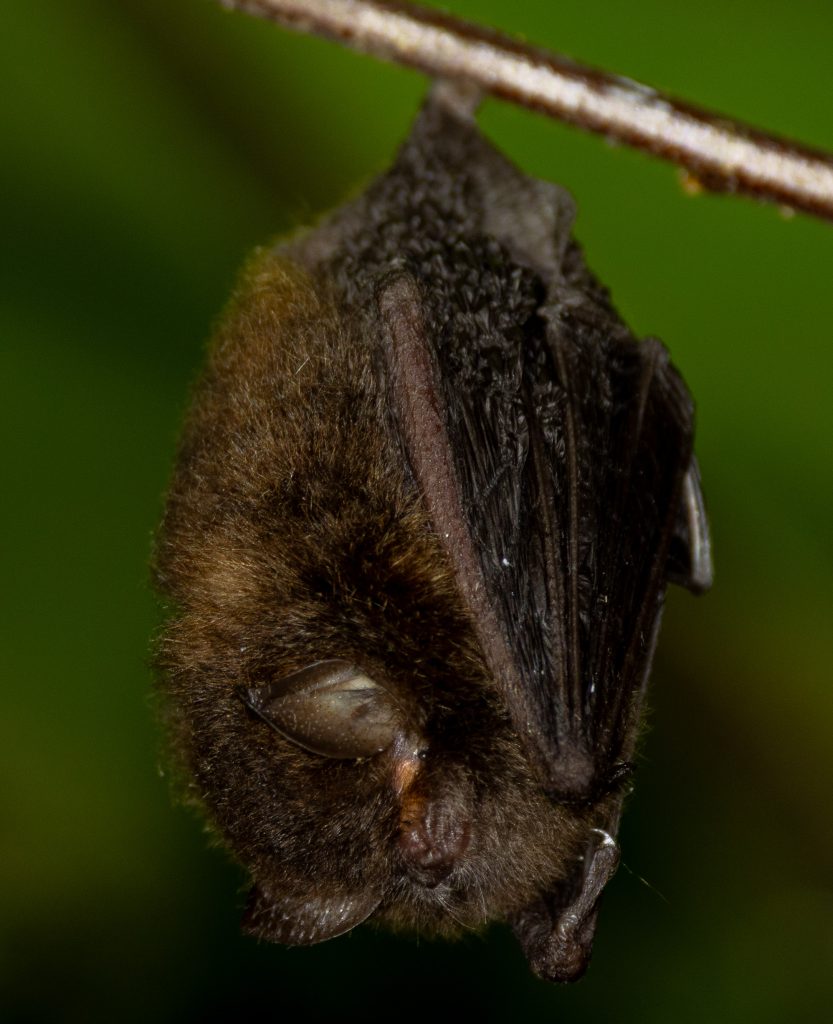
Photo János Oláh
János photographed this similar looking bat two nights later lower down on Lore Lindu close to the road. Juliana thinks is the same hardwickii type species.
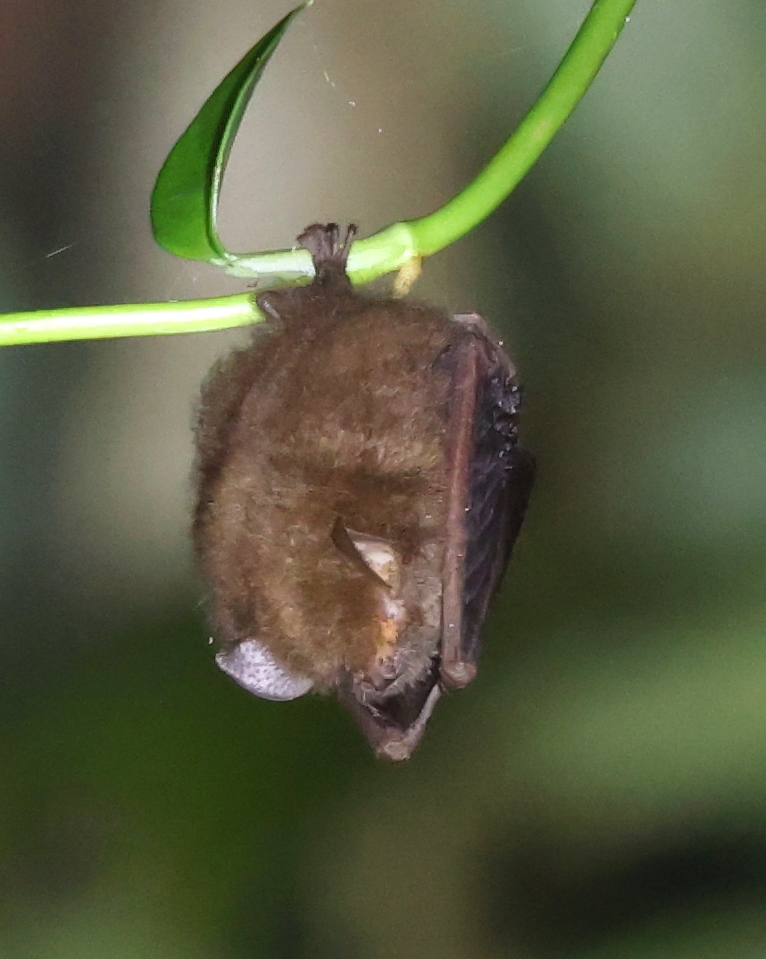
Photo János Oláh
János also photographed this bat in the Peleng Highlands which may also be hardwickii. Maybe.
45. (Probably a new species) Undescribed ‘Lore Lindu’ Woolly Bat (Kerivoula sp. nov) [Kerivoula papilosa group]
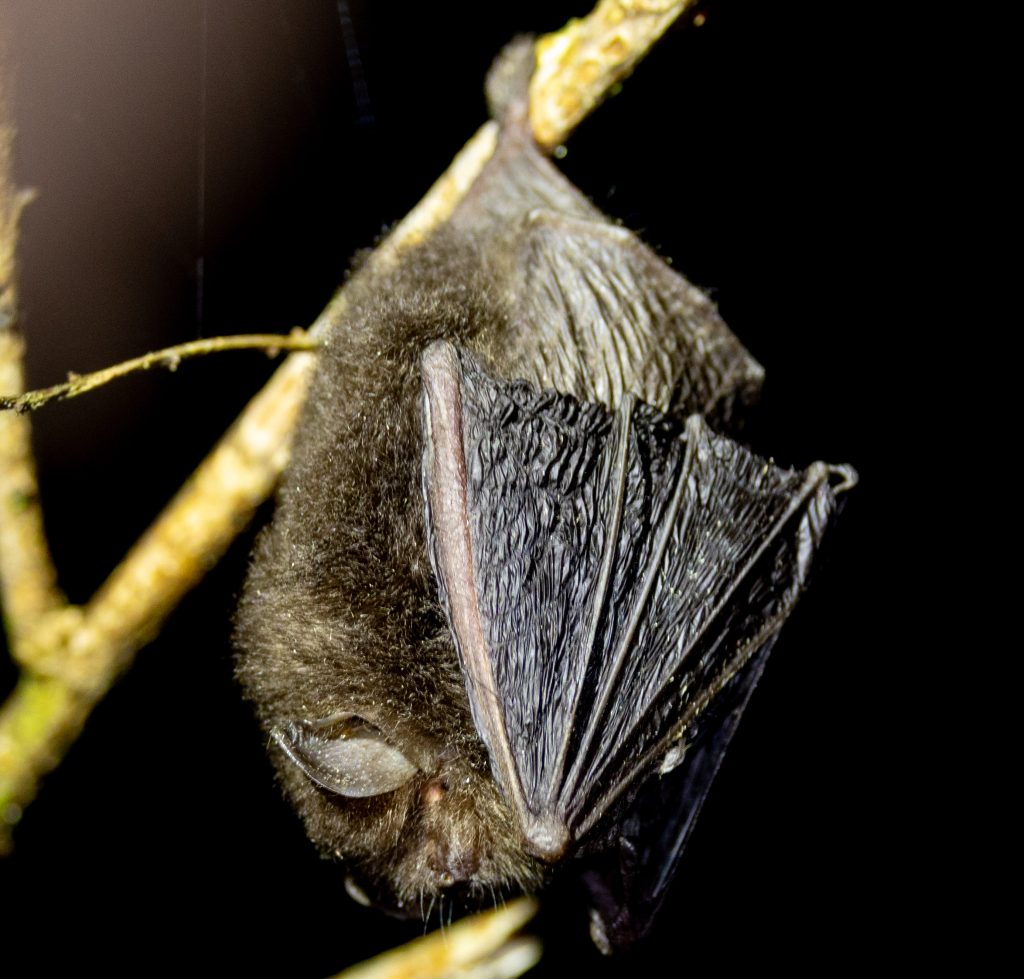
Photo János Oláh
As I wrote above we saw another woolly bat on the way back down Lore Lindu’s Anasso Track that Juliana believes was not from the Kerivoula hardwickii complex.
Here is her thinking.
“Based on the side view of the face, it appears to resemble the Kerivoula papilosa group. There are at least four species from this group reported in Indonesia (K. papilosa, K. lenis, K. intermedia, and K. minuta); however, all four have so far been recorded only from Java, Sumatra and Kalimantan.
Without measurements, I cannot be certain, but based on my observations of these species from other parts of their distribution range, the individual observed in Sulawesi most closely resembles Kerivoula lenis, though it appears slightly smaller in size (yet somewhat larger than K. intermedia).
I’m still debating what would be the most appropriate name for this species. Should we refer to it as Kerivoula cf. lenis? But then again, the type specimen of K. lenis is from India. I think the best approach for now is to label it as Kerivoula sp. ‘Lore Lindu’.
P/S – As these two individuals were observed in very close proximity but at different times, how can we tell if they are the same or different individuals? In the case of Kerivoula, I often look at the snout area – the structure and shape of the forehead and snout can appear quite distinctive to me. That being said, I would still need to examine them from several different angles to be sure. More photos from various perspectives would definitely help.”
The moral of the story: take more photographs!
46. Peters’s Myotis (Myotis ater) – Lifer
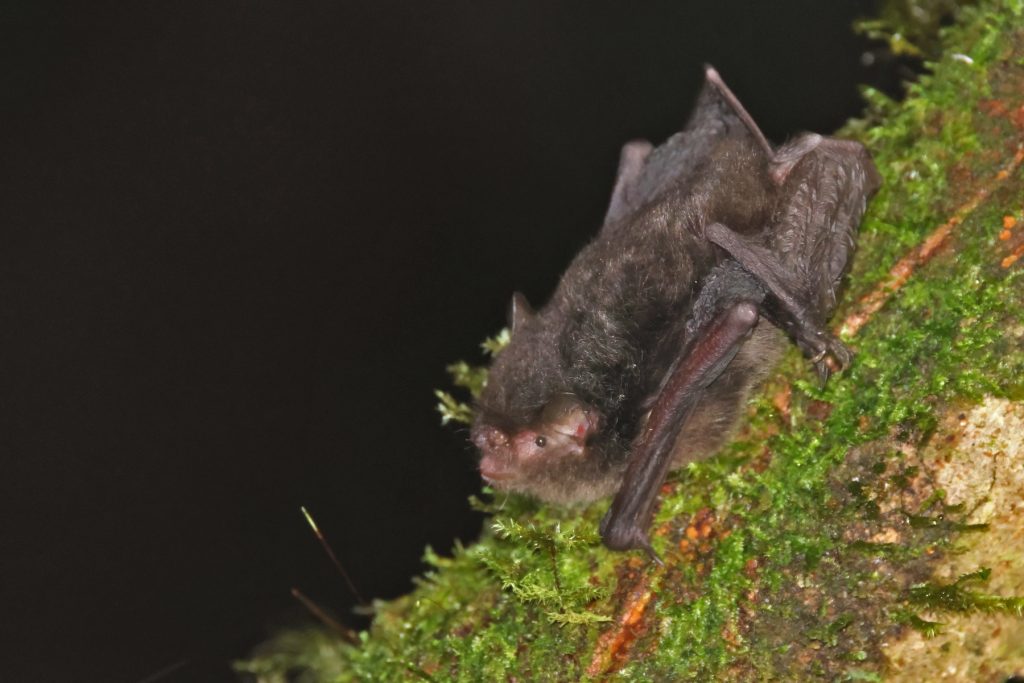
Photo János Oláh
Myotis species can be challenging to identify but based on the measurements this bat – from Lore Lindu – appears to be Myotis ater.
47. Javan Pipistrelle (Alionoctula javanica)
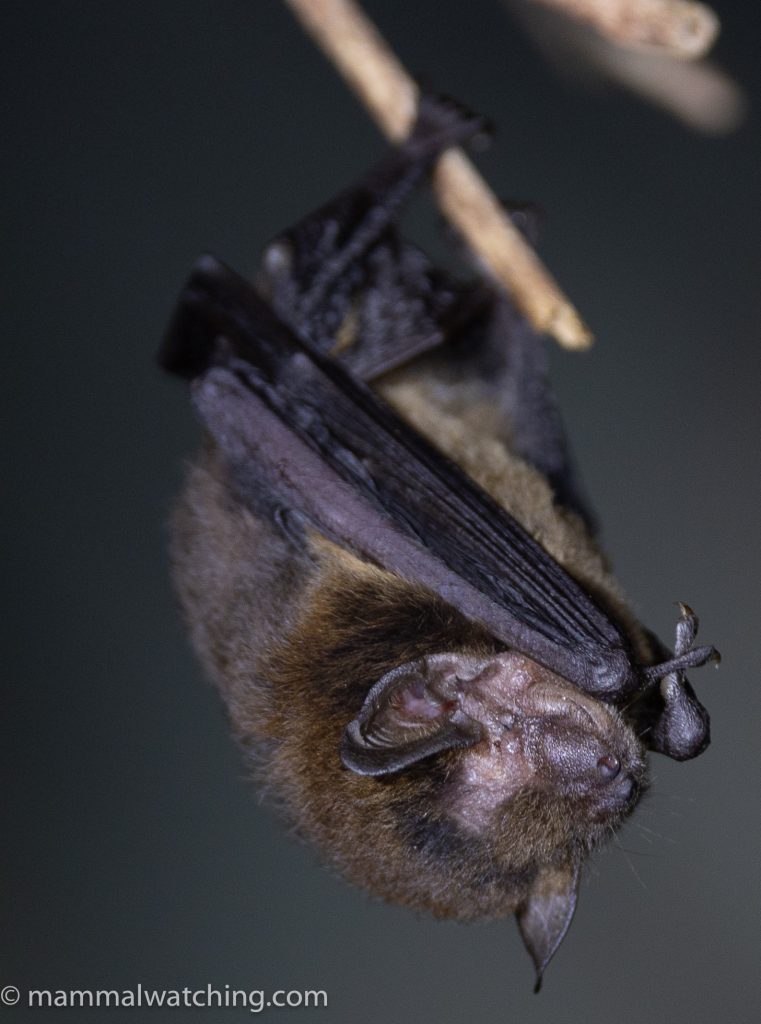
This balding bat was found by a thermal and seen very well spinning from a twig in Makassar. Juliana noted that “although it looks slightly different from similar specimens in Malaysia—particularly with its tufted hair—I think we can identify it as Alionoctula javanica. The variation is likely a morphological adaptation within its broad distribution range.”
(Possibly a new species) Javan Pipistrelle (Alionoctula cf. javanica)
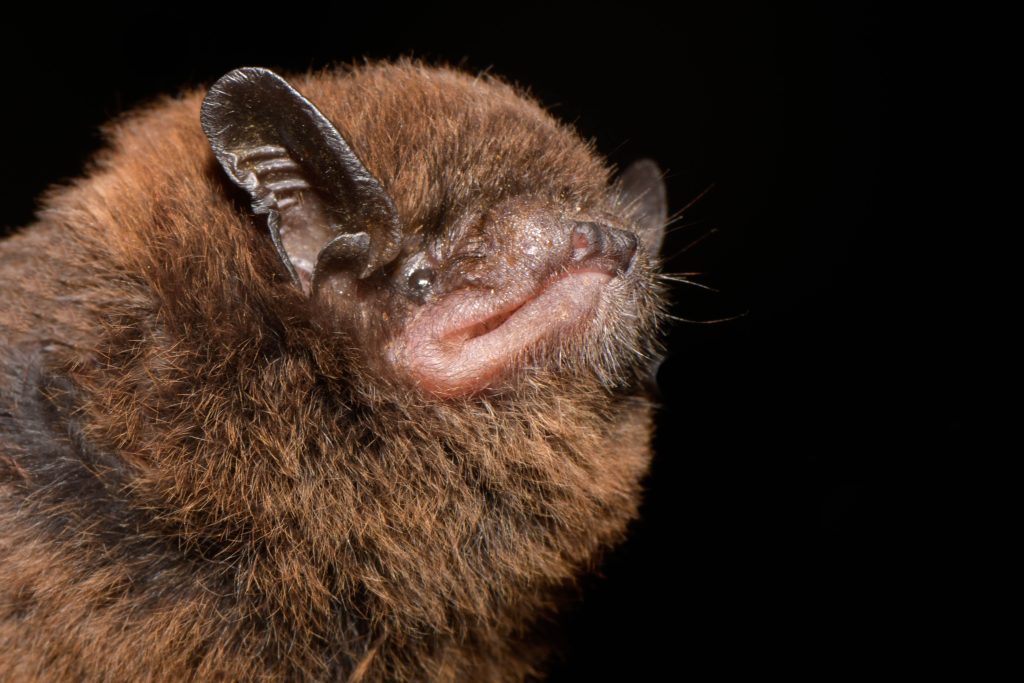
Photo Juliana Senawi
Local researchers caught this bat at Lompobattang. With a forearm length of 38.2 mm and a weight of 5.5 grams it may be a rather large Javan Pipistrelle or it may be a brand new species.
According to Juliana “This specimen also falls under Alionoctula. Among the three species known to occur in this area, it most closely resembles A. javanica. I’ve encountered this species before in several countries, and given its wide distribution range, considerable variation is expected.
Interestingly, this individual appears slightly larger than the ones I’ve seen previously. I’m not entirely sure whether this represents a cryptic species or simply a morphological variation of A. javanica. For now, I’ll identify it as Alionoctula cf. javanica.”
48. (Possibly a new species) Minahassa (Napu) Pipistrelle (Alionoctula cf. minahassae) – Lifer
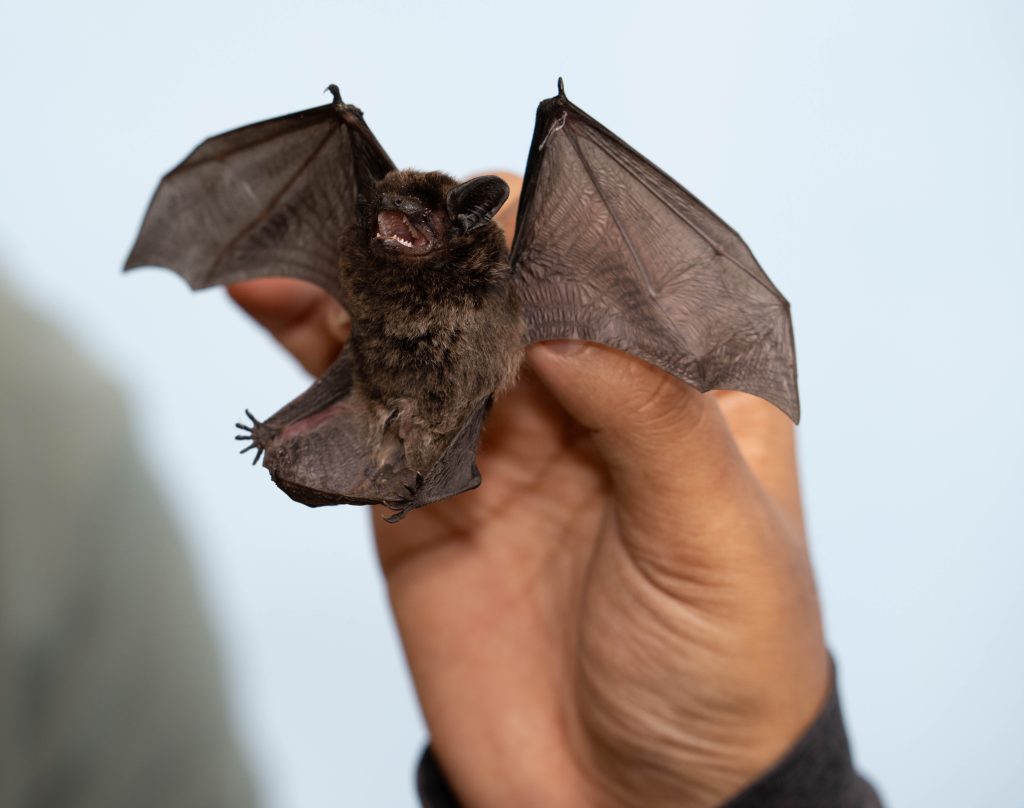
Photo Nick Cox
Our local guides at Lore Lindu also discovered a few of these bats roosting under the woodwork in an abandoned building in Napu village near Lore Lindu.
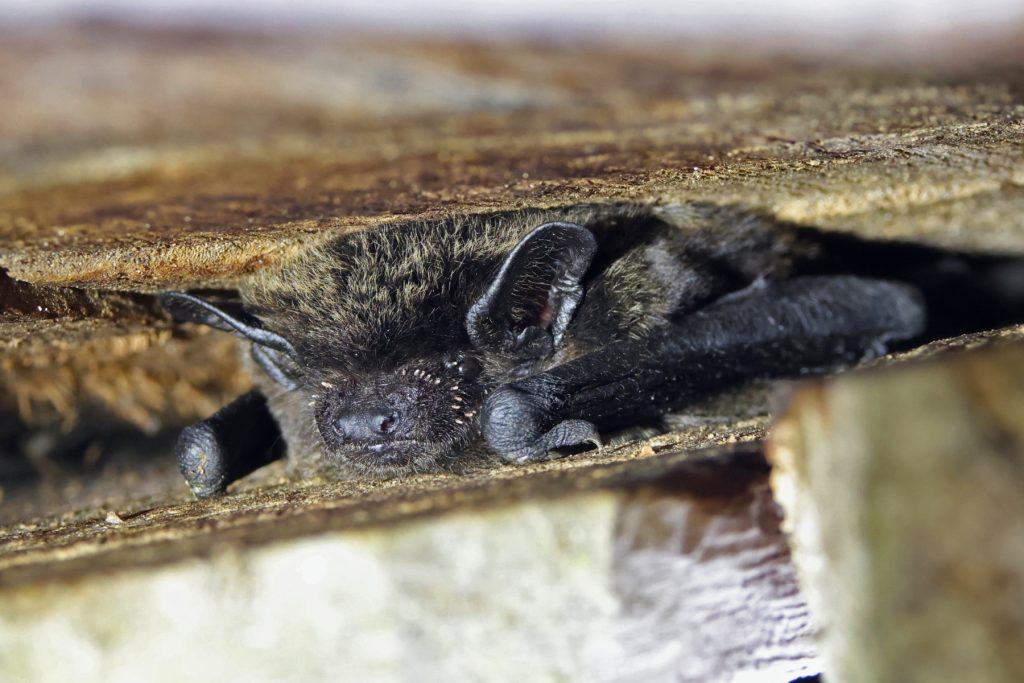
Photo János Oláh
We were able to remove one to take measurements to try to confirm the identity. The forearm was 41.5mm and it weighed 6 grams. Juliana believe the animals might be Minahassa Pipistrelles or possible a new species.
Juliana wrote: “Based on the tragus shape and structure, this specimen best fits within the genus Alionoctula (formerly Pipistrellus). There are seven known Alionoctula species recorded in Indonesia, with three reported from Sulawesi: A. javanica, A. tenuis, and A. minahassae.
This individual is larger than both A. javanica and A. tenuis, and it also differs from A. minahassae, which is described as having relatively small ears. However, among the three, it most closely resembles A. minahassae.
I’ve personally never seen A. minahassae before, and available information on the species is quite limited. For now, we can refer to this specimen as Alionoctula sp. “Wanga” or Alionoctula cf. minahassae.” For the time being I chose the more conservative route and call it minihassae pending further work.
49. Common Swift Fruit Bat (Thoopterus cf. nigrescens)
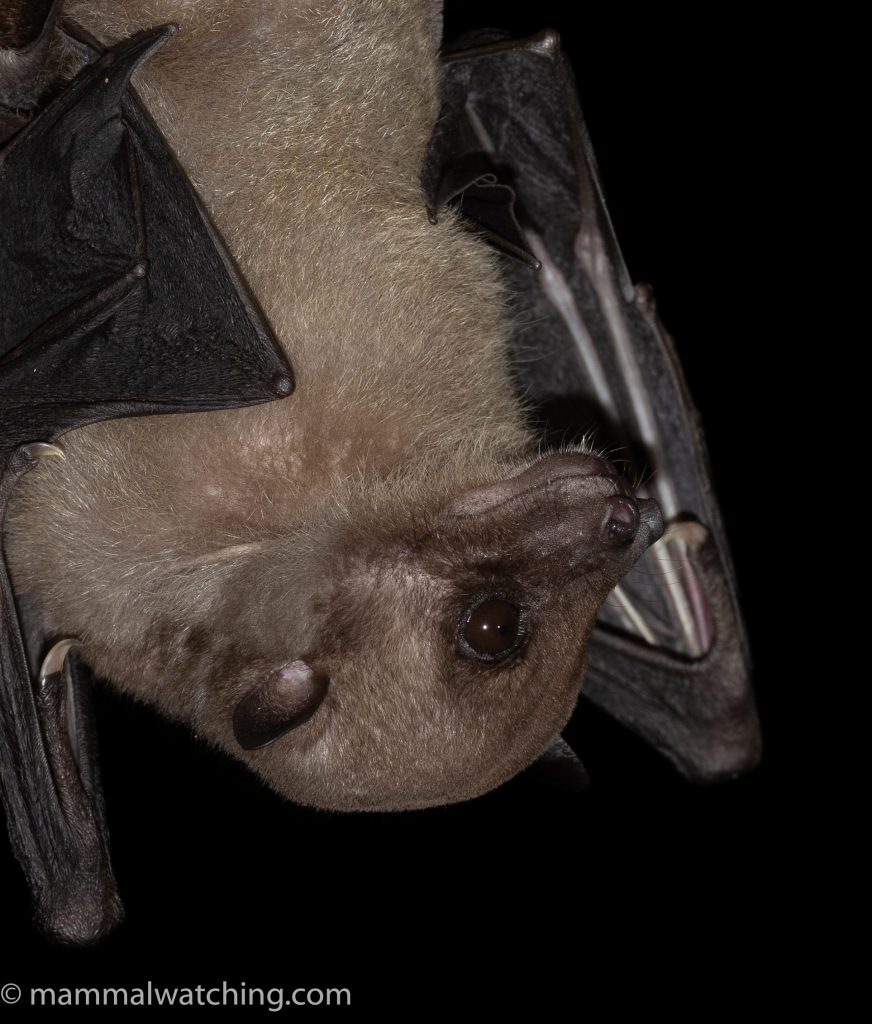
Animals found in Lore Lindu, Lompobattang and both the bat cave in Peleng and the highlands. I have seen this species in Tangkoko. Juliana felt the faces of these bats were somewhat different to the photographs she had of nigrescens and that they may be something different (hence the “cf.”)
50. Suhaniah’s Swift Fruit Bat (Thoopterus suhaniahae) – Lifer
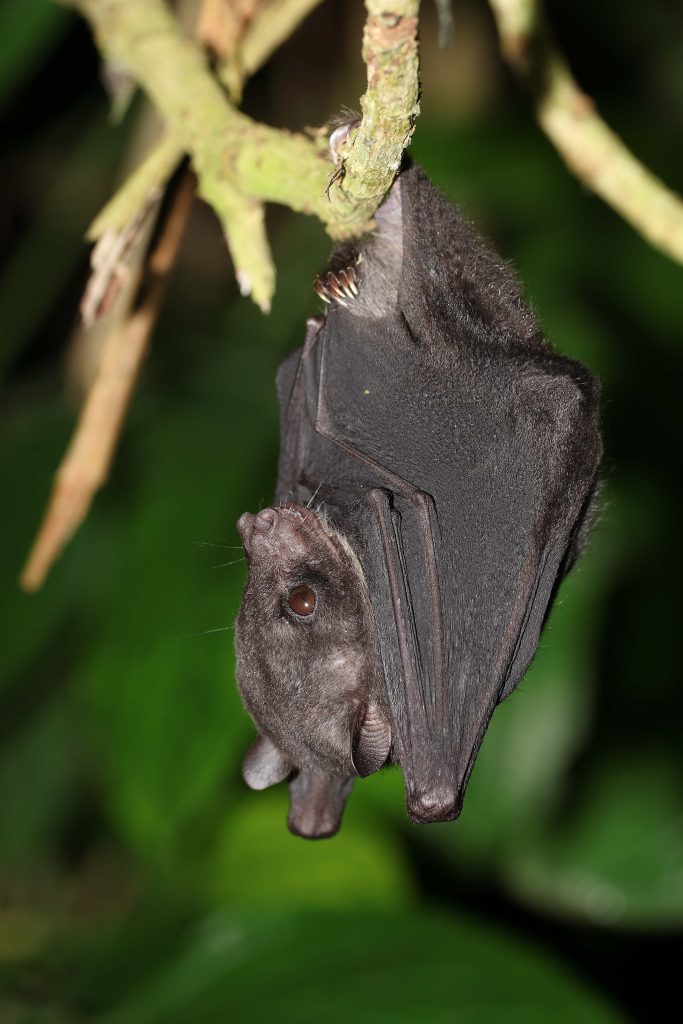
Photo Carlos Bocos
Juliana was excited to find some of these bats at Lore Lindu, not least because they are one of the few bats named after a woman. Similar to the Swift Fruit Bat, but with a hairier bum.
51. Peters’s Short-nosed Fruit Bat (Cynopterus luzoniensis) – Lifer
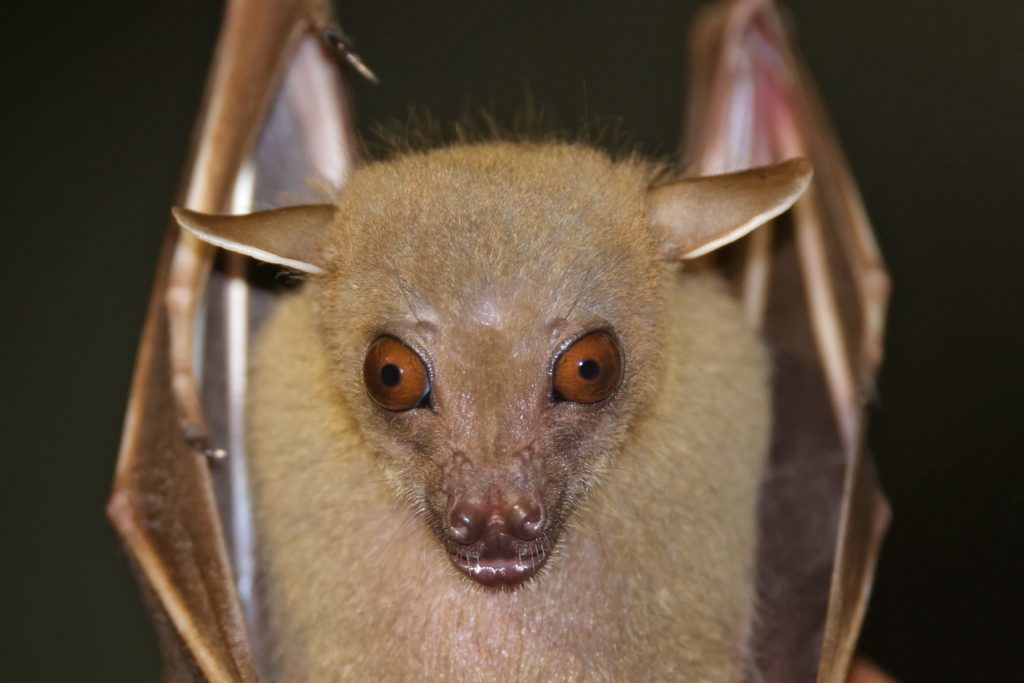
Photo János Oláh
Several on Malenge Island.
52. Minute Short-nosed Fruit Bat (Cynopterus minutus)
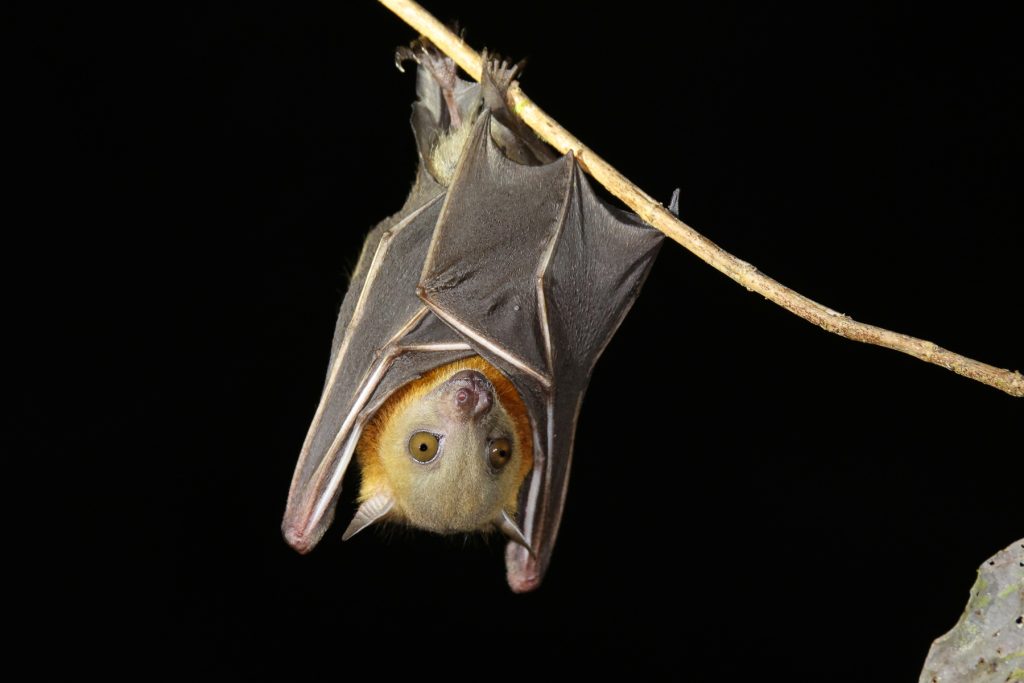
Photo János Oláh
Several at Kendari on our first night.
(Possibly a new species) ‘Peleng’ Short-nosed Fruit Bat (Cynopterus cf. minutus)
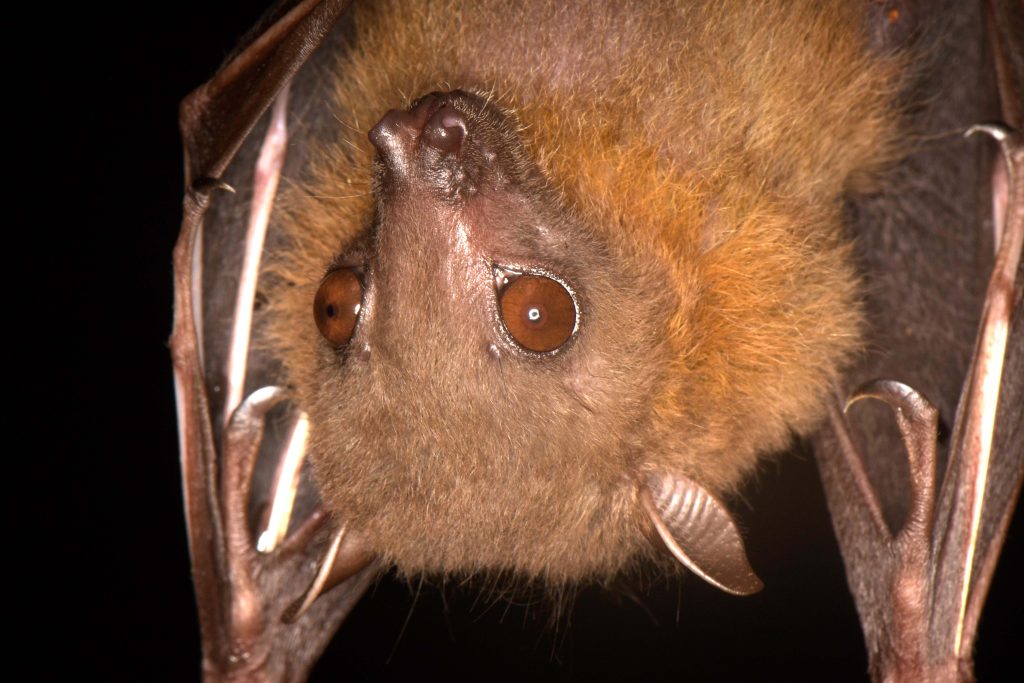
Photo Juliana Senawi
On our last night while we were searching for the Peleng Cuscus, Juliana was searching for bats and the locals capture several of these Short-nosed Fruit Bats. But both Juliana and Carlos saw immediately that their faces looked different to the other cynopterus we had seen during the trip. As Juliana noted: “the unusual Cynopterus in Peleng closely resembles Cynopterus minutus; however, it has a noticeably longer and narrower muzzle compared to the C. minutus individuals near Kendari. To me, this specimen appears somewhat intermediate between Thoopterus and Cynopterus, although this impression is likely subjective. For now, I suggest assigning it as Cynopterus cf. minutus.”
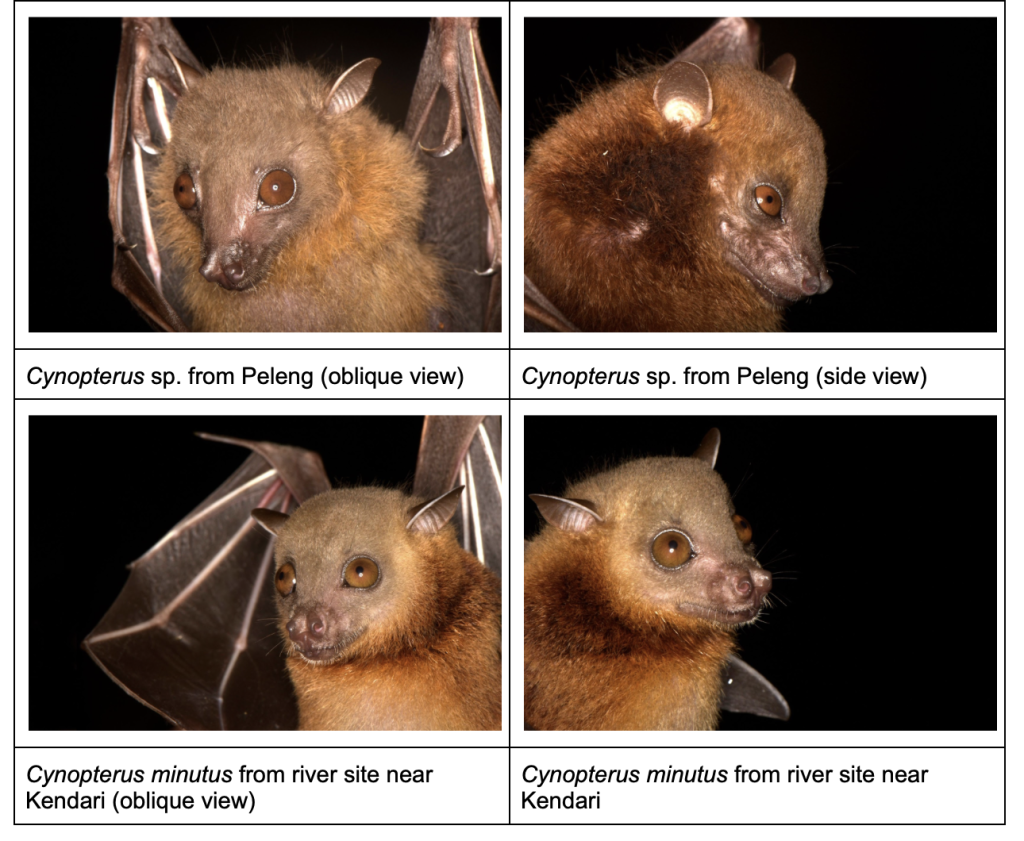
Prepared by Juliana Senawi
53. Lesser Dawn Bat (Eonycteris spelaea)
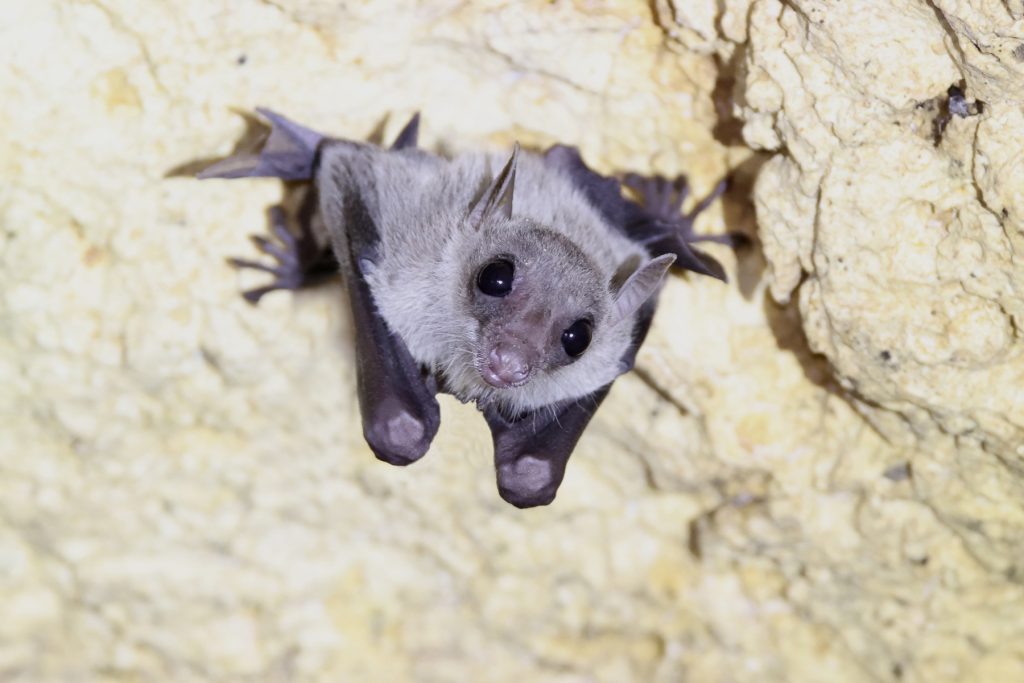
Photo János Oláh
A few in the bat cave at Malenge.
54. Sulawesi Fruit Bat (Pilonycteris celebensis)
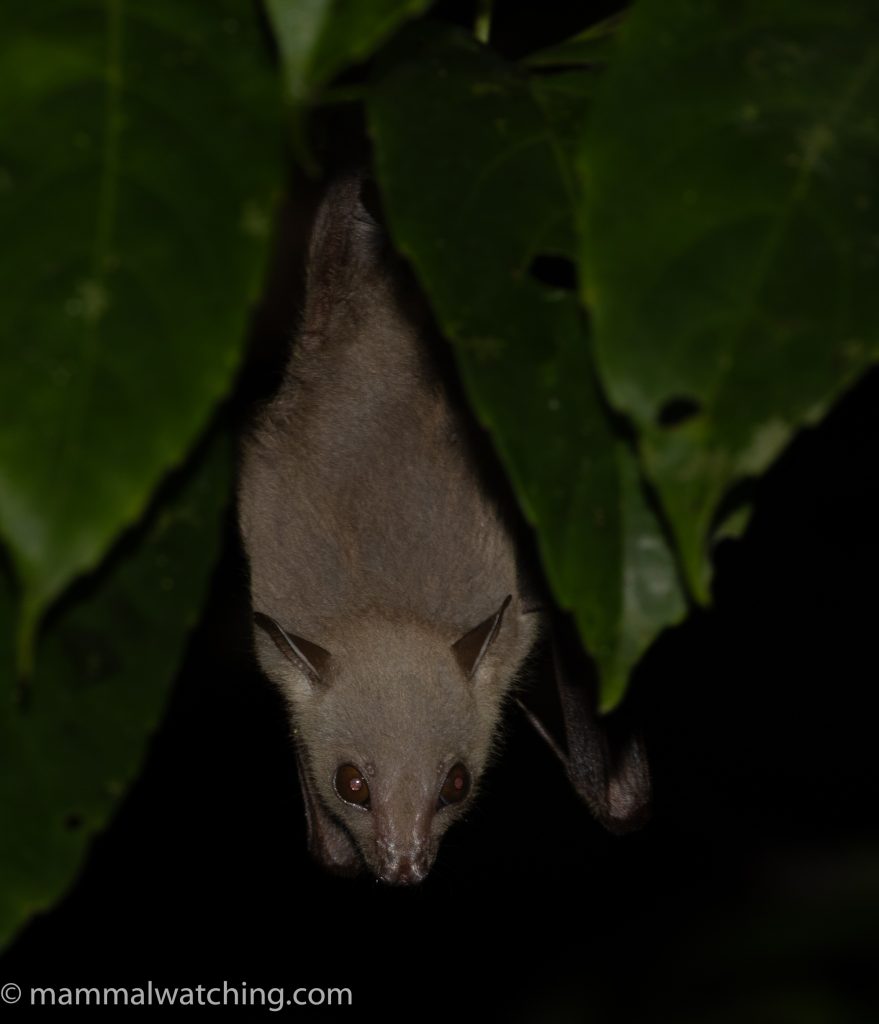
Photo János Oláh
A few at Kendari. This species is usually quite easy to see in Tangkoko
55. Geoffroy’s Rousette (Rousettus amplexicaudatus)
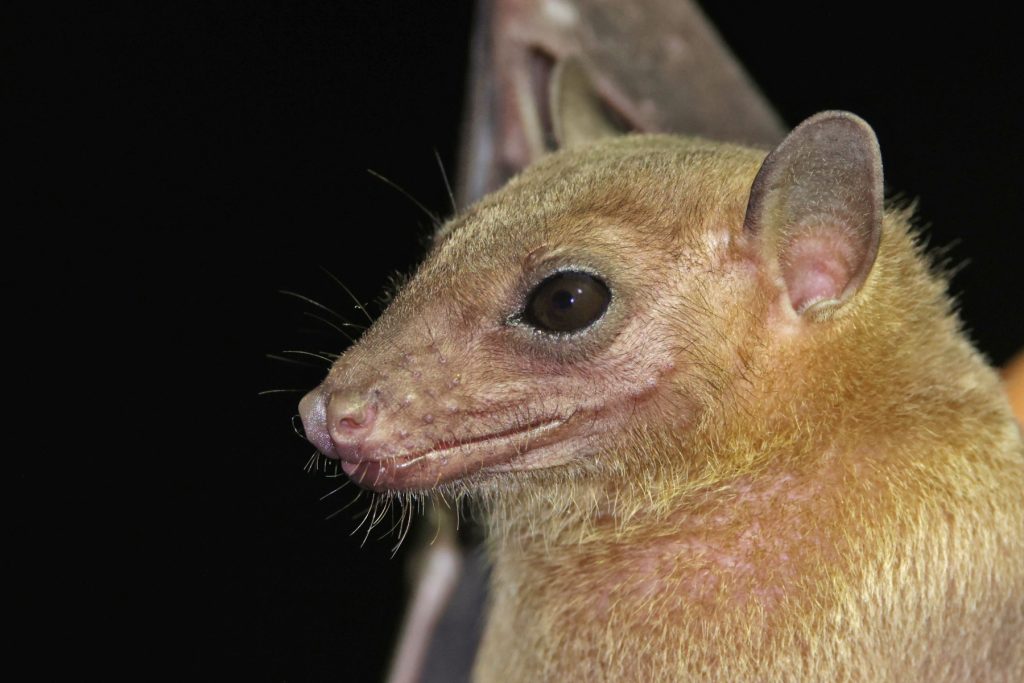
Photo János Oláh
In the bats caves at Kendari, Malenge and Peleng. We also saw some near Luwuk.
56. Sulawesi Naked-backed Fruit Bat (Dobsonia exoleta)
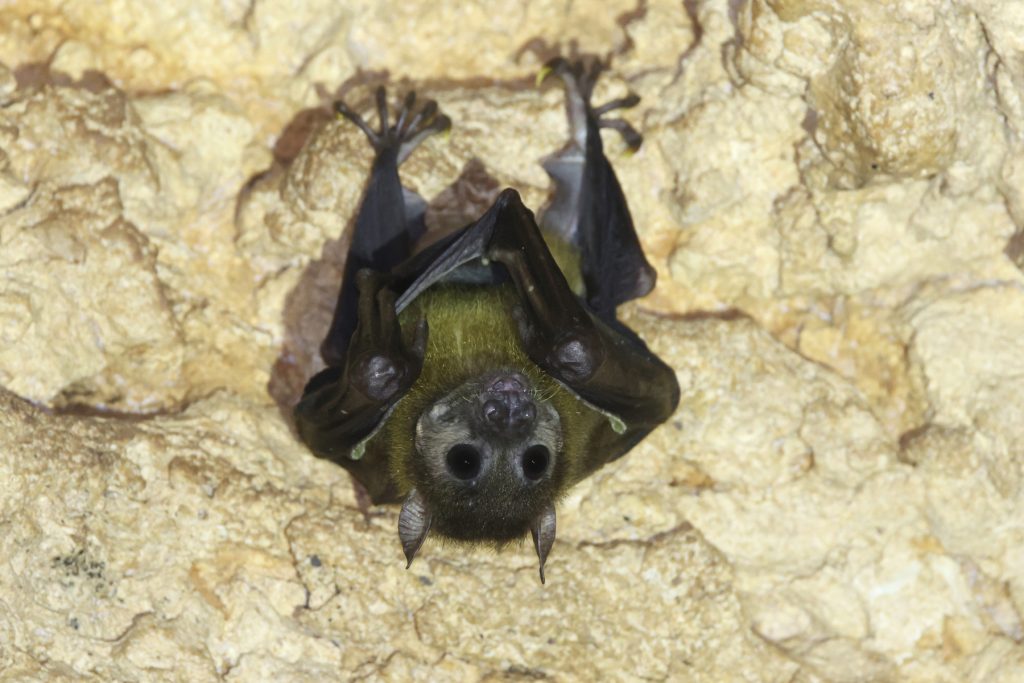
Photo János Oláh
Hundreds of these large, distinctive and messy bats in the cave on Malenge.
57. Sulawesi Harpy Fruit Bat (Harpyionycteris celebensis) – Lifer
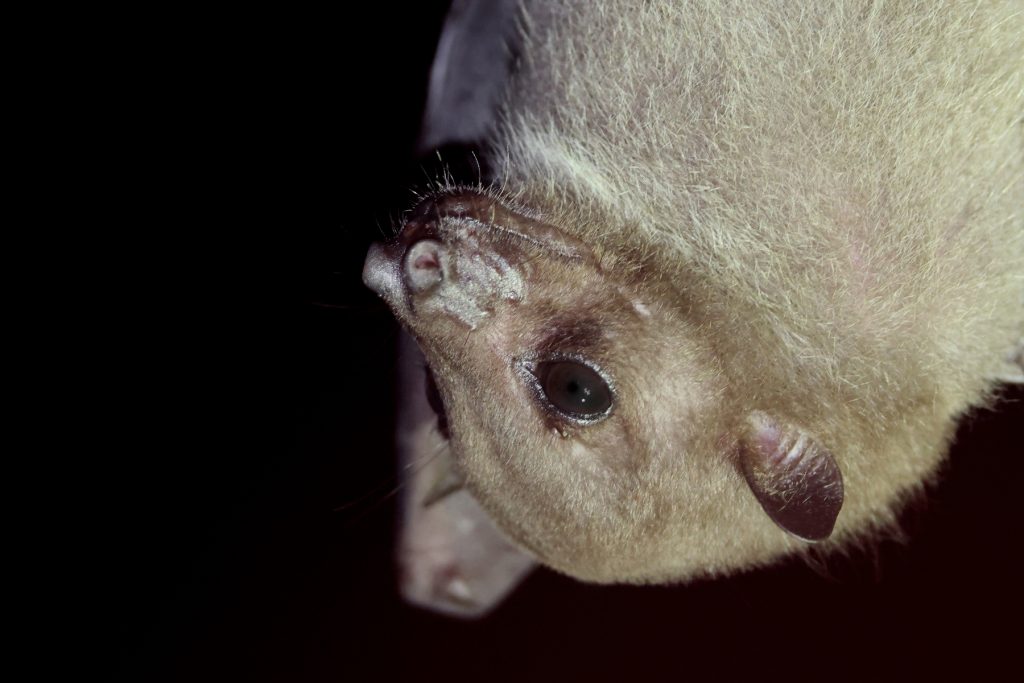
Photo János Oláh
Juliana found several around our camp in the Peleng Highlands on our last night and also at Lore Lindu and Lompobattang. A bat I wanted to see for its latin name alone!
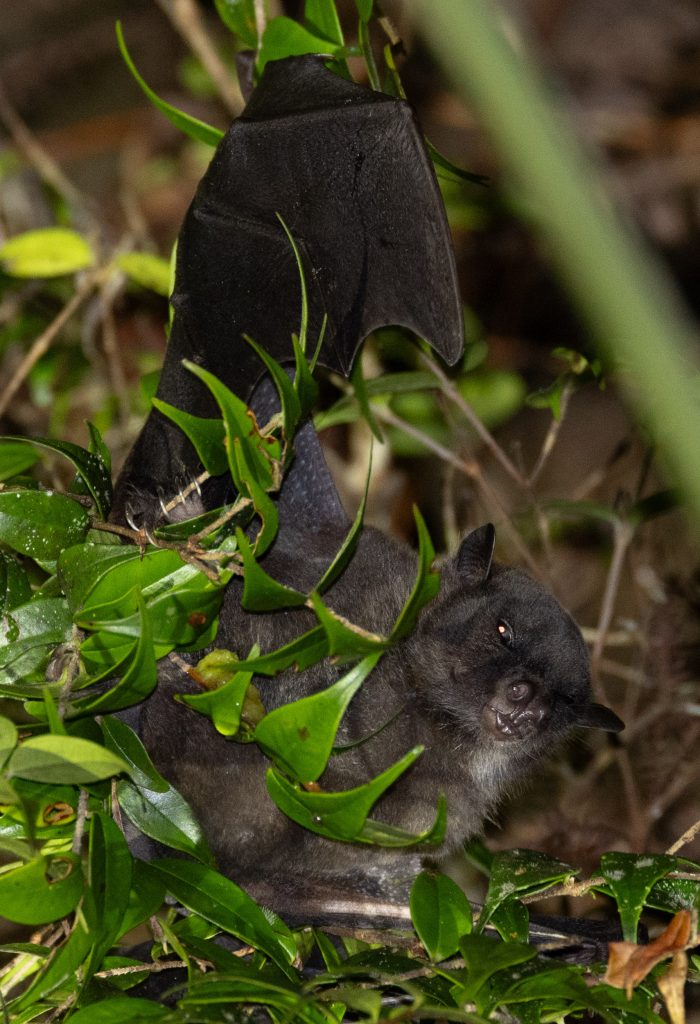
Photo János Oláh
This animal feeding on Lore Lindu is also possibly a Harpy Fruit Bat. But without good views it is very difficult to separate Harpyionycteris celebensis, Boneia bidens and Thoopterus species. The presence or absence of a tail is an important diagnostic so try to get photos of both ends of the bat.
58. Long-tongued Blossom Bat (Macroglossus minimus)
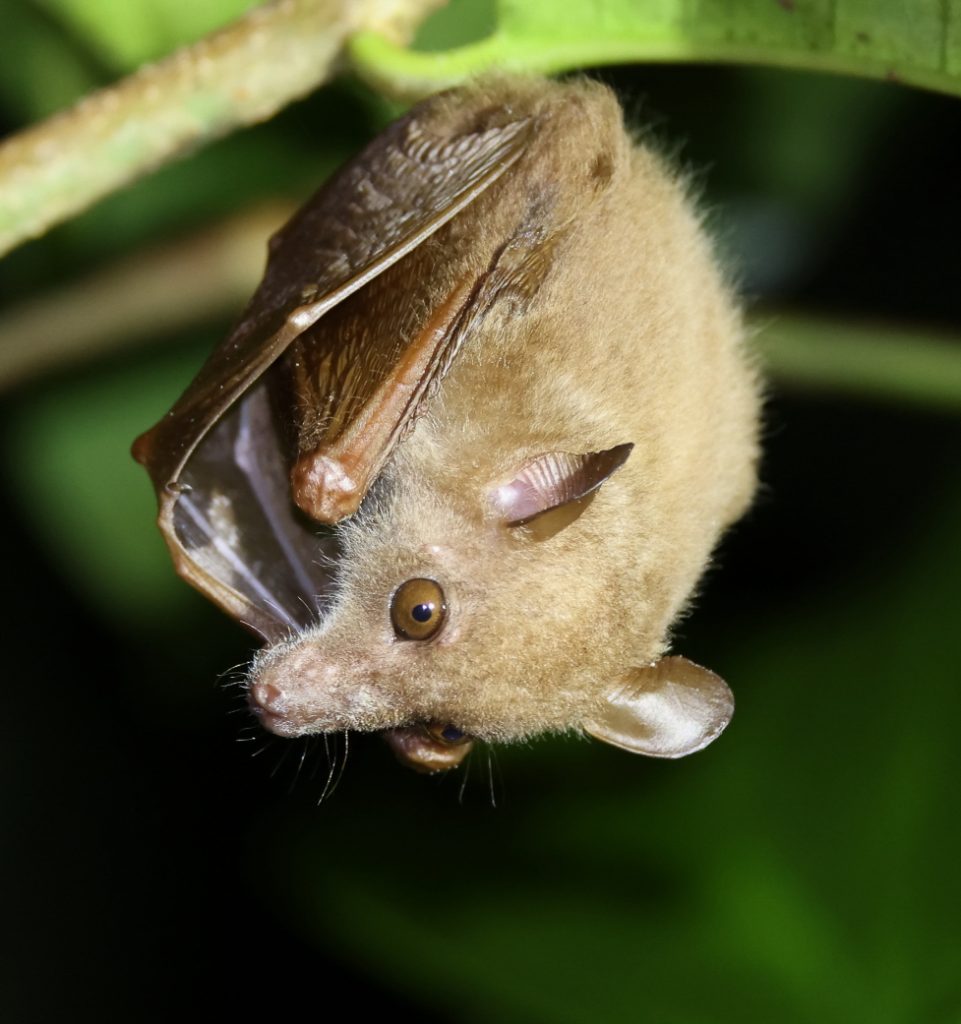
Photo János Oláh
A few seen at night around Lore Lindu and the Peleng Highlands.
59. Pallas’s Tube-nosed Fruit Bat (Nyctimene cephalotes) – Lifer
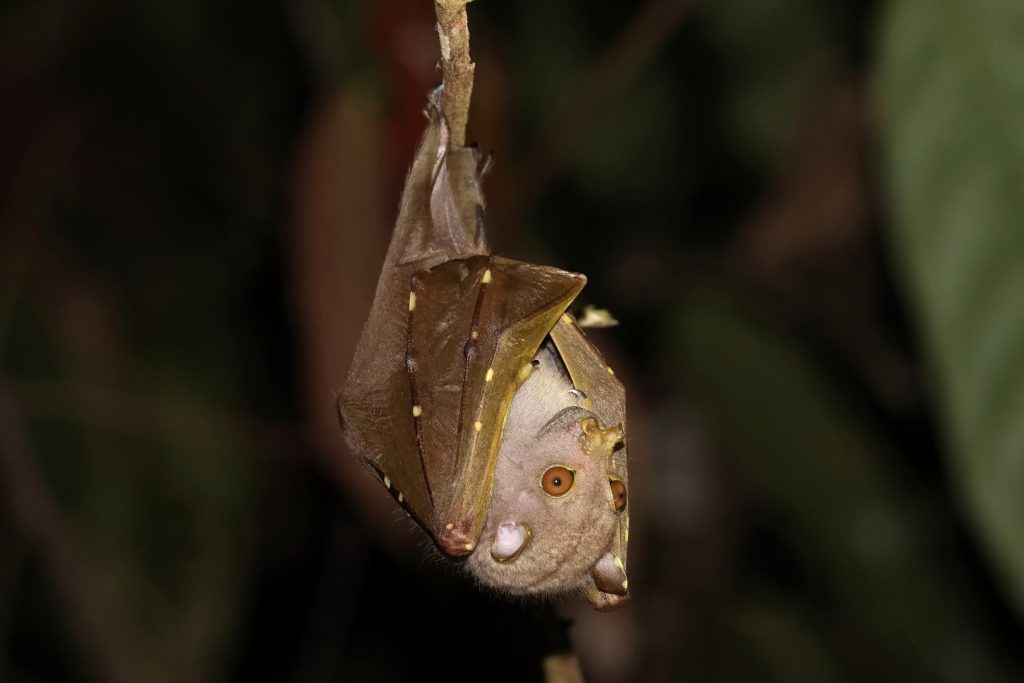
Photo János Oláh
Our thermals found several of these strikingly pretty bats on Peleng Island.
60. Sulawesi Flying Fox (Acerodon celebensis)
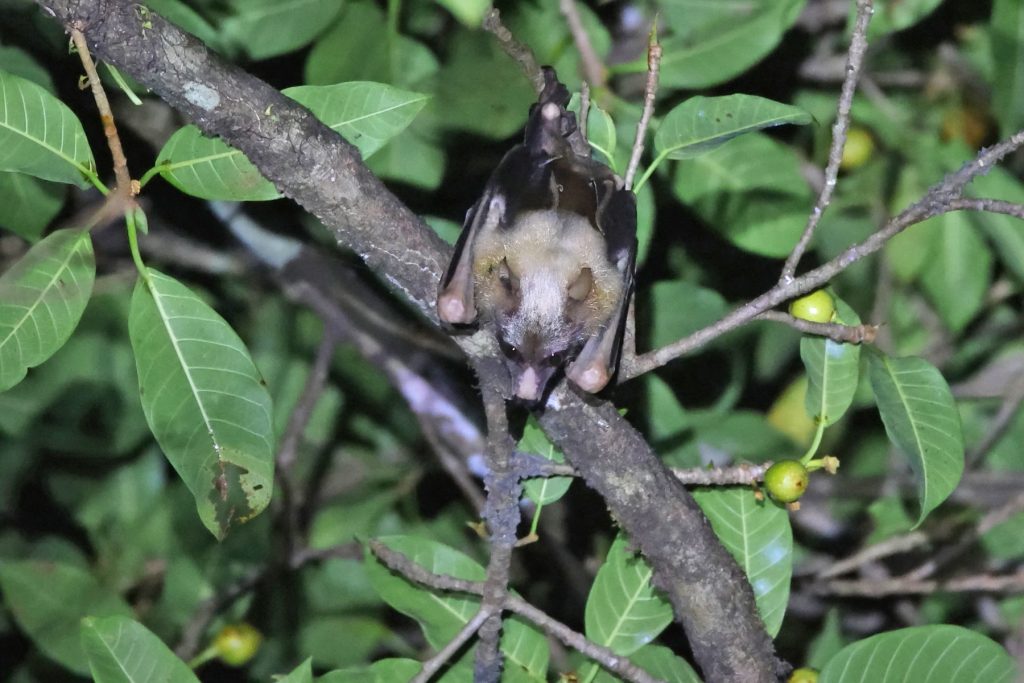
Photo János Oláh
A couple at Makassar. This species is quite easy to find in Tangkoko.
61. Wallace’s Stripe-faced Fruit Bat (Styloctenium wallacei) – Lifer
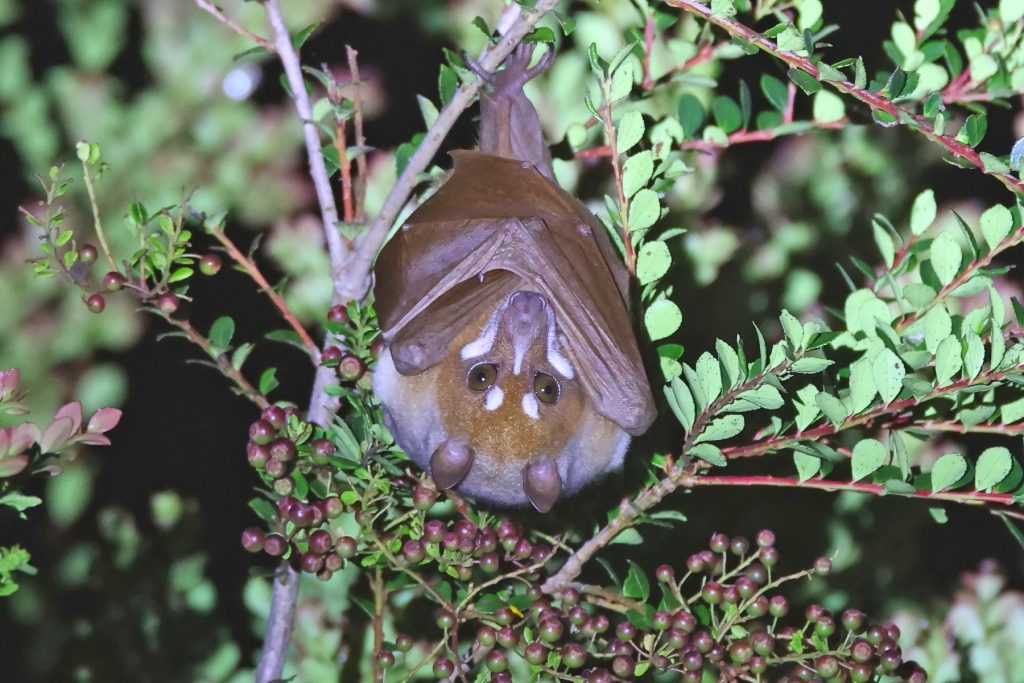
Photo János Oláh
An absolutely stunning bat. Surely one of the world’s most attractive! Though they are not uncommon on Sulawesi we only saw the species twice: on the Anaso Track at Lore Lindu and in the highland forest at Peleng.
62. Common Dusky Roundleaf Bat (Hipposideros ater)
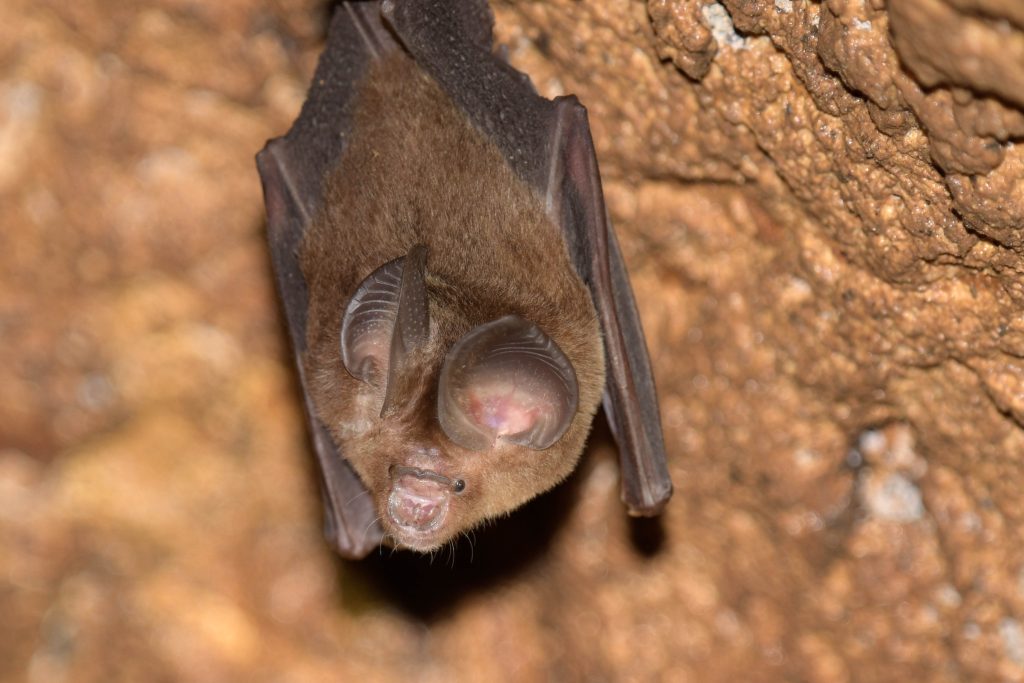
Photo Juliana Senawi
Some in the Malenge Island bat cave and the mega cave on Peleng.
63. Boeadi’s Roundleaf Bat (Hipposideros boeadii) – Lifer
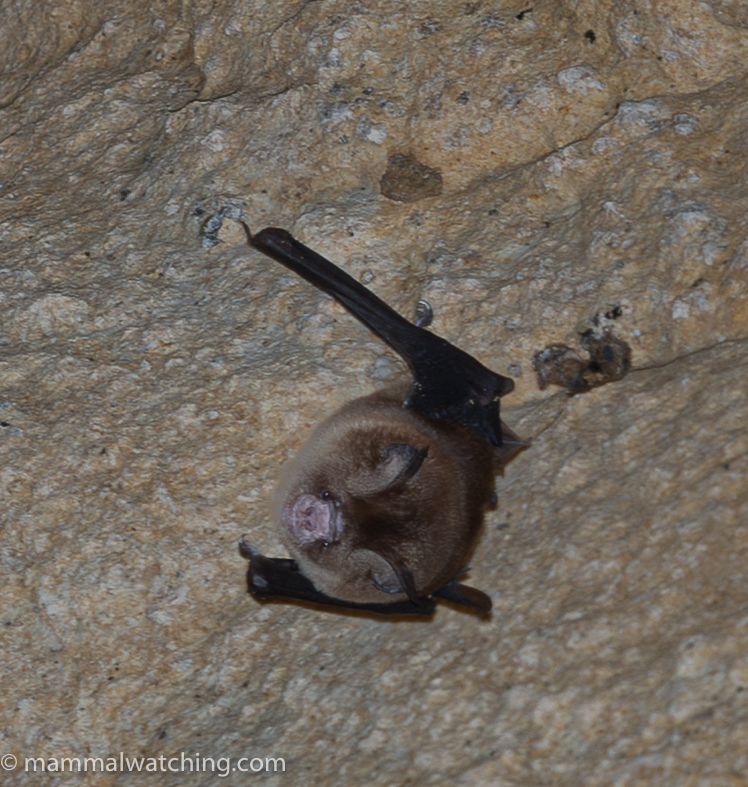
A few of these small roundleaf bats were roosting in the ‘Japanese Cave’ near Kendari.
64. Fawn-colored Roundleaf Bat (Hipposideros cervinus)
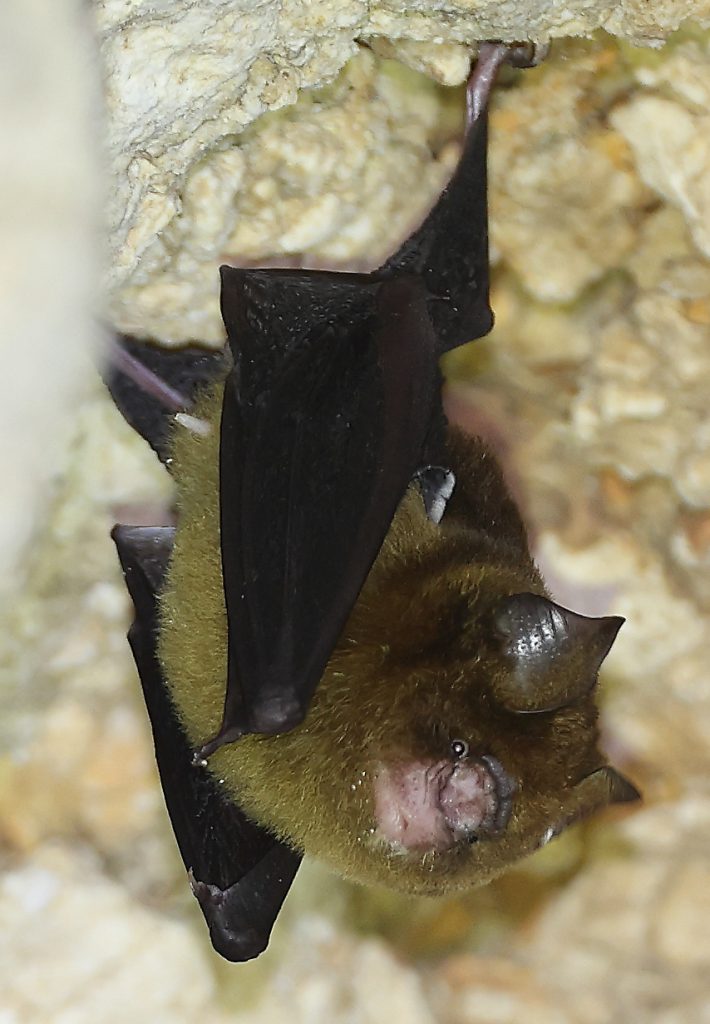
Photo Carlos Bocos
Many in the mega bat cave at Peleng.
65. Diadem Roundleaf Bat (Hipposideros diadema)
We saw several of these distinctive bats flying at night in Kendari but were not able to photograph them. Juliana for one was confident they were H. diadema rather than H. pelengenensis which were roosting in a cave in the same area (see below).
66. (Probably) Crested Roundleaf Bat (Hipposideros inexpectatus) – Lifer
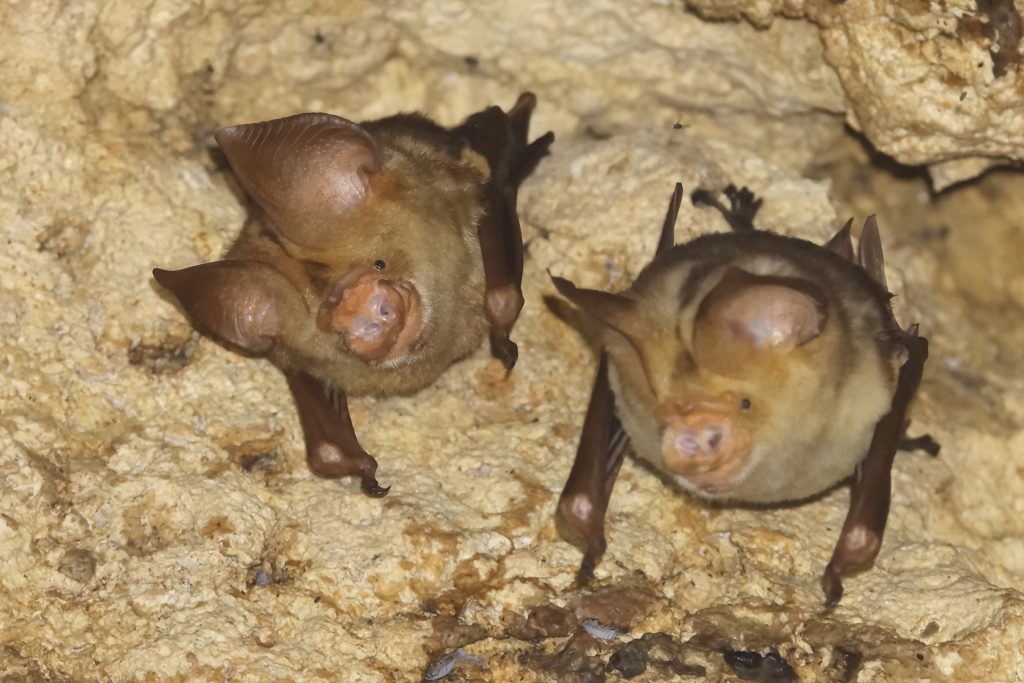
Photo János Oláh
The cave on Malenge was home to a colony of larger hipposideros which we initially assumed were Diadem Roundleaf Bats.
But when Juliana examined the photos she realized the bats were unusually large and thinks the species was Crested Roundleaf Bat (Hipposideros inexpectatus).
She wrote: “Based on limited available information, the principal diagnostic difference between Hipposideros diadema (FA ≈ 76–87 mm) and H. inexpectatus (FA ≈ 100.8 mm) is forearm length. No diagnostic differences in pelage coloration have been described for these species.
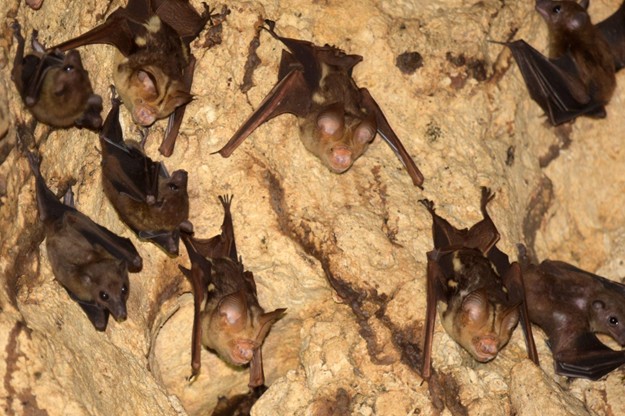
In the photograph above, the Hipposideros individual is positioned next to Thoopterus nigrescens (FA ≈ 74–82 mm). Proportional comparison suggests a forearm length of approximately 90–100 mm for the Hipposideros photos.
I’ve seen many H. diadema, but I’ve never encountered H. inexpectatus, so it’s actually difficult for me to make a firm decision. But, I think we can probably settle on Hipposideros cf. inexpectatus for now, as it is a poorly described and data-deficient species.”
67. Peleng Roundleaf Bat (Hipposideros pelingensis) – Lifer
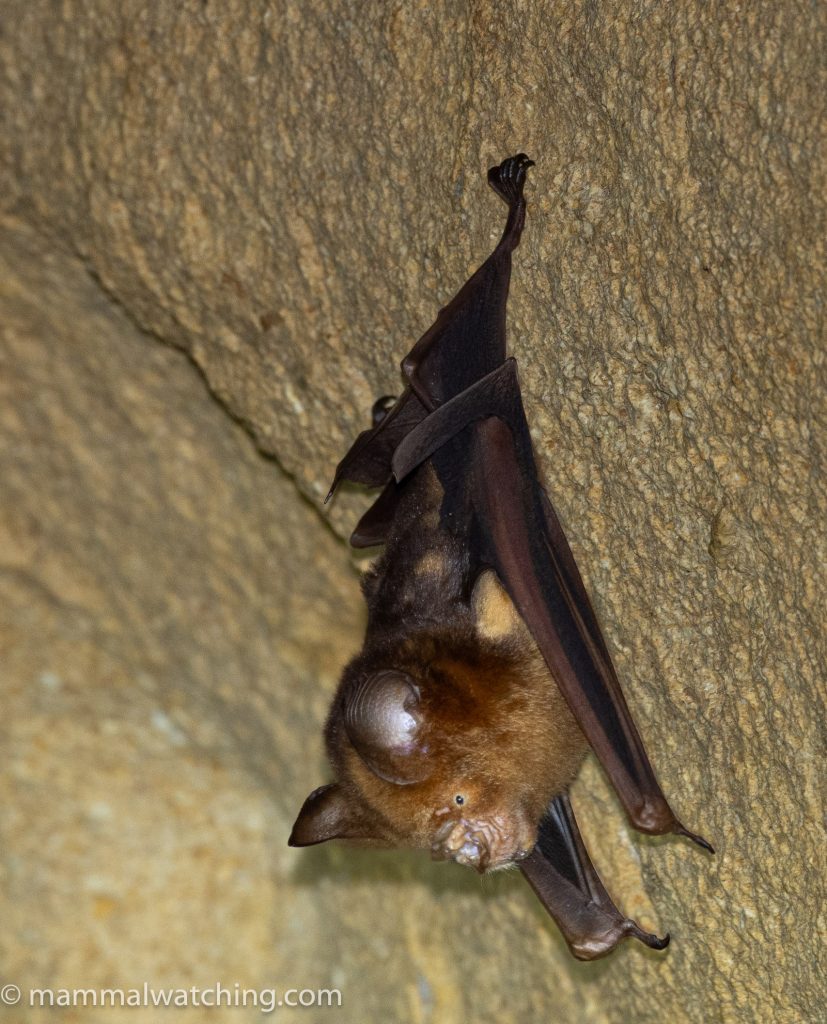
Peleng Roundleaf Bat (Hipposideros pelingensis)
Several of these large distinctive bats in the ‘Japanese’ cave near Kendari.
68. Lesser Asian False-vampire (Megaderma spasma)
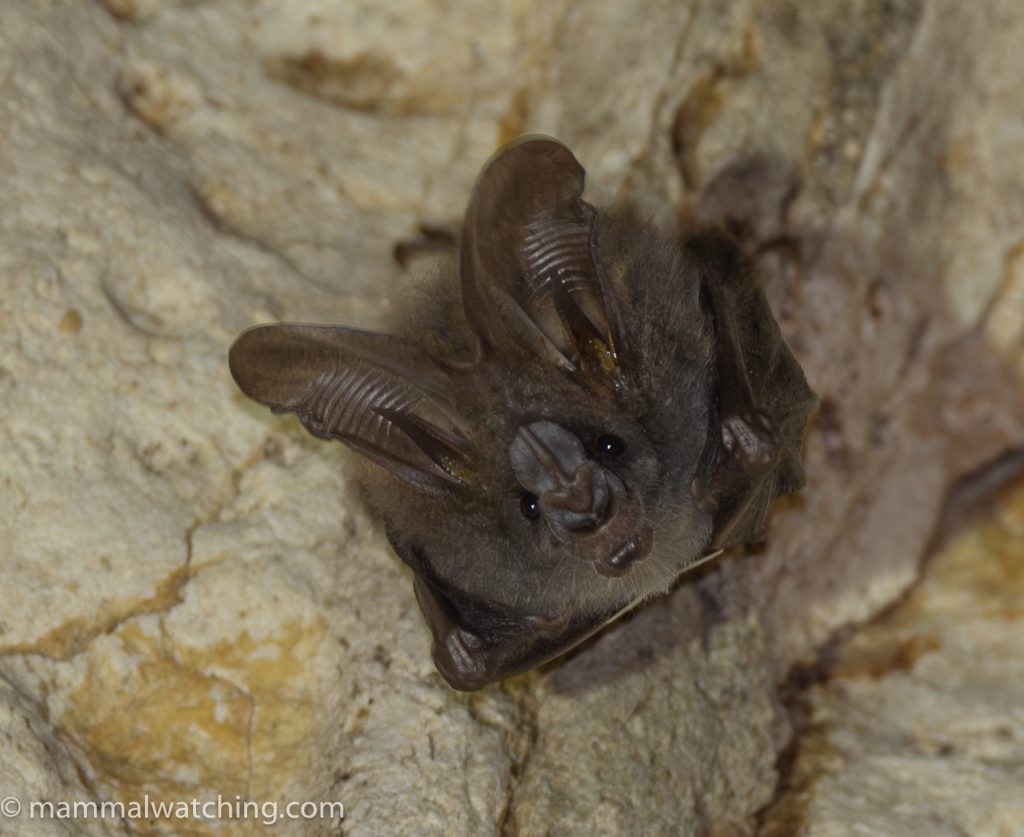
Photo János Oláh
A handful in the mega cave on Peleng.
69. Poso Horseshoe Bat (Rhinolophus cf. belligerator) – lifer
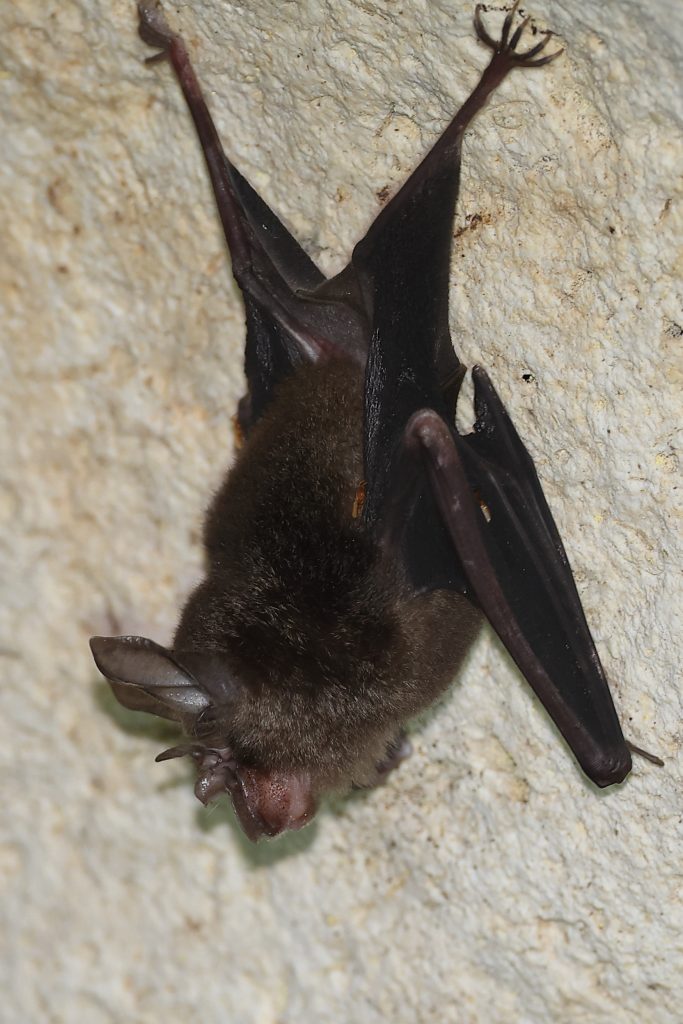
Photo Carlos Bocos
Another exciting find from the mega cave on Peleng, the cave that keeps on giving, was this horseshoe bat species that Julliana believes is the almost unknown Rhinolophus belligerator (another great name!) and these may be the first photos of live animals.
She notes that “Although this species was only described relatively recently (in 2013), its description was based on craniodental morphology. Sometimes scientists do make field identification more challenging for us!
- belligerator belongs to the euryotis group, of which at least four species are known to occur in Sulawesi: R. belligerator, R. arcuatus, R. tatar, and R. euryotis. The main diagnostic characters distinguishing these species are forearm length and the shape of the sella.
- belligerator was described following the taxonomic splitting of the former R. arcuatus subspecies from Sulawesi, the Philippines, and Borneo. The current understanding is that R. arcuatus is primarily found in the Philippines, R. belligerator in Sulawesi, and R. proconsulis in Borneo.
Therefore, I suggest identifying the Rhinolophus observed in Mega Cave, Peleng, as Rhinolophus cf. belligerator. I am using “cf.” because we may be among the first to obtain photographic documentation of this species.”
70. Sulawesi Horseshoe Bat (Rhinolophus celebensis)
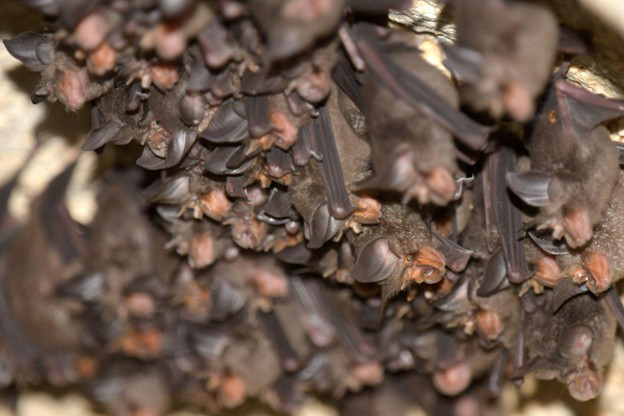
Photo Juliana Senawi
We were unable to photograph animals we saw night roosting around Makassar and Kendari, but Juliana identified the yellow-faced morph of this species at the mega cave in Peleng.
71. (Probably) Large-eared Horseshoe Bat (Rhinolophus cf. philippinensis) (small morph) – Lifer
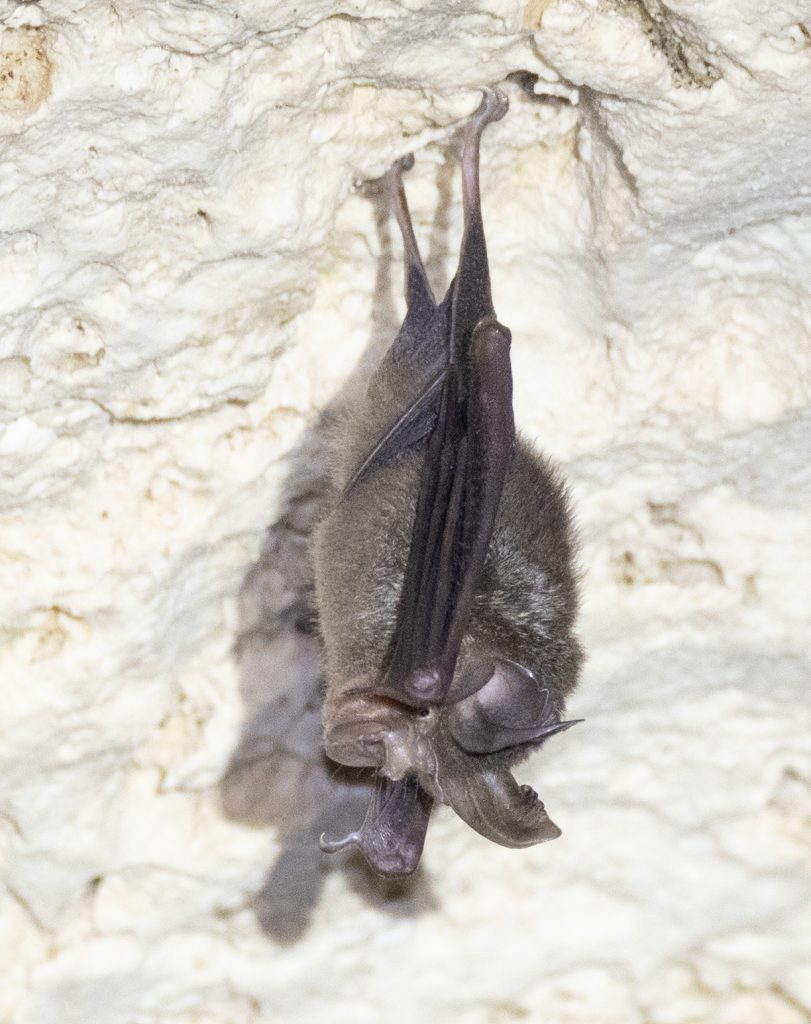
Photo János Oláh
A species I desperately wanted to see, and we saw it in good numbers in the mega cave on Peleng, though photographing them in the humidity was very challenging. According to Juliana these may be the small morph of the species or may represent an undescribed species.
72. Sulawesi Broad-eared Horseshoe Bat (Rhinolophus tatar) – Lifer
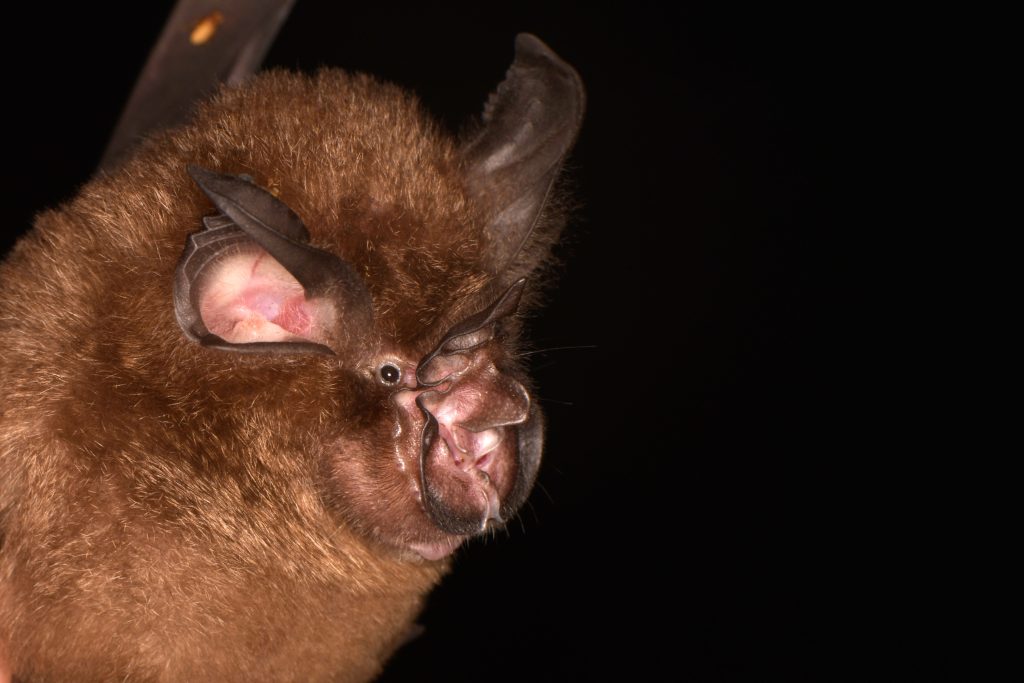
Photo Juliana Senawi
This animal was in the forest on Malenge Island.
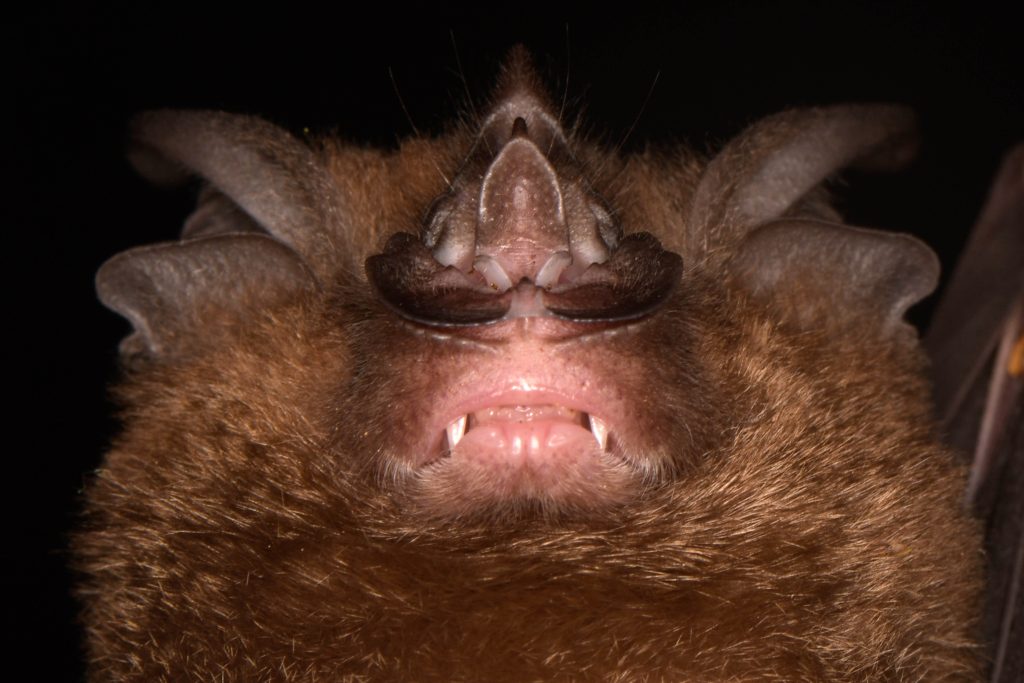
Sella detail of Rhinolophus tatar. Photo Juliana Senawi
73. Spinner Dolphin (Stenella longirostris)
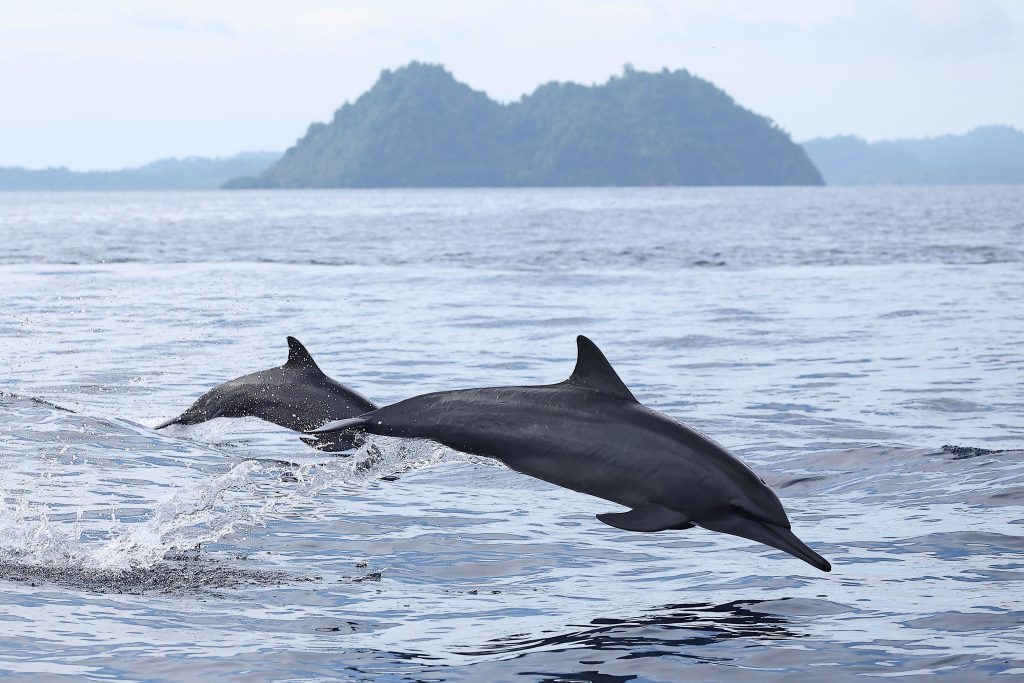
Photo Carlos Bocos
A small pod seen briefly close to Malenge Island.
74. Risso’s Dolphin (Grampus griseus)
A pod seen briefly from the boat between the mainland and Malenge Island.
75. Togian Babirusa (Babyrousa togeanensis) – Lifer
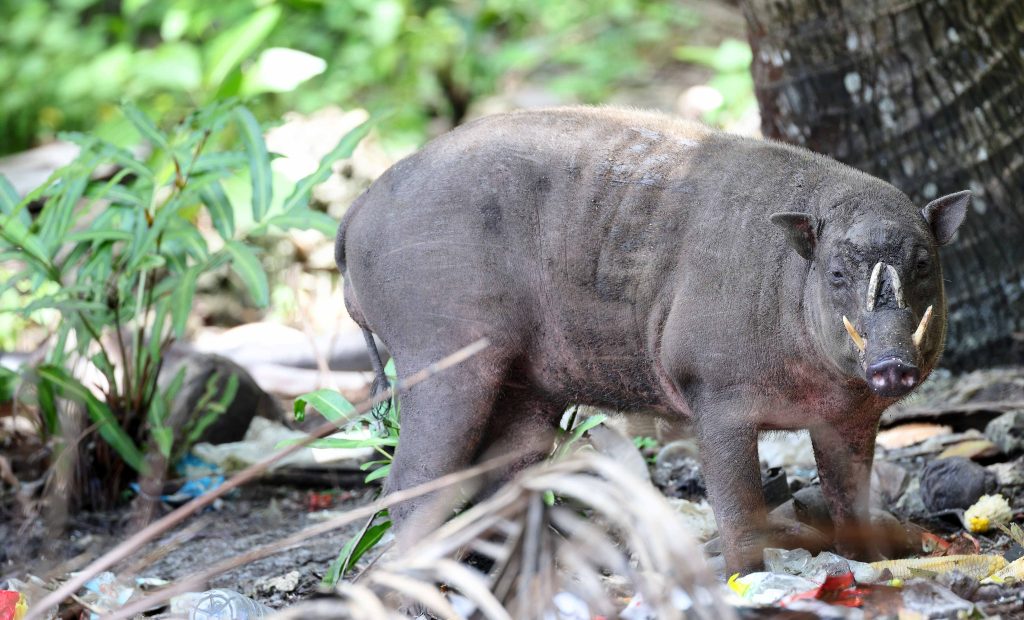
Photo Carlos Bocos
Easy to see on Malenge Island behind our hotel now that several animals have been habituated thanks to the work of Dr. Ating Solihin (see the Malenge Island section above). Hopefully Asian Swine Flu will not reach Malenge.
Stuff We Missed
There were plenty of other possibilities we might have run into, but we missed four targets in particular. We failed were the Mountain Bear Cuscus, Sulawesi Giant Squirrel and Montane Long-nosed Squirrel on Lore Lindu. All of them are seen there quite often. We also missed an undescribed tarsier at Kendari, much to Carlos’s surprise. And last we had a vague hope of running into Sulawesi Palm Civet near Luwuk: the local guides have seen them there occasionally.
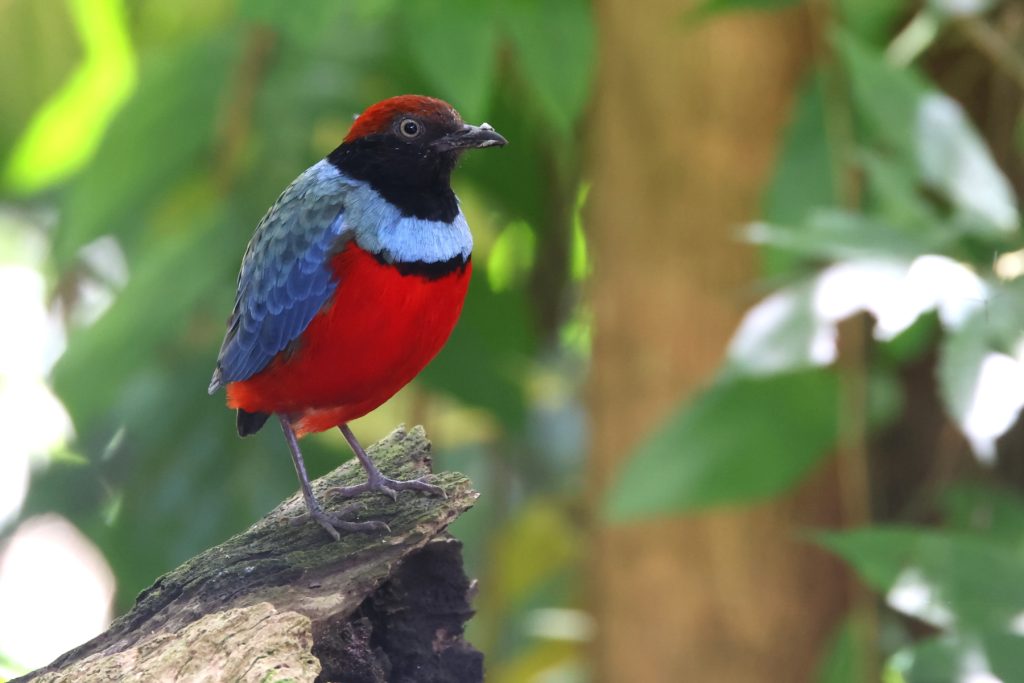
Sula Pitta. Photo Photo János Oláh
Final Thoughts and Thanks
What a trip! 75 species beat everyone’s expectations, with 47 lifers for me and a few more in the pipline.
There is a great deal still to be discovered in Sulawesi. Too much in fact. The initial excitement of finding possible new species soon turned to groans. New species are all very well but how can we tick them off! Uptown problems,
Many people deserve thanks: all of my companions on the trip for their good humour, great company, teamwork and enthusiasm for everything including making sure we never missed “sweetie time” at the local 7-11s. I ate a year’s worth of ice cream and M&Ms in a fortnight. Thank you for joining me!
They have also had to deal with about a hundred emails from me asking for photos in the course of preparing this report. A special thanks to János for answering most of them.
Thanks to all the local guides and drivers we used – all great people.
A massive thank you Juliana Senawi for being a fountain of bat knowledge on the trip, working so hard and always smiling no matter how many times we asked her the same question. When she got home she worked tirelessly to try to figure out all those bats.
Thank you too to the experts who have already taken a look at some of these pictures and offered advice, especially Kevin Rowe from Museums Victoria in Australia who has been super helpful. Of course all mistakes and the courageous ID decisions are down to me.
And finally the biggest thanks of all to Carlos for designing and leading such a superb trip which he managed to complete just hours before the birth of his son. His new company mammalia will be returning to Sulawesi soon. So please go and please try to get more bat photos!
I have seen the mammalwatching future. The future is Carlos.

Charles Foley. Sweetie time connoisseur.

Post author
8 Comments
-
-
-
-
OrnithologyDevotee
Indonesia is a treasure trove of new species. I imagine new species will be described from Indonesia for a long time, even when most other countries slow down. Too bad it makes identification so challenging! I have been reading through the site for a while, but I have only made an account today. I must say, this is the most in-depth report I’ve ever read on mammal watching. I truly appreciate the time you put into your reports, Jon. As always, excellent photograph, and in-depth details (taken to a whole other level than I typically see).
-
Jon Hall
Thank you! I’m glad to know you thought this report was worth the effort it took to write. We were so fortunate to go on an expedition like this which might contribute something to science so I tried to get our IDs as accurate as we could. But it’s a challenge there for the reasons you said.
-


Leave a Reply
You must be logged in to post a comment.
CarlosBocos
Absolutely amazing trip report, Jon! What a wealth of knowledge! It will be a reference for anyone interested in the mammals of Sulawesi