

Chasing Madagascar’s Carnivores, September 2026
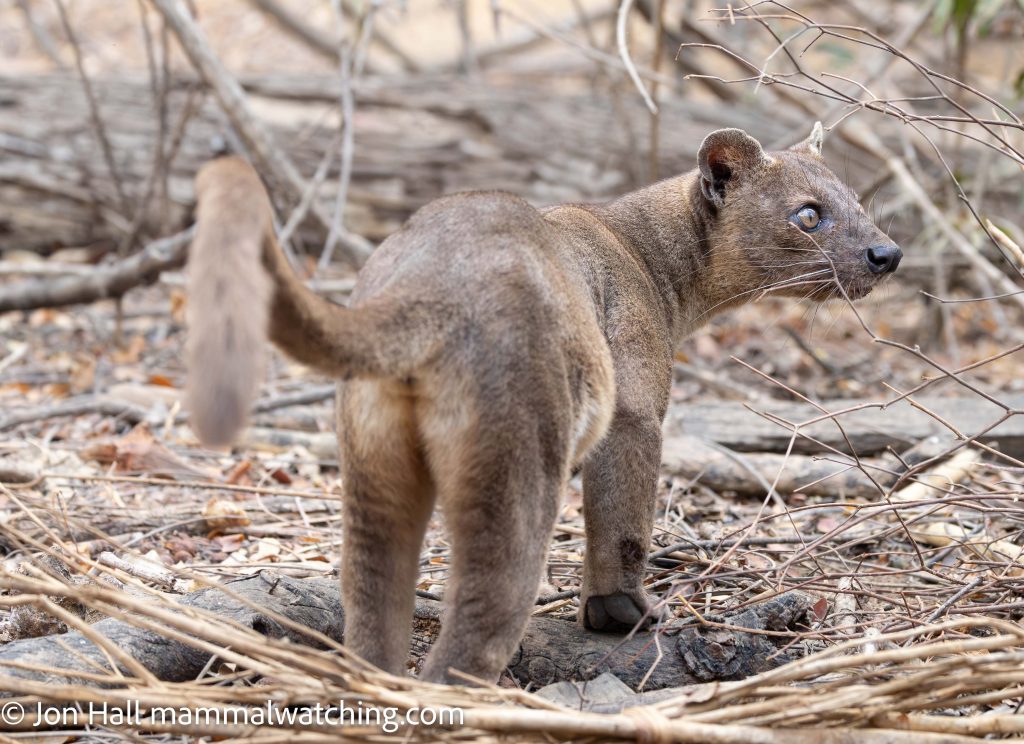
Fossa (Cryptoprocta ferox), Kirindy
Jon Hall & Patrick Richard; with Karen Czekalski, Daniel Dahan, Andy Holman, Kat Smith, Michael and Janet Turner, and Simon Van Der Meulen.
If you have been to Madagascar then I you will understand what I mean when I say the island is more of a continent than country. At least it is from a mammalwatching perspective.
Like every continent it deserves multiple trips to do it justice. And that is why I returned for a third time in September 2026, to guide a tour operated by Miru Adventures alongside brilliant local guide Patrick Richard. More on him in a minute.
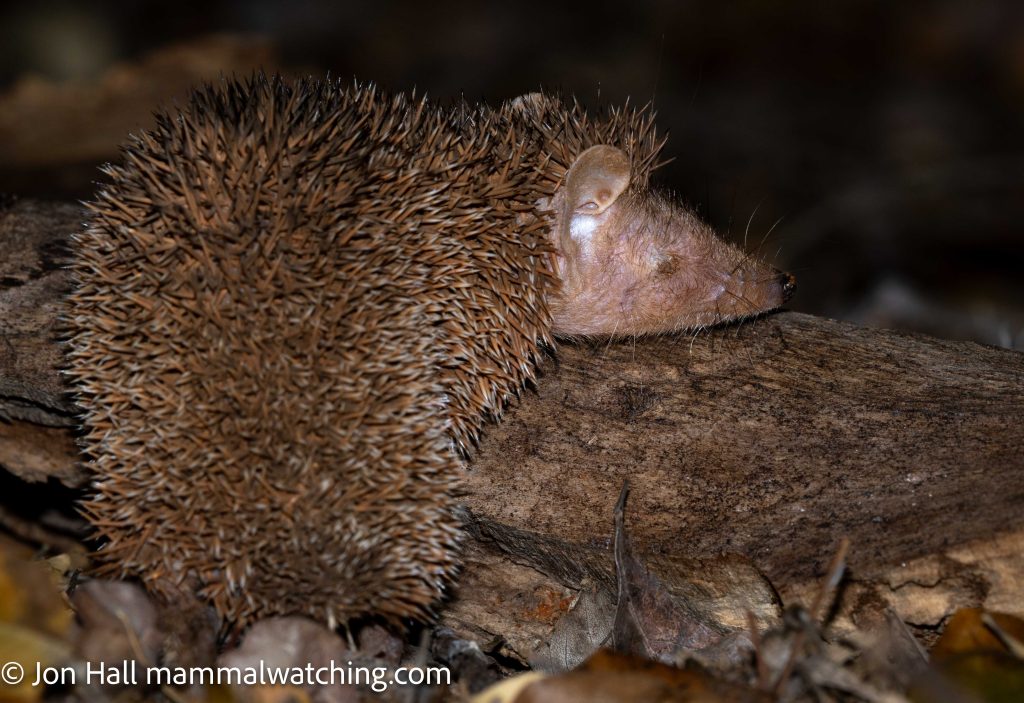
Lesser Hedgehog Tenrec (Echinops telfairi), Chez les ZA Spiny and Baobab Forest
Now I love lemurs as much as the next man, but there is more to Madagascar than a 110 lemur species. Not least the seven endemic carnivores from the Eupleridae family, all of which don’t get enough nearly enough press in my view.
So Patrick and I – with help from Sam Riley at Miru Adventures – cooked up what was almost certainly the first carnivore tour to the island. It won’t be the last though! My new tour company – mammalwatcher tours – will be running an almost identical trip in August next year, once again with Patrick. Let me know if you are interested in joining.
Patrick deserves nearly all the credit for the success of this tour. My only real contribution was coming up with the idea of running a carnivore tour in the first place and making sure we ran it with Patrick.
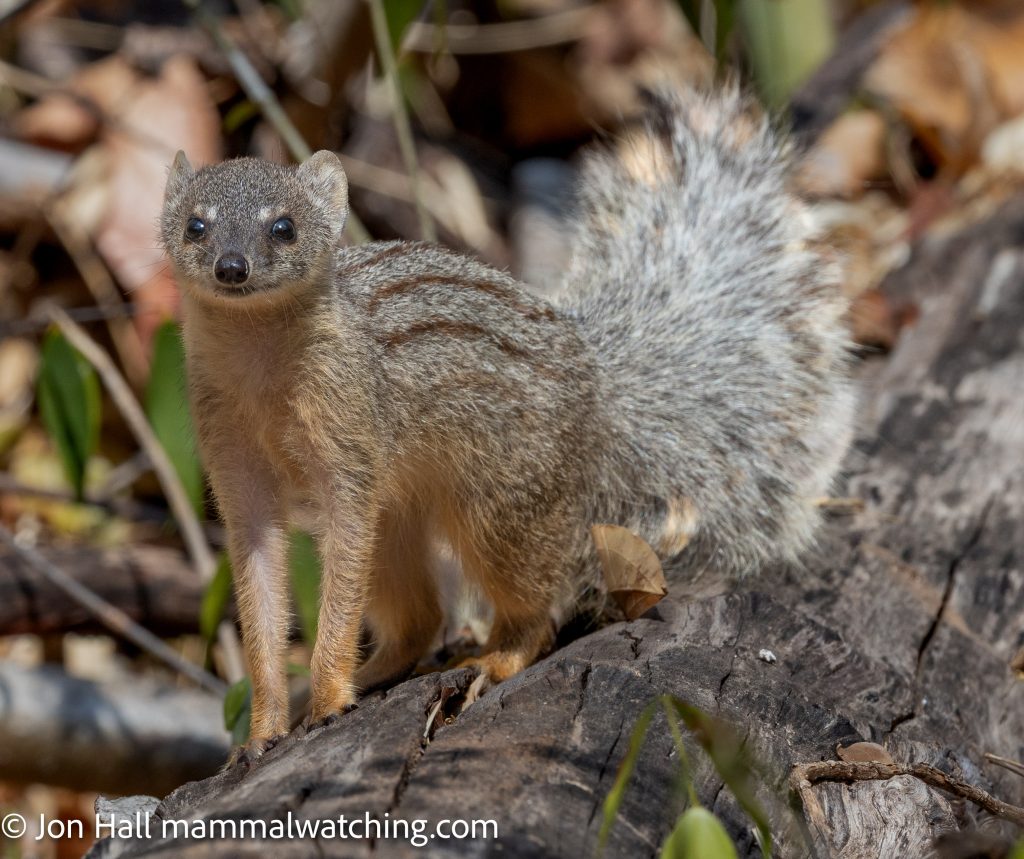
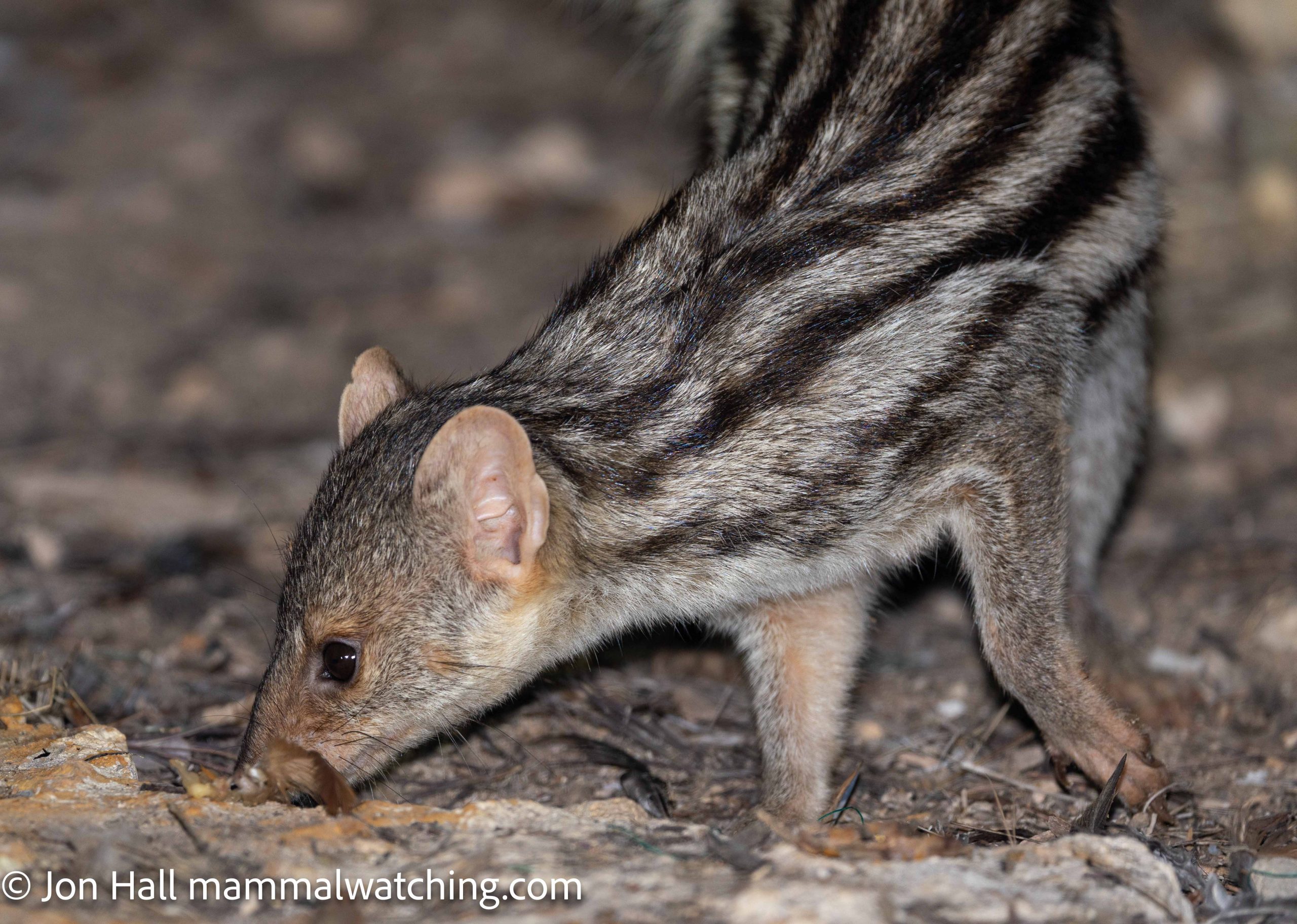
Narrow-striped Boky (Mungotictis decemlineata), Kirindy
Patrick Richard
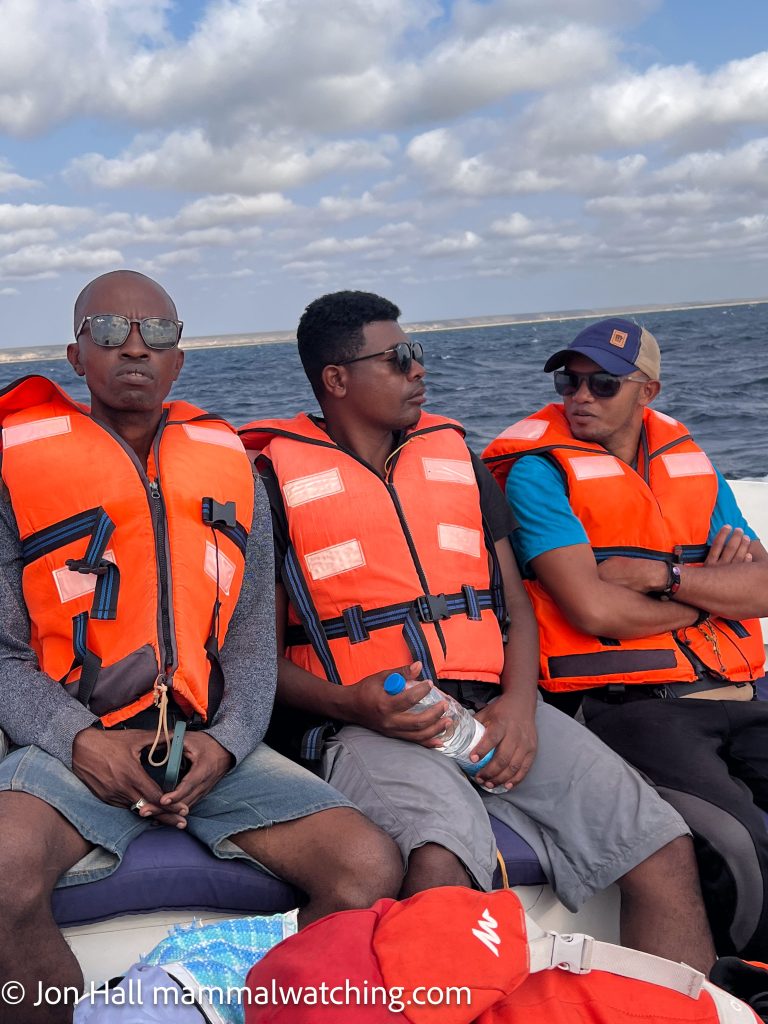
Patrick (right) models his lucky cap
Patrick Richard ran his first mammalwatching tour – for me – in 2022. He was fantastic and so it is no surprise to see he has gone from strength to strength over the past four years and built a successful business. He has learned a lot in the process and organized this complicated trip to perfection.
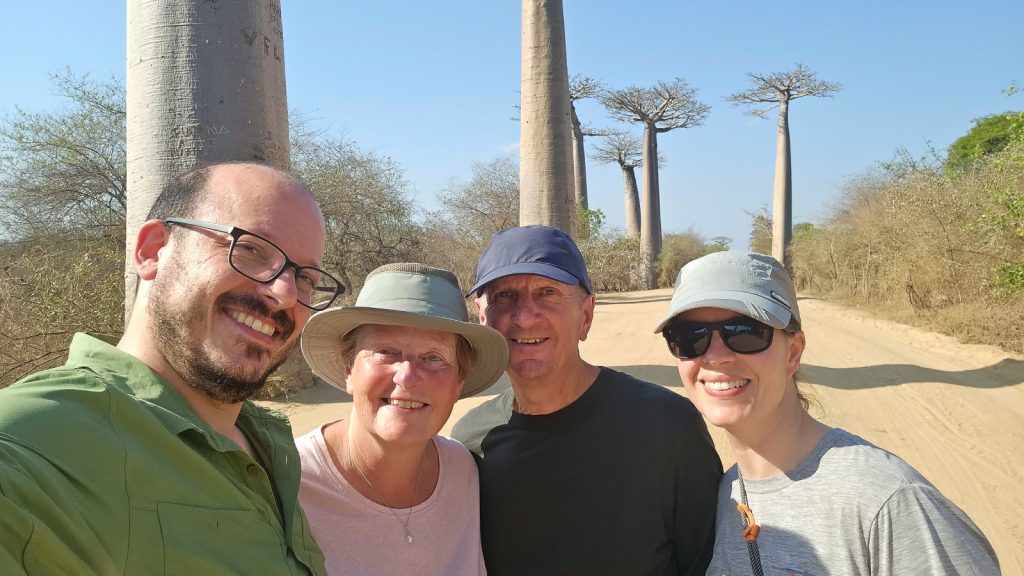
Daniel, Janet, Michael and Kat. Four of Patrick’s seven happy clients!
There is a lot more to being a guide than finding the animals. It is easy to forget how complicated it must be to organise a trip across Madagascar connecting flights with drivers, boats and accommodation.
Yet everything went smoothly.
Because Patrick is so well connected across the country he secured excellent and flexible local guides who could cater to our particular interests. We visited the best areas, at the right times of day, to find our target species. It made me super happy to see several local guides nervously approach Patrick to introduce themselves. He’s become a bit of a celebrity and is now a role model for a new generation of young Malagasy guides.
Enough said. Book your trip with Patrick. You won’t be disappointed.
Getting Around, Hotels, Food and Stuff
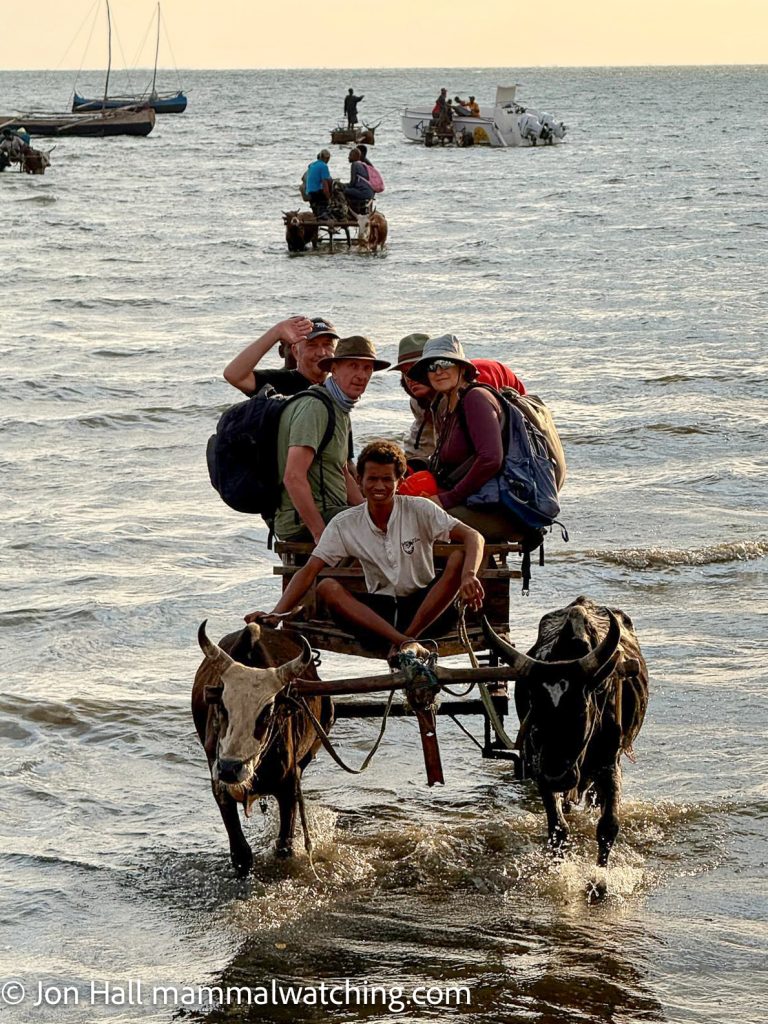
Zebu Uber – aka ‘ZUber’ XL
This was by far the most comfortable of the three trips I’ve taken to Madagascar. Nearly all of the hotels we stayed in were very good and one – the Bakuba Lodge in Toliara – was jaw-droppingly wonderful. When I sent the pictures to my daughter Katy she texted back “This looks like the kind of hotel you would take me to so you could say you had gotten me a pool. But we’d arrive at midnight and leave at 6am”. Thankfully we had more time than Katy ever did to enjoy that place.
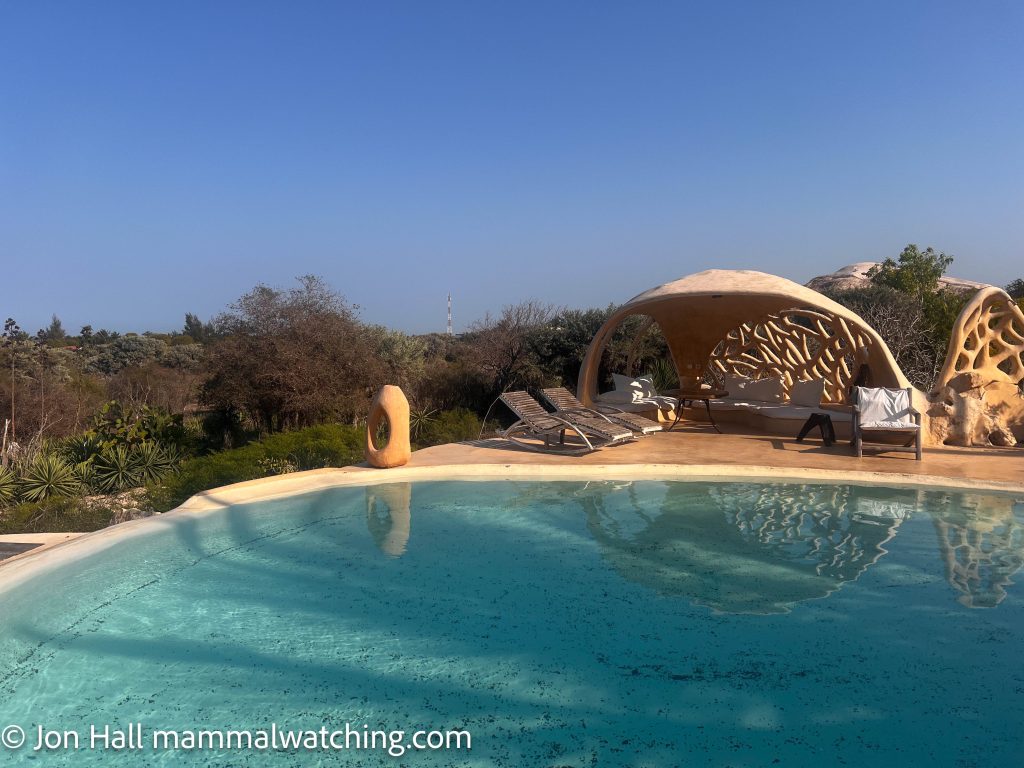
Bakuba Lodge
To mix things up we camped for a couple of nights in Tsimanampetsotse and Farankaraina, and spent two nights in the basic Kirindy Ecolodge, which is the best place to see Fossa.
Some of the roads had far more than their fair share of pot holes but they were much better than most of the roads we had used in the north in 2022.
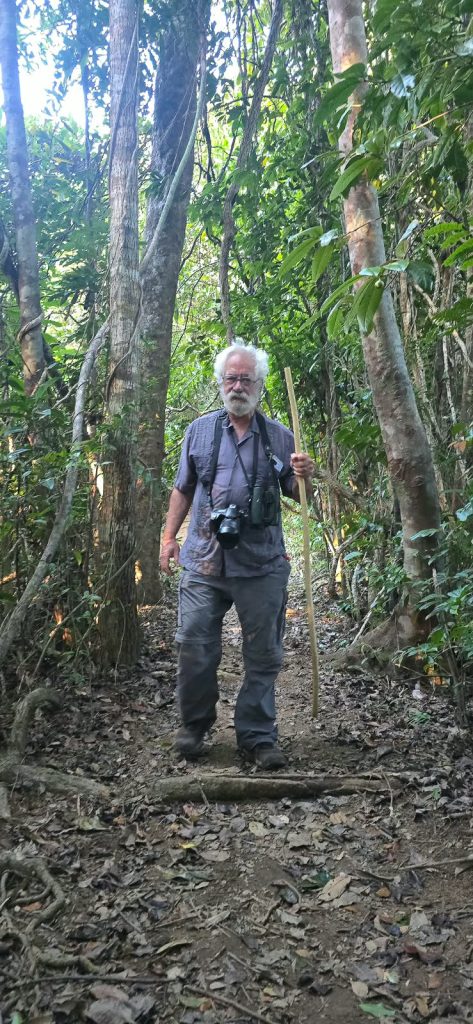
Andy in Masoala
The food was generally good and sometimes excellent, especially if you are a fan of Zebu steak. Most of the group got sick once or twice. I am not sure whether this was ‘Madagastro’ or a virus. It may have been the latter as the stomach problems moved from person to person during the course of the trip.
Most of the walking was easy other than in Masoala and Farankaraina where we did some long, steep and sometimes slippery hikes.
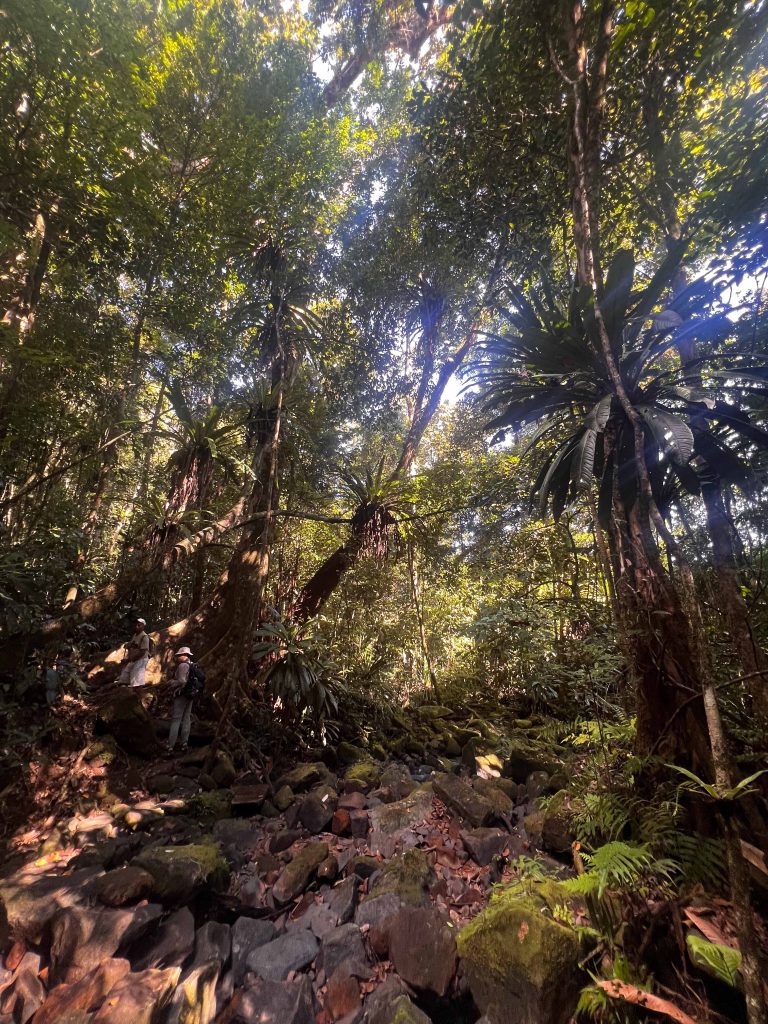
Masoala National Park
In 2024 Madagascar Airlines appeared to cancel more flights than they actually ran (see Ian Thompson’s 2024 report for example). They are now vastly improved and all of our flights operated on schedule more or less. Schedules still have a habit of changing randomly a few days out so Patrick had been careful not to plan any tight connections. As a result we had a couple of days more downtime than we actually needed. But this was preferable to getting stranded.
The airline now has a ridiculous policy of allowing only 5kg of hand luggage per passenger, a policy they strictly enforce by weighing everyone’s bags. But that 5kg doesn’t include cameras or computers. So at every check in we would empty our bags of photo gear, have the almost empty bags weighed and tagged, and then repack our cameras and computers. This is a policy so pointless that I suspect it was designed by someone from the United Nations HR department.
Itinerary
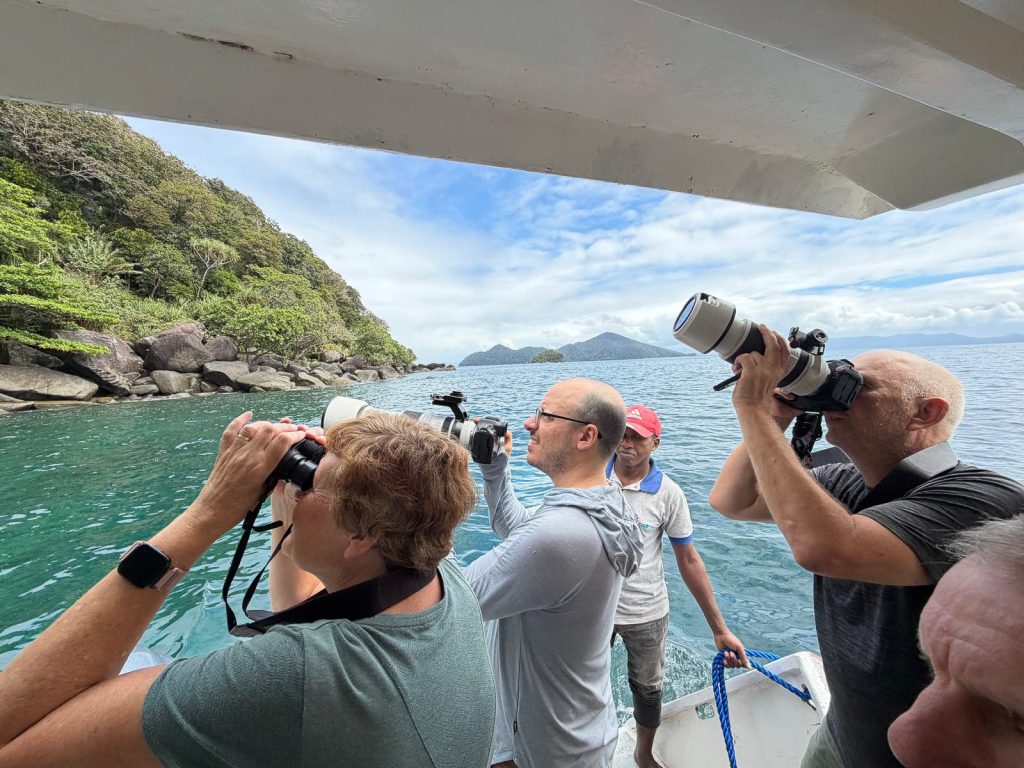
Madagascar Flying Fox photo shoot
There were three legs to the trip and we returned to Tana for a night between each. We didn’t have much choice, given the flight schedules, but it worked well and gave us opportunities to do laundry and generally recalibrate between each of destination.
1. The southwest for Grandidier’s Vontsira: Nights 1 – 3, Ifaty & Tsimanampetsotse National Park
Antanarivo: Night 4
2. The central west for Fossa and Boky-boky: Nights 5 – 7, Kirindy Forest and Morandava
Antanarivo: Night 8
3. The northeast for Fanaloka, Brown-tailed & Ring-tailed Vonstira and Falanouc: Nights 9 – 15, Masoala National Park and around.
Extension: Nights 16 & 17, Andasibe National Park
We travelled by boat, minivan and 4WD.
Leg 1. The Southwest: Ifaty & Tsimanampetsotse National Park
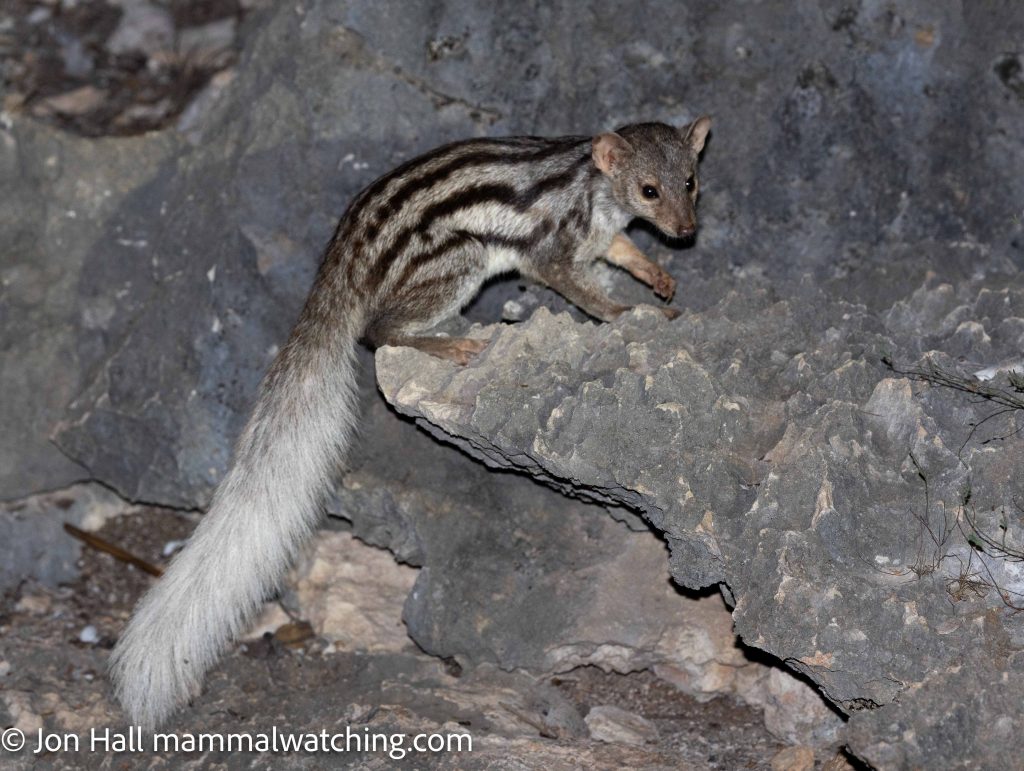
Broad-striped (Grandidier’s) Vontsira (Galidictis fasciata)
The tour started with a flight to Toliara and a short drive to nearby Mangily (Ifaty). After checking in to the lovely La Bella Donna hotel we headed to a small community reserve – Chez les ZA Spiny and Baobab Forest – in search of our first mammals during a late afternoon and evening walk.
Chez les ZA Spiny and Baobab Forest
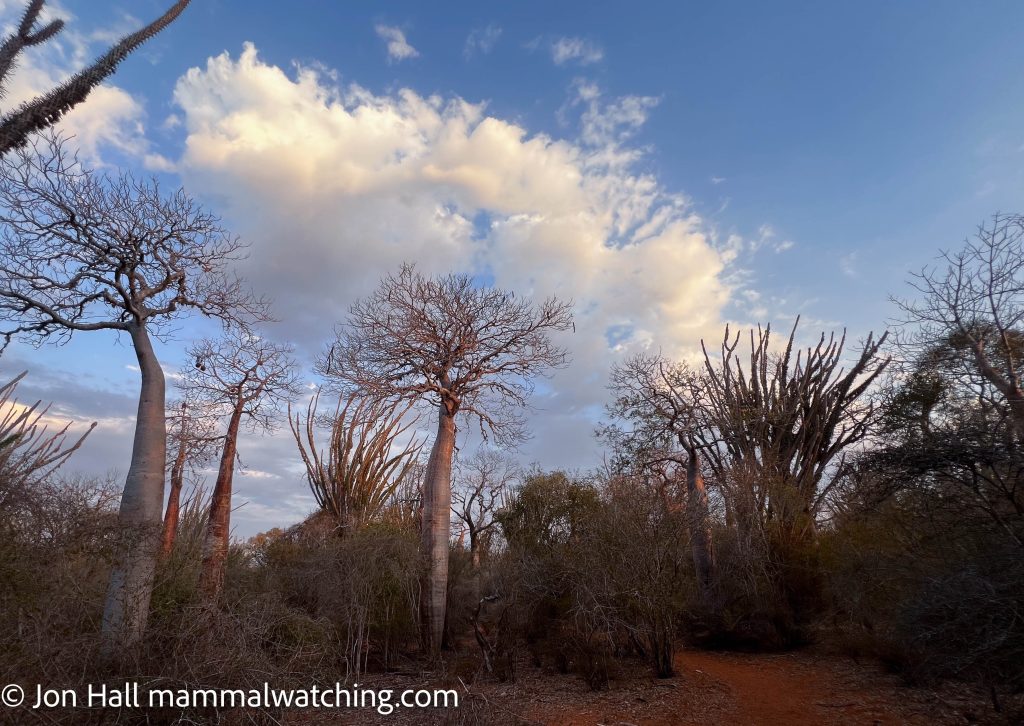
The small reserve was a nice introduction to the south. Our local guide quickly located Petter’s Sportive Lemur in its day roost, one of the key targets here.
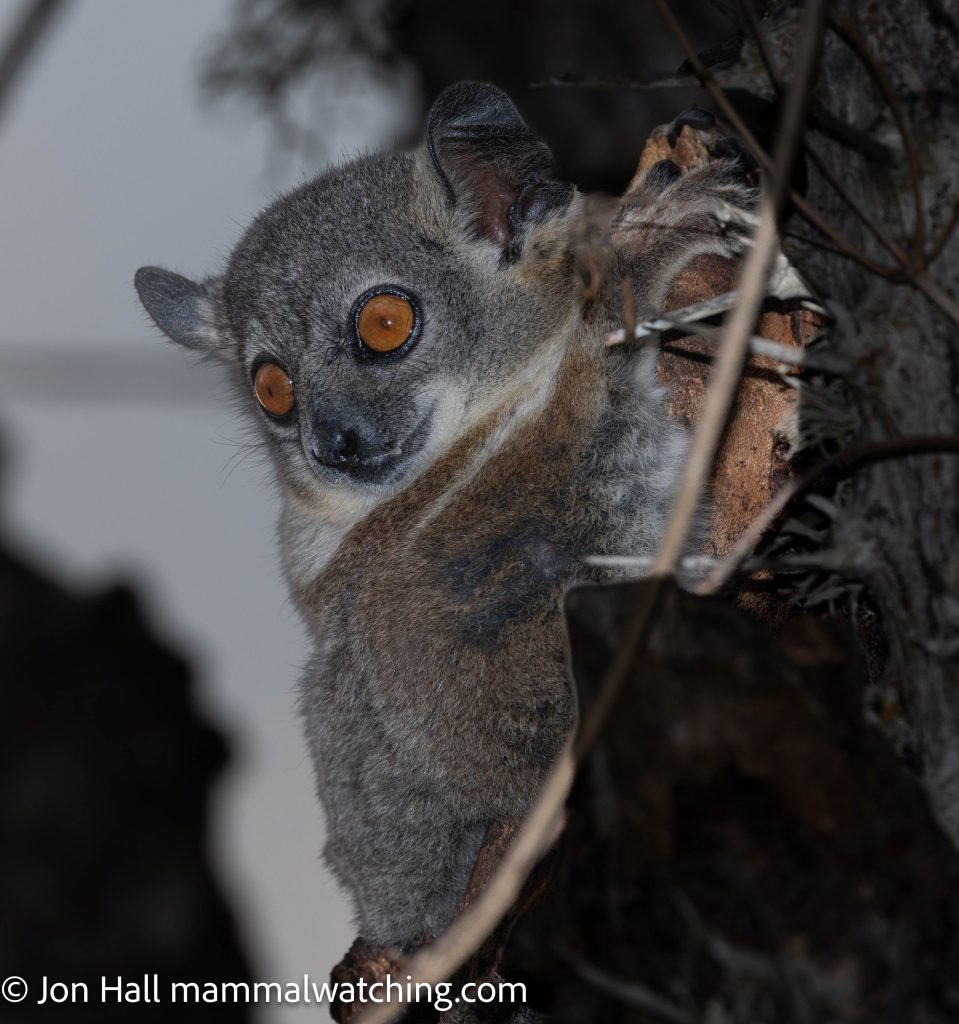
Petter’s Sportive Lemur (Lepilemur petteri)
After dark we saw several Grey Mouse Lemurs.
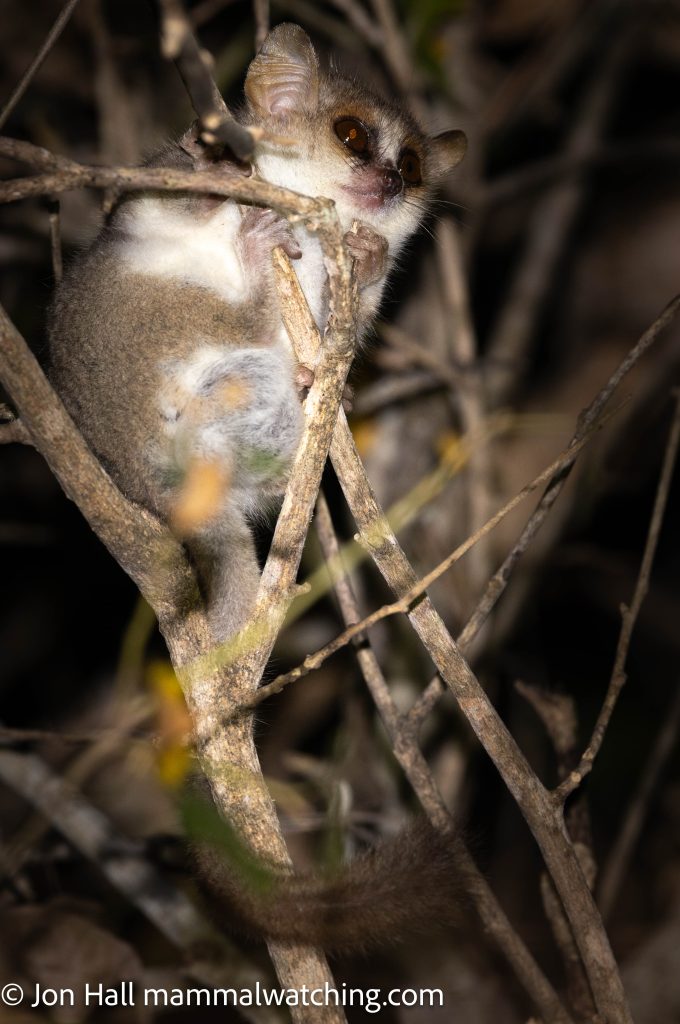
Gray Mouse Lemur (Microcebus murinus)
And finally, as Patrick had guaranteed, we saw a very cool Lesser Hedgehog Tenrec.
The tenrec sat in front of us for ten minutes doing very little. In fact I have not seen a mammal so immobile since I was waiting for an immigration officer to stamp my passport at the Eswatini border.
I suspect that it may have been dormant that day (the tenrec I mean not the eSwatini immigration officer). It was hard to get to the bottom of how it had been found and whether it was sleeping.
It is hard not to be concerned about the impact on an animal from possibly nightly disturbance for a photo session. But it was unharmed and eventually returned to the forest under its own steam.
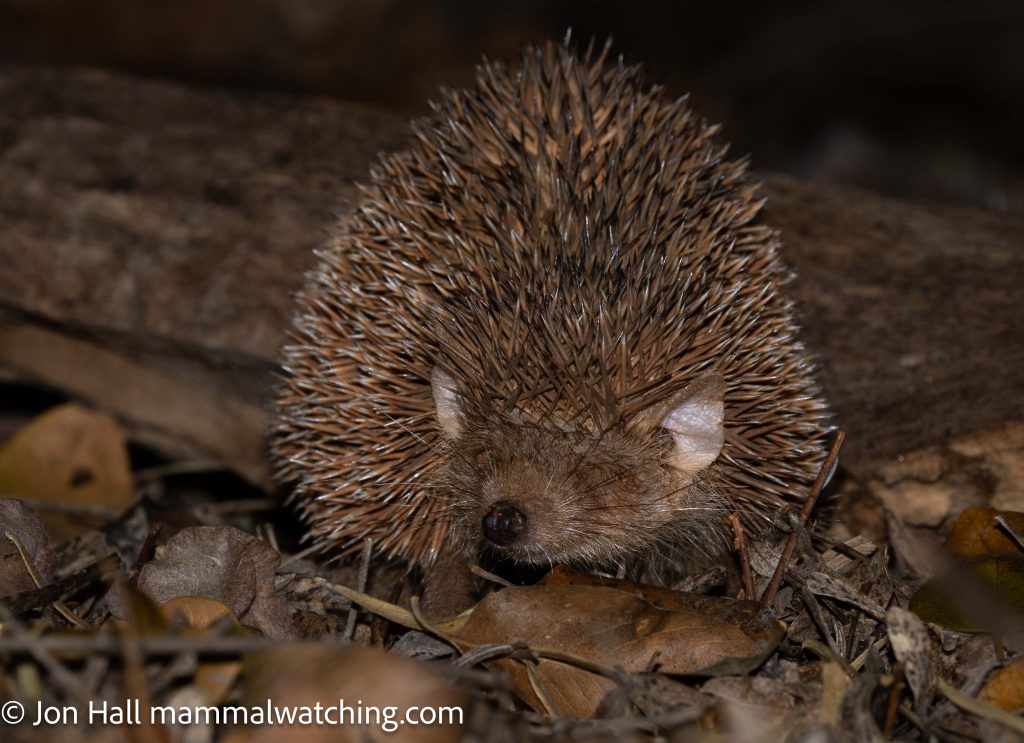
Lesser Hedgehog Tenrec (Echinops telfairi)
Tsimanampetsotse National Park
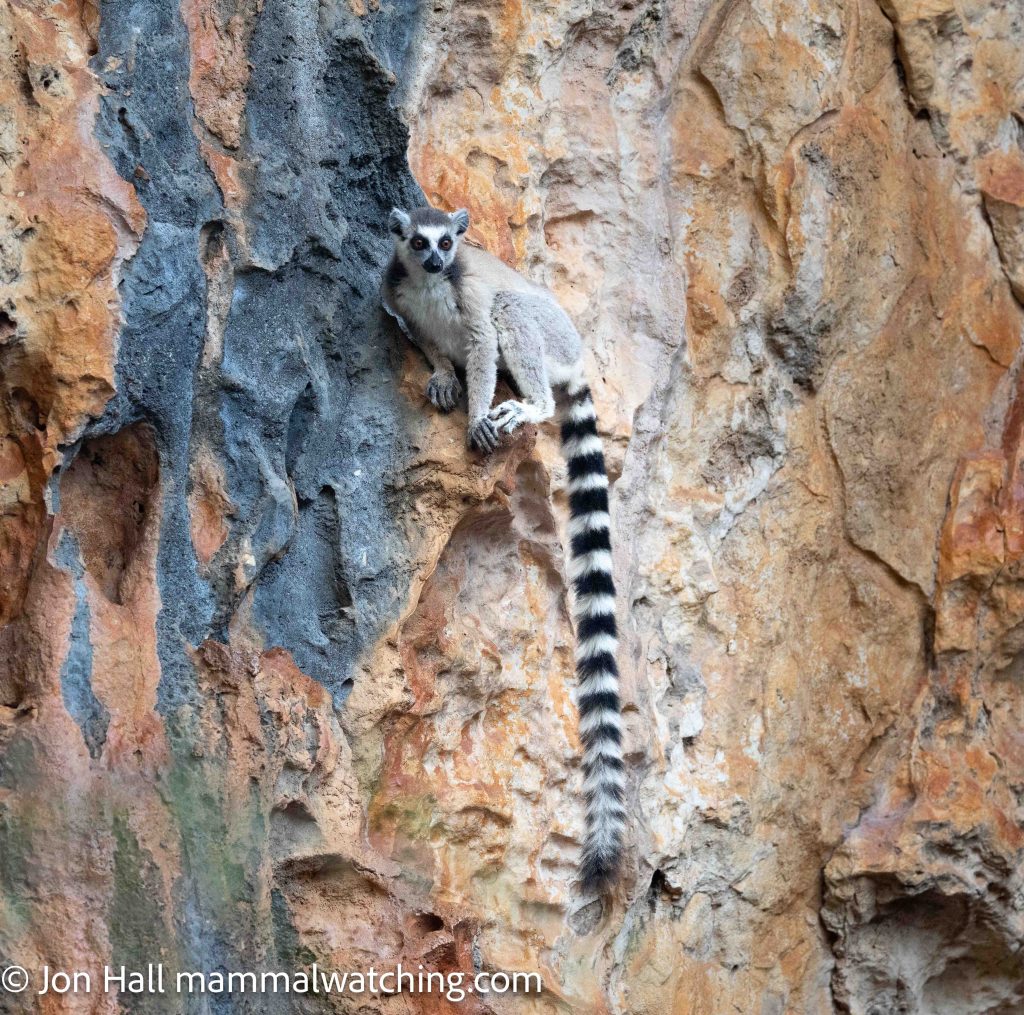
Ring-tailed Lemur (Lemur catta)
The following day we took a boat across the bay and transferred to a couple of Land Cruisers for a two hour drive to Tsimanampetsotse National Park.
This beautiful park is an excellent place to see Ring-tailed Lemurs. We saw many habituated animals and enjoyed watching them return in the evening to the cliffs they sleep on.
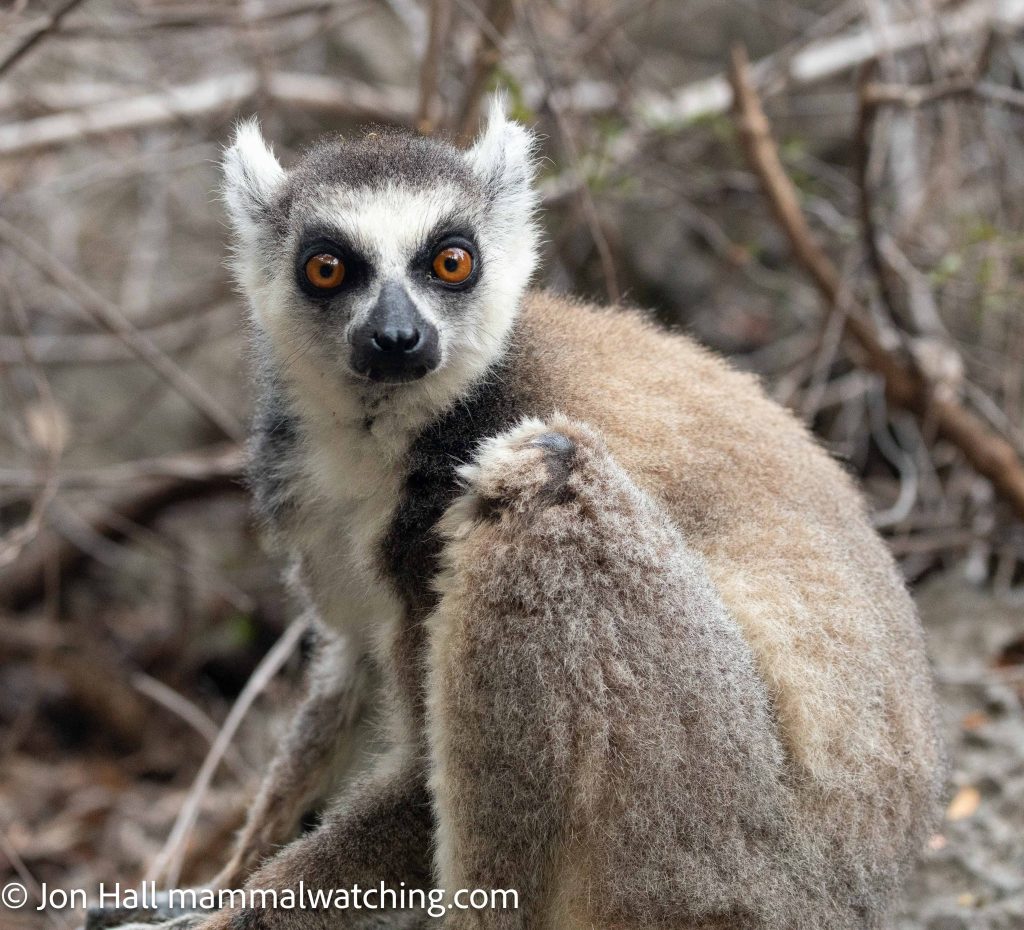
Ring-tailed Lemur (Lemur catta)
After dark we saw plenty of mouse lemurs. Both the widespread Gray Mouse Lemur, and the more localized Gray-brown Mouse Lemurs, a lifer for all of us.
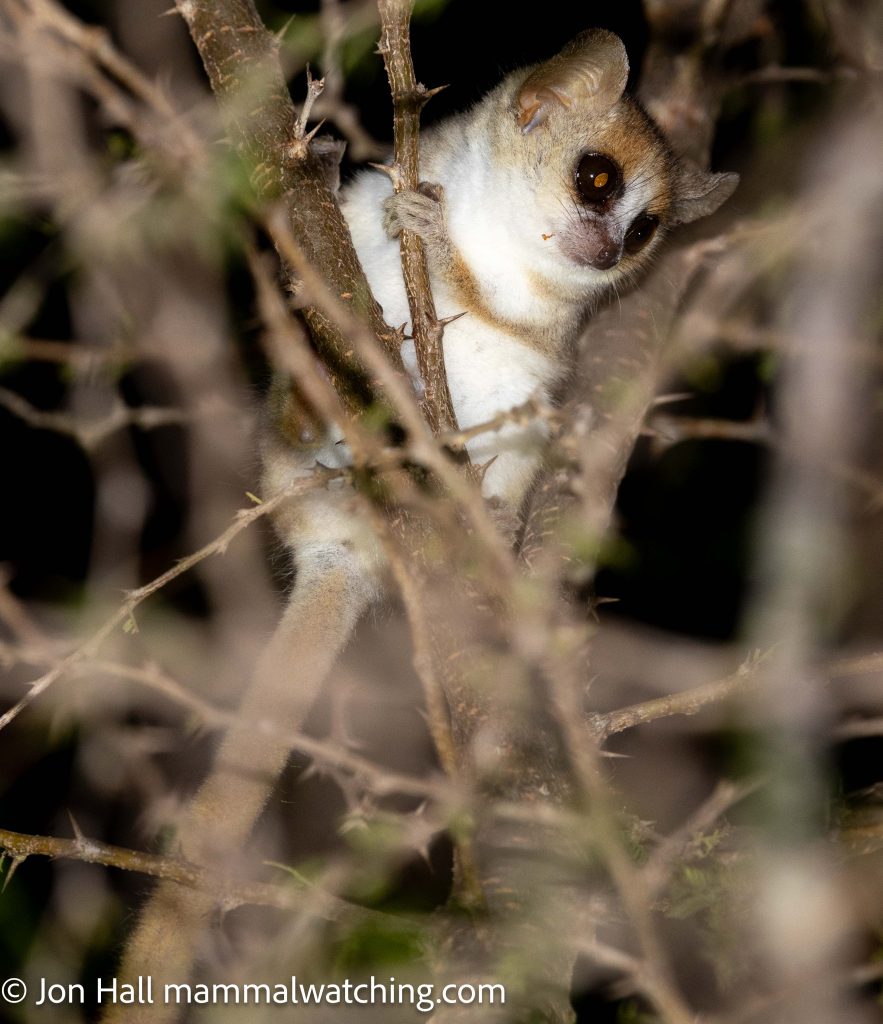
Gray-brown Mouse Lemur (Microcebus griseorufus)
But the main event here are the superb Grandidier’s – or Broad-striped – Vontsira. They are not uncommon around the camp ground and are often attracted by the smell of food cooking on the campfire.
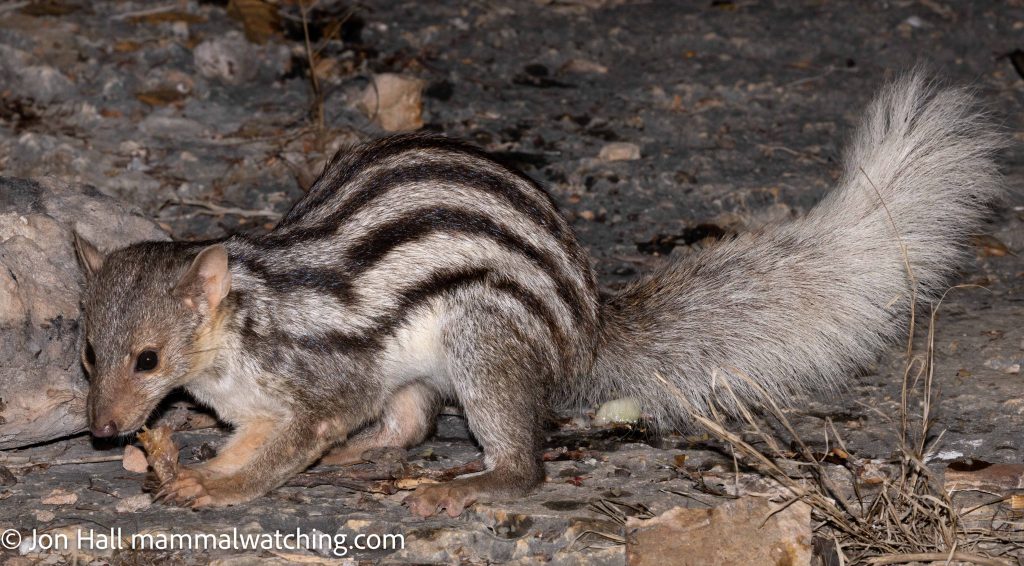
Broad-striped Vontsira (Galidictis fasciata)
Sure enough an animal, closely followed by a second, appeared just as we were finishing our dinner. Absolutely gorgeous things.
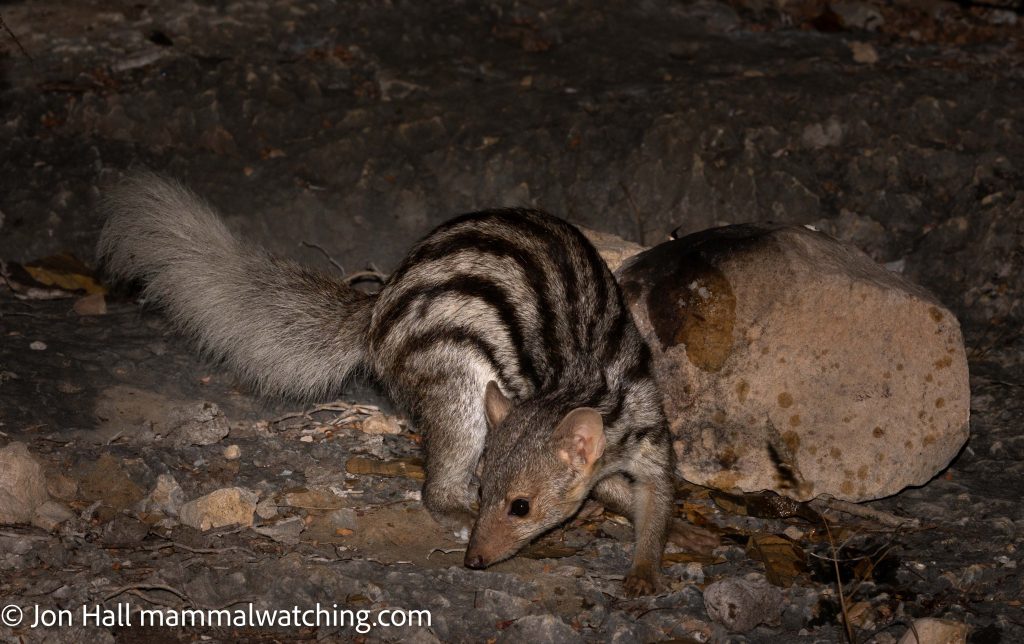
Broad-striped Vontsira (Galidictis fasciata)
Our first carnivore was on the scoreboard.
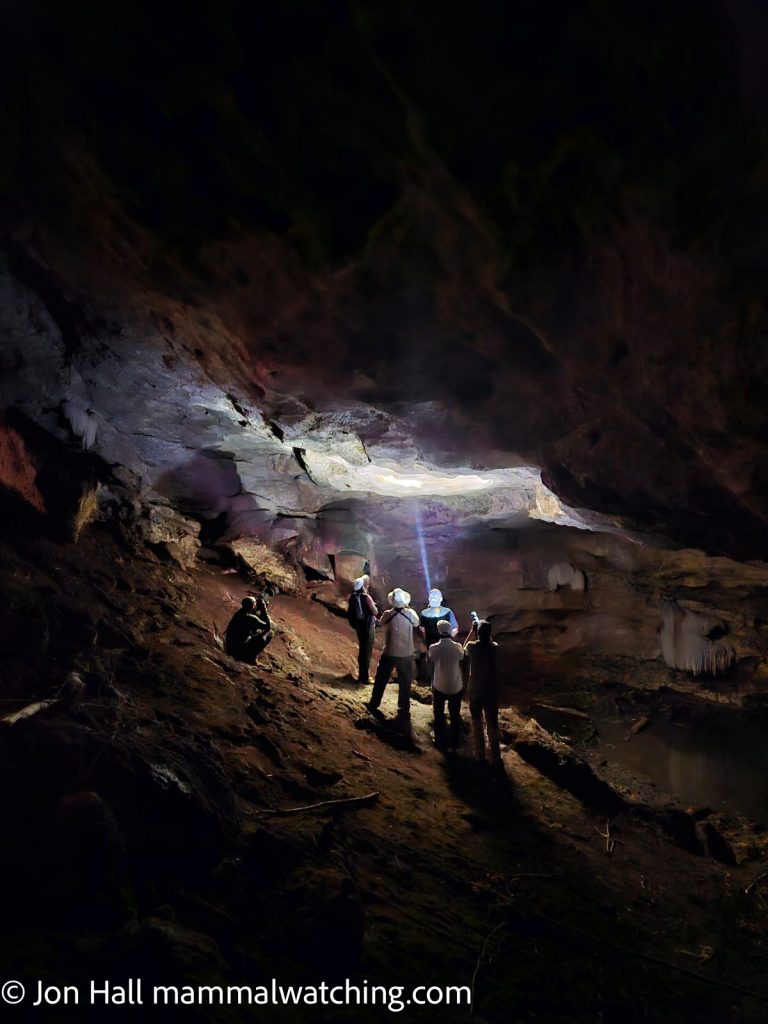
The following morning we visited a cave to see a few Mahafaly Bentwing Bats.
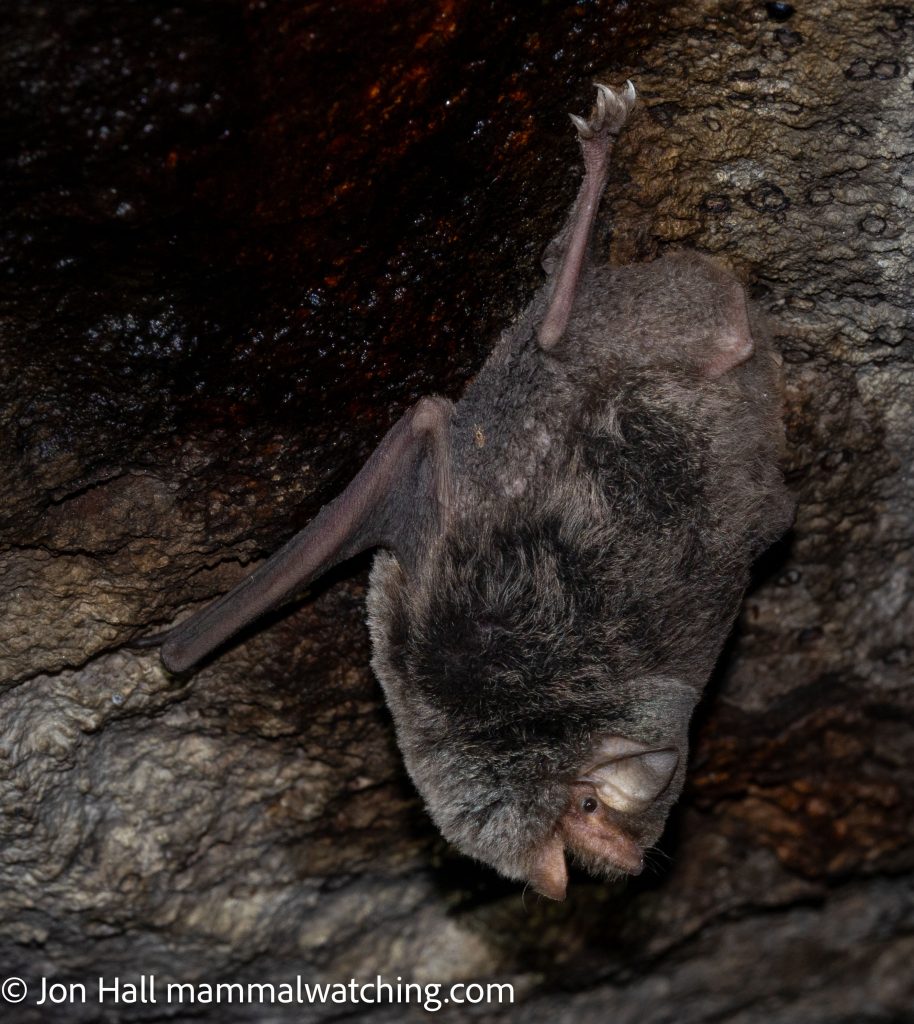
Mahafaly Long-fingered Bat (Miniopterus mahafaliensis)
The return to Toliara was one of the more remarkable journeys of the trip. When our boat pulled into the town we were met by a flotilla of carts pulled by Zebus that waded out into the ocean to transport us from the boat to shore.
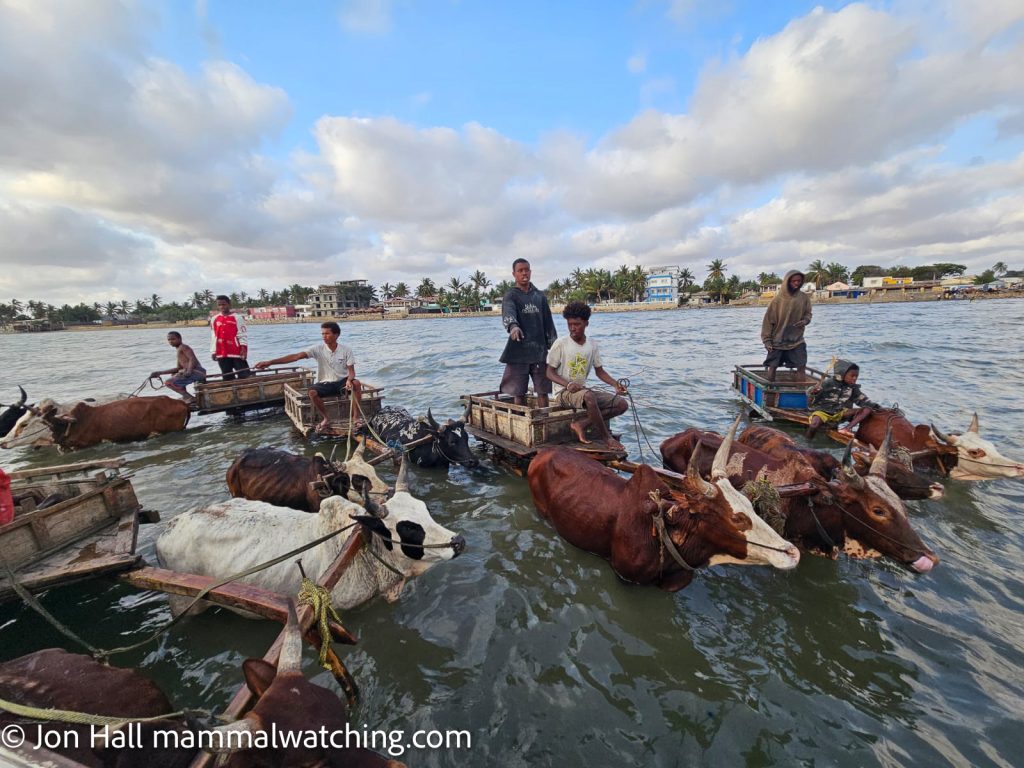
Utter chaos. Each cart was jostling for position to try to get our business, with the kids driving the carts yelling simultaneously as us, each other, and their poor Zebus. If reincarnation is a thing there can be few punishments worse than returning as a Zebu in Toliara.
Somehow we all got to shore safely and with our luggage. And from there we were transported to the exquisite Bakuba Lodge. It is not often I spend time talking about a hotel but this place was something else: if George Clooney has a mansion in Baja California I suspect it would have a similar vibe.
Leg 2. The Central-west: Kirindy
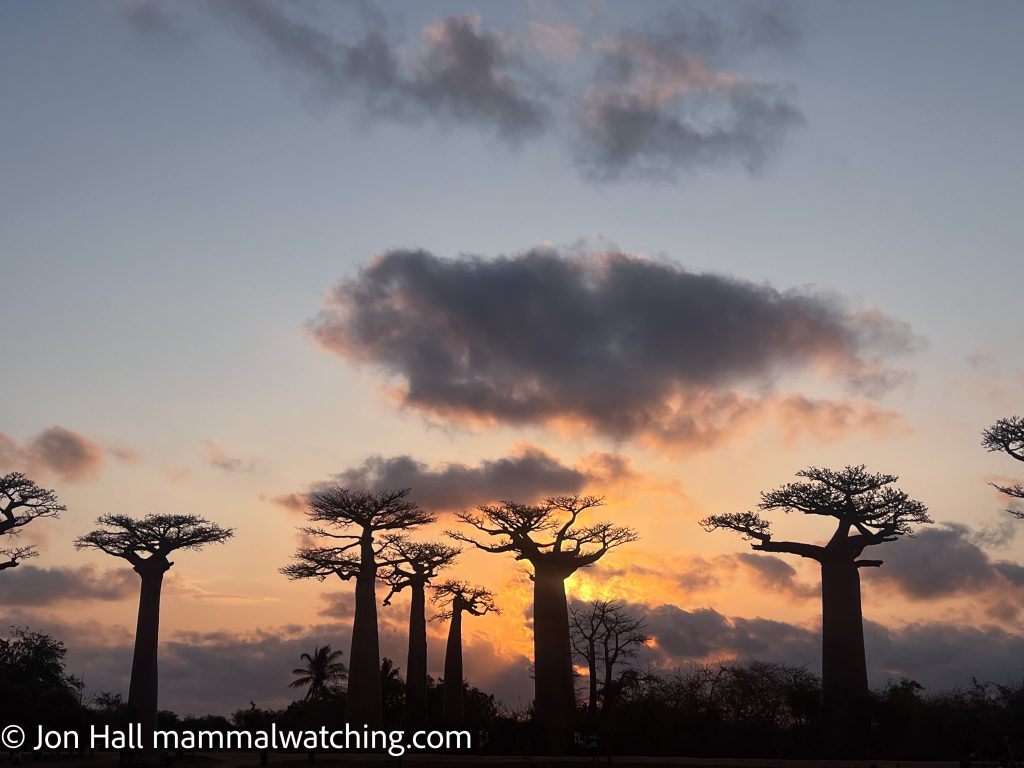
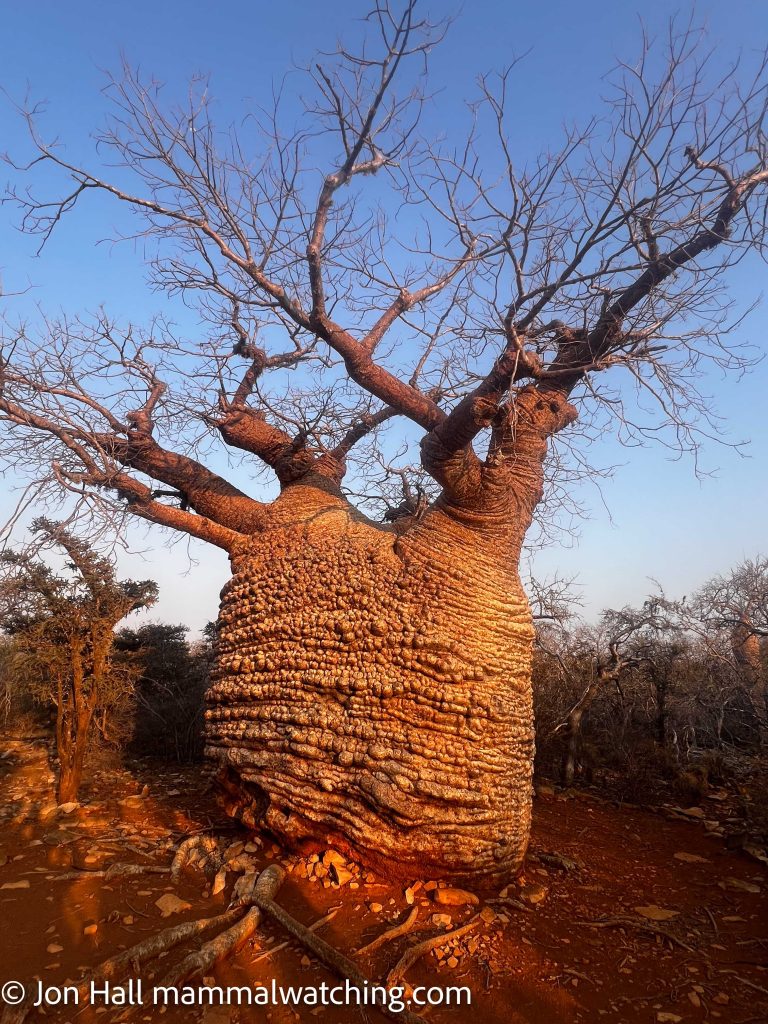
Avenue des Baobabs
After a night in Tana we flew to Morondava and drove to Kirindy Forest, arriving in the late afternoon.
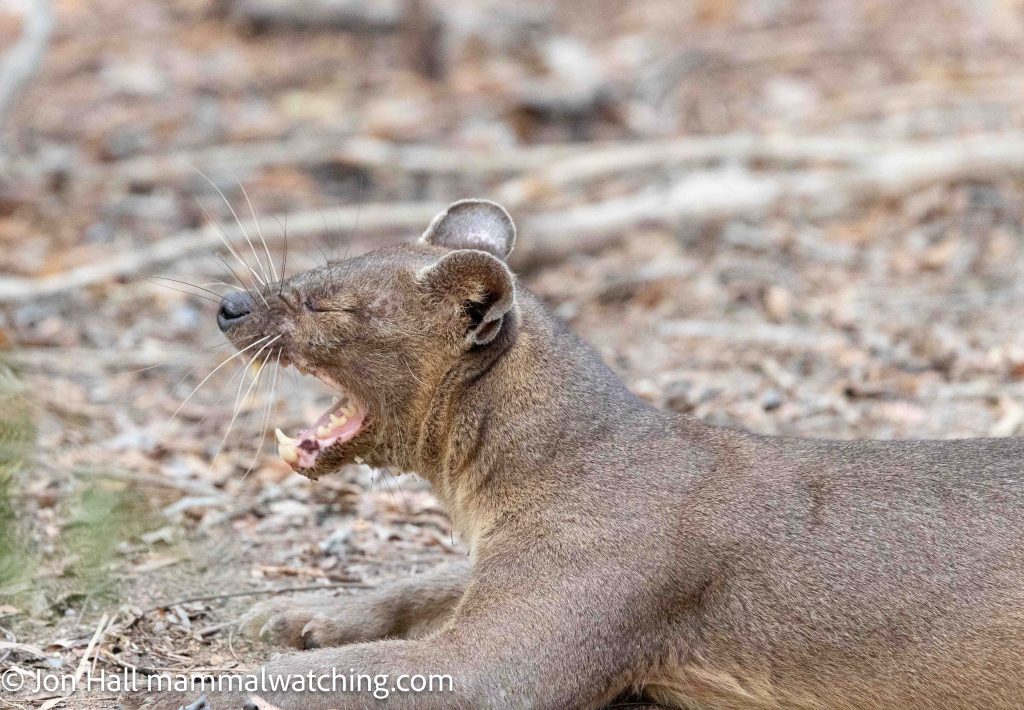
The key target here of course was Fossa, a species I had somehow missed on both my previous trips to Kirindy and which was now arguably the most embarrassing gap on my mammal list.
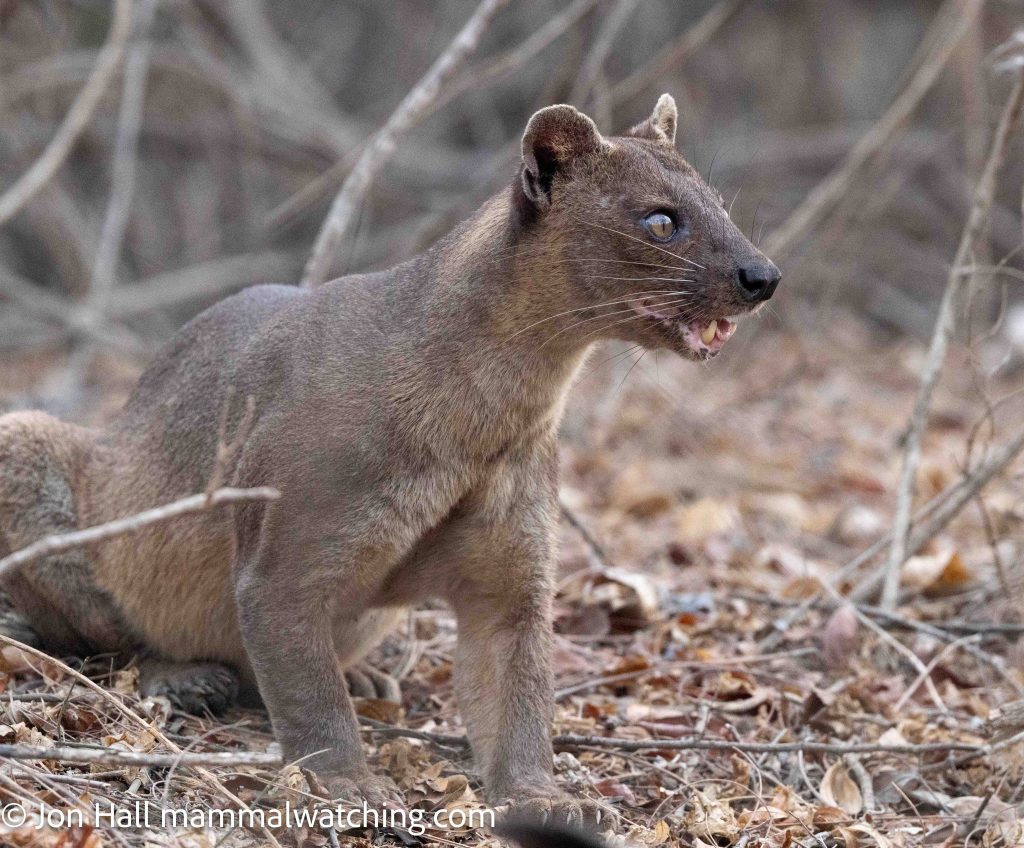
Fossa (Cryptoprocta ferox)
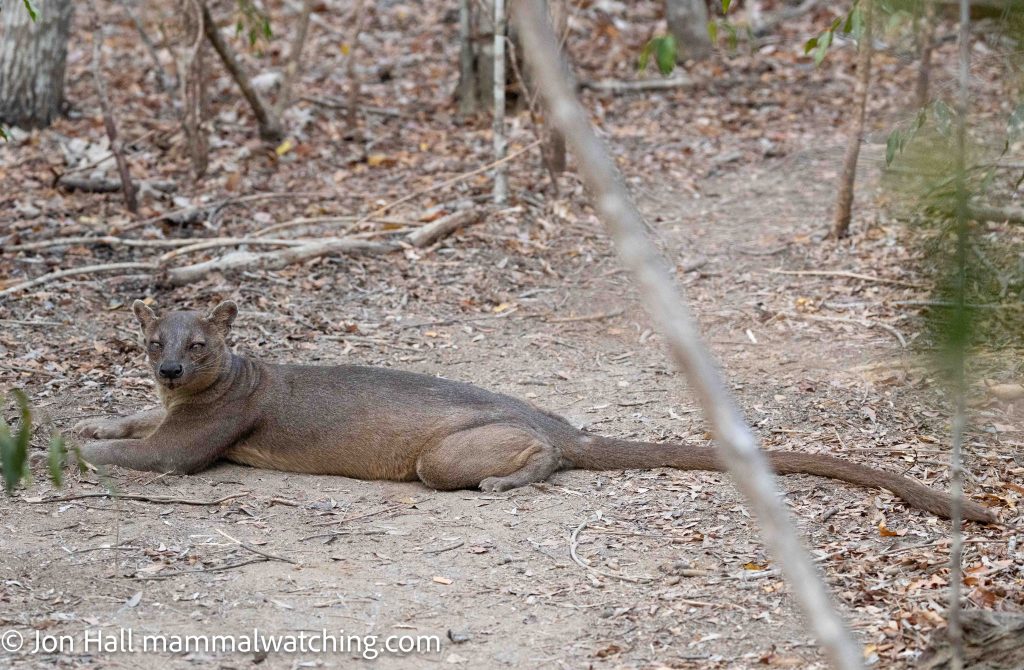
But third time lucky. Within minutes of us arriving a Fossa was spotted behind our cabins at the ecolodge and we followed the animal for 30 minutes as she scavenged around the lodge grounds. Not the wildest Fossa on Madagascar. But wild enough.
Fossa (Cryptoprocta ferox)
We saw the same animal 36 hours later on the morning of our departure.
It’s worth noting that although Kirindy is the best place to see Fossas on Madagascar they are not guaranteed. The animal we saw, just minutes after we arrived, was the first that had been seen in three days.
Fossa (Cryptoprocta ferox)
With the Fossa in the bag we could relax and focus on other mammals.
Kirindy has become a circus at night. While most people stay in fancier accommodation than our ecolodge, dozens of cars descend on the lodge car park at dusk to meet their guides for a night walk.
Everyone heads to a small grid of trails and we joined the excited throng. I realized that this was the first time I had seen mammalwatching for the masses. Because the 100 or so people walking the trails that night were truly mammalwatching in the sense we use the word. They weren’t looking for the Big 5 in Kenya, or photographing Humpback Whales. They were using head torches to spot mouse lemurs.
It left me with mixed emotions. On the one hand, I was happy to see so many people enjoying what I love to do, especially when I thought about the positive impact their money must be having on protecting what is left of the forest around Kirindy. On the other hand, I did not enjoy looking for wildlife while surrounded by crowds of loud and excited tourists.
Gray Mouse Lemur (Microcebus murinus)
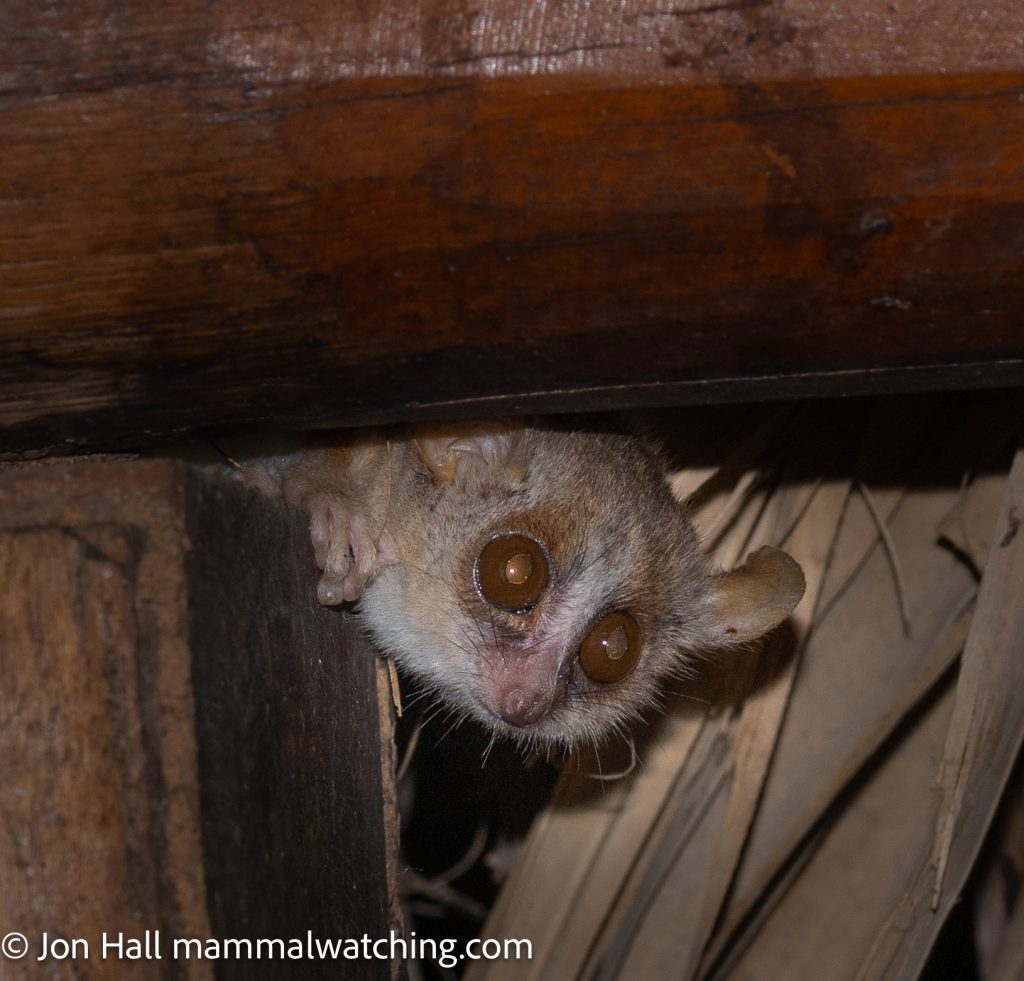
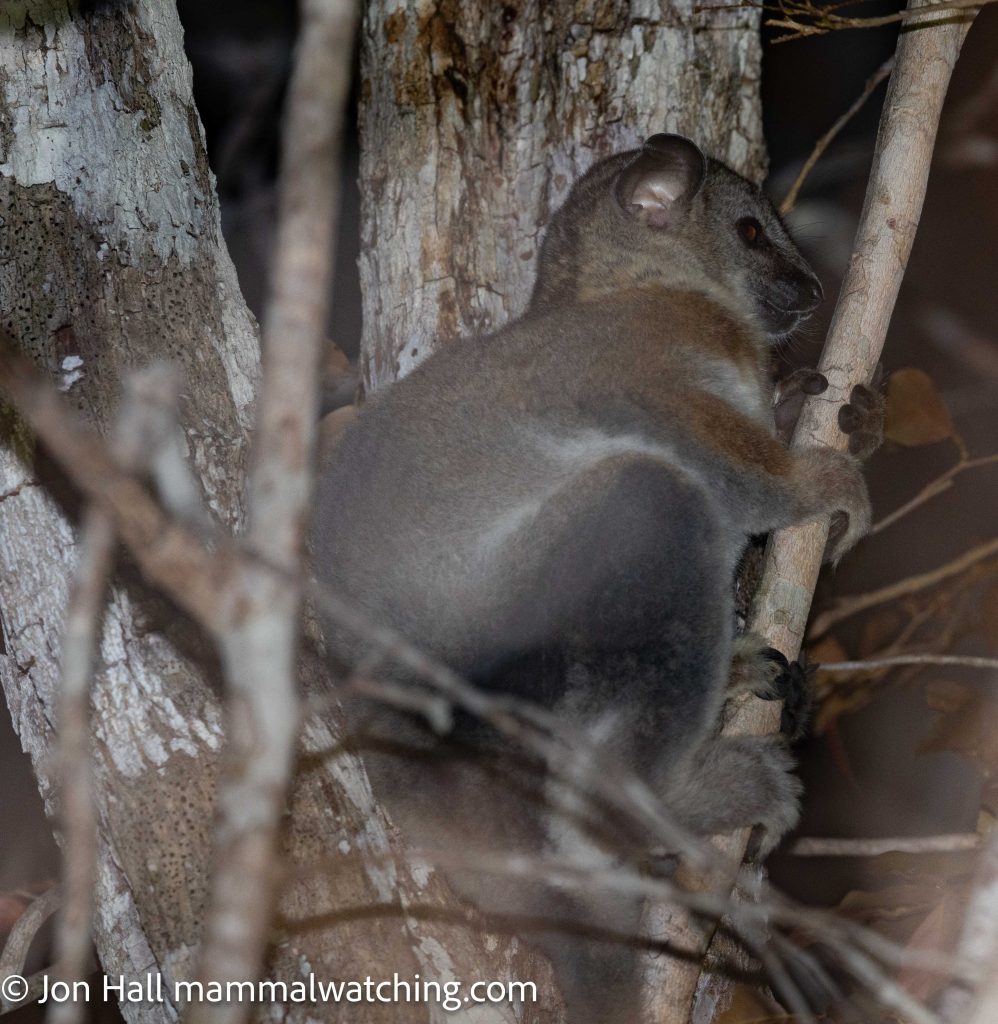
Over the course of two nights in the park we saw Gray Mouse Lemurs, including animals living in the thatch over the lodge’s dining room, and Red-tailed Sportive Lemurs.
Red-tailed Sportive Lemur (Lepilemur ruficaudatus)
We saw only one Pale Fork-marked Lemur.
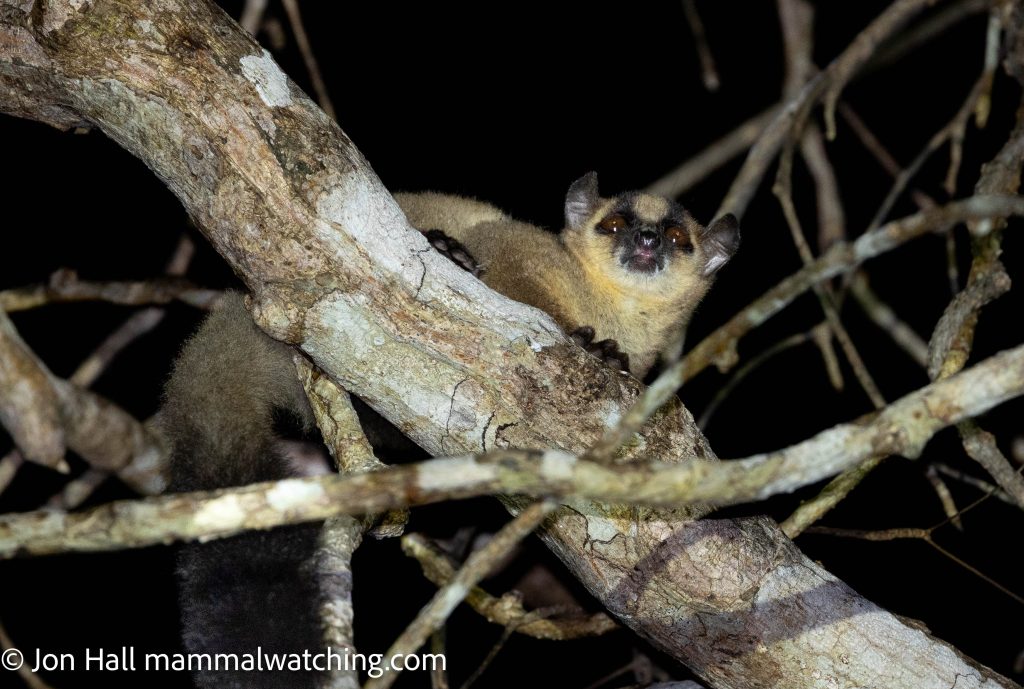
Pale Fork-marked Lemur (Phaner pallescens)
During our second evening we staked out a Giant Jumping Rat burrow and had superb views of a pair of animals.
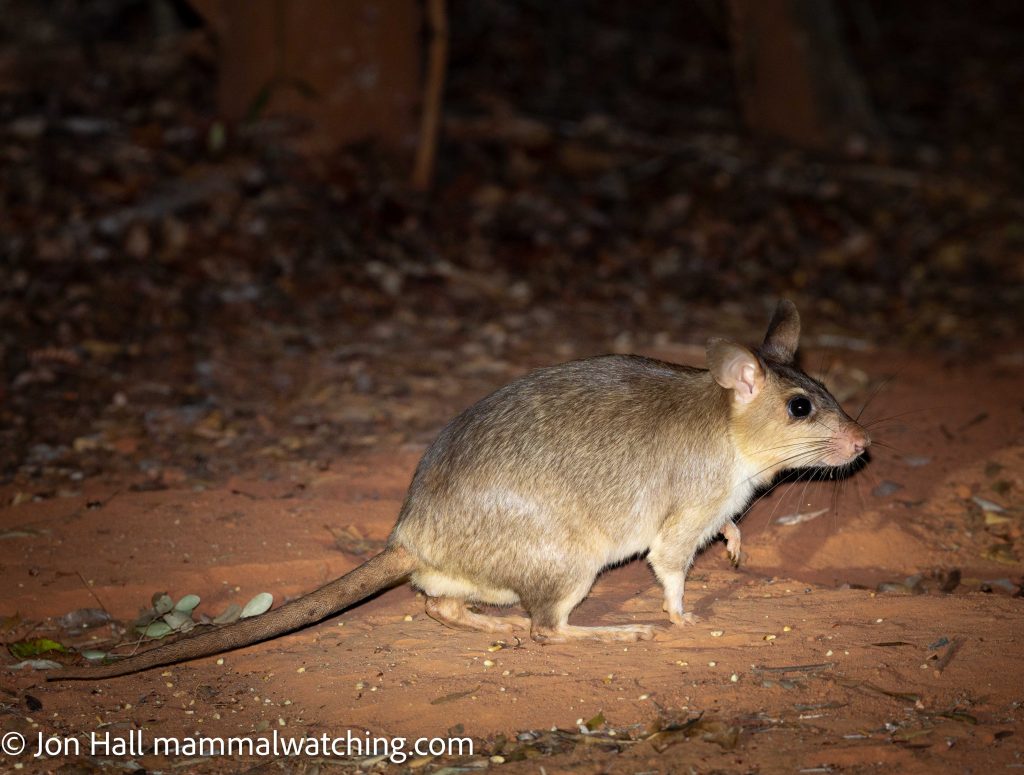
Giant Jumping Rat (Hypogeomys antimena)
One of the world’s great rats and one we all enjoyed. Especially Janet who let out a series of gasps that suggested she could have a promising career doing voice over work in the Adult film industry.
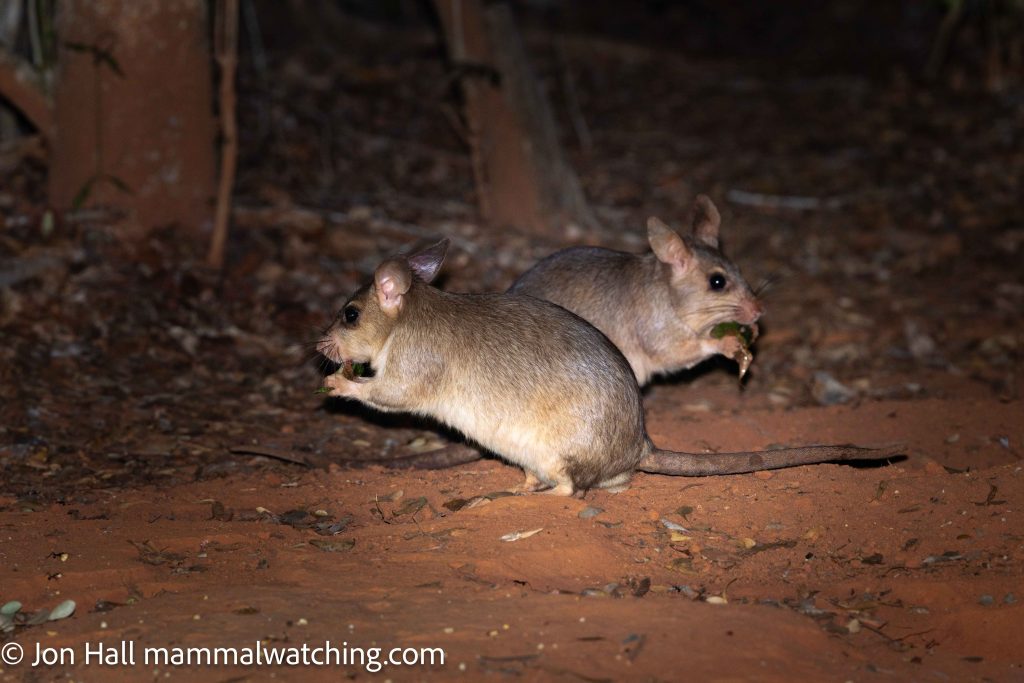
Giant Jumping Rat (Hypogeomys antimena)
A lone Western (Bastard’s) Big-footed Mouse also put in an appearance.
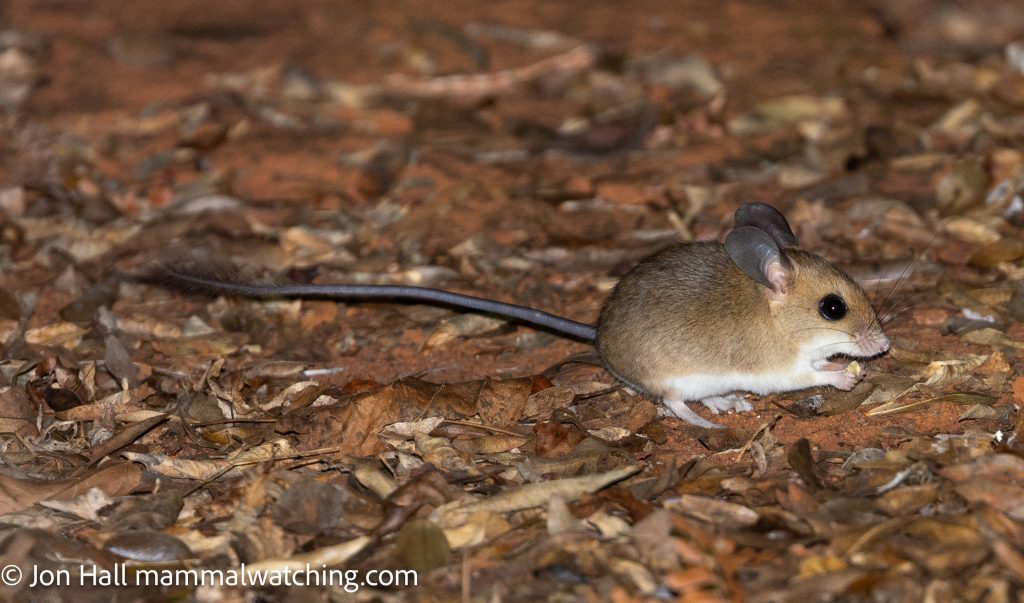
Bastard’s Big-footed Mouse (Macrotarsomys bastardi)
During the day we searched for the third carnivore on our hit list, the Boky-boky or Narrow-striped Vontsira. They took a bit of tracking down. While we were searching we saw plenty of Verreaux’s Sifakas.
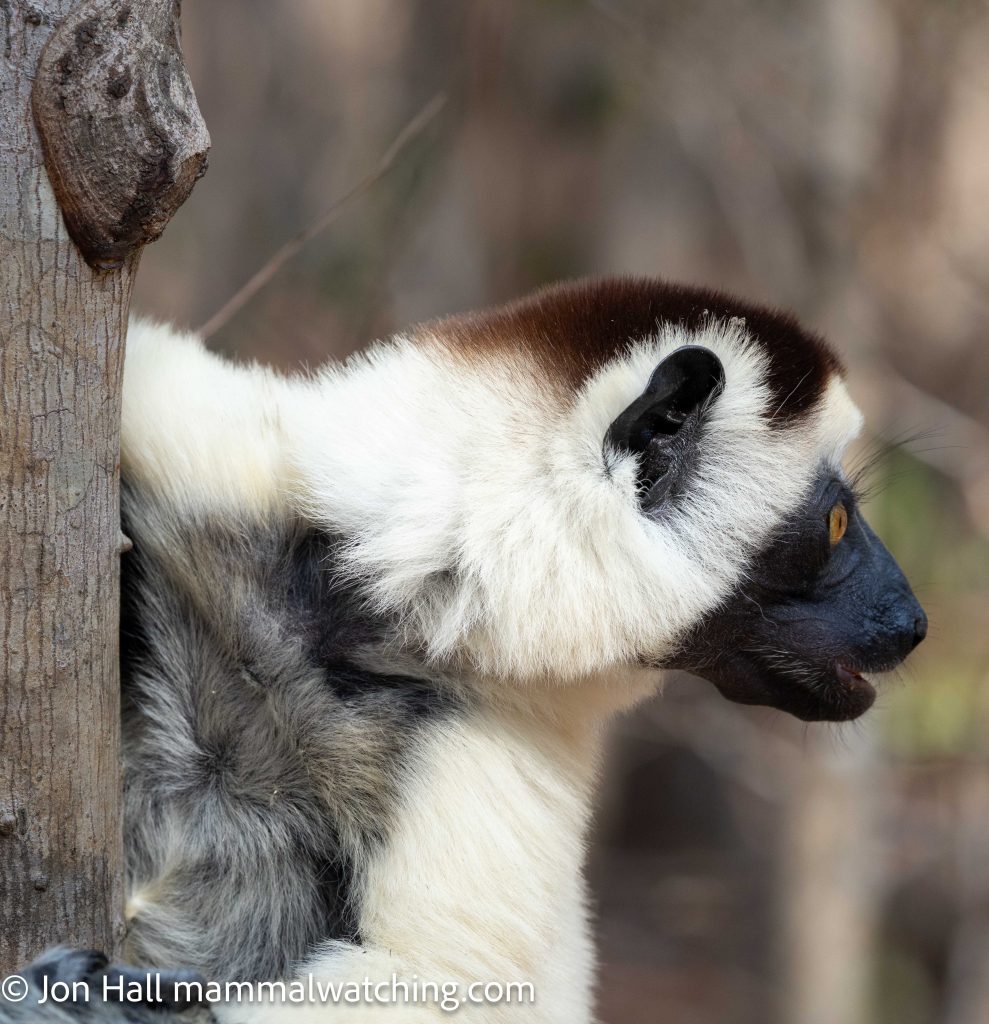
Verreaux’s Sifaka (Propiethecus verreauxi)
It was particularly fun admiring their prowess in jumping from tree to tree with babies clinging on.
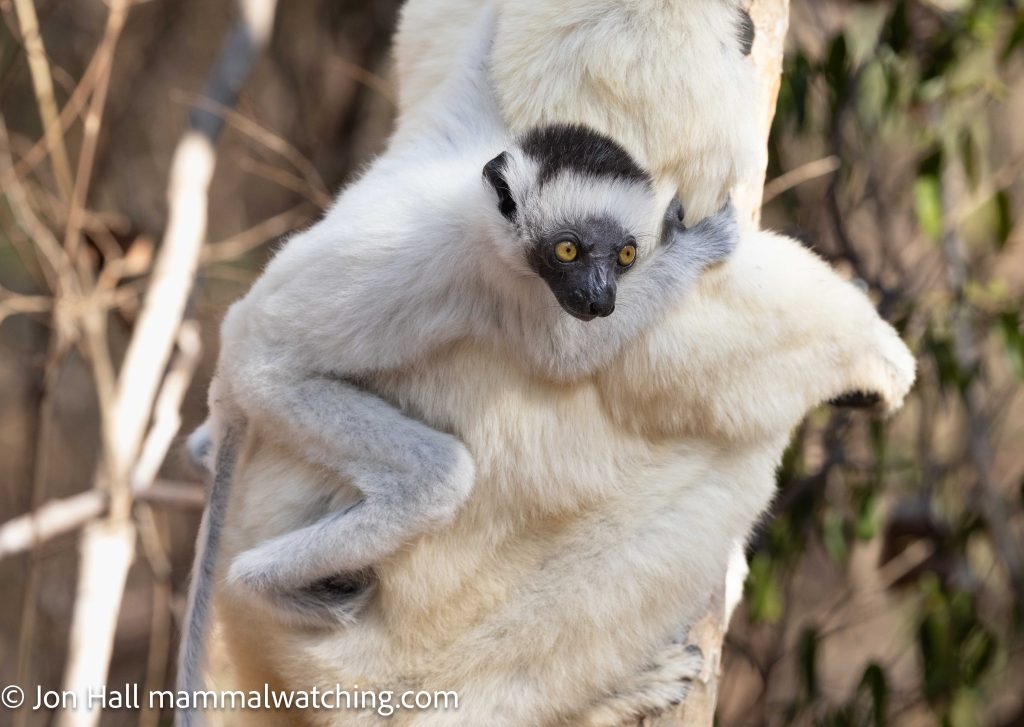
Verreaux’s Sifaka (Propiethecus verreauxi)
Red-fronted Brown Lemurs are common around Kirindy.
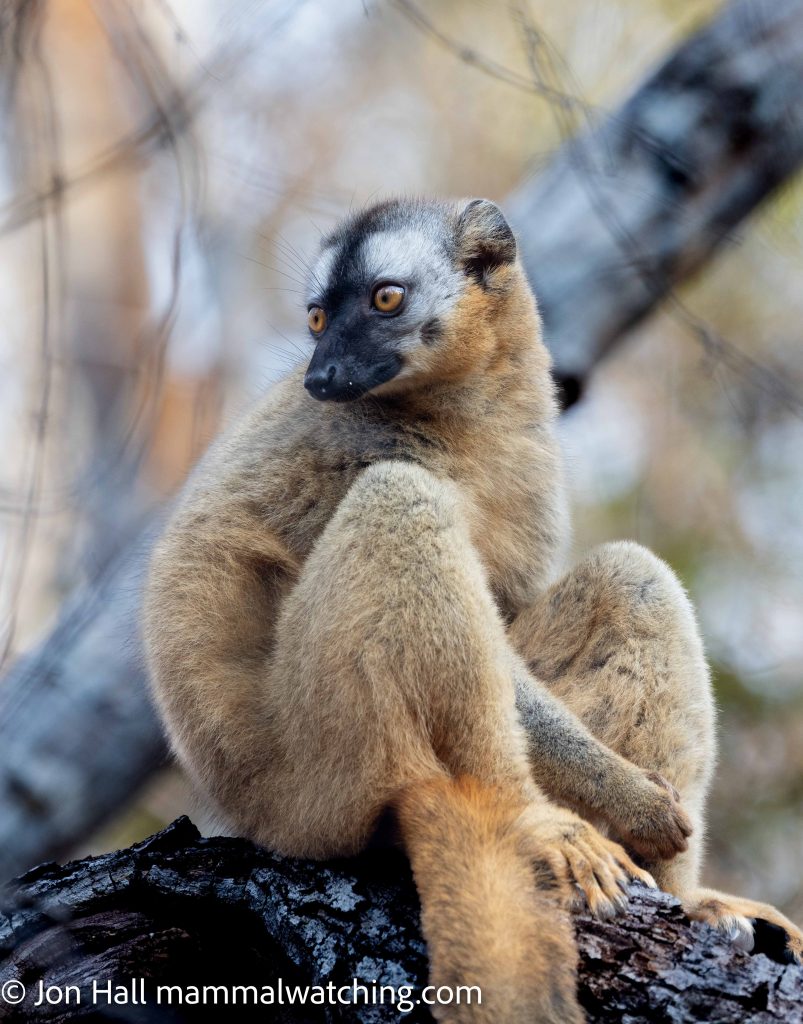
Red-fronted Brown Lemur (Eulemur rufifrons)
And we saw another Red-tailed Sportive Lemur, this time in its day roost.
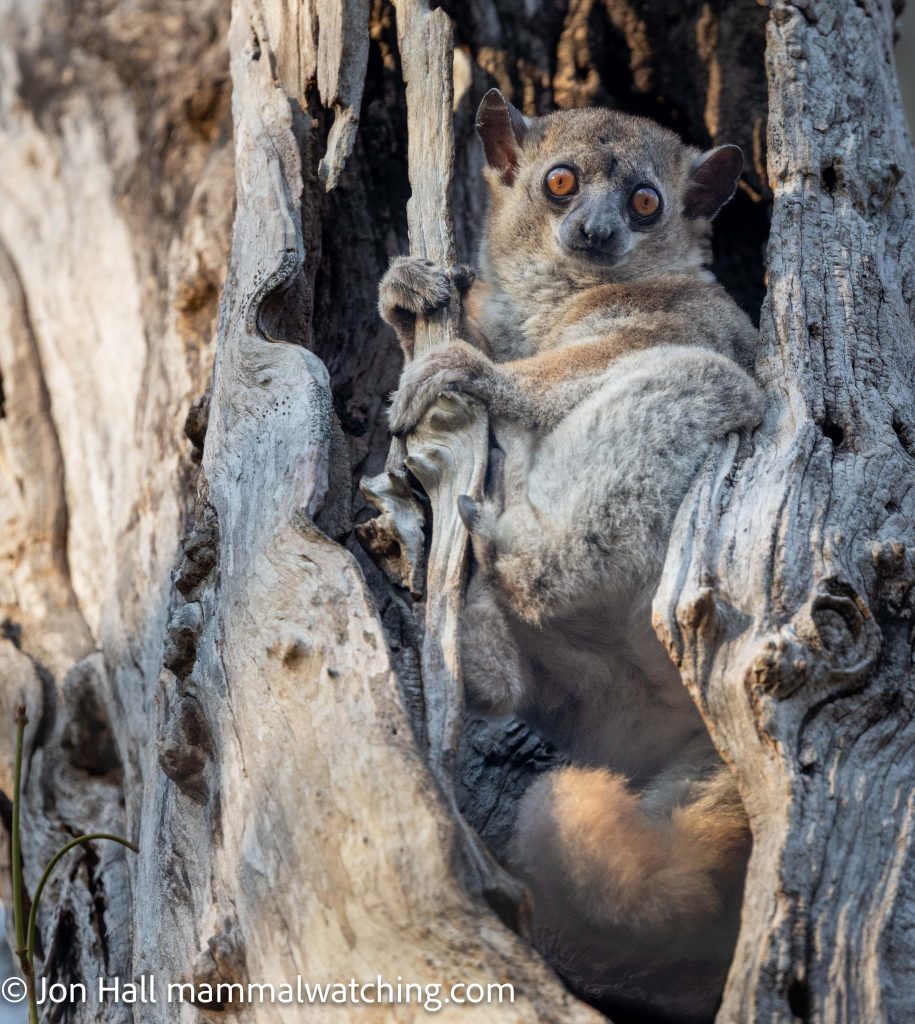
Red-tailed Sportive Lemur (Lepilemur ruficaudatus)
But it wasn’t until our second and final morning that we found the Boky-boky. Patrick and the local guide had split up to coordinate their searches via walkie talkie … or as they say in French, talkie walkie … I am not joking.
Patrick found a family of animals and summoned us. They gave excellent views.
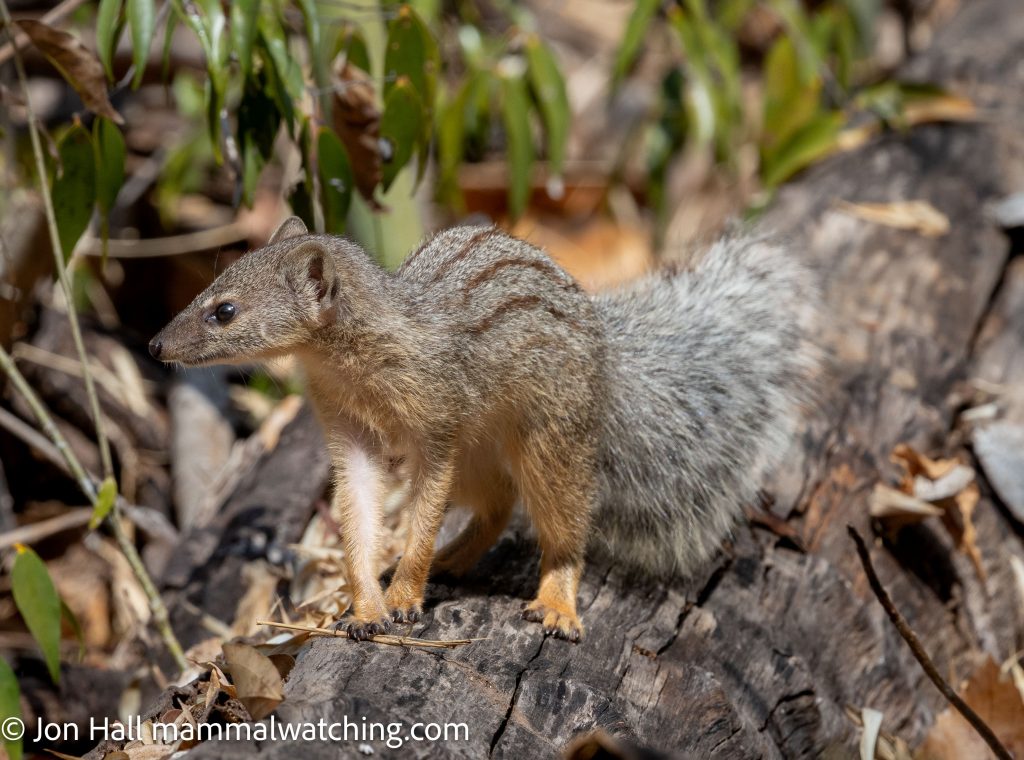
Narrow-striped Boky (Mungotictis decemlineata)
We were now scoring three for three on the carnivores!
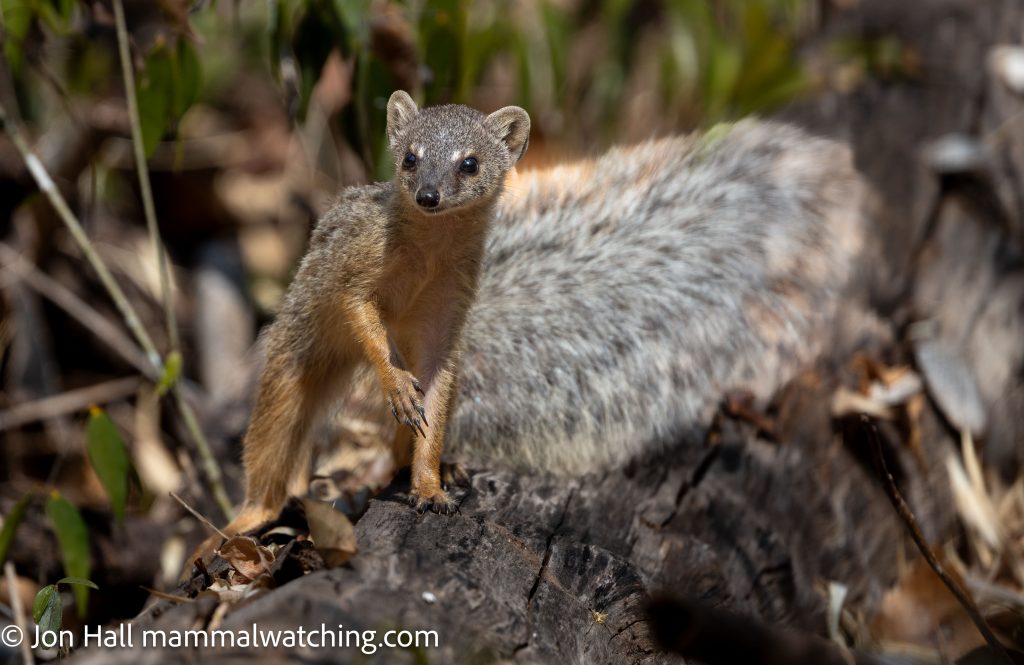
Narrow-striped Boky (Mungotictis decemlineata)
On the way back to Morandava we stopped at the (now) very touristy Avenues des Baobabs and watched sunset along wth a couple of hundred other people. When I first drove the avenue in 2010 I don’t recall seeing anybody or anything. Now a whole community has sprung up alongside the trees and they are making a living selling tourists gifts or access to a toilet.
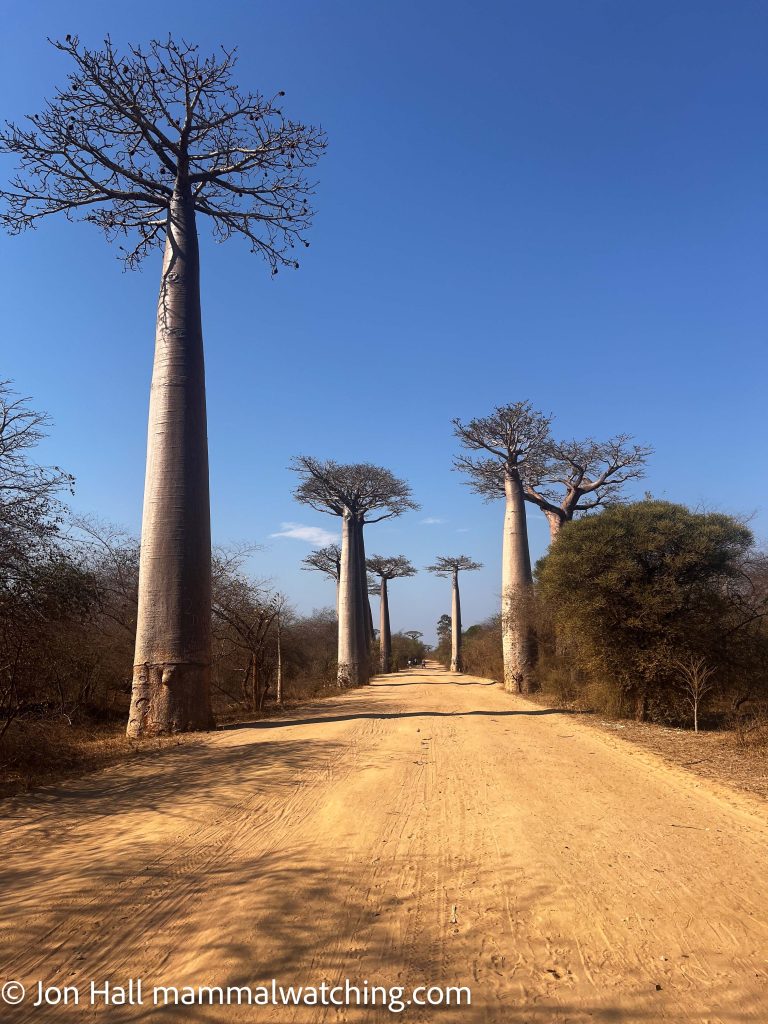
Avenue des Baobabs
We spent the night in Morondava in yet another great beach hotel (the Palissandre Côte Ouest) and flew back to Tana the following morning.
Leg 3. The Northeast: Masoala Peninsula
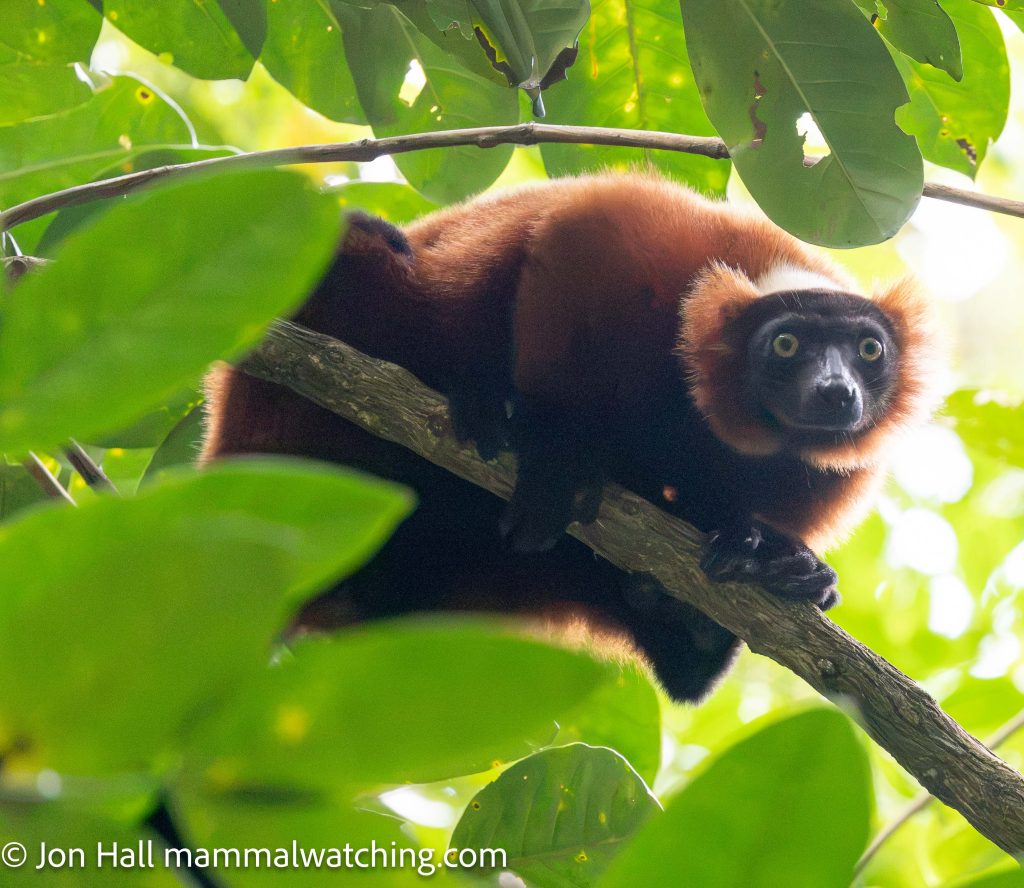
Red Ruffed Lemur (Varecia rubra)
We spent a whole week in the Masoala Peninsula. In part because Madagascar Airlines only runs one flight a week to Maroansetra but it is such a great area it was worth it. This was the bit of the trip I had been most excited about and I wasn’t disappointed.
We arrived on time into Maroansetra in the mid-morning. If we’d felt more secure that the flight would arrive on schedule we could have planned to head straight to the forest. But although Madagascar Airlines have improved one still needs to be cautious. So we spent the rest of the day and night at a hotel in the town.
I can think of only reason to spend time in Maroansetra. And that reason – the endemic Tomato Frog which has a habitat preference for garbage – is not particularly inspiring.
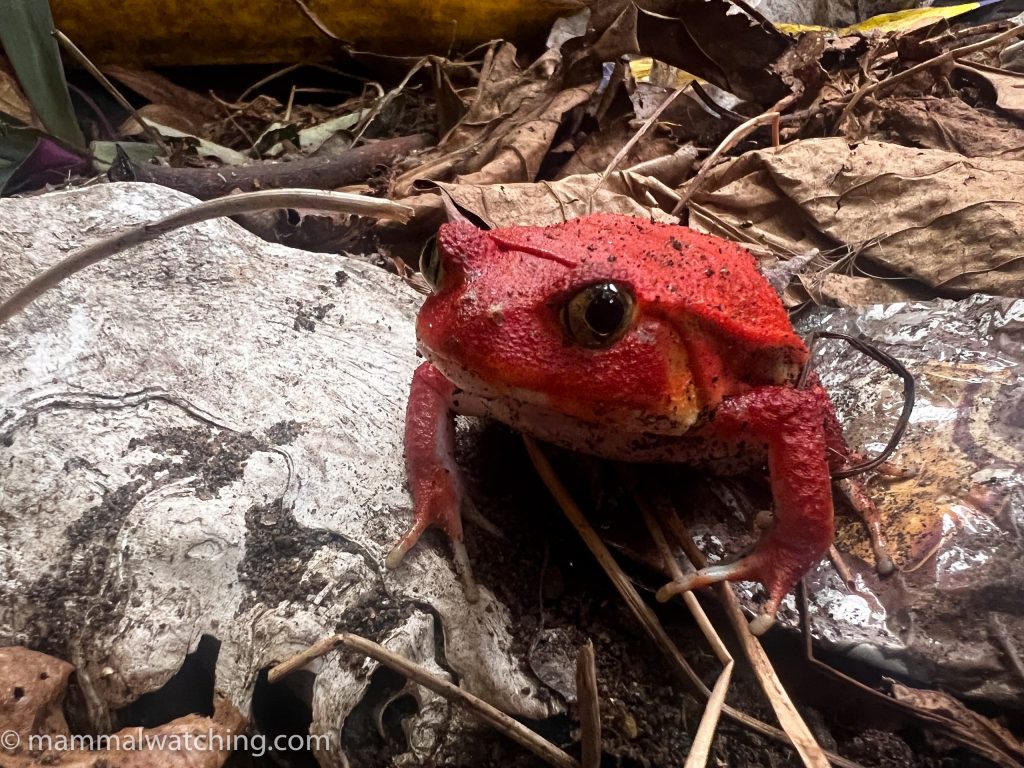
Tomato Frog
So after marveling at the frog for five minutes while trying not to inhale I joined Daniel and Patrick for a $2 haircut, and then did very little.
Farankaraina
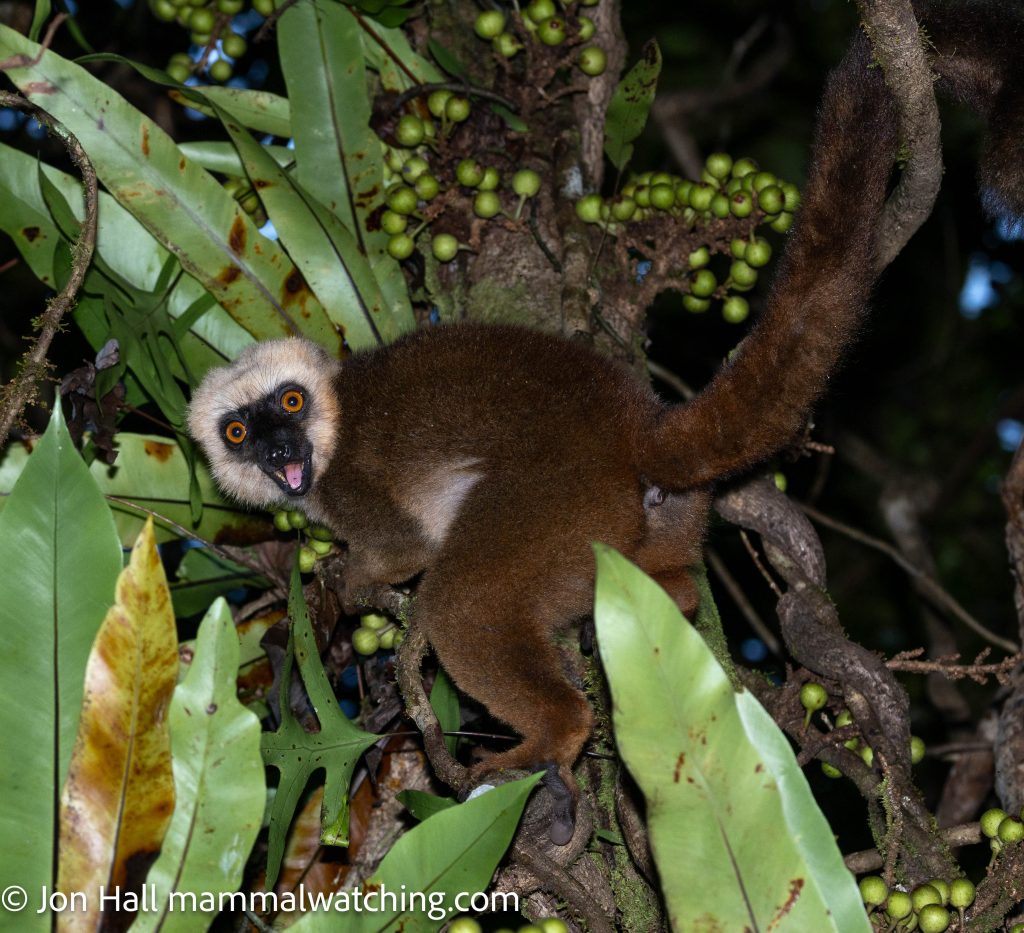
White-fronted Brown Lemur (Eulemur albifrons)
Early the following morning we took a speedboat along the river, hugging the coastline, to the Farankaraina Reserve where we would spend a night camping.
The campsite, on the beach, is fine but a new – and apparently fancy – lodge is being constructed.
We took a short walk before lunch along some of the trails and saw our first White-fronted Brown Lemurs.
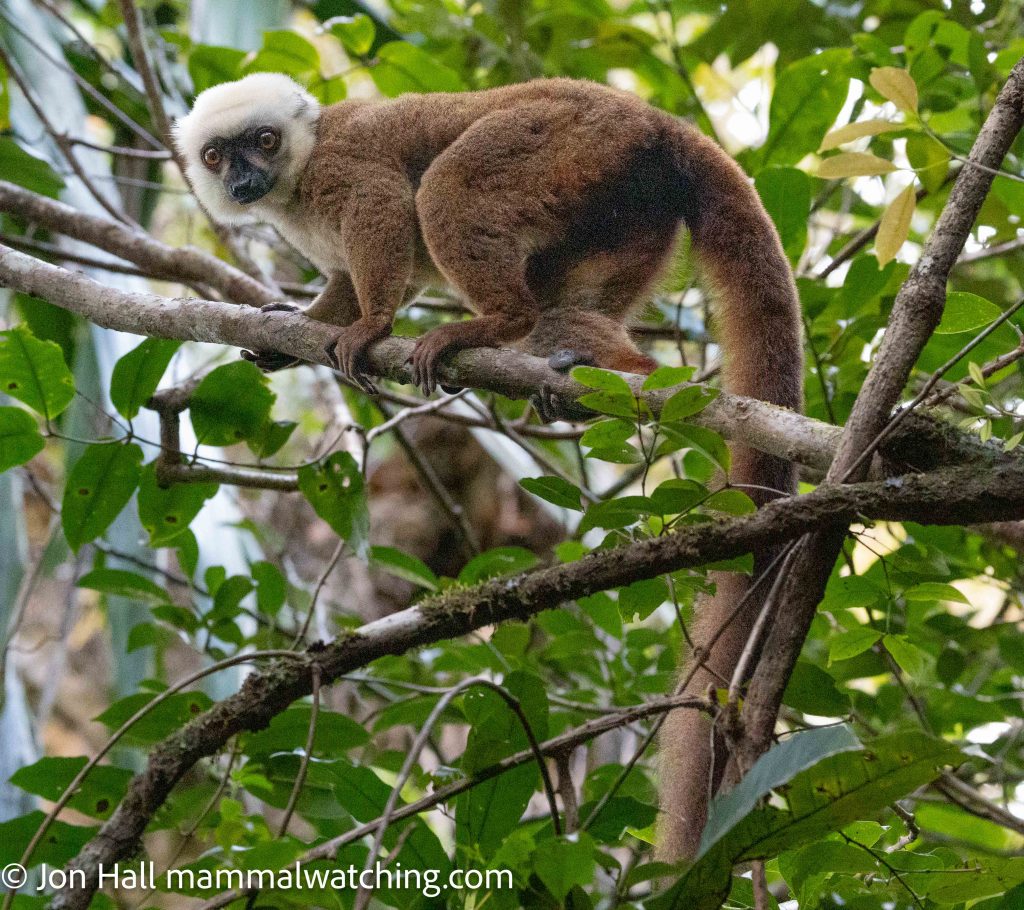
White-fronted Brown Lemur (Eulemur albifrons)
As we were almost back at camp our guide spotted a carnivore and most of us had a brief look at a vontsira running through the forest. My first thought was that it was very dark and short-tailed to be the Ring-tailed Vontsira we had been expecting.
Our guide was also puzzled. After cross examination from Patrick, armed with a field guide, he confirmed that he was certain it was not the Ring-tailed Vontsira he was familiar with but was a Brown-tailed Vontsira, a species he had never seen before. Patrick couldn’t believe it. He hadn’t seen a Brown-tailed Vontsira either! And while we were looking at our animal he was busily photographing a Ring-tailed Vontsira on the other side of the campsite.
A few minutes later Simon returned to where we had seen our vontsira and saw it again, this time much closer and confirmed he too was 100% sure it was the Brown-tailed Vontsira.
When I planned this trip I hadn’t even considered we would see this carnivore: I’d thought it was too rare even to mention. As you will read below, some of the group saw a second animal a couple of days later and for longer, though once again no one got a photo. I suspect that the Brown-tailed Vontisra isn’t as rare as I had believed, though it seems much shyer and harder to spot than the other vontsiras.
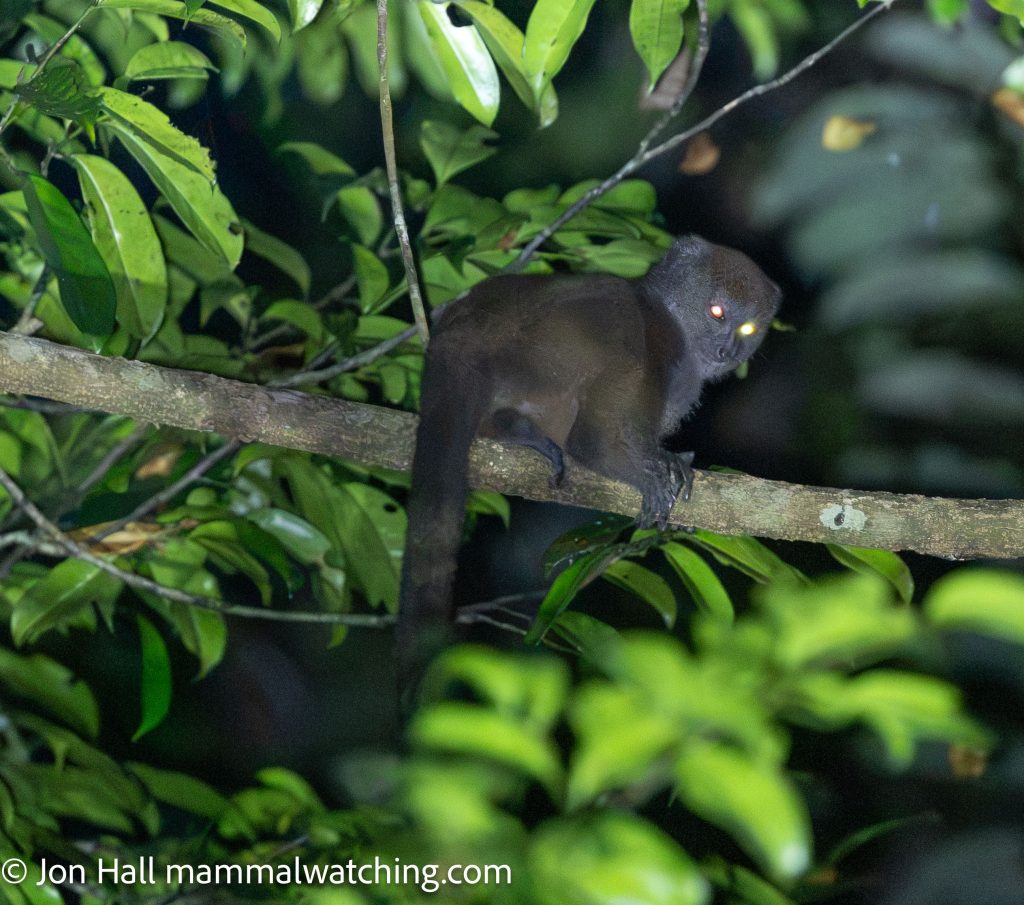
Northern Bamboo Lemur (Hapalemur occidentalis)
Farankaraina is reputed to be a good place to see Aye-aye and so in the evening we headed out to find one, after first watching some Northern Bamboo Lemurs settle down for the night.
It wasn’t the best evening of the trip.
I had assumed – based on my Aye-aye watching at Daraina – that the guides were taking us to an active nest. I had also assumed it was quite close to camp. And, probably because I was sick, had not put much effort into double checking what was happening.
My assumptions were wrong.
We walked – and walked quickly – for almost an hour, along steep and slippery trails, to reach the Aye-aye zone. We sat there for two hours, feeling damp and miserable. We didn’t see an Aye-aye. I then learned that we were not next to a nest as I had thought but next to some trees that the Aye-ayes ‘always’ feed in. Always other than tonight.
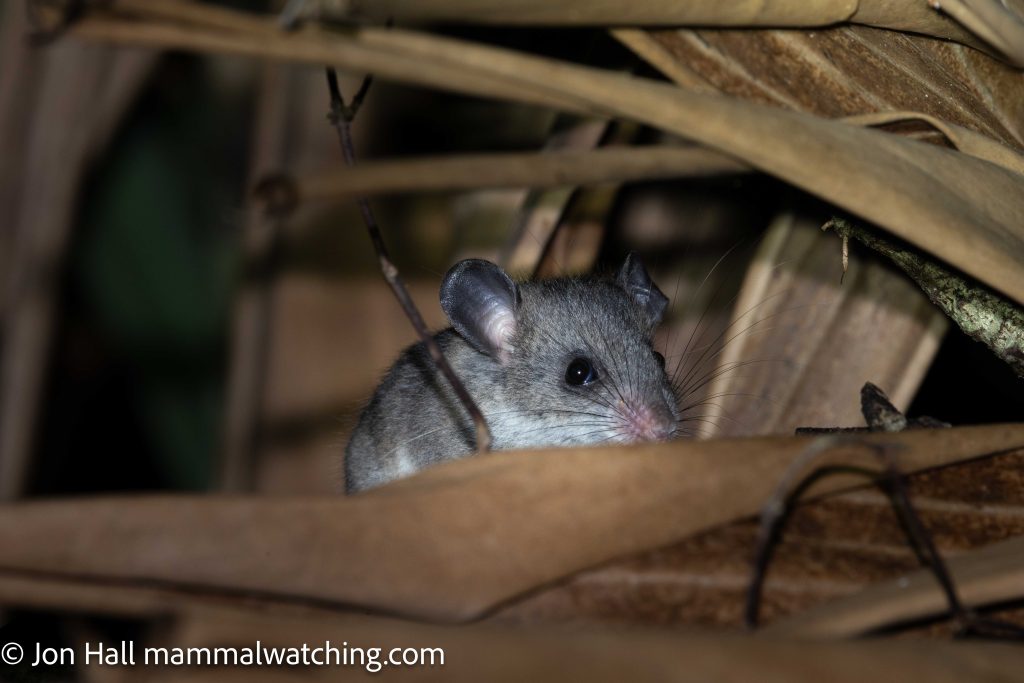
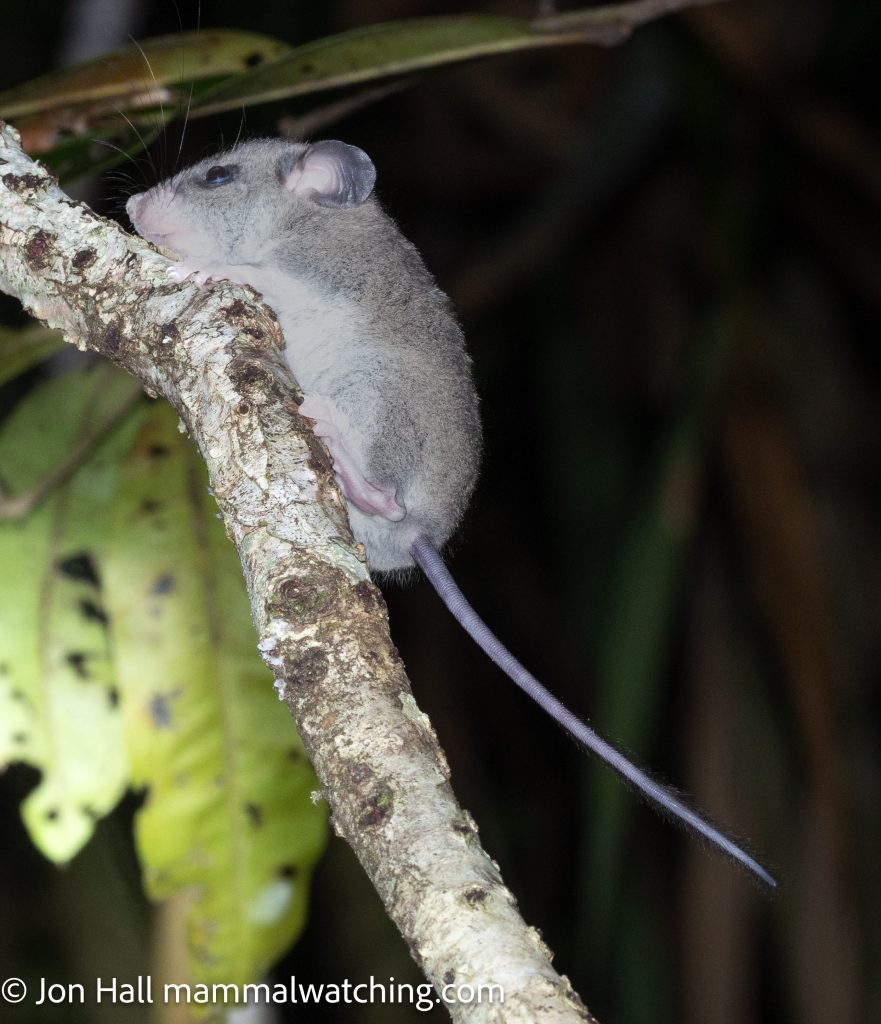
While we were sitting waiting for the Aye-ayes not to arrive we had poor views of a Greater Dwarf Lemur and a Webb’s Tuft-tailed Rat.
On the walk back to camp I had a much better look at a Lesser Tuft-tailed Rat.
The next morning a speed boat took us direct to our lodge on the edge of Masoala National Park.
Masoala National Park
Spotted Fanaloka (Fossa fossana)
We spent four nights at the lovely Dounia Forest Lodge on the beach and at the edge of the national park. We walked in the forest each morning and afternoon and at night, visiting both the national park and the community reserve on the other side of our lodge.
This is beautiful rainforest and almost empty of tourists. There are several endemic lemurs here along with four species of carnivore, three of which we were still chasing for the trip list.
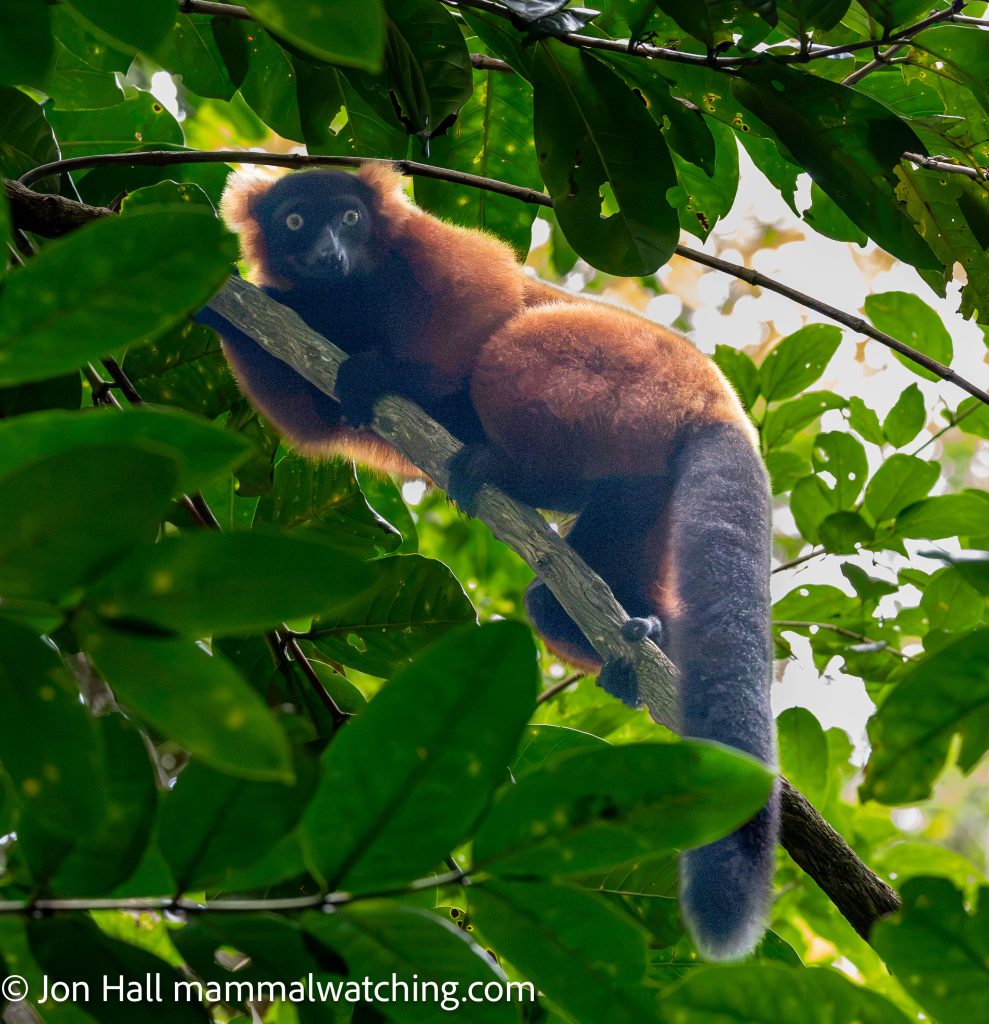
During the day, beautiful Red-ruffed Lemurs were easy to hear and fairly easy to track down.
Red Ruffed Lemur (Varecia rubra)
And White-fronted Brown Lemurs were common.
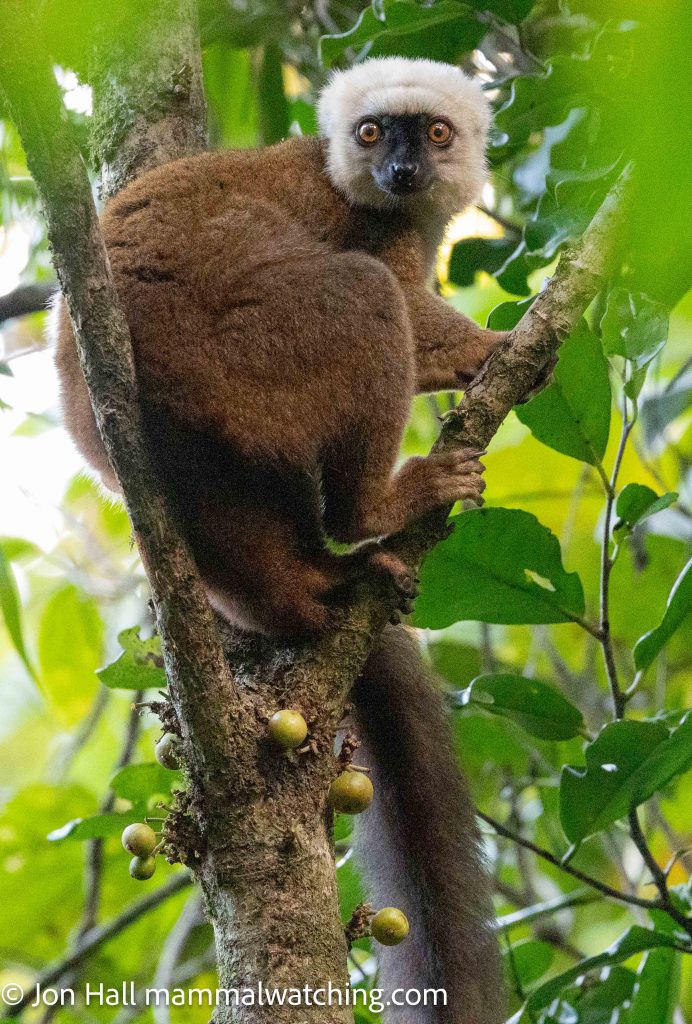
White-fronted Brown Lemur (Eulemur albifrons)
On our second morning we had a wonderful encounter with a Ring-tailed Vontsira. Carnivore number five.
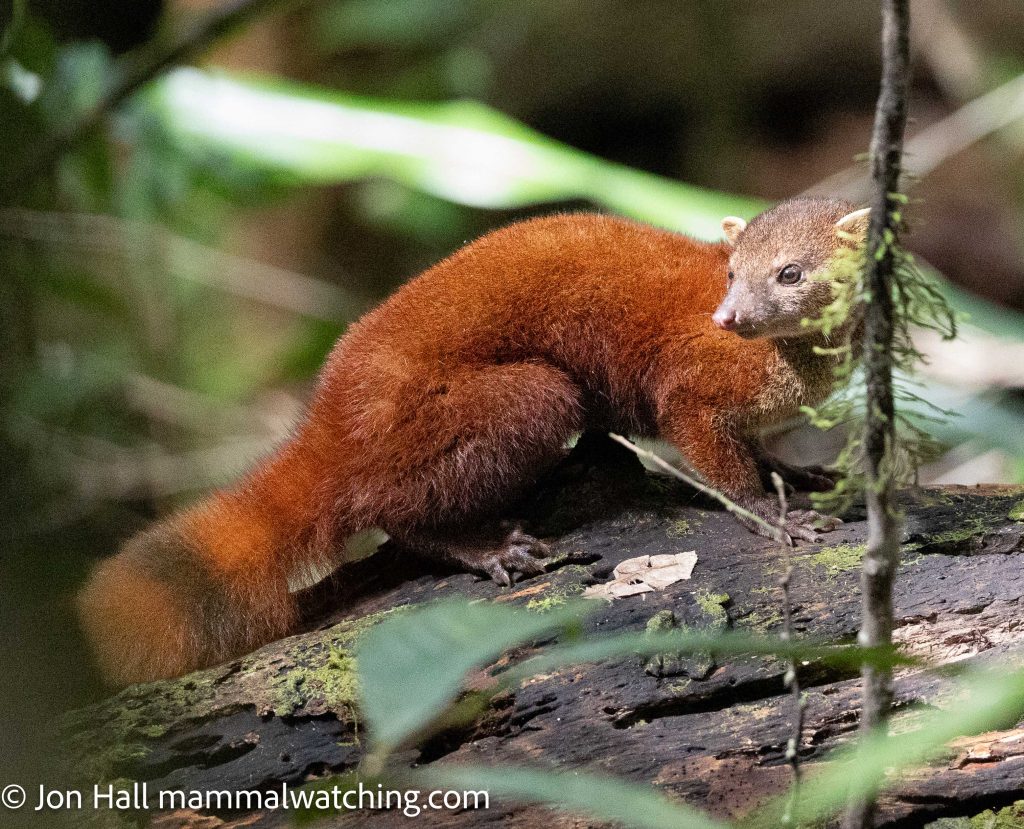
Ring-tailed Vontsira (Galidia elegans)
We watched it for half an hour feeding on insects in the crown of a palm tree. They climb surprisingly well.
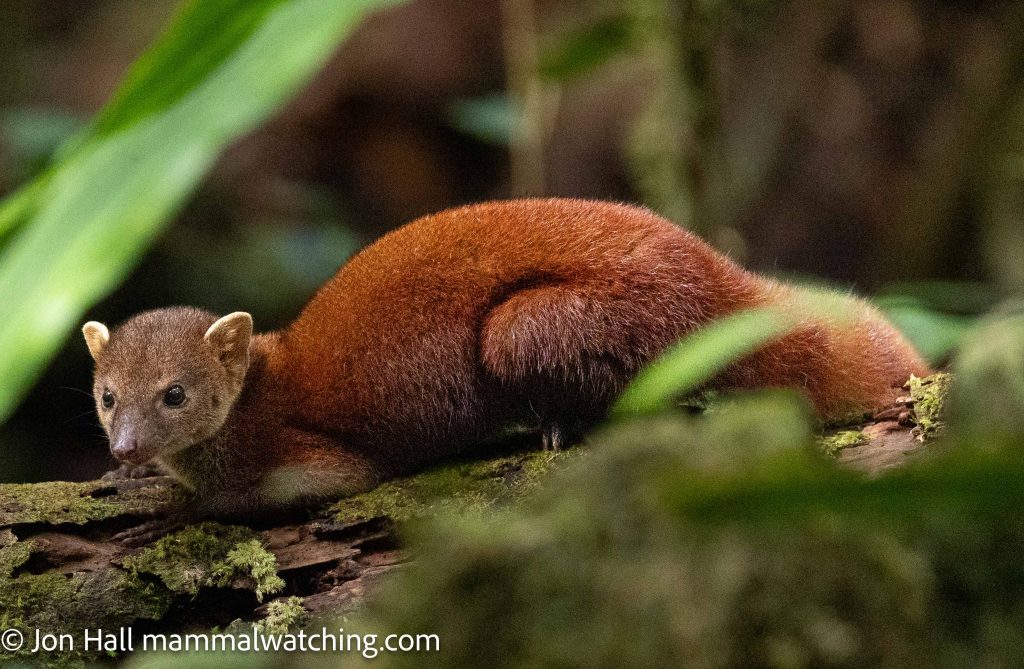
Ring-tailed Vontsira (Galidia elegans)
One afternoon some of the group – but not me – saw another Brown-tailed Vontsira. Simon almost got a photograph of it sitting watching him for ten seconds. But his camera settings were messed up.
At night we saw many Masoala Sportive Lemurs in the forest and along the beach.
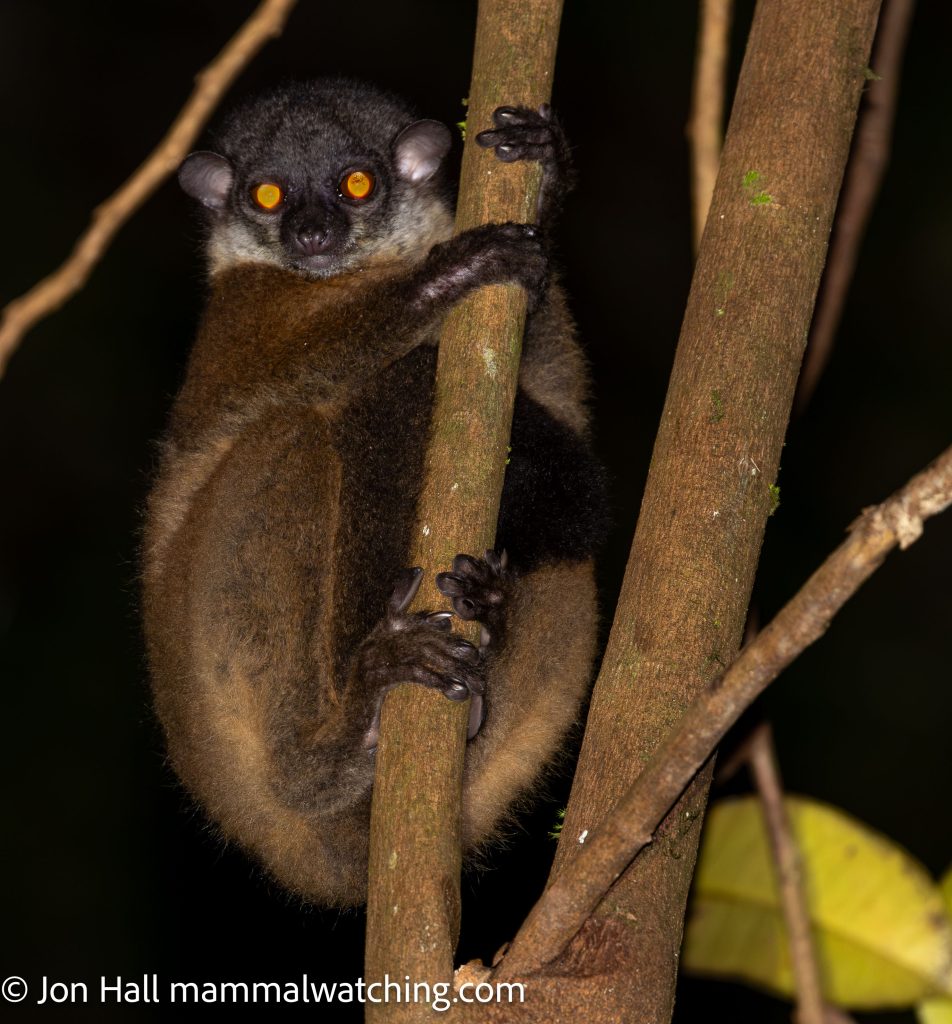
Masoala Sportive Lemur (Lepilemur scottorum)
And Masoala Woolly Lemurs were not too difficult to track down.
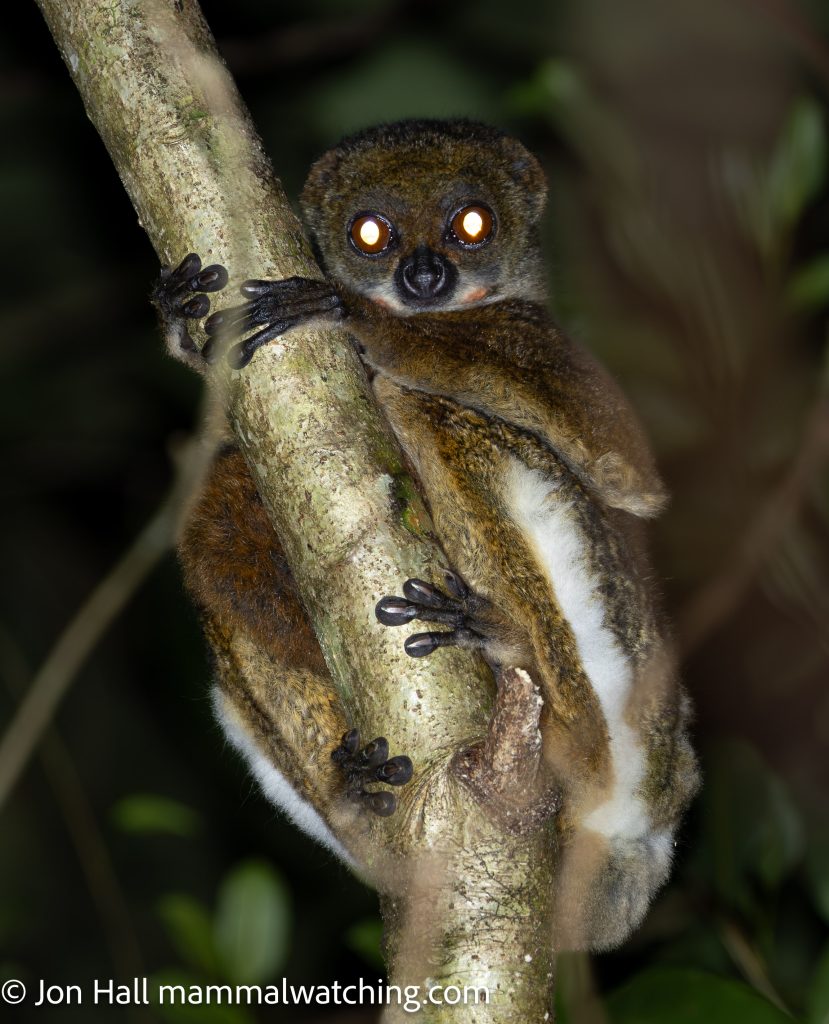
Masoala Woolly Lemur (Avahi mooreorum)
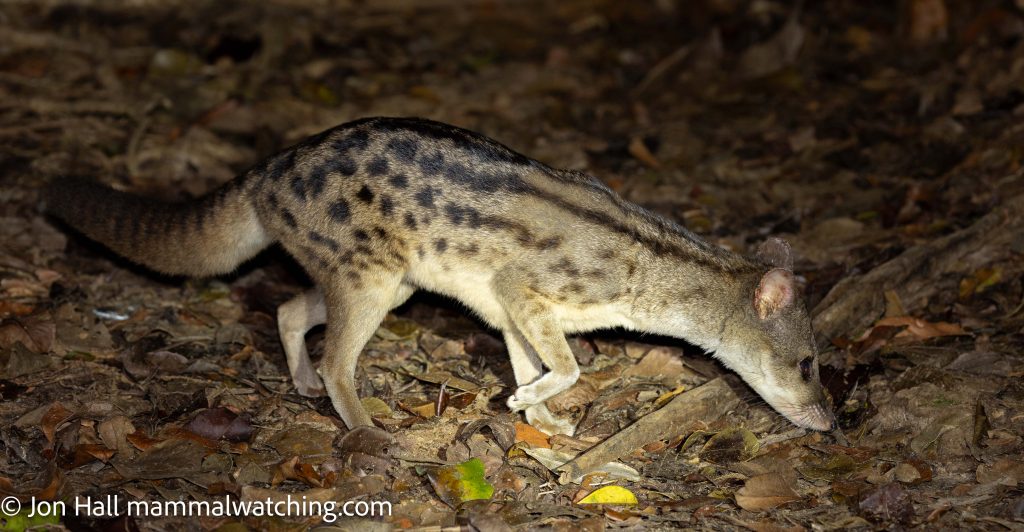
We saw Spotted Fanaloka three nights in a row: probably the same individual not far into the community forest about Chez Arol.
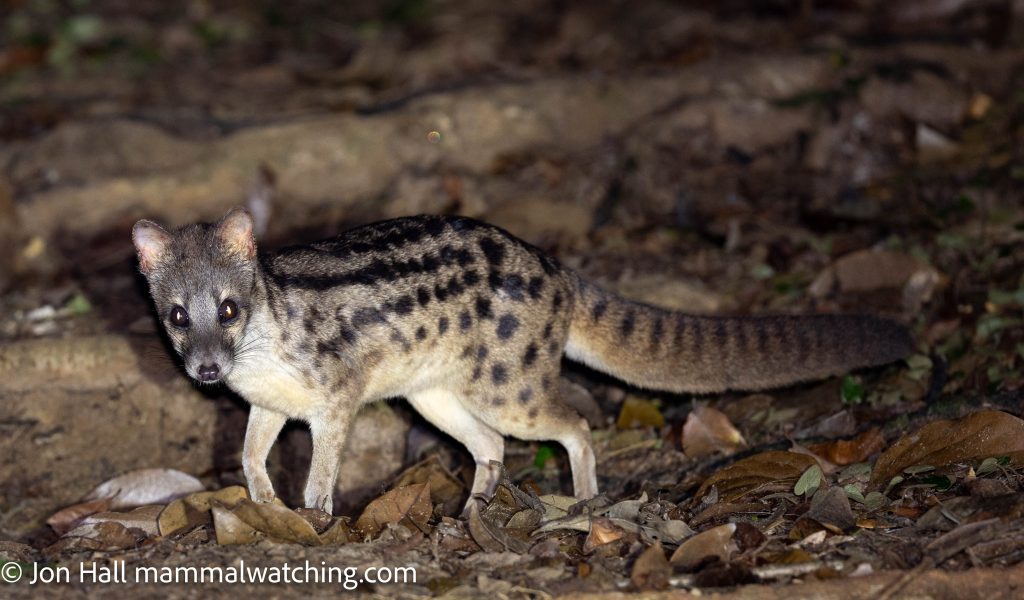
Spotted Fanaloka (Fossa fossana)
Another beautiful carnivore, the sixth for the trip, and not shy.
Greater Dwarf Lemurs were common.
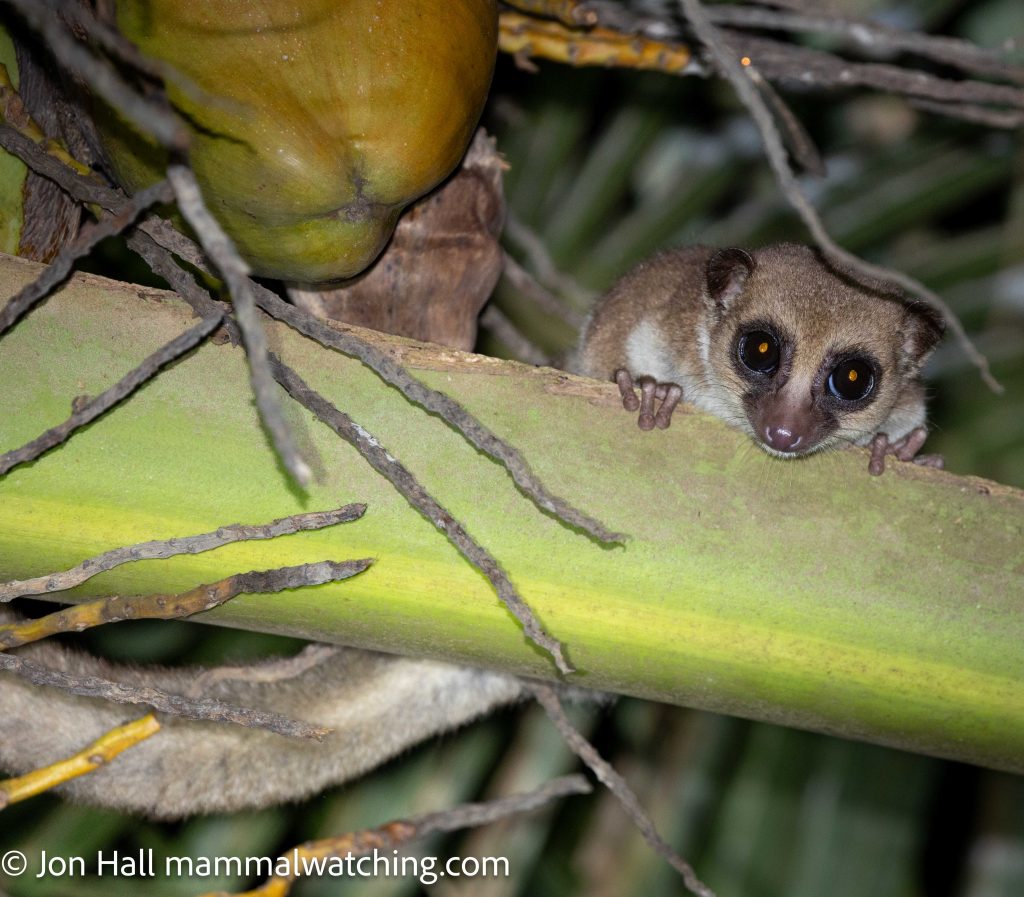
Greater Dwarf Lemur (Cheirogaleus major)
Somewhat surprisingly we saw only one mouse lemur and couldn’t get a photo. The mouse lemurs here may be an undescribed species but for the time being I will record it as Anjiahely Mouse Lemur (Microcebus macarthurii) which are known from close by Farankaraina.
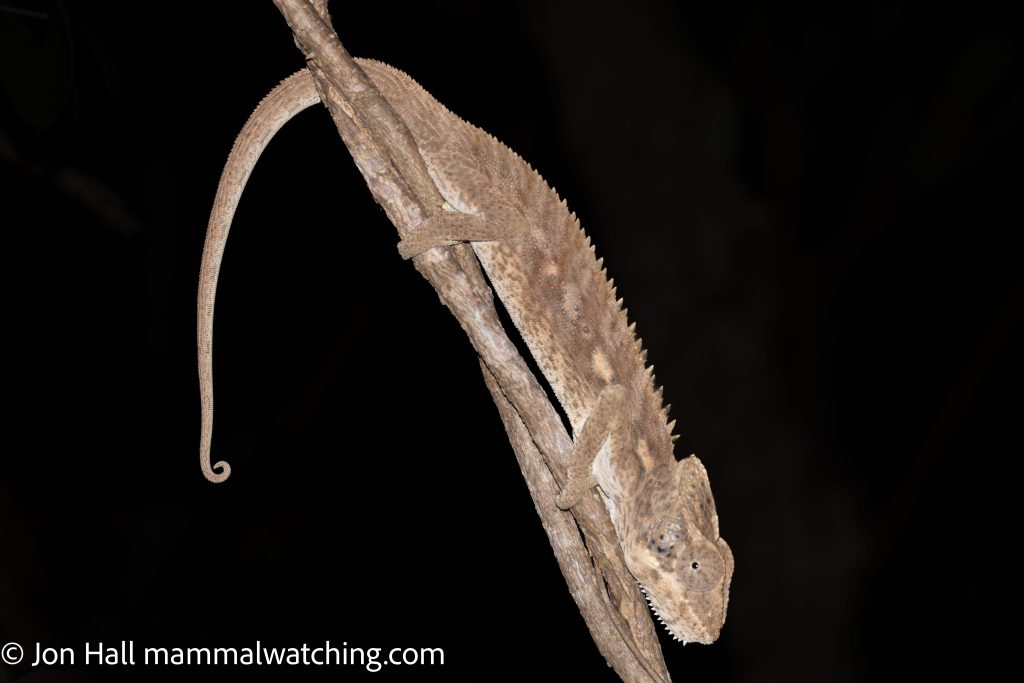
Patrick was particularly excited to find a Hooded Chameleon.
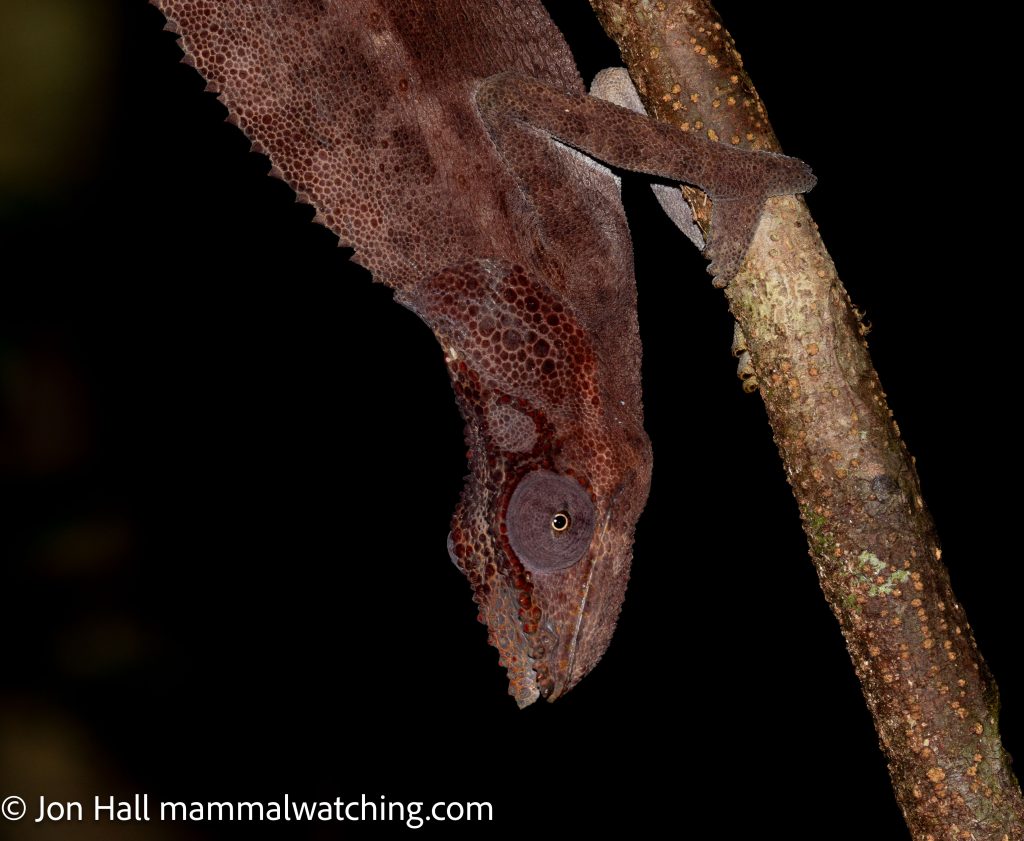
Hooded Chameleon (Calumma cucullatum)
Some of us saw an Aye-aye after midnight during a long night walk. It showed well, but briefly, moving high through the canopy. Once again no pictures.
The forest is very good for rodents.
I had a brief look at one of the diurnal red forest rats (Nesomys species) one afternoon, but there are two species here and I needed a better view to get that animal down to species.
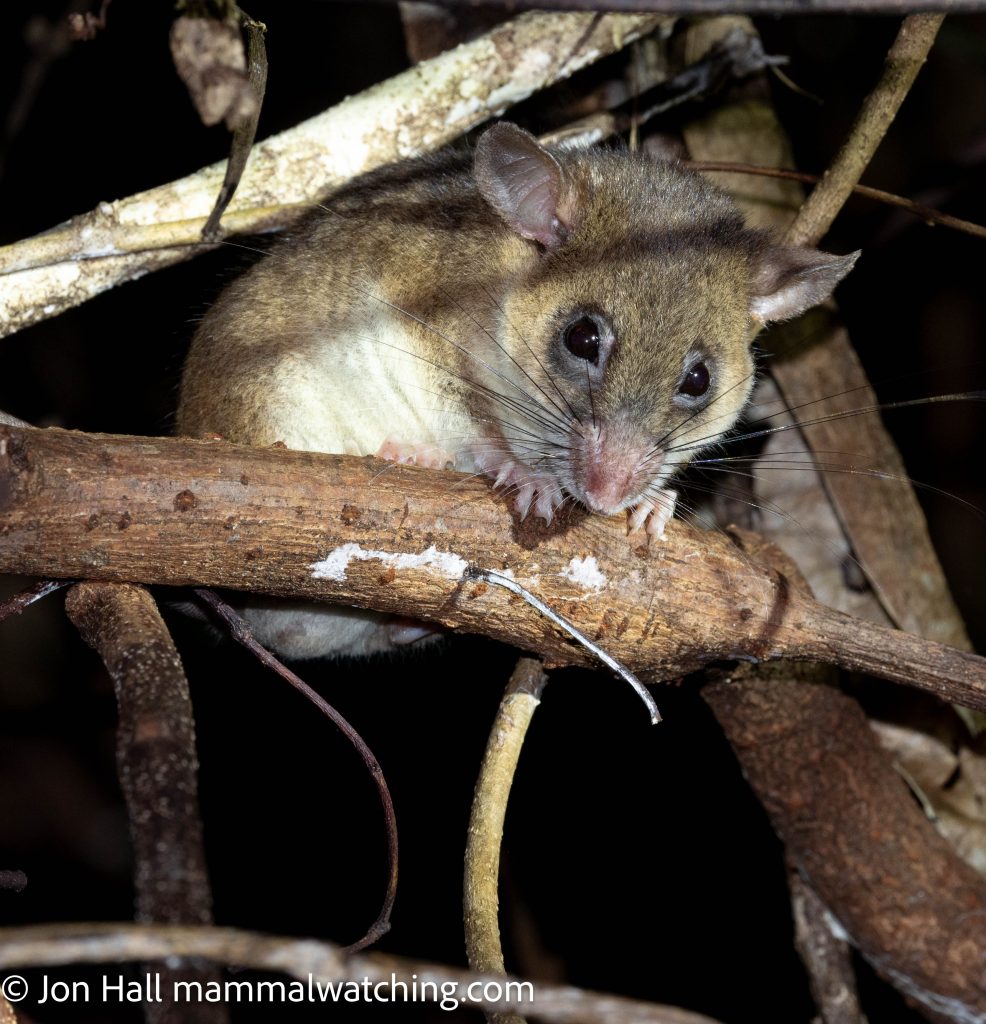
Webb’s Tufted-tail Rat (Eliurus webbi)
We saw many tuft-tailed rats all but one of which Patrick confidently identified as Webb’s Tuft-tailed Rats. The other one was a Lesser Tuft-tailed Rat.
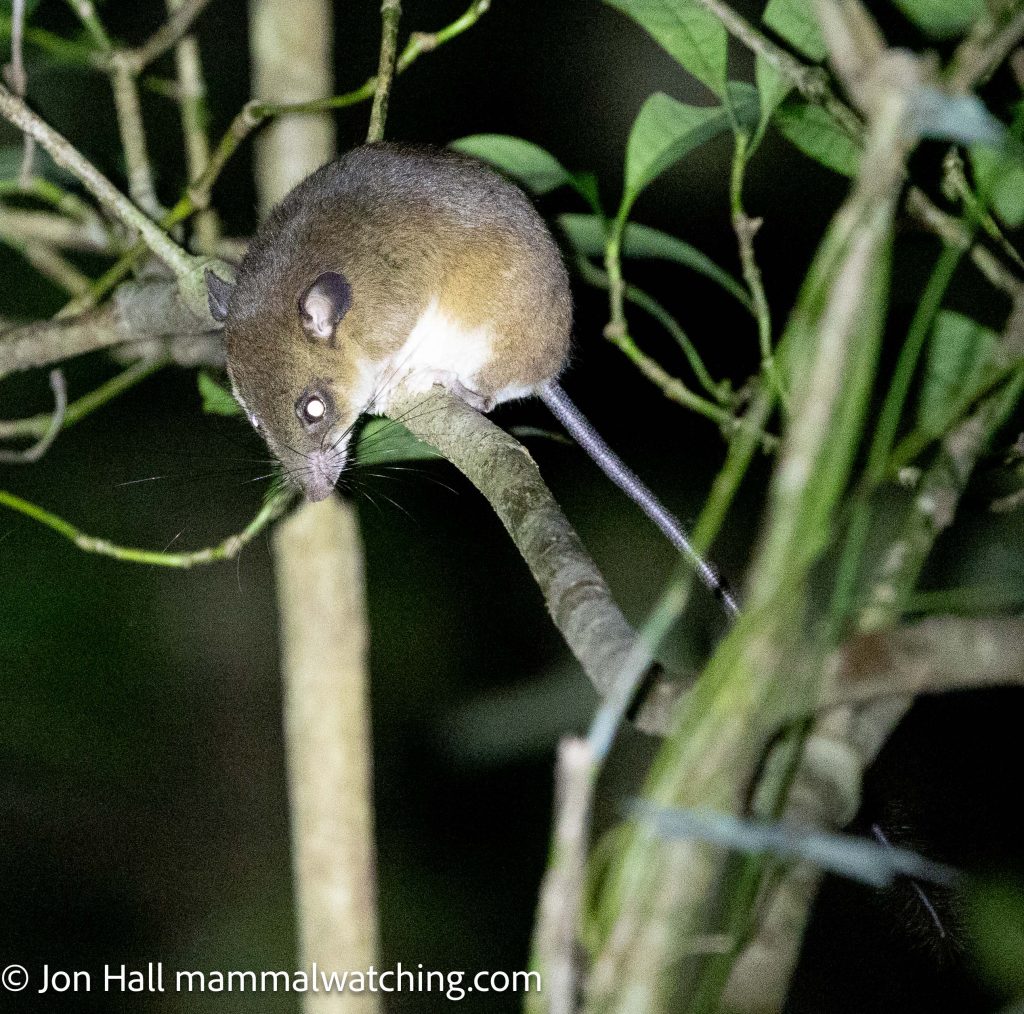
Webb’s Tufted-tail Rat (Eliurus webbi)
I’m including several rat pictures here in the hope someone can turn one of them into a different species.
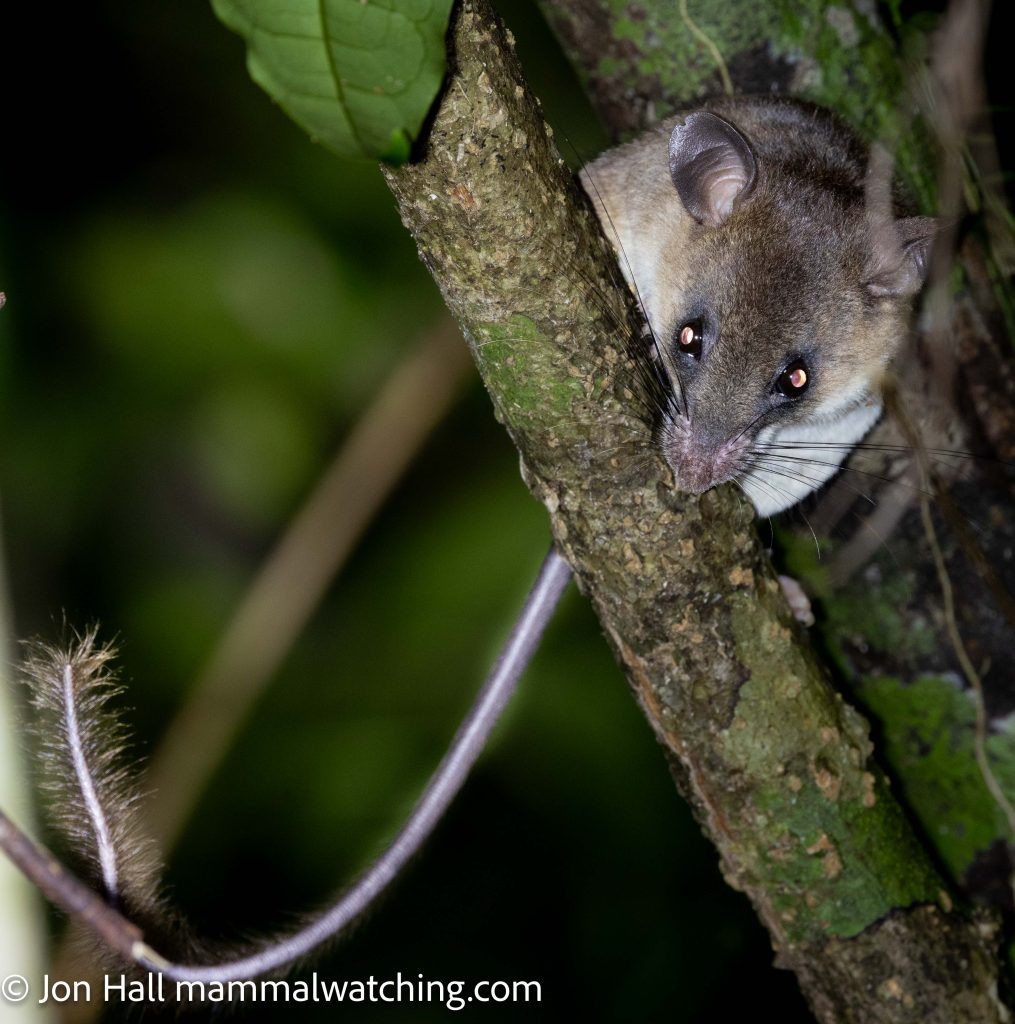
Webb’s Tufted-tail Rat (Eliurus webbi)
One of my favourite sightings of the trip was this chunky White-tailed Tree Rat, found with a thermal late into the night.
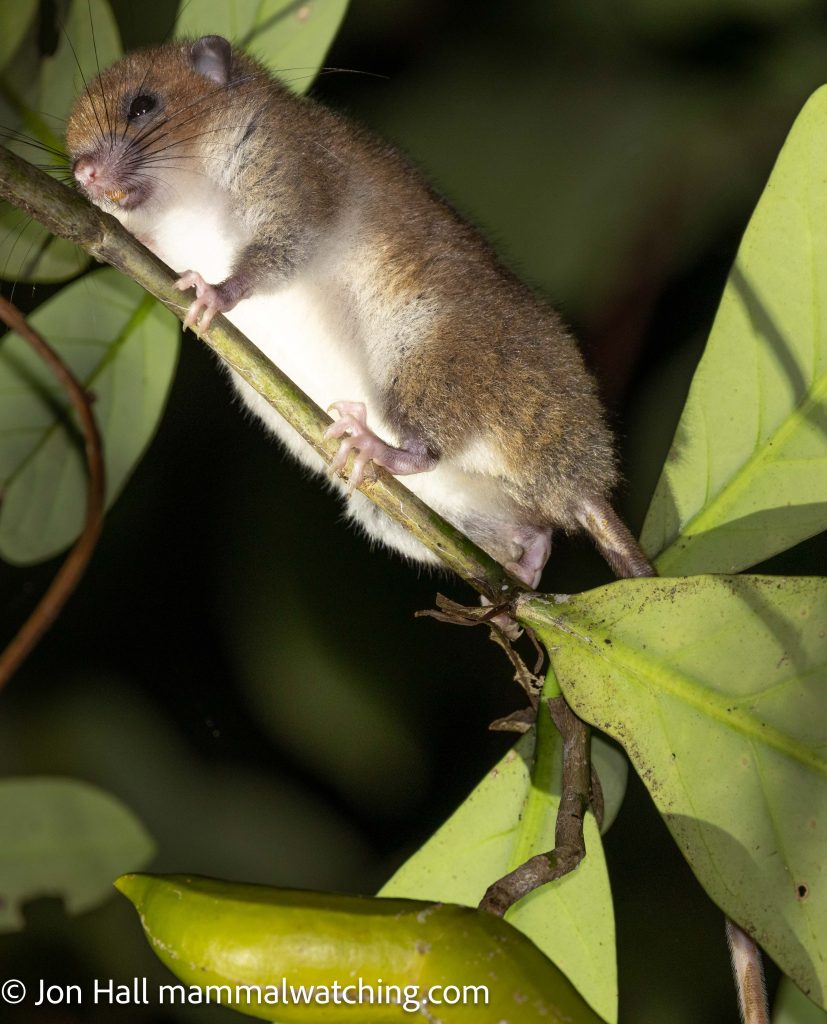
White-tailed Tree Rat (Brachytarsomys albicauda)
A gorgeous rat. And apparently rare.
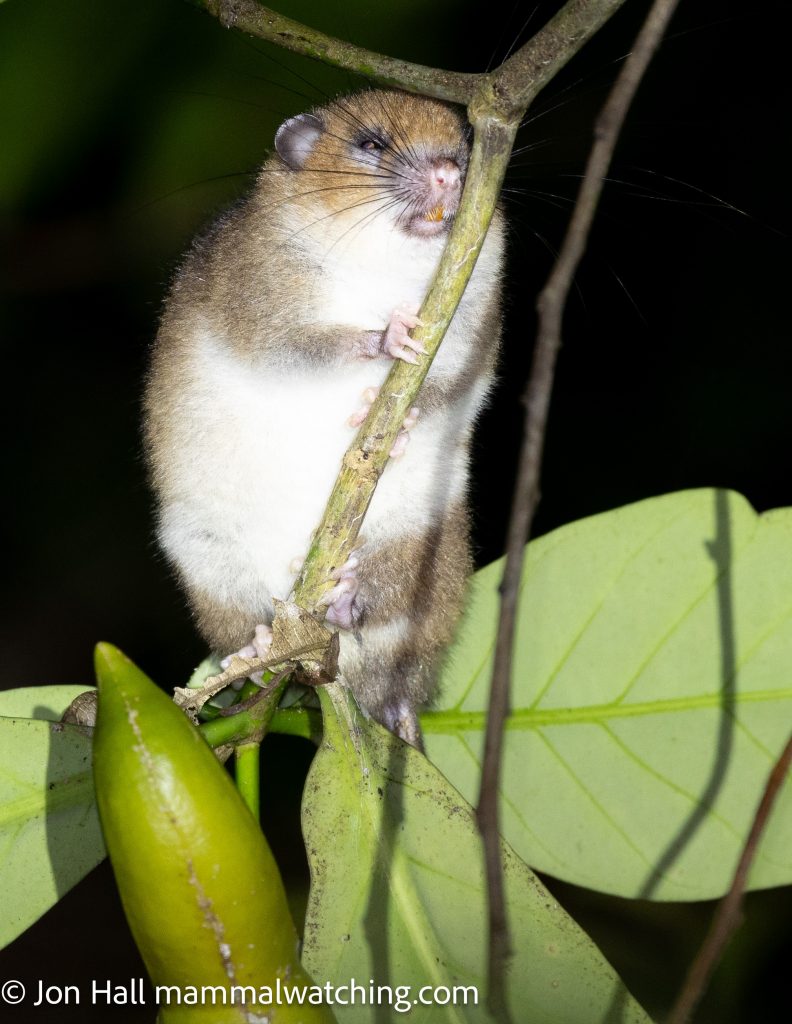
White-tailed Tree Rat (Brachytarsomys albicauda)
Spectacular Lowland Streaked Tenrecs are common around the village next to the lodge and locals caught two for us to photograph. Bizarre looking animals. A friend who saw the photos described it as a “toothpick mouse” which I like as an alternative name.
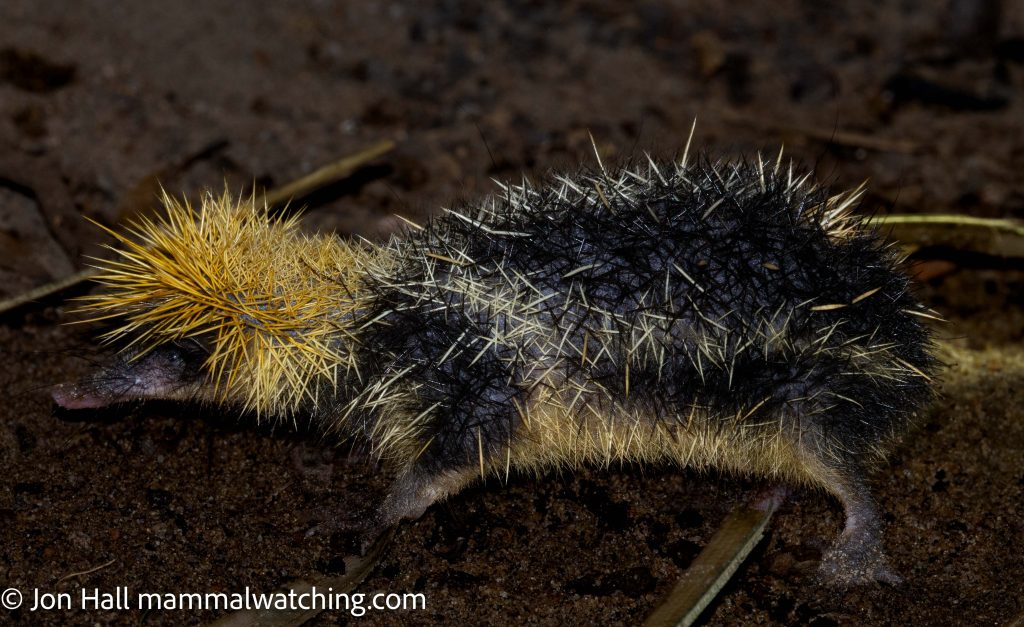
Lowland Streaked Tenrec (Hemicentetes semispinosus), aka Toothpick Mouse
The only bats we saw were several of the robust Commerson’s Leafnosed Bats which cooperated well for photos when we found them with our thermals hanging from trees.
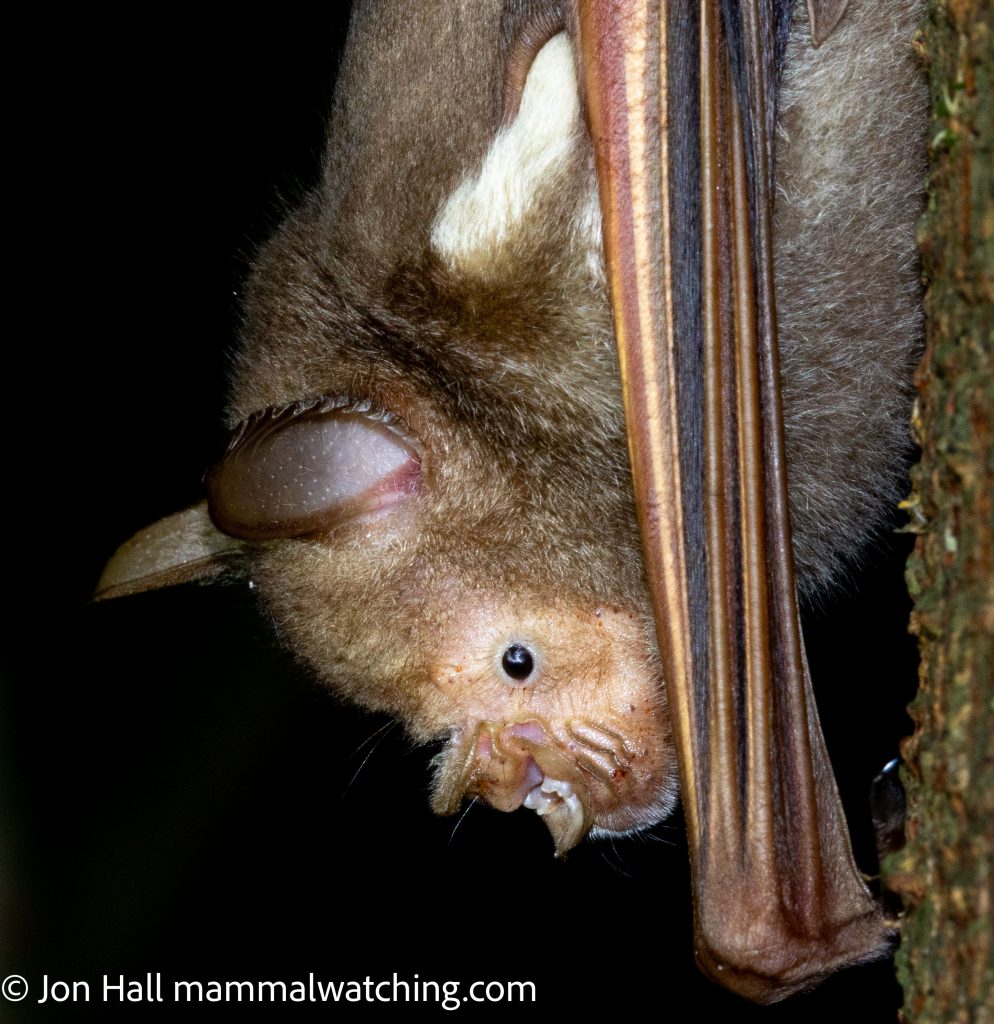
Commerson’s Roundleaf Bat (Macronycteris commersonii)
By the end of our second night at Masola, we had seen six of the seven carnivores on our trip and just needed a Falanouc for the clean sweep. But this fairly large and very bizarre carnivore did not play ball.
They can be active day or night.
We spent time in the day sitting and hoping one would cross the trail in an area where Patrick had seen one before during his trip with Alex Meyer.
And we spent many hours walking at night with our thermal scopes hoping to run into one. On the final night I thought we’d done it, but the animal in the thermal revealed itself to be ‘just’ another Fanaloka. A disappointment of course and I’m now desperate to see a Falanouc (of course).
I didn’t really need an extra reason to want to return to Madagascar but I have one now.
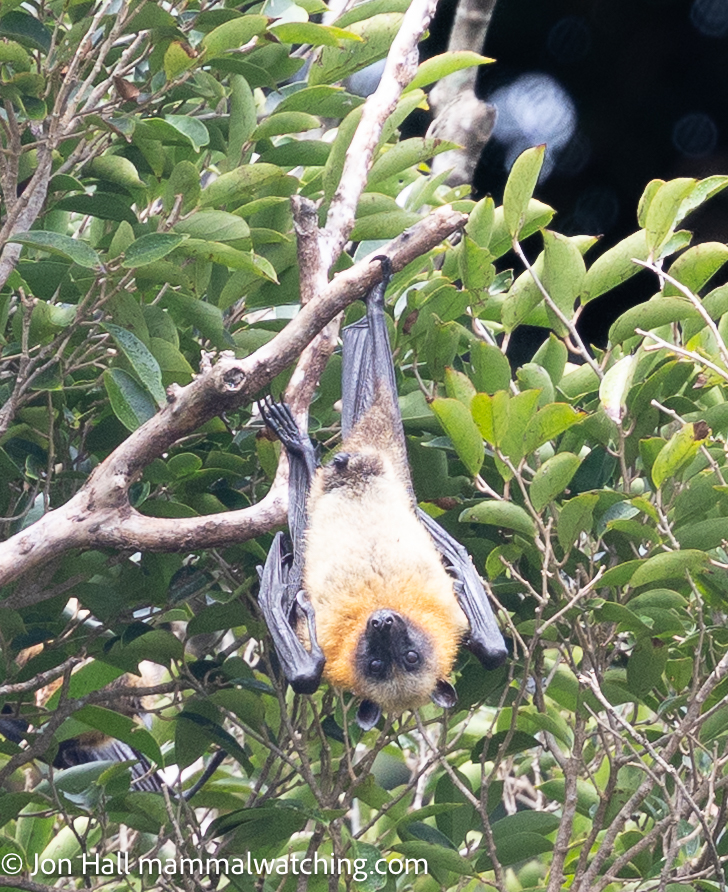
Malagasy Flying Fox (Pteropus rufus)
On the boat back from Masoala to Maraonsetra we drove past a Malagasy Flying Fox colony on Nosy Haramy island.
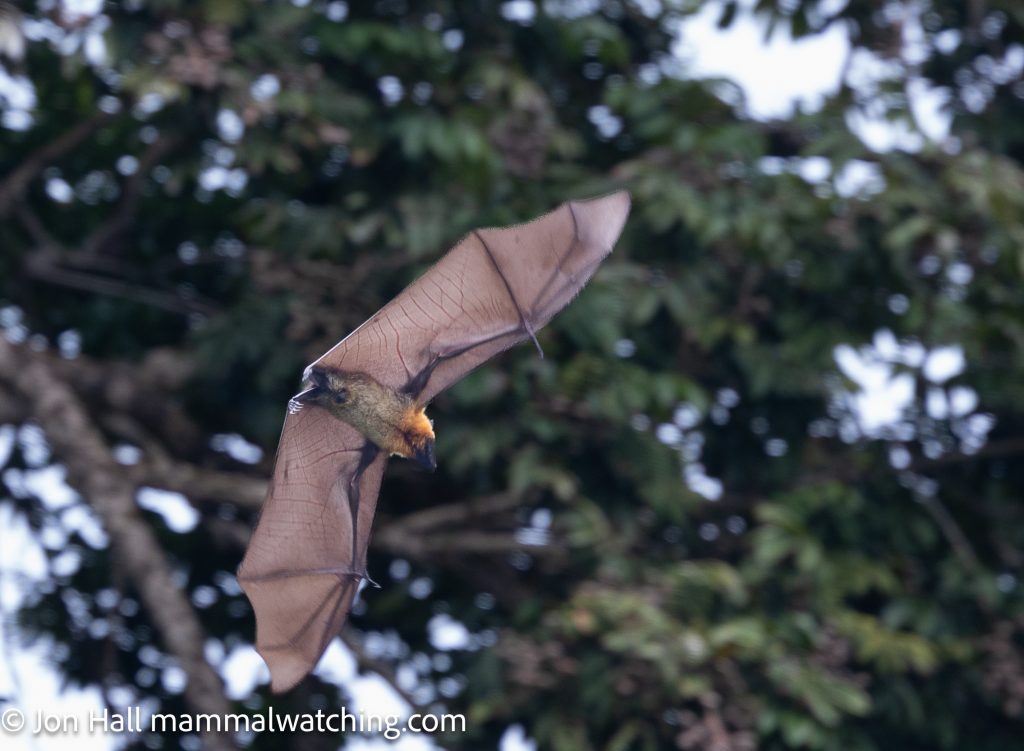
Malagasy Flying Fox (Pteropus rufus)
We spent the last night of the main tour in Maraonsetra and I somehow resisted the urge to go see another Tomato Frog. Our flight to Tana left the following morning. Andy and Karen left for their flights home while the rest of us got on a bus and drove to Andasibe National Park for the extension trip.
Post-tour Extension: Andasibe National Park
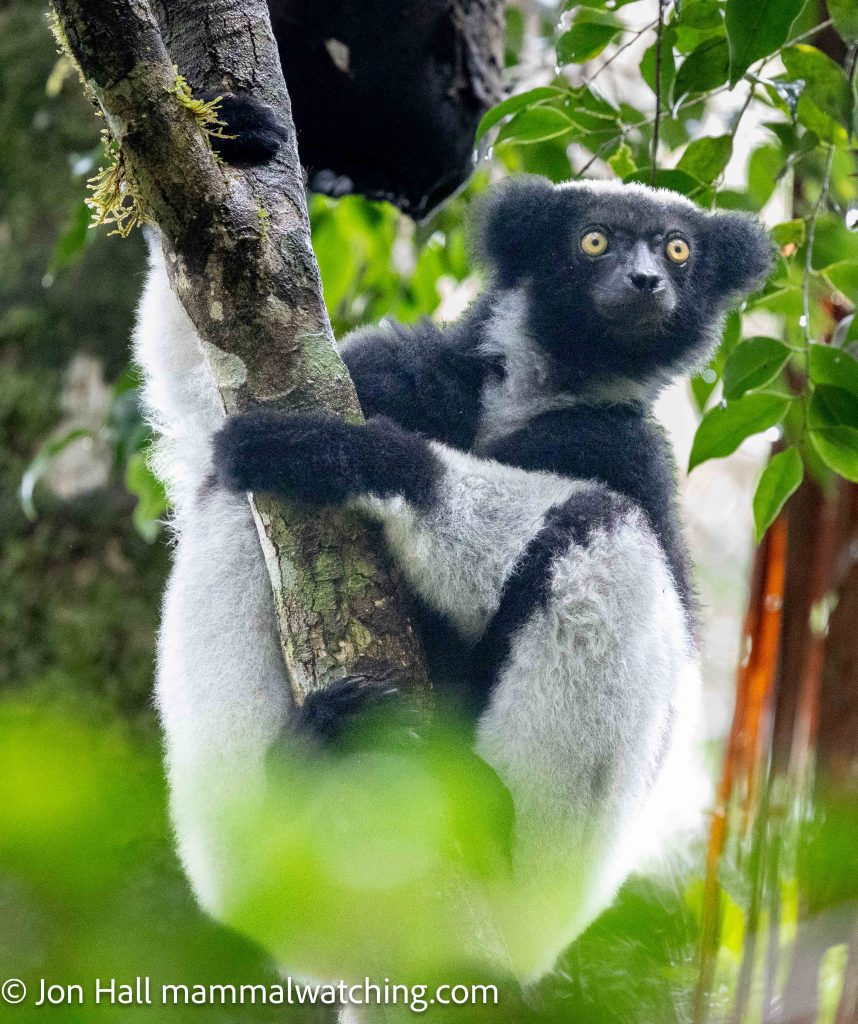
Indri (Indri indri)
The two night post-trip extension was to Andasibe where we stayed at the Sahatandra River Hotel. The place was a little underwhelming although we could hear Indris calling from our rooms. There are better lodges in the area but they were fully booked.
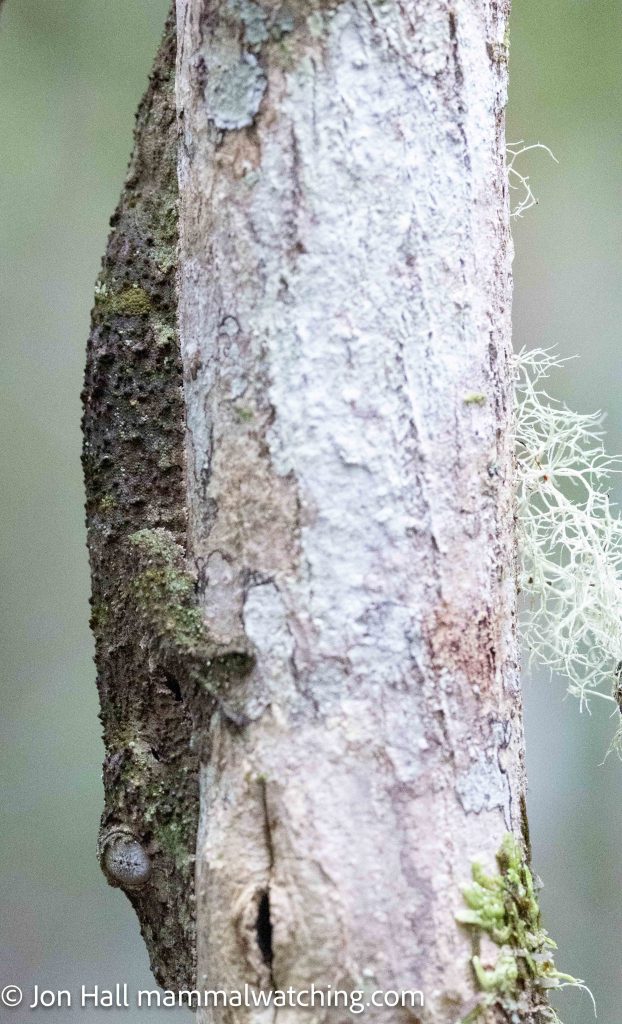
Mossy Leaf-tailed Gecko
Andasibe is on the main Madagascar tourist circuit and the Analmazoatra section of the park was very busy during our morning visit. Like us, everyone had come to see Indri and Diademed Sifaka. Both were easy to find but we had to share the experience with dozens of other people.
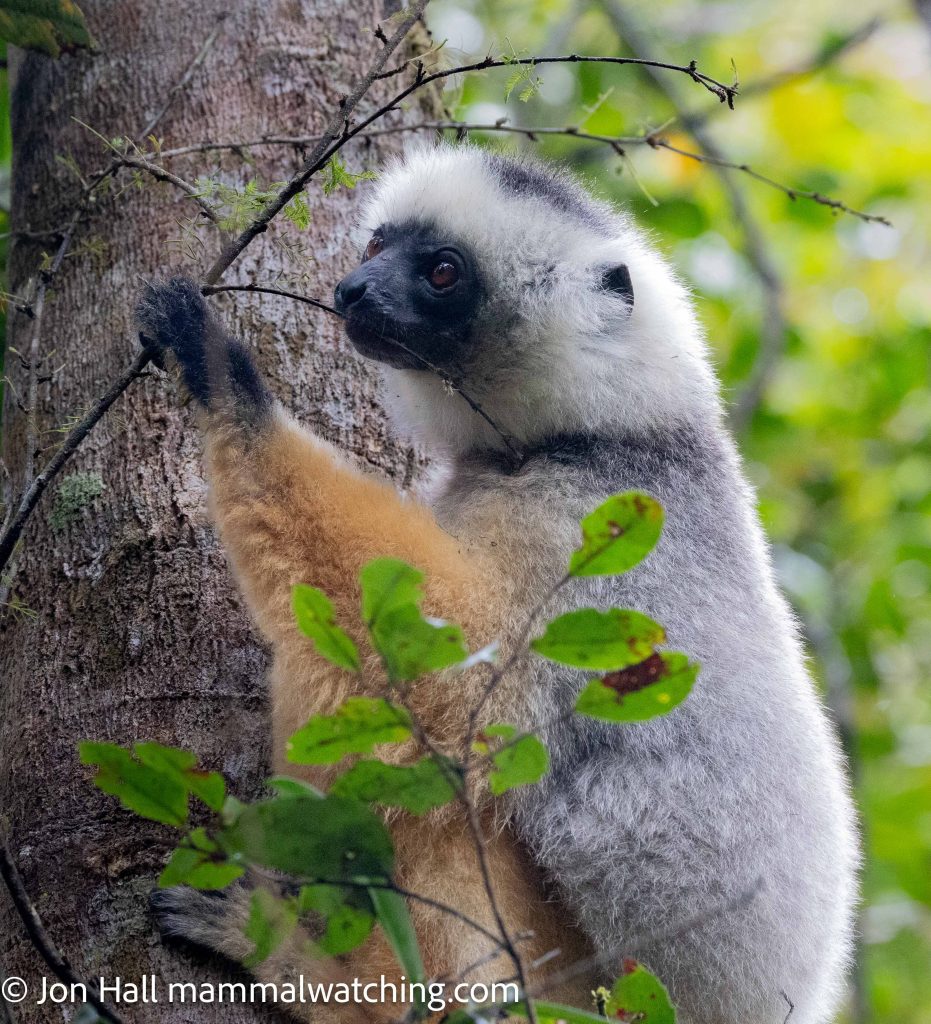
Diademed Sifaka (Propithecus diadema)
We also saw Brown Lemurs.
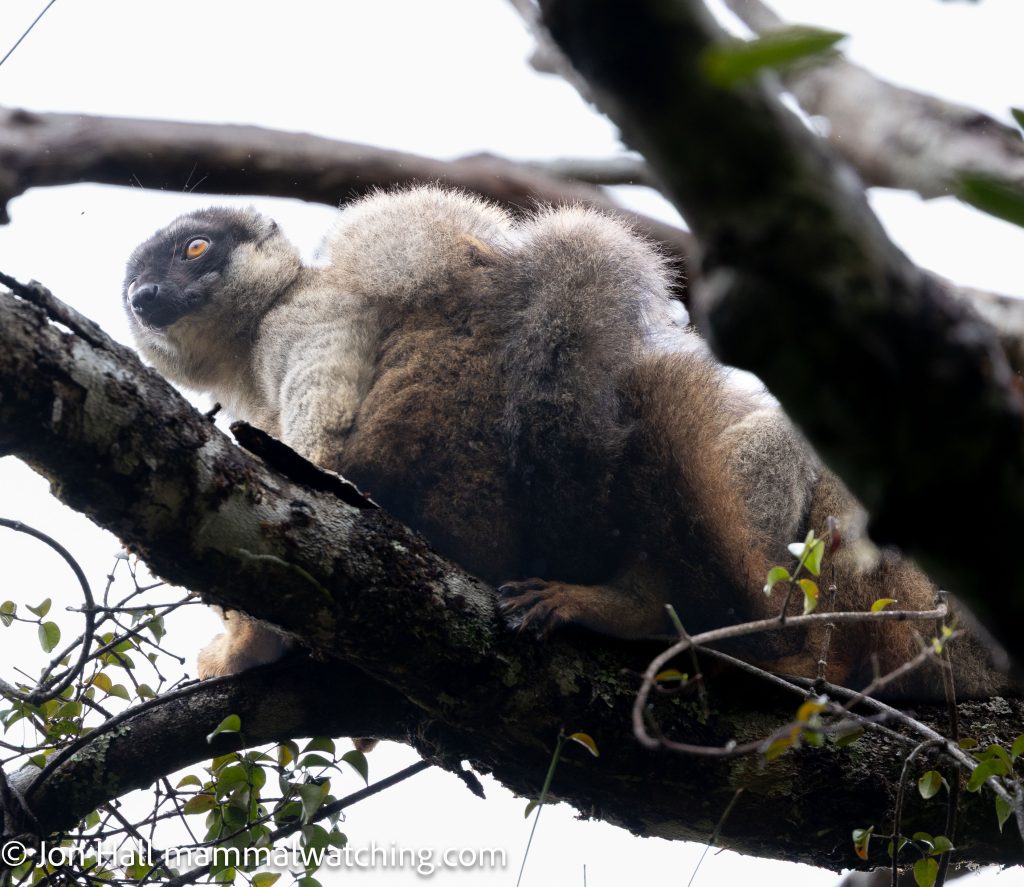
Brown Lemur (Eulemur fulvus)
And Gray (Eastern) Bamboo Lemurs in the bamboo patch by the bridge.
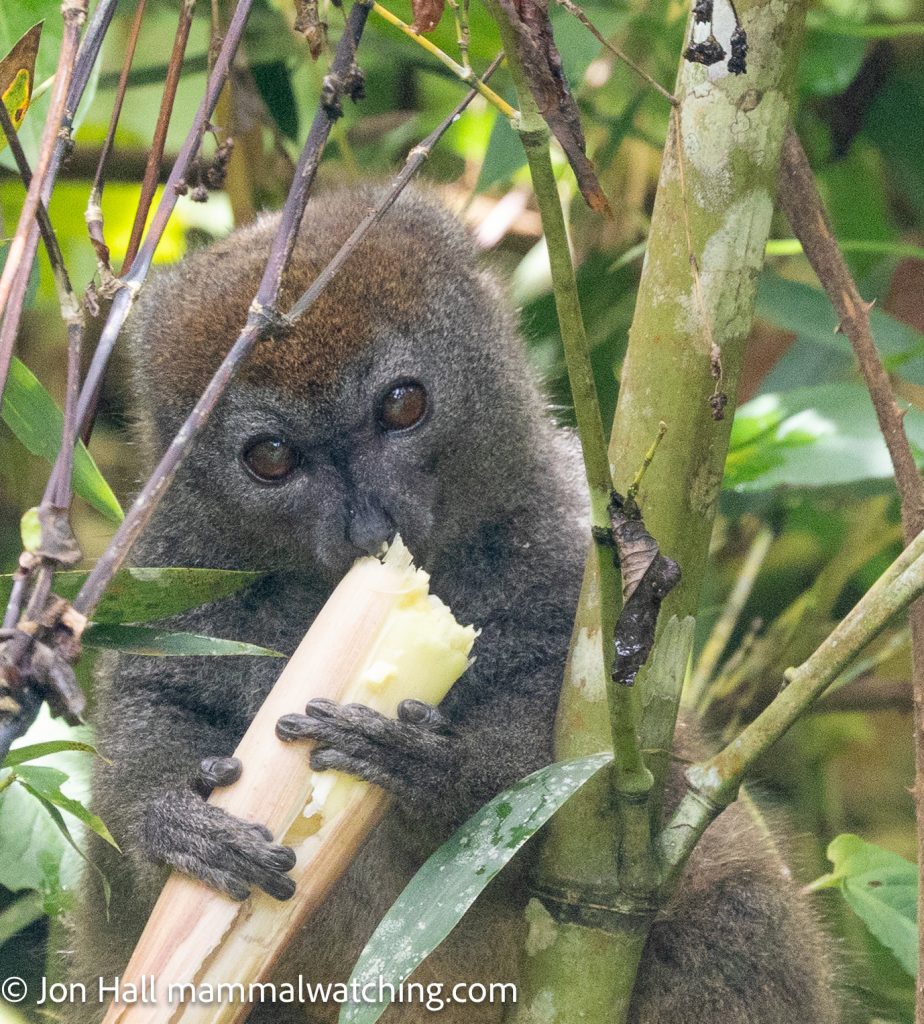
Gray Bamboo Lemur (Hapalemur griseus)
it took about six hours to drive to Andasibe from Tana. We arrived after dark in the rain and visited the small V.O.I.M.M.A park for our first night walk. The forest isn’t great and I imagine the rain didn’t help with the mammalwatching. In three hours we only saw a handful of mammals there: Goodman’s Mouse Lemur, Eastern Wooly Lemur, Brown Lemur and Webb’s Tuft-tailed Rat.
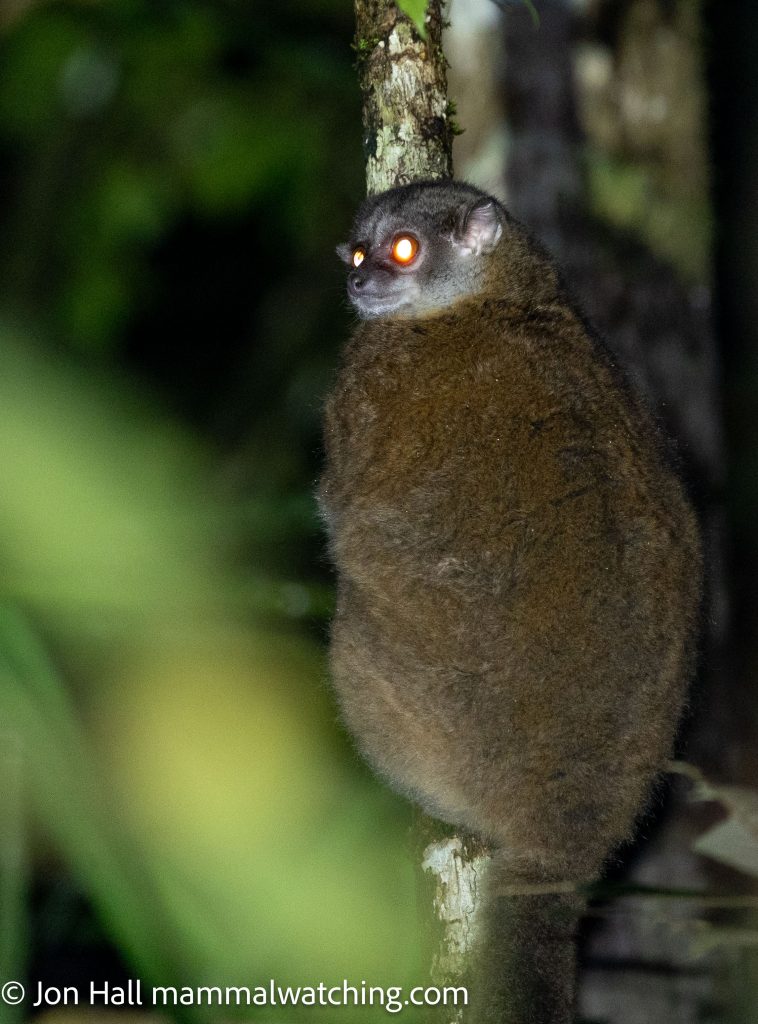
Weasel Sportive Lemur (Lepilemur mustelinus)
We spent the following afternoon and evening in the excellent Maromizaha Reserve nearby. The forest here is impressive and we had the whole park to ourselves.
The local guides had staked out some Black and White-ruffed Lemurs when we arrived but they lost track of the lemurs before we arrived at the spot in the late afternoon.
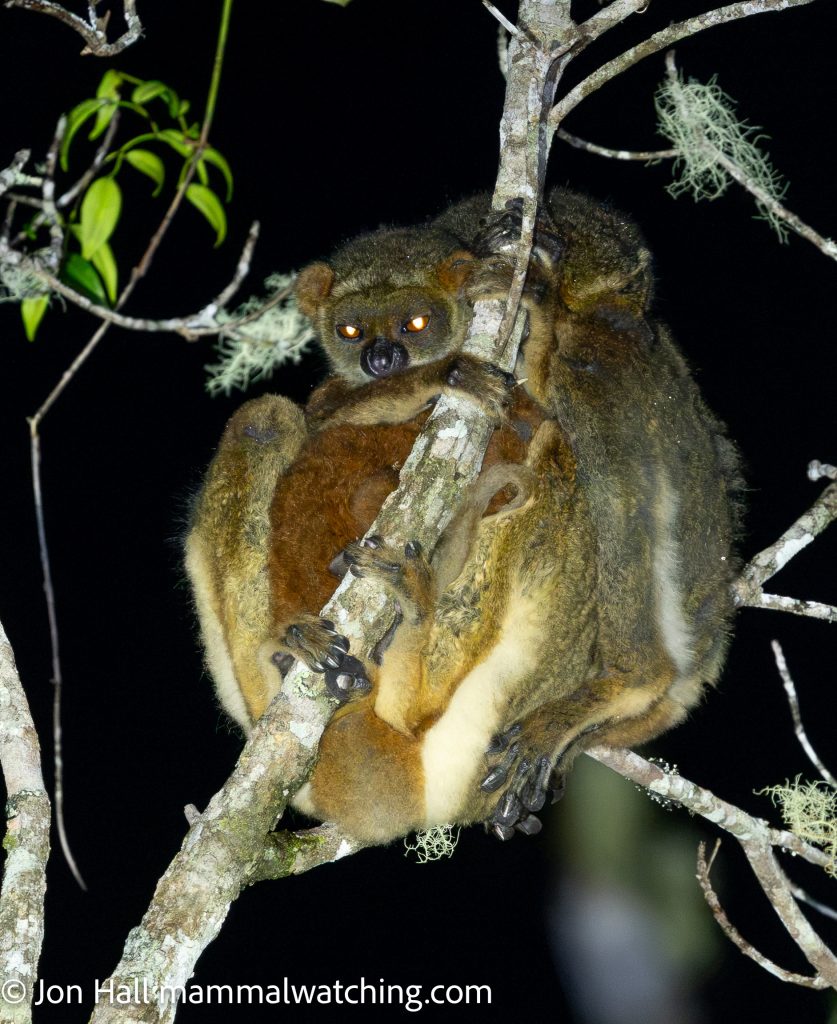
Eastern Woolly Lemur (Avahi laniger)
The three hour night walk back to our bus was excellent. We saw several Weasel Sportive Lemurs, a lifer for me, along with several Eastern Woolly Lemurs.
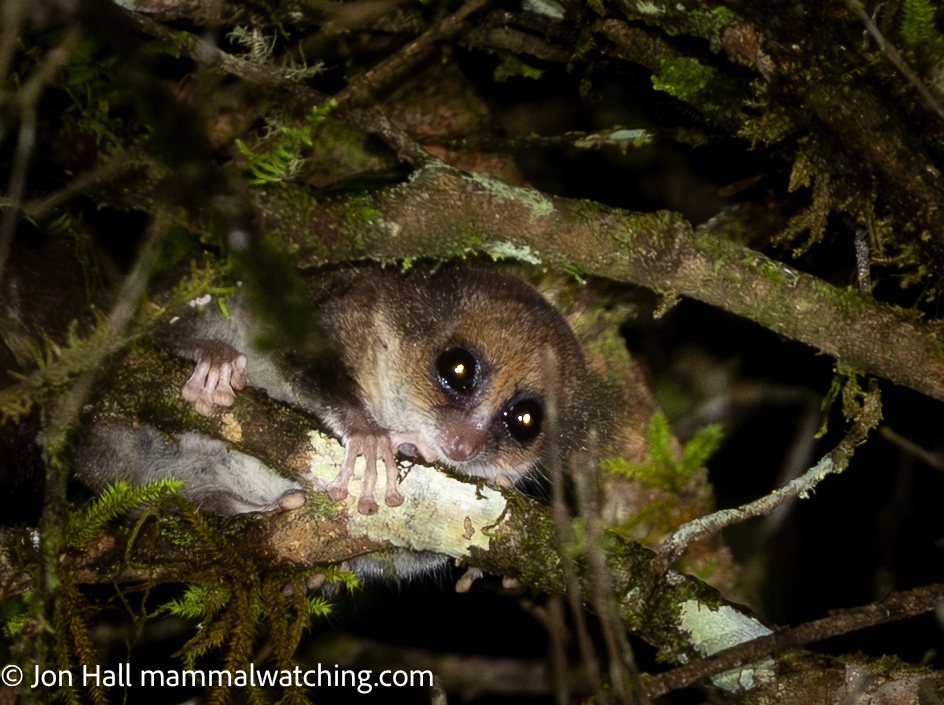
Hairy-eared Dwarf Lemur (Allocebus trichotis)
A key target here is Hairy-eared Dwarf Lemur and Patrick found one high in the canopy that, although distant, posed well for photos.
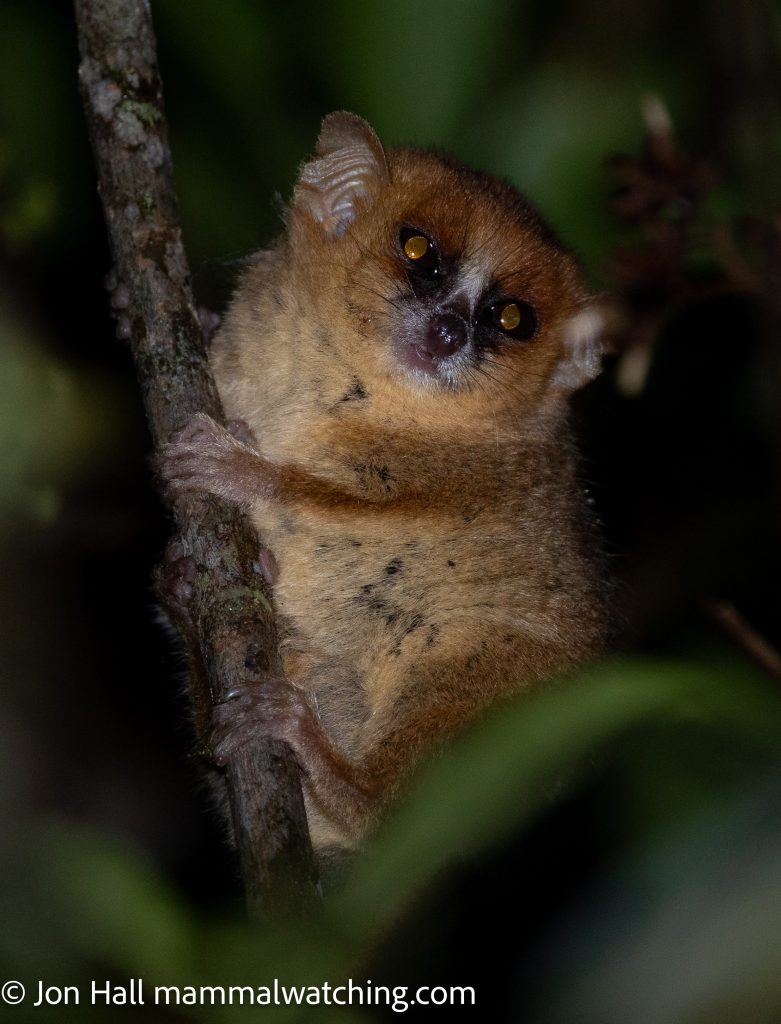
Goodman’s Mouse Lemur (Microcebus lehilahytsara)
We also found several Goodman’s Mouse Lemurs and two species of tuft-tailed rats.
Everyone saw the Lesser Tuft-tailed again – a species we had seen in Masoala – but only some of the group saw a Tanala Tuft-tailed Rat. I missed it. It would have been a lifer. But I think I managed to remain composed and admired the great photo that Simon took with barely a twinge of pain.
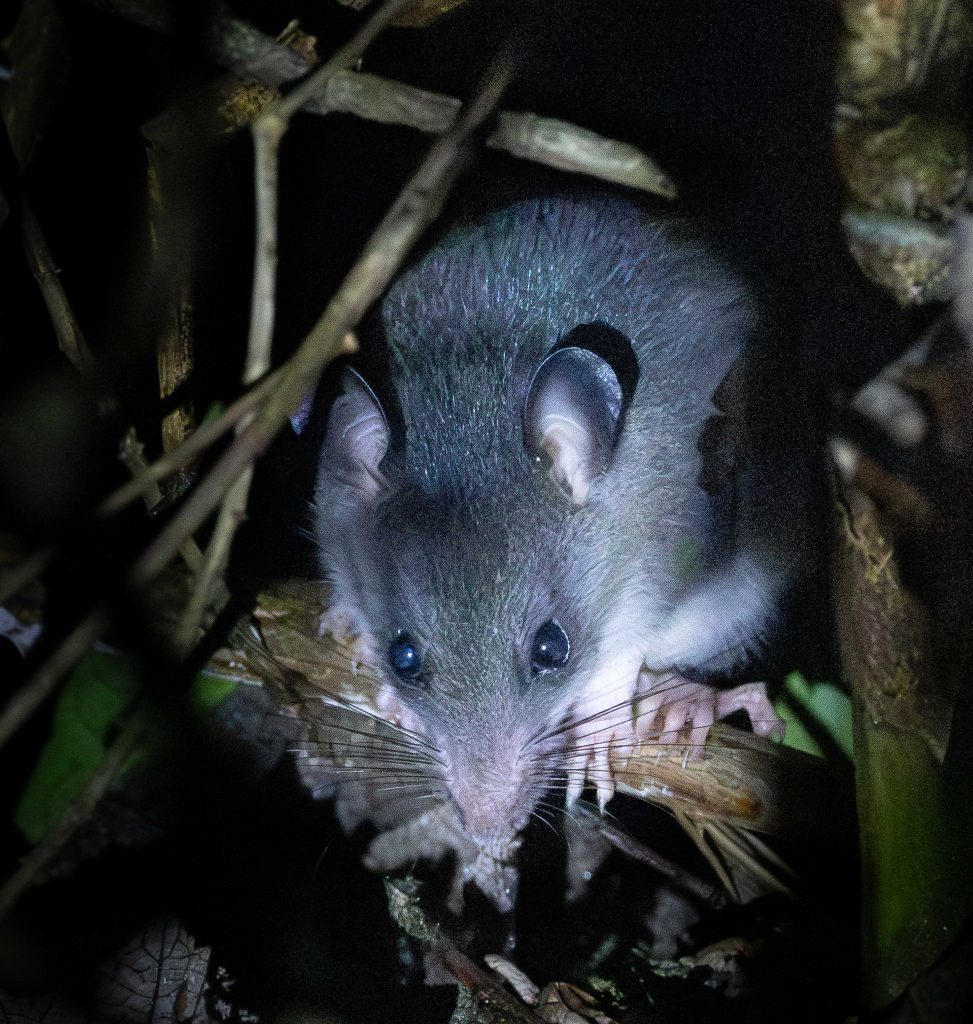
Tanala Tuft-tailed Rat (Eliurus tanala). Photo Simon van der Meulen
We left for Tana the following morning, stopping briefly at the V.O.I.M.M.A reserve entrance to see a bizarre Giraffe Weevil, which was worth the stop.
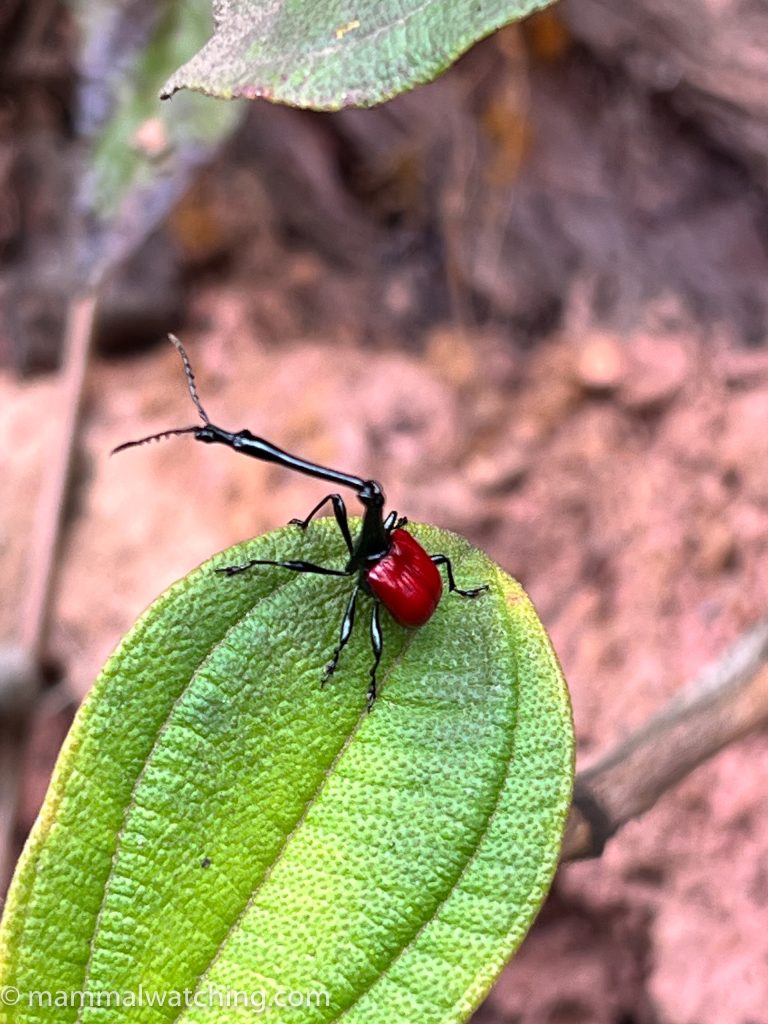
Giraffe Weevil
Before we left we met up with local guide Luc in the village who let us see the freetail bats roosting in his attic. Most of them were Madagascar Free-tailed Bats, my 19th lifer for the trip, but there were also one or two of the pure white-bellied Malagasy White-bellied Free-tailed Bats in amongst them.
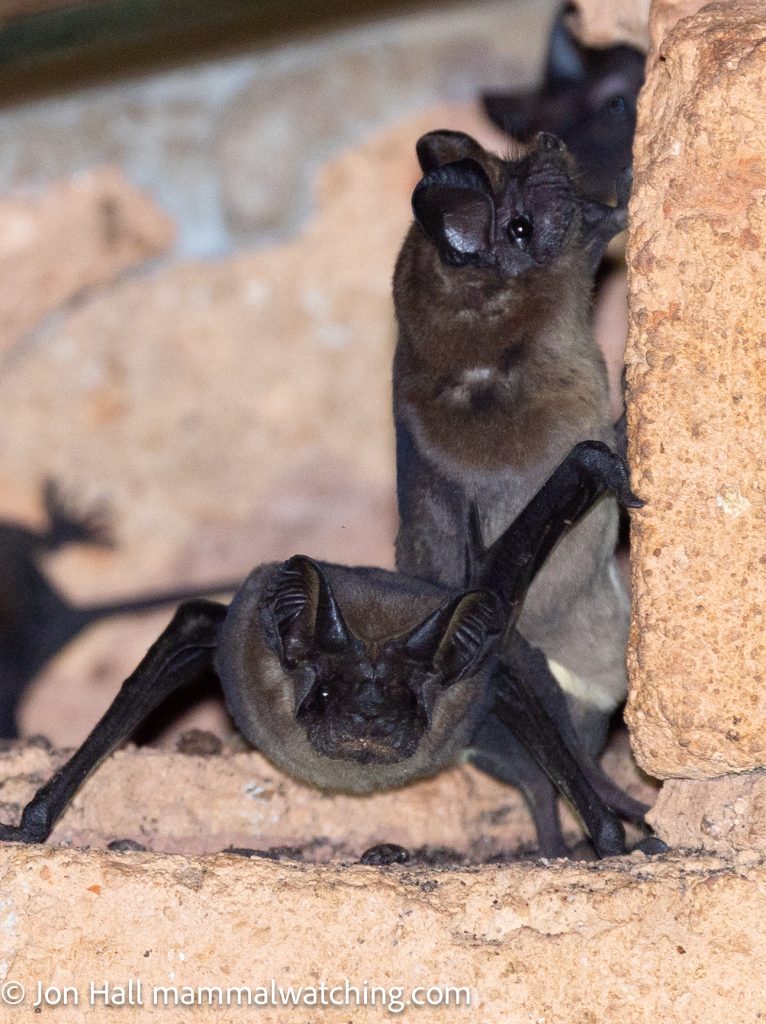
Madagascar Free-tailed Bat (Mops atsinanana)
And five hours later we were back in Tana for a farewell dinner.
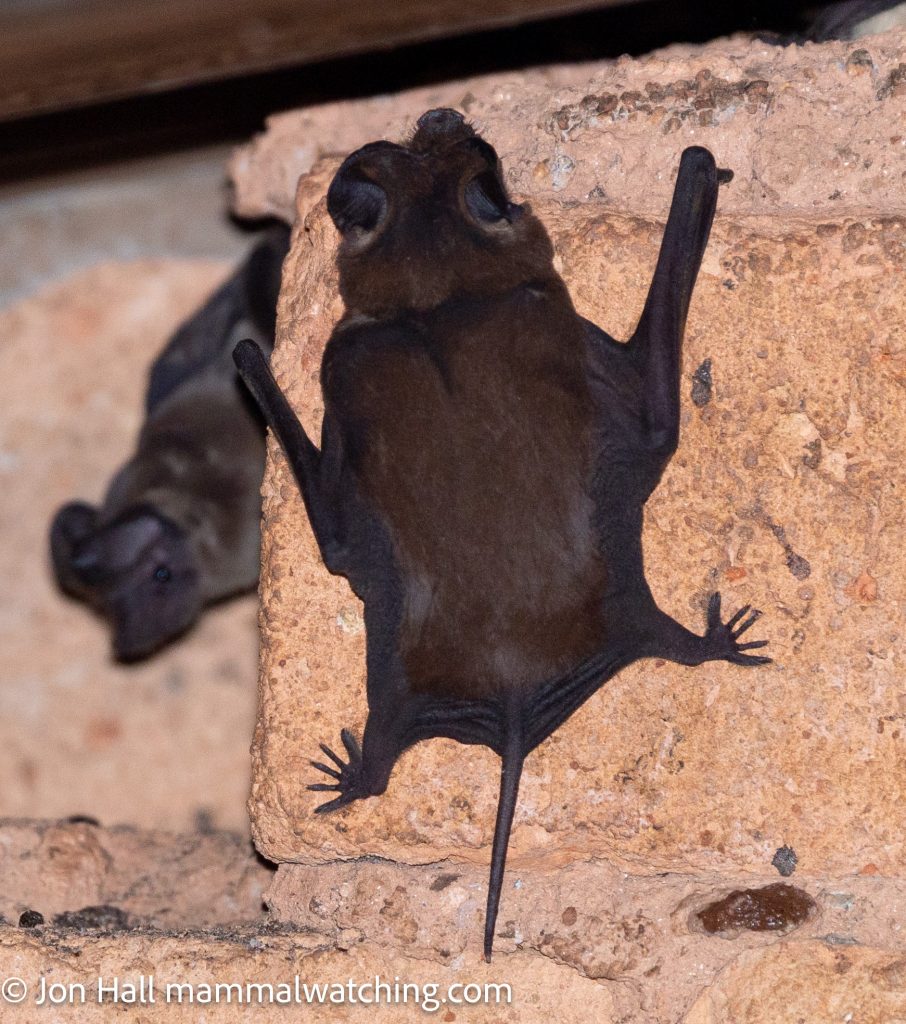
Madagascar Free-tailed Bat (Mops atsinanana)
Thank You
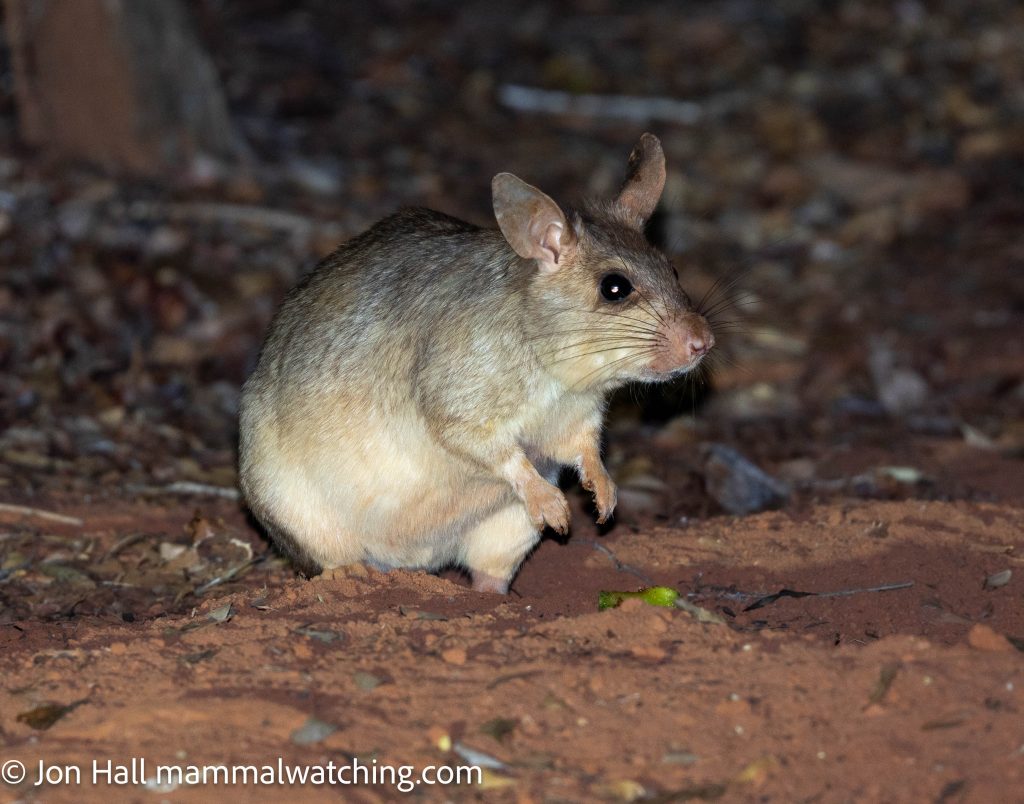
Giant Jumping Rat (Hypogeomys antimena), Kirindy
As always thanks are due to many people including the team at Miru Adventures, particularly Sam Riley who did most of the work in setting this trip up with Patrick. We used many local guides across Madagascar along with drivers and boat captains. They were all excellent. And a big thank you to my group: everyone worked hard to find the animals, didn’t complain about anything even when they were sick, and despite some very different personalities in the group we all parted friends.
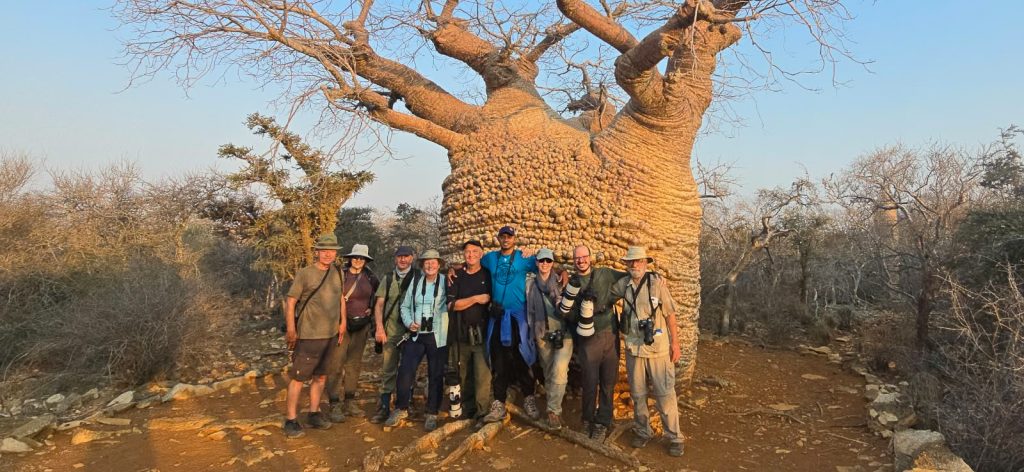
But the biggest thanks must go to Patrick for doing an amazing job in running the trip, finding great local guides and getting the best out of them, and for looking after all of us with patience and good humour. None of us would hesitate in travelling again with Patrick.
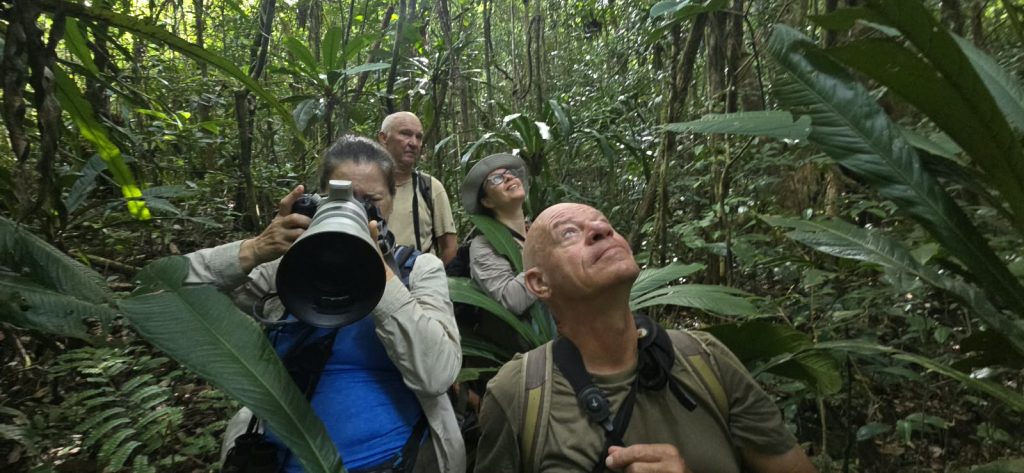
Simon and Karen at the front in Masoala
I’m about to launch a new mammalwatching tour company and Madagascar will be one destination we will focus on. Patrick will run a carnivores trip again with us in August 2026 (by which time I hope he will have figured out how to find a Falanouc) and I plan to run a Madagascar Off the Beaten Path trip in 2028 to visit a bunch of places that few people have been to.
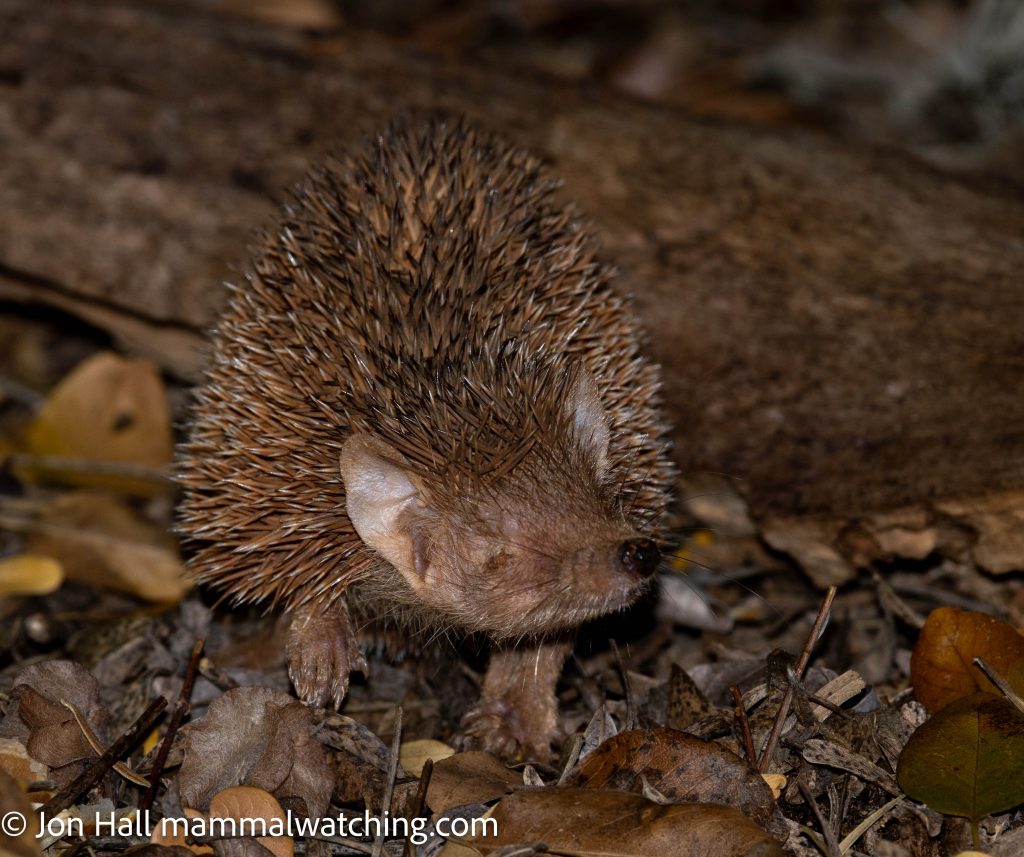
Lesser Hedgehog Tenrec (Echinops telfairi), Chez les ZA Spiny and Baobab Forest
There is so much to see on this fascinating island and so much of it is threatened. So visiting here should be a priority for ever mammalwatcher who wants to enjoy the wildlife while they still can, knowing also that every trip here helps protect what is left. Get in touch for details!
Stuff We Missed
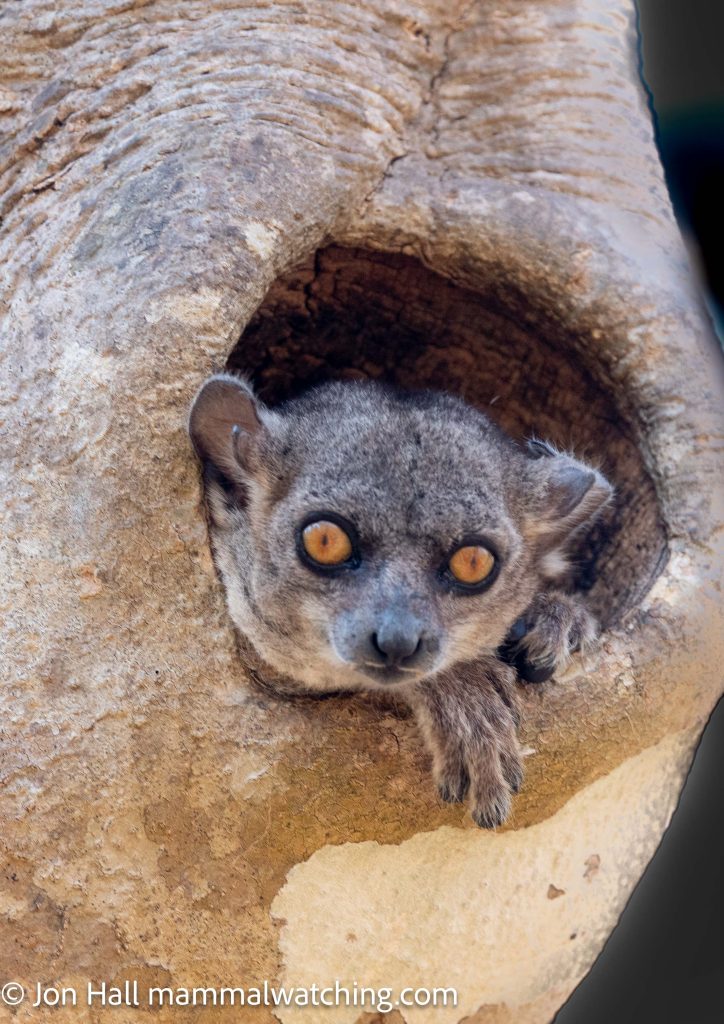
Red-tailed Sportive Lemur (Lepilemur ruficaudatus), Kirindy
The carnivores were the key focus for the trip. We saw six of the seven with only the Falanouc evading us. We tried hard for it and I am not sure what else we could have done to improve our chances.
In Kirindy I hoped we might find a Coquerel’s Giant Mouse Lemur but they are now extremely rare in the area where they night walks run. So too are the tiny Madame Berthe’s Mouse Lemurs, though I imagine both species might be easier to see elsewhere in Kirindy (perhaps around some of the lodges?).
We missed Seal’s Sportive Lemurs in Farankaraina which I had been expecting to see. If I had been feeling better during our one night there I might have gotten lucky. We were also unlucky with the Aye-ayes in Farankaraina. Although we found an animal in Masoala most people didn’t see it well and the animal disappeared quickly, probably because of all the commotion from us. On reflection we should have stayed calmer when we found it.
And we were half an hour too late to see the Black and White Ruffed Lemurs in Andasibe.
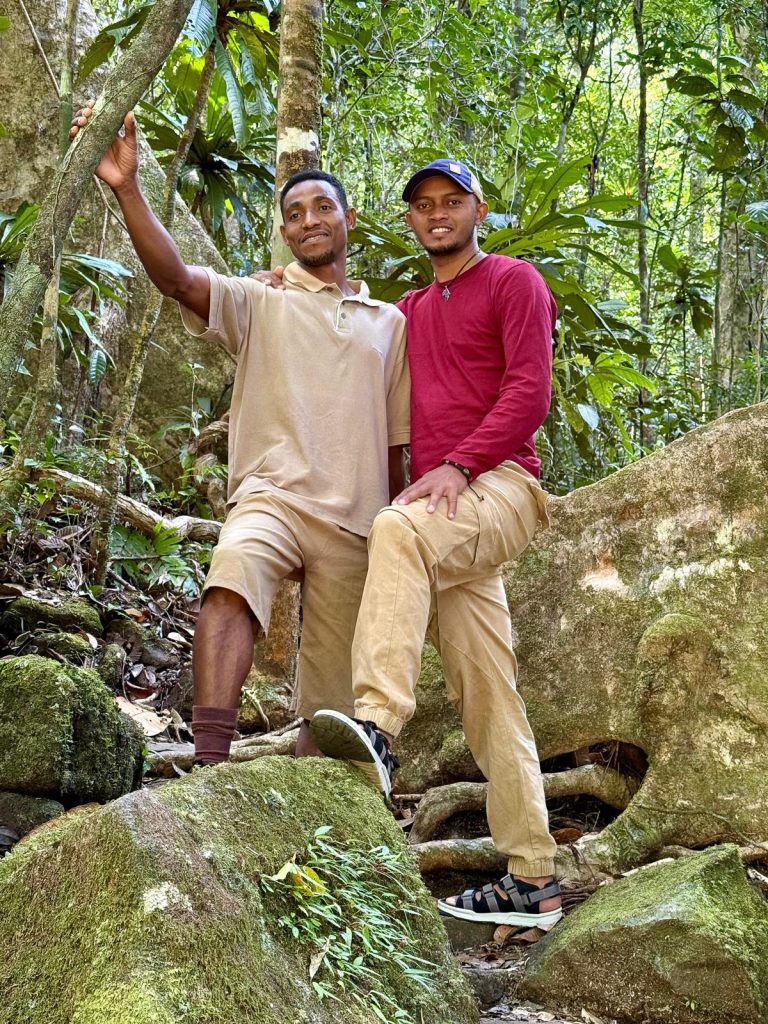
Patrick and the excellent local guide Dolin, Masoala
There were a few other potential species we missed, including the extremely rare Masoala Fork-marked Lemur which is almost unknown. But on the whole I was pleased to rack up 45 species in just over two weeks.
Trip List
Lesser Hedgehog Tenrec (Echinops telfairi) – endemic
Lowland Streaked Tenrec (Hemicentetes semispinosus) – endemic
Aye-aye (Daubentonia madagascariensis) – endemic
Hairy-eared Dwarf Lemur (Allocebus trichotis) – endemic
Greater Dwarf Lemur (Cheirogaleus major) – endemic
Gray-brown Mouse Lemur (Microcebus griseorufus) – endemic
Goodman’s Mouse Lemur (M.lehilahytsara) – endemic
Anjiahely Mouse Lemur (M.macarthurii) – endemic
Gray Mouse Lemur (M.murinus) – endemic
Pale Fork-marked Lemur (Phaner pallescens) – endemic
Eastern Woolly Lemur (Avahi laniger) – endemic
Masoala Woolly Lemur (A.mooreorum) – endemic
Indri (Indri indri) – endemic
Diademed Sifaka (Propithecus diadema) – endemic
Verreaux’s Sifaka (P.verreauxi) – endemic
White-fronted Brown Lemur (Eulemur albifrons) – endemic
Brown Lemur (E.fulvus) – endemic
Red-fronted Brown Lemur (E.rufifrons) – endemic
Gray Bamboo Lemur (H.griseus) – endemic
Northern Bamboo Lemur (H.occidentalis) – endemic
Ring-tailed Lemur (Lemur catta) – endemic
Red Ruffed Lemur (Varecia rubra) – endemic
Weasel Sportive Lemur (Lepilemur mustelinus) – endemic
Petter’s Sportive Lemur (L.petteri) – endemic
Red-tailed Sportive Lemur (L.ruficaudatus) – endemic
Masoala Sportive Lemur (L.scottorum) – endemic
Roof Rat (Rattus rattus) – introduced
White-tailed Tree Rat (Brachytarsomys albicauda) – endemic
Lesser Tufted-tail Rat (Eliurus minor) – endemic
Tanala Tufted-tail Rat (E.tanala) – not by me – endemic
Webb’s Tufted-tail Rat (E.webbi) – endemic
Giant Jumping Rat (Hypogeomys antimena) – endemic
Bastard’s Big-footed Mouse (Macrotarsomys bastardi) – endemic
Red Forest Rat (Nesomys sp.) – endemic
Mahafaly Long-fingered Bat (Miniopterus mahafaliensis) – endemic
Madagascar Free-tailed Bat (Mops atsinanana) – endemic
Malagasy White-bellied Free-tailed Bat (M.leucostigma)
Malagasy Flying Fox (Pteropus rufus) – endemic
Commerson’s Roundleaf Bat (Macronycteris commersonii) – endemic
Fossa (Cryptoprocta ferox) – endemic
Spotted Fanaloka (Fossa fossana) – endemic
Ring-tailed Vontsira (Galidia elegans) – endemic
Broad-striped Vontsira (Galidictis fasciata) – endemic
Narrow-striped Boky (Mungotictis decemlineata) – endemic
Brown-tailed Vontsira (Salanoia concolor) – endemic
45 species & 19 lifers (in bold)
Herps
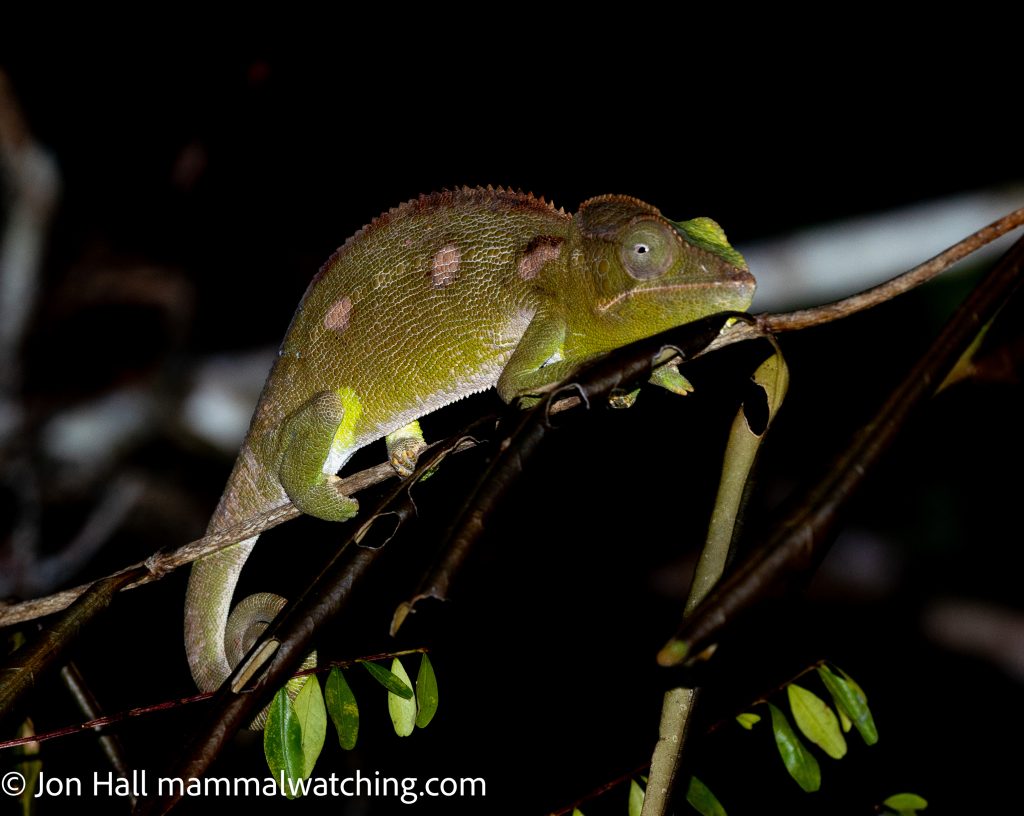
Nicosia’s Chameleon
We saw a ton of herps too and here’s a list from Simon that covers most of them
Radiated Tortoise
Madagascar Ground (or Big-headed) Gecko
Standing’s Day Gecko
Modest Day Gecko
Giant Leaf-tailed Gecko
Mossy Leaf-tailed Gecko
Brown Leaf (or Stump-tailed) Gecko
Satanic Leaf-tailed Gecko
Malthe’s Green-eared Gecko
Warty (or Spiny) Chameleon
Antimena Chameleon
Oustalet’s (or Malagasy Giant) Chameleon
Nicosia’s Chameleon
Panther Chameleon
Hooded Chameleon
Elephant (or Short-horned) Chameleon
Parson’s Chameleon
Merrem’s Madagascar Swift
Cuvier’s Madagascar Swift
Madagascar Keeled Cordylid
Three-eyed Lizard (or Madagascar Iguana)
Marked Madagascar Swift
Madagascar Girdled (or Plated) Lizard
Dumeril’s (or Madagascar Ground) Boa
Madagascar Tree Boa
Four-striped Snake
Birds
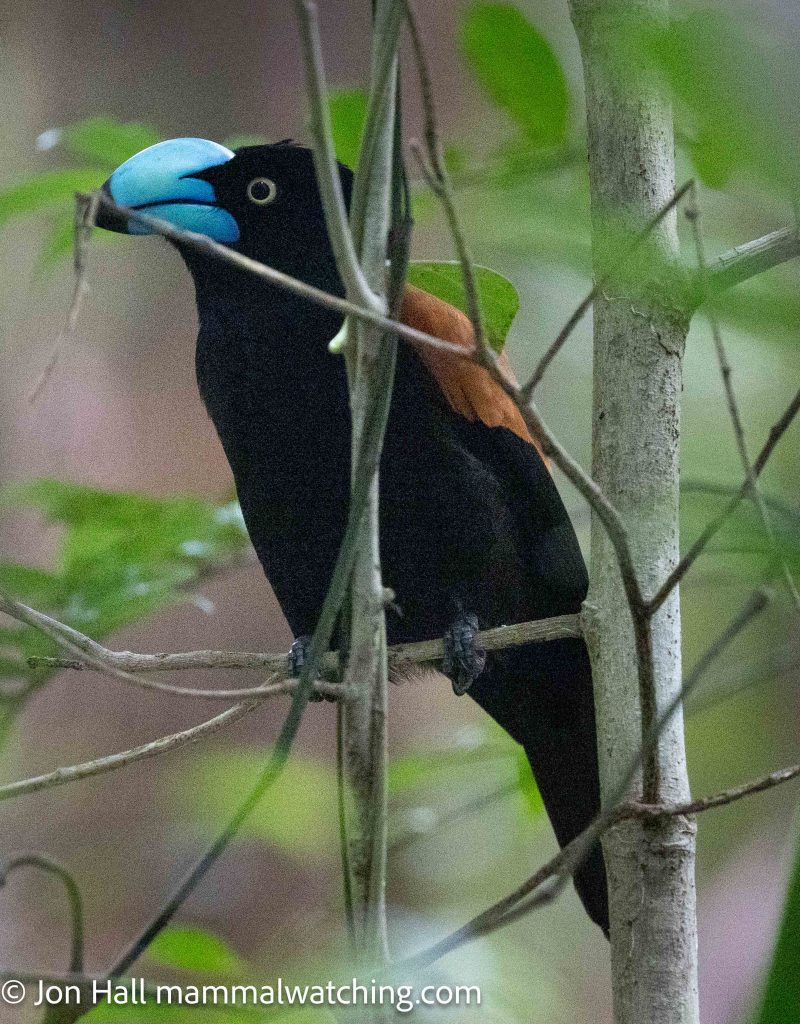
Helmeted Vanga
And yes there were birds too. Helmeted Vanga was one of them. There were others.
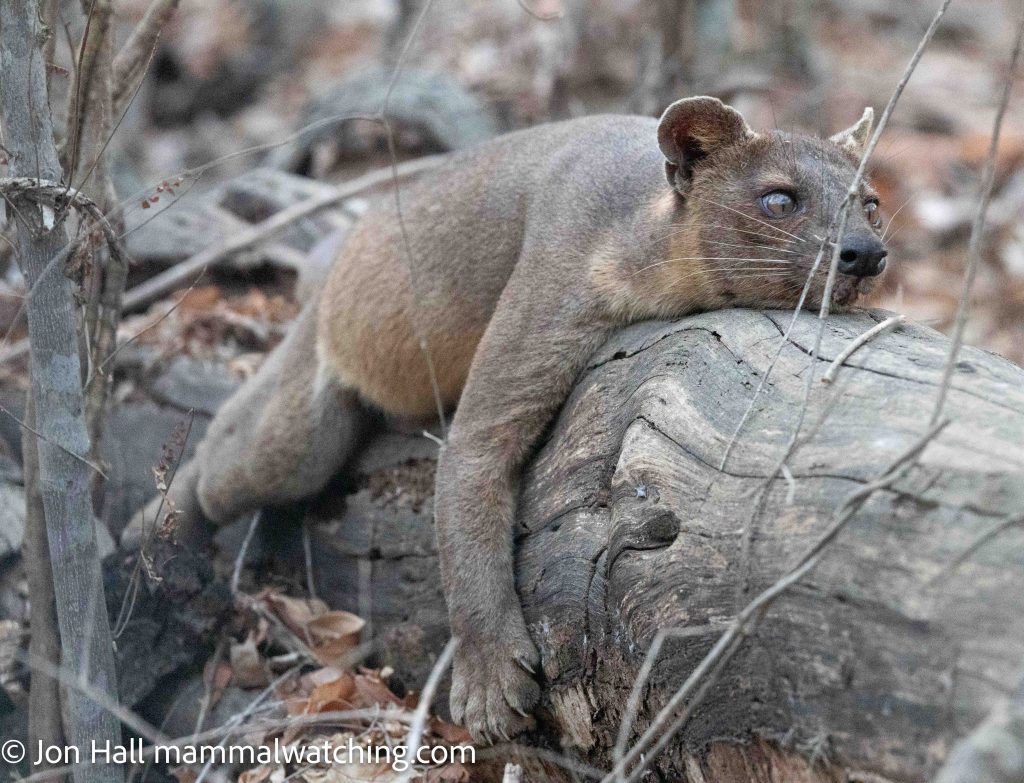
Fossa (Cryptoprocta ferox), Kirindy

Post author
Leave a Reply
You must be logged in to post a comment.