

Cape Verde food poisoning
… is the first Google hint when searching for “Cape Verde food”. Despite having had a whooping 11 (and a half) fish dinners during our two-week stay on the islands in April 2026, neither of us had any digestive issues, so the report name thus generated is a pure clickbait on my side.
Cape Verde is a poor but friendly country spread across a bunch of pretty small but diverse islands. The logistics between the islands can be a bit confusing: ferries are often cancelled due to bad weather, and their schedules can change due to availability of boats. Internal flights are not much more expensive, but their schedule was published only a few weeks before our trip due to a change of operator, which seems to happen surprisingly often. On Santiago it is worth (and easy) renting a car as the island is topologically quite large due to the winding roads, on other islands a combination of walking, public transportation, taxi and occasional car rental is best.
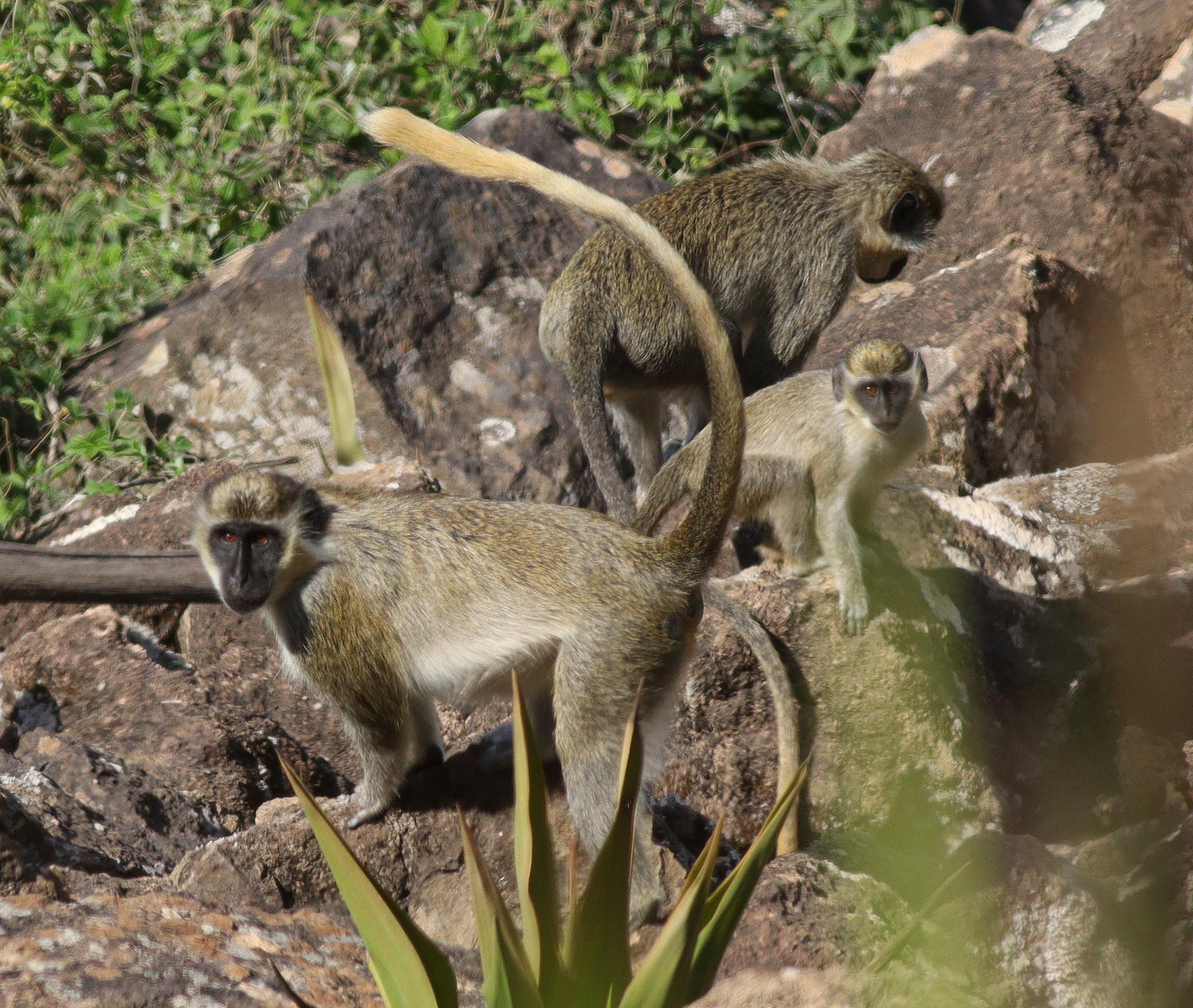
Cape Verde has not been on mammalwatchers’ radar so far, probably because there isn’t really that much to see when it comes to mammals. The only major land mammal is the Green Monkey, which is introduced on Santiago. Considering that the introduction happened half a millennium ago, they can be considered pretty much established and fair game to watch; at this point, they are an integral part of the local ecosystem. We were not really sure where to look for them, until we randomly decided for a short hike along the crest of Parque Natural De Serra Malagueta and the information board right at the parking on the side of the main road had a map which showed “monkey habitat” next to the trail; we indeed briefly saw a group of monkeys there. Later we had a more extended observation at Barragem Ribeira Principal – the monkeys were further away from us across the lake, but we could nicely watch them with a scope as they played around and they didn’t seem to mind our presence at all. Our friends reported seeing them at other parts of the island as well, so they can be expected moreorless anywhere.
The only other land mammals we saw were Black Rats – running across a road at night near Barragem de Poilão and on the beach in Tarrafal on São Nicolau – and a House Mouse also near Barragem de Poilão.
We had high hopes for some cetaceans, but we saw nothing from land anywhere (despite the occasional seawatching). To improve our chances, we booked a local ferry between Santiago and São Nicolau. Originally scheduled to leave at 2 pm and arrive at 10 am the next day, it promised ample daytime to watch out for cetaceans, but the originally planned boat run aground a few weeks before our departure and was replaced by a faster boat, changing the schedule to 4 pm to 6 am. Moreover, this boat did not have any outside space, so we had to watch through the not-so-transparent windows. In the afternoon, we saw Pantropical Spotted Dolphins and Short-finned Pilot Whales near Santiago and then nothing; thanks to a delay, we had almost 2 hours of daylight in the morning near São Nicolau, but with no sightings. We also chartered a fishing boat for two daytrips from São Nicolau primarily in search of birds and again saw no mammals, neither did we see any from the ferry between São Vicente and Santo Antão and back, so the mammals count stops at 5 species. Our friends took photos of some cetaceans from a viewpoint in the SW of Santiago, some 500 meters above sea level, but the animals were far and always in the water and likely not identifiable.
The main purpose of our visit was birding. We saw only 64 species of birds, but 18 were additions to our Western Paleartic list (yes, this is still WP from birding point of view!) and 7 were global lifers, including some fun island endemics. We tried snorkelling wherever possible and it was a little mixed – a lot of the fish species were new for us, but it was a constant fight against waves and visibility. The few places where the water was clear and sheltered were nice, but the overall diversity wasn’t that great, probably due to the lack of any considerable coral reefs. It was also the first place ever where someone stole my shoes from the beach while I was in the water …

Post author
1 Comment
Leave a Reply
You must be logged in to post a comment.
Chad Johnson
We should have a badge of honor to give out for getting food poisoning on a mammal watching trip. I earned mine in southern Madagascar.