

Three days in Panama, 2026: Clouded Oncilla and more!
I spent three nights in Panama this month on my way back to New York from Brazil. A free stopover on COPA airlines was the perfect opportunity for me to see a friend in Panama City and then check out Ignacio Yúfera’s new lodge in the Chiriqui highlands near the Costa Rican border. And what a lodge it is!
Gamboa
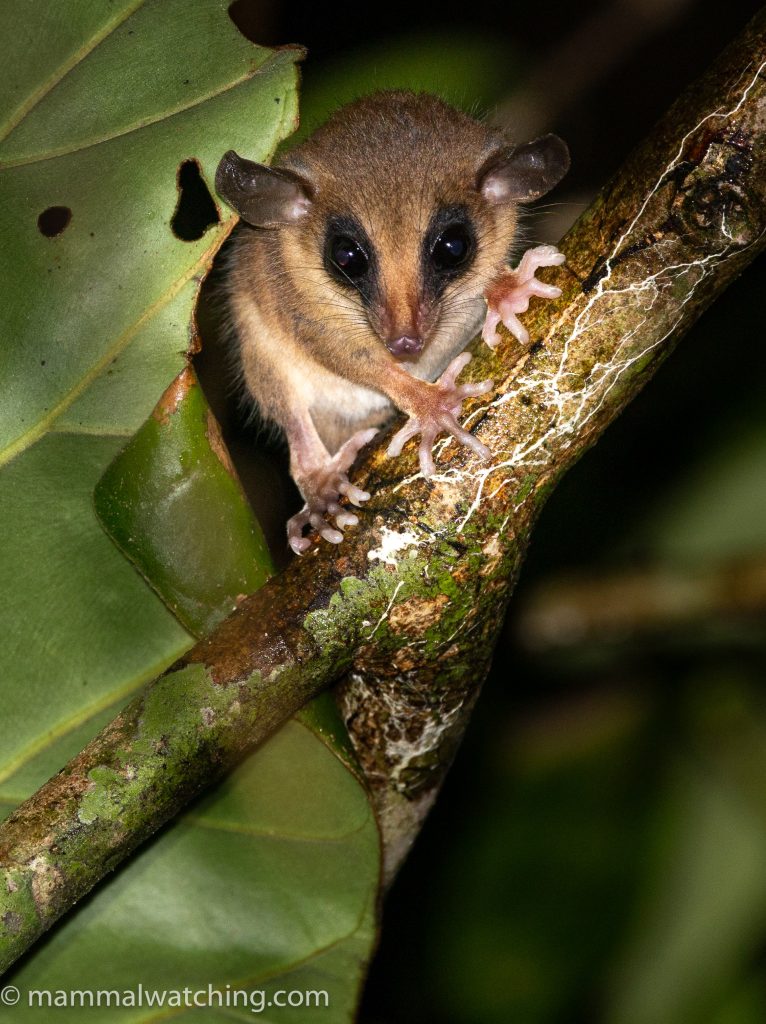
Panama Mouse Opossum (Marmosa isthmica)
I spent my first night in Panama City with a friend. We went to the Rainforest Discovery Centre in Gamboa in the late afternoon. I have been to Panama several times, but each time I visit I am yet ago surprised that you can be in superb rainforest just 40 minutes from the city. We only spent three hours here, slowly walking the trail at the discovery centre.
We heard Central American Black Howlers and saw several Central American Agoutis before sunset.
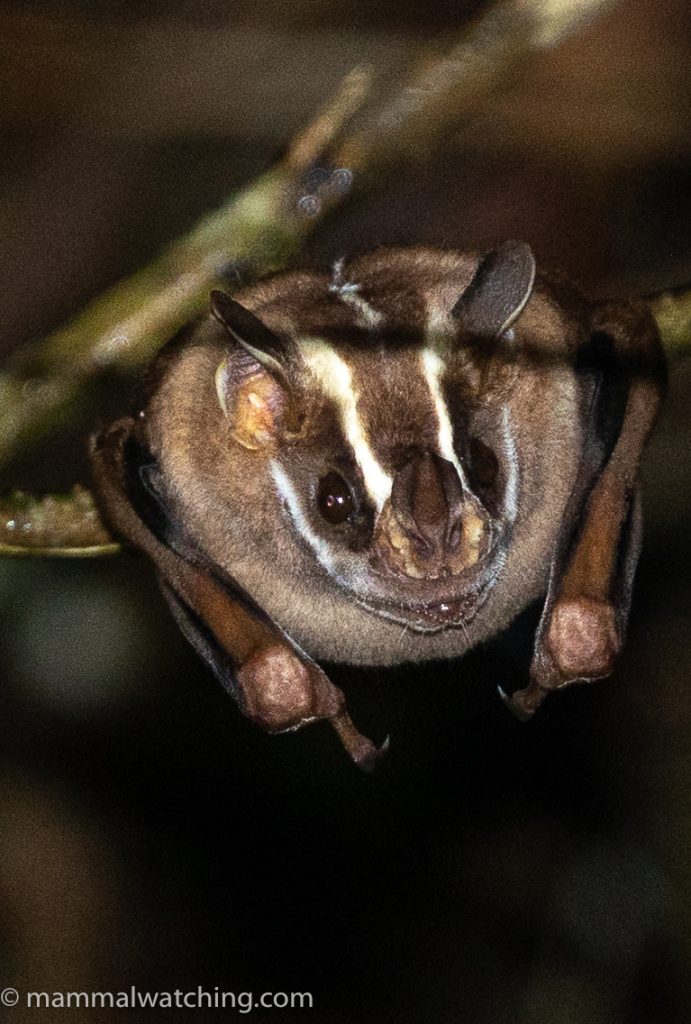
Great Stripe-faced Bat (Vampyrodes major)
After dark we found this bat which I initially assumed was a Pacific Tent-making Bat that are common in Gamboa. However – thanks to Venkat Sankar’s eagle eyes – the long back striped that reaches to the head, together with the broad facial stripes and robust appearance means it ought to be a Great Stripe-faced Bat (Vampyrodes major), a lifer for me. Central American bat guru Jose Gabriel Martinez-Fonseca agreed the photo looked right for the species, even though Fiona Reid wasn’t certain.
We also saw what looks like a juvenile Jamaican Fruit-eating Bat.
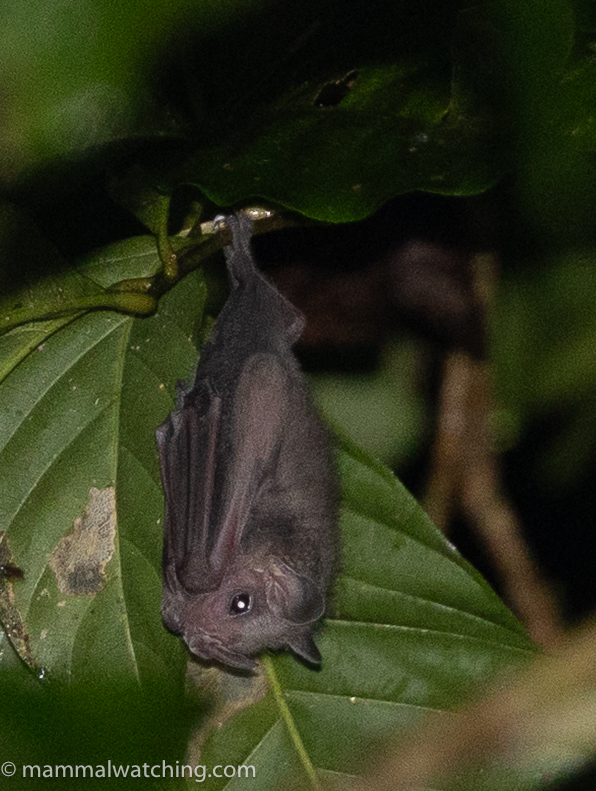
Juvenile Jamaican Fruit-eating Bat (Artibeus jamaicensis) probably
Best of all was a Panama Mouse Opossum that – as they often seem to do – posed perfectly for us.
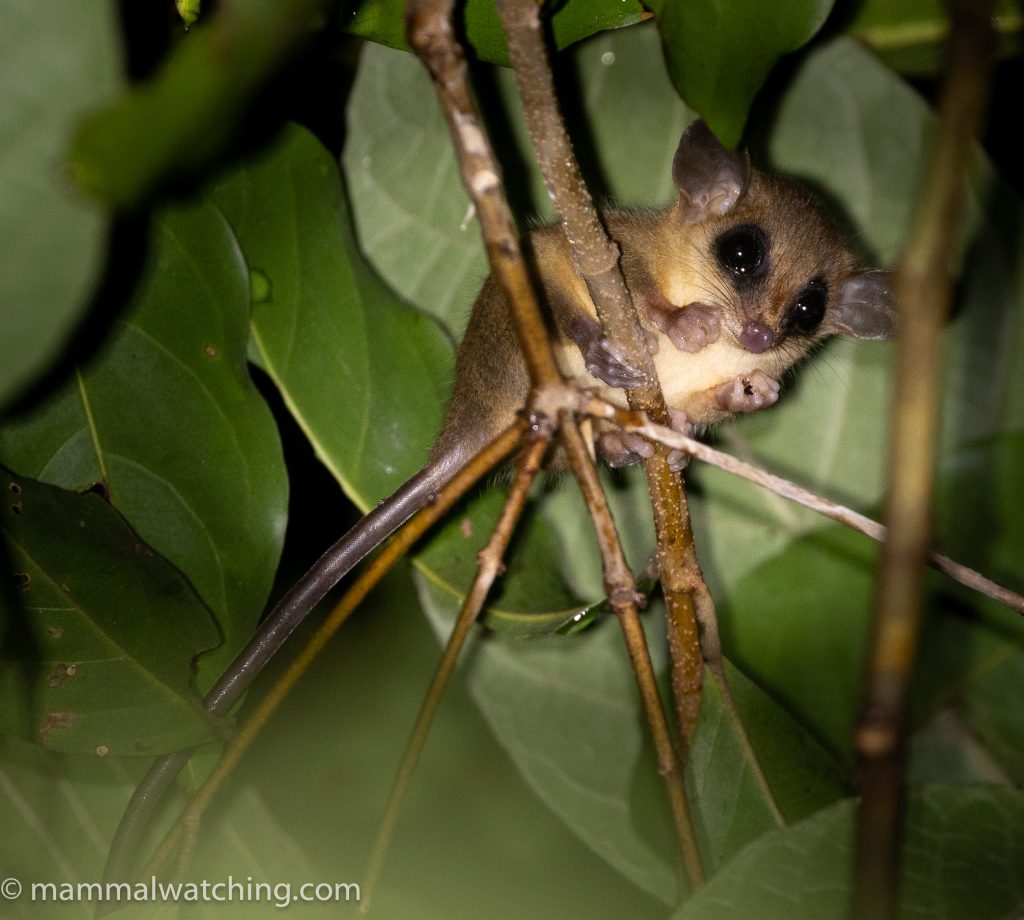
Panama Mouse Opossum (Marmosa isthmica)
Tamandua Cloud Forest Reserve, Cerro Punta
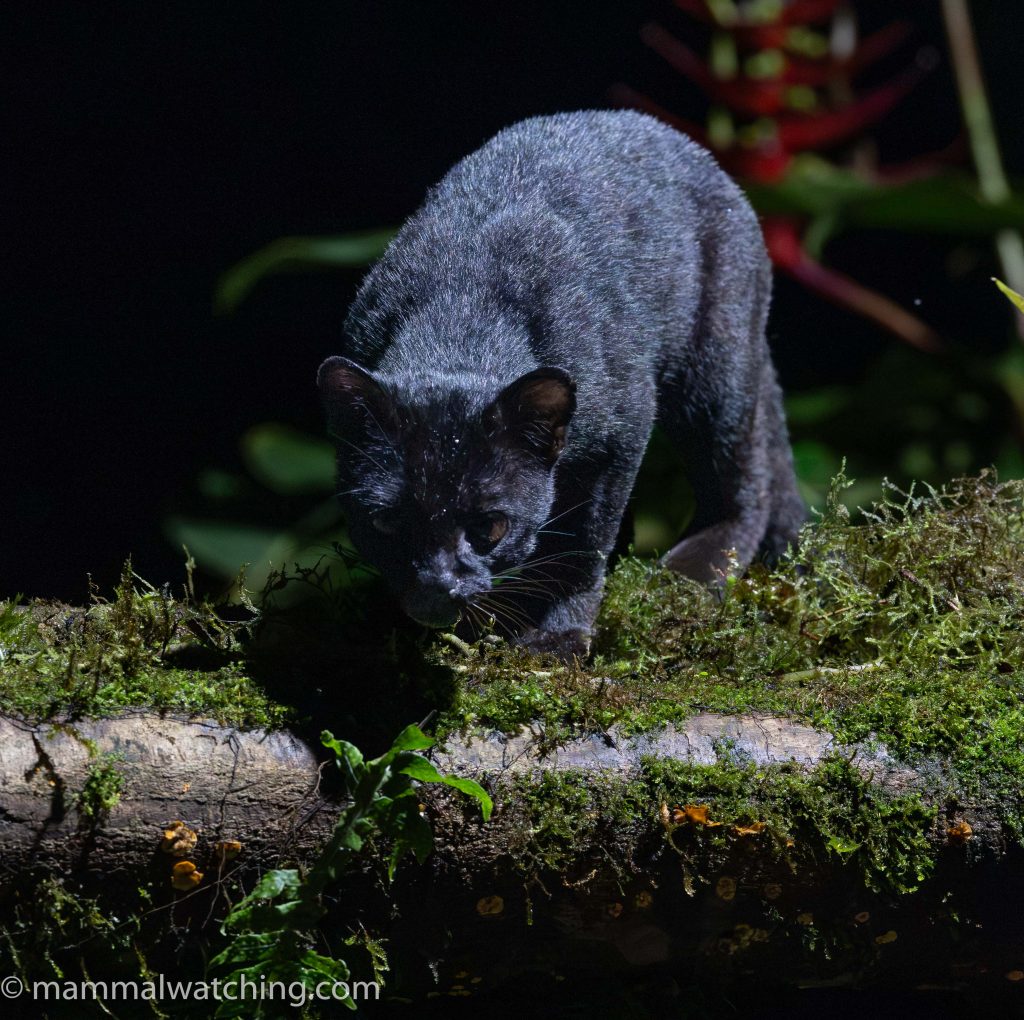
Clouded Oncilla (Leopardus pardinoides)
Ignacio Yúfera is a Spanish photographer living in Panama, and a long time follower of this website (see for example his reports from Uganda and Spain). We travelled together along the Amazon in 2017 (the trip report features several of his photos and after that trip I was not the only photographer on that trip wondering what was wrong with my camera after seeing the pictures Ignacio was taking) and to Peru in 2019.
Ignacio now runs Tamandua Tours, based in Cerro Punta, just across the road from Los Quetzales Lodge (where I stayed in both 2016 and 2022).
He’s in the process of opening a new lodge just above Los Quetzales and for the past three years he has been telling me about the Clouded Oncillas in the area, which are now regularly visiting his lodge. So when he invited me to come stay and ‘put the lodge on the map’ I didn’t need to think twice.
The Lodge
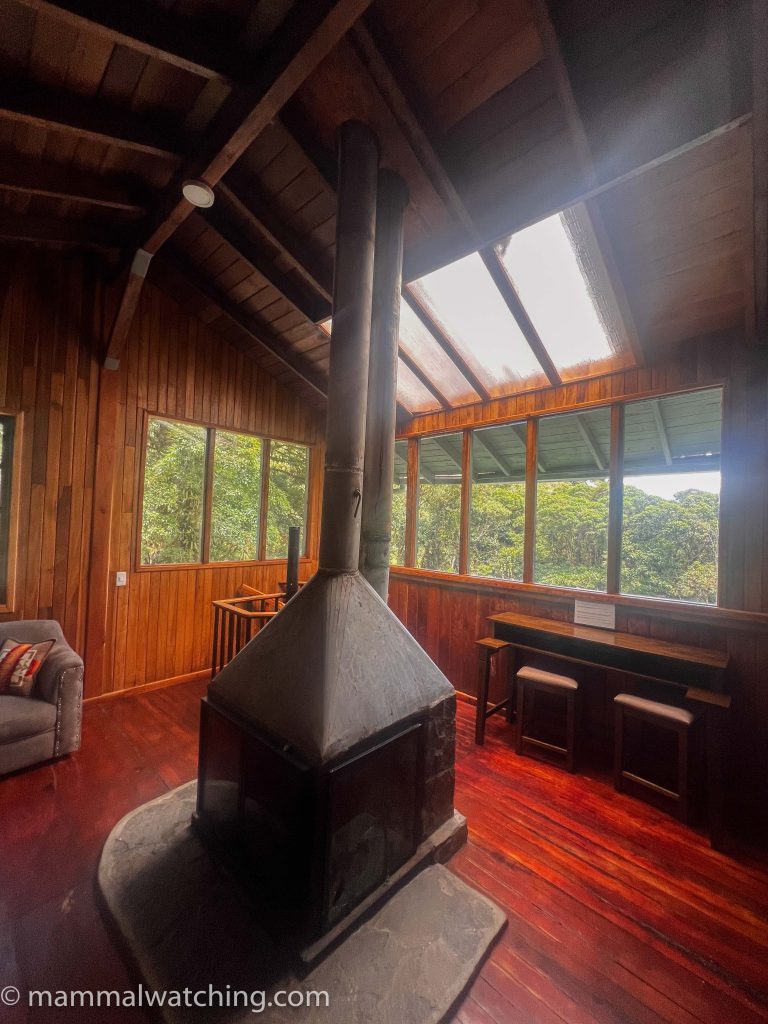
Lounge area
The lodge is up at 2,200 meters in 100 hectares of cloud forest bordering Amistad National Park on the Panama- Costa Rica border. It’s a photographer’s and nature lover’s paradise. The place is already open to tourists. Right now they have are three very comfortable rooms which share a bathroom. But a larger building with several more rooms should be finished by the end of the year, at which point all the rooms will have en-suite bathrooms.
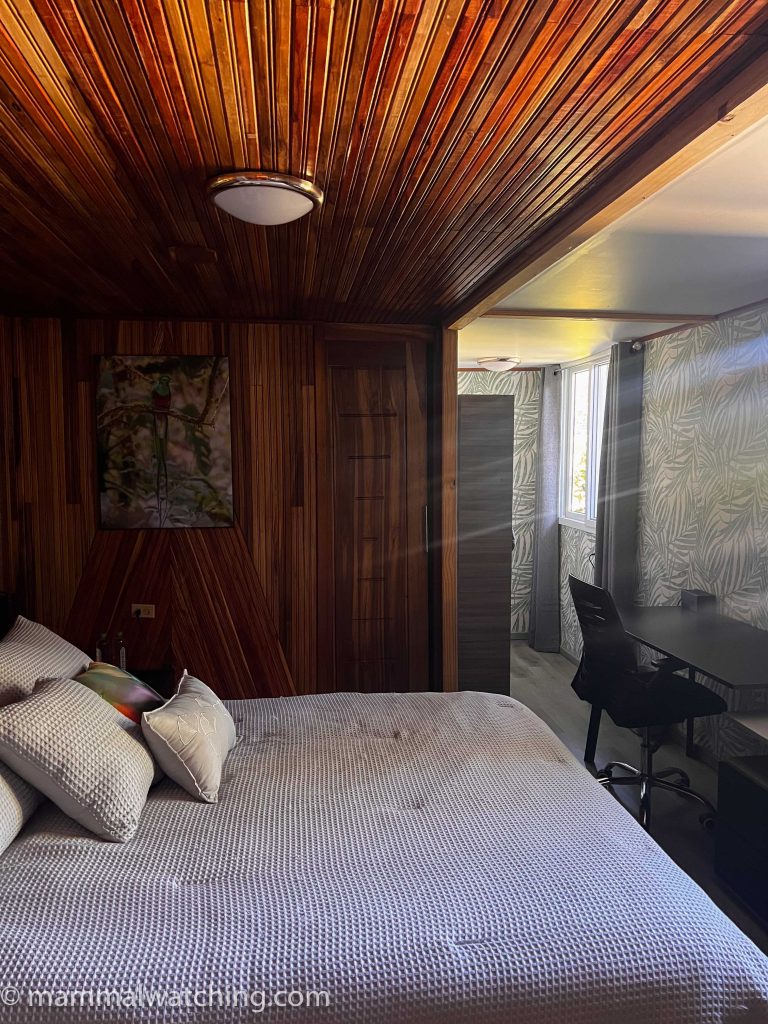
This is already one of the nicest lodges I have ever stayed in and I can’t imagine anyone – even if they don’t know an Agouti from an Aardvark – would not enjoy some time here. It is super comfortable, beautifully furnished and – as you might expect from a Spaniard – the food is excellent!
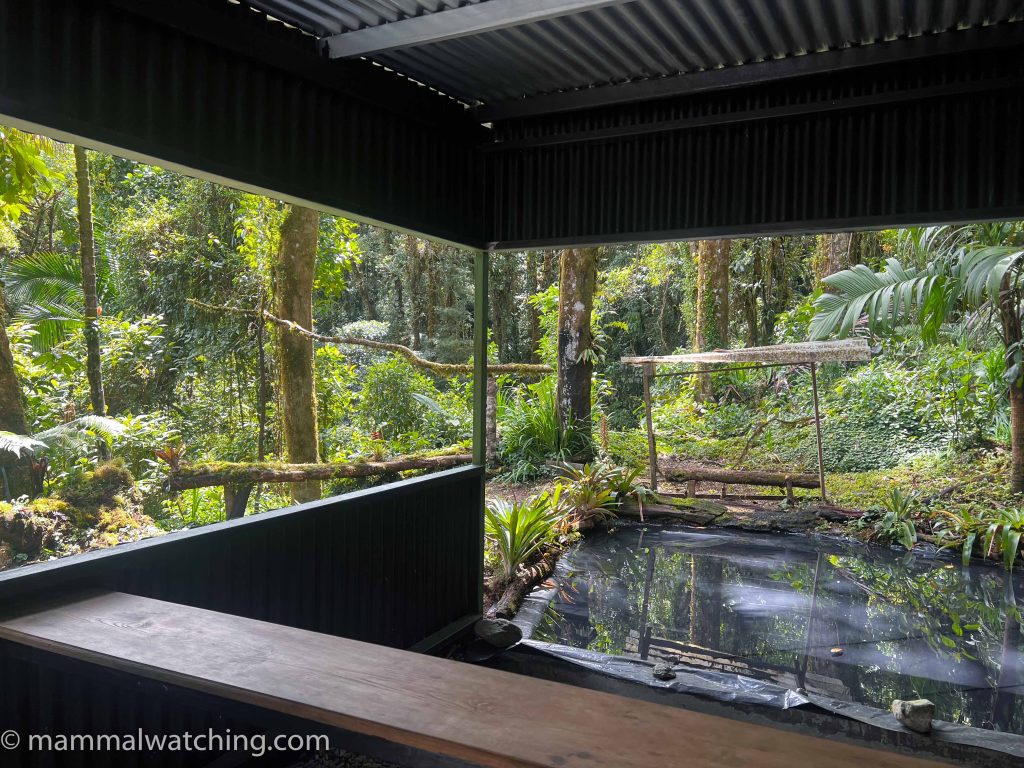
The carnivore hide
And as you might expect from a photographer, the whole place is geared towards photographing the wildlife by day and night. There is a hide next to the dining room, another area with hummingbird feeders galore and a third spot to attract some of the skulking birds like Wrenthrushes that are usually very hard to see.
There are camera traps around the lodge which means you can see the latest data on what is visiting and when. Plus Tamandua’s excellent team led by Genover ‘Ito’ Santamaria will keep lookout so everything is set up well to make sure you can see the mammals you are chasing without agonizing over which spot to keep watch from.
It takes about 8 hours to drive to Cerro Punta from Panama City or you can take one of the daily flights to David and drive 90 minutes, which I did.
Ignacio met me at the David airport and took me to the Tamandua Tours’ office. From there we took a couple of serious 4WDs up to the lodge itself, which is just past the top cabins at Los Quetzales lodge along a very steep and rough track.
The Mammals
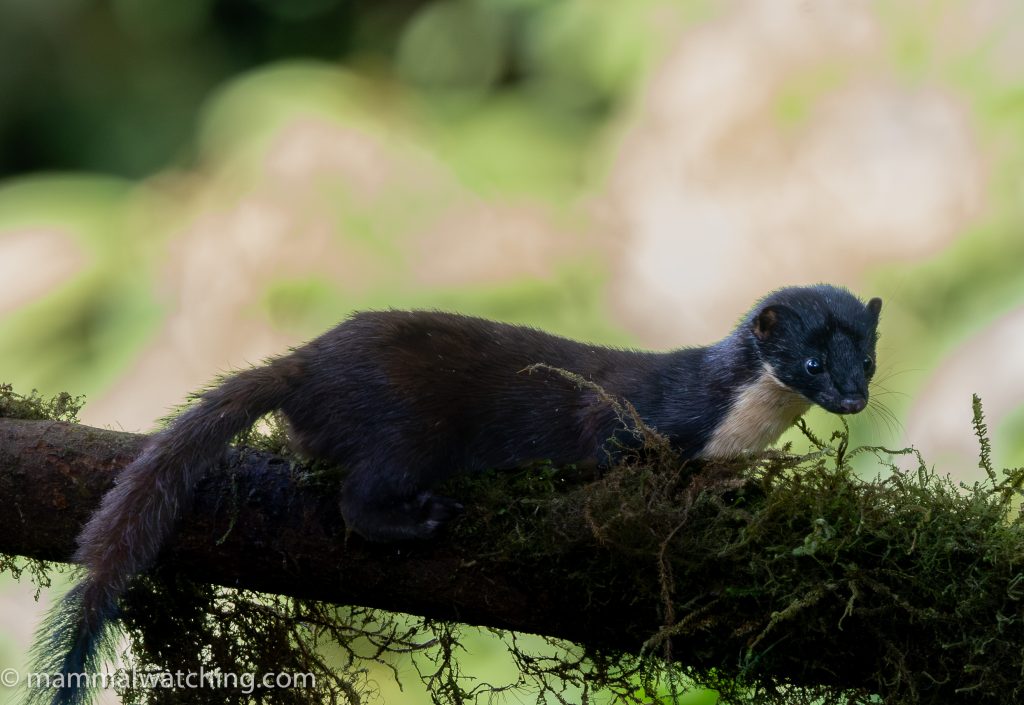
Long-tailed Weasel (Neogale frenata)
I was there for just over 24 hours. The mammals came thick and fast. The team have been feeding birds here since 2022 and the mammals started arriving almost immediately. Rare species like Bangs’s Mountain Squirrel and Cacomistle came in search of the bananas left out for the birds. Rodents started to visit in search of the bird seed, and then carnivores started visiting in search of the rodents. It took the Oncillas about a year to find the place.
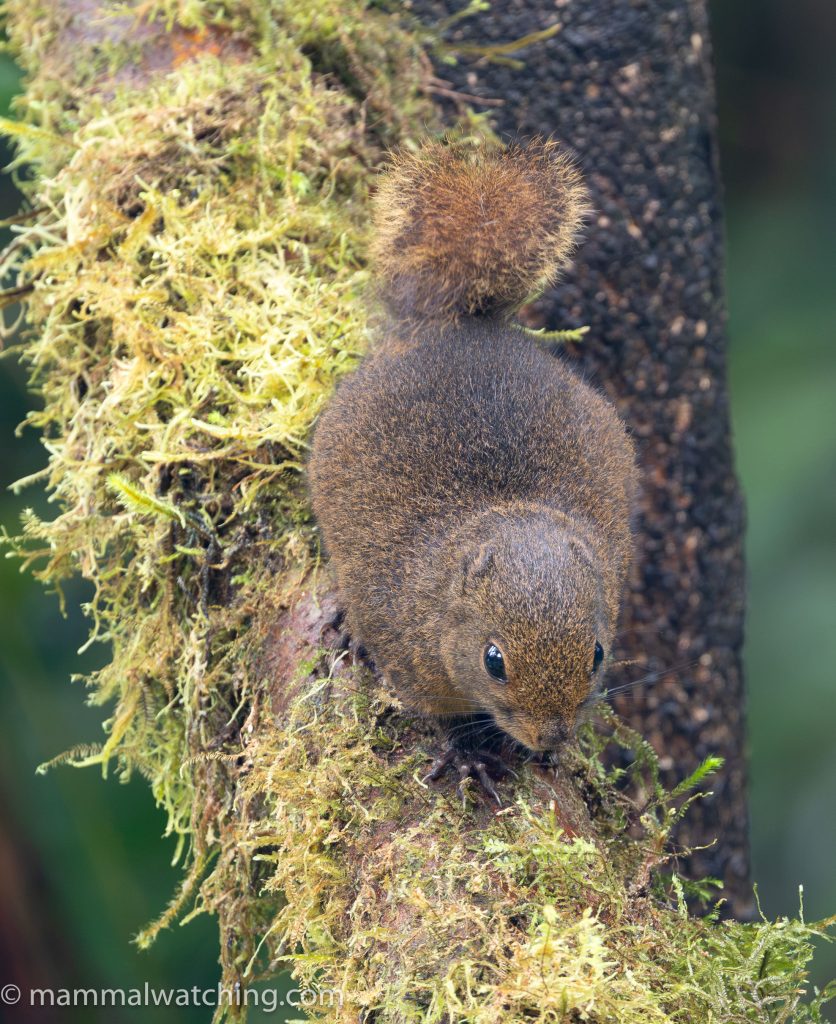
Bangs’s Mountain Squirrel (Syntheosciurus brochus)
The first animals I saw were the squirrels. This has to be the best place in the world to see the little known Bangs’s Mountain Squirrel. Until recently there were virtually no photos of this species and many of the ‘pictures’ online are of misidentified Red-tailed Squirrels (also frequently misidentified by local guides and – still – on the Wikipedia page!). I had only glimpsed this squirrel once and it was high on my list of ‘dubious ticks I needed to rectify’. Rectification complete.
Red-tailed Squirrels are also common on same bird table in front of the dining room, and at times you can see the two species side by side.
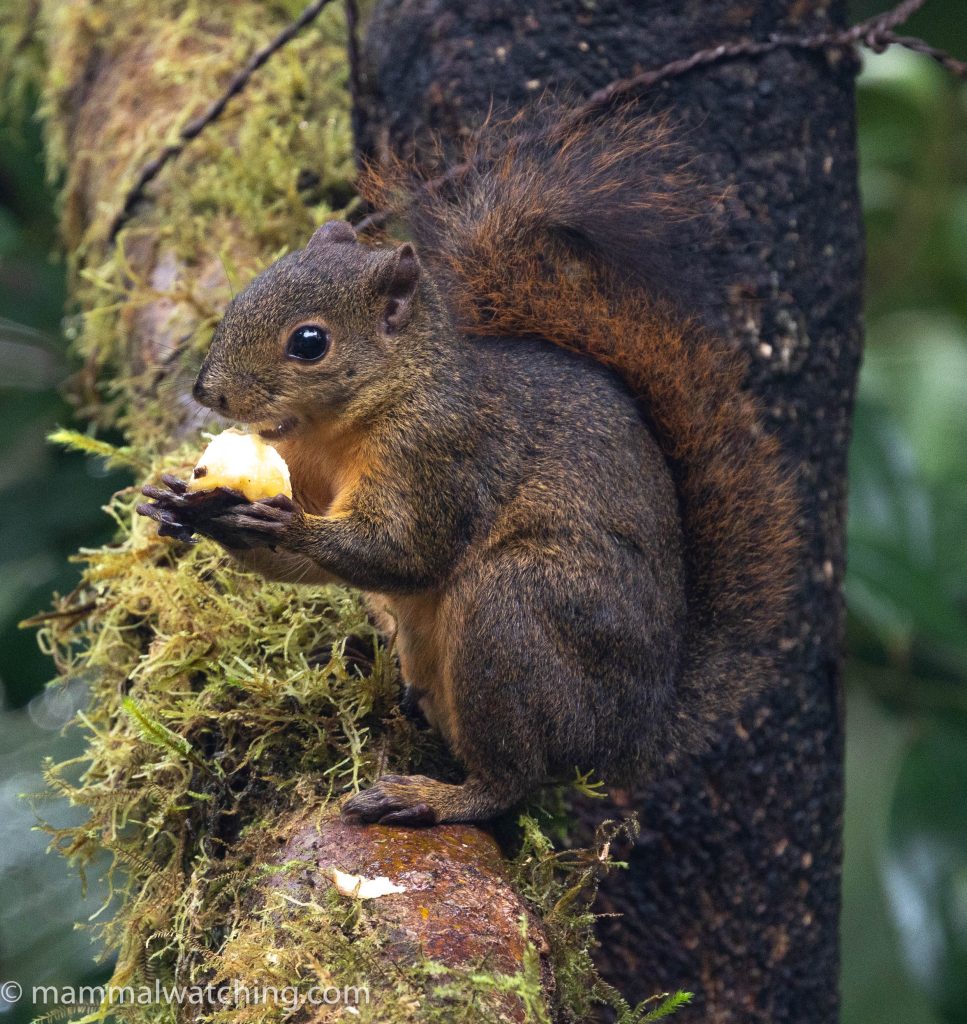
Red-tailed Squirrel (Sciurus granatensis)
They are quite different looking, with the large ears of the Red-tailed Squirrel the most obvious difference, along with different shaped faces.
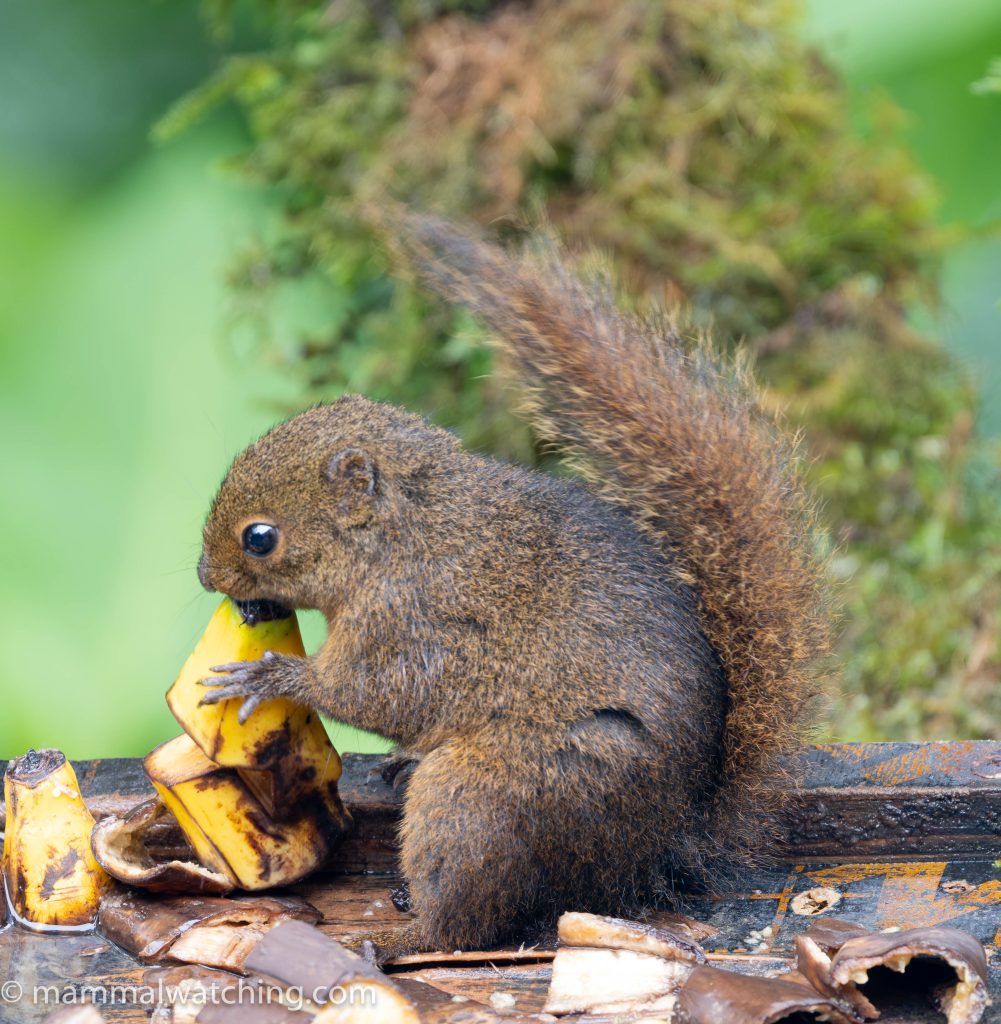
Bangs’s Mountain Squirrel (Syntheosciurus brochus)
I saw a Tayra twice – also in search of bananas – but unlike the other species it didn’t stay around for photographs. Here is a picture from Ignacio.
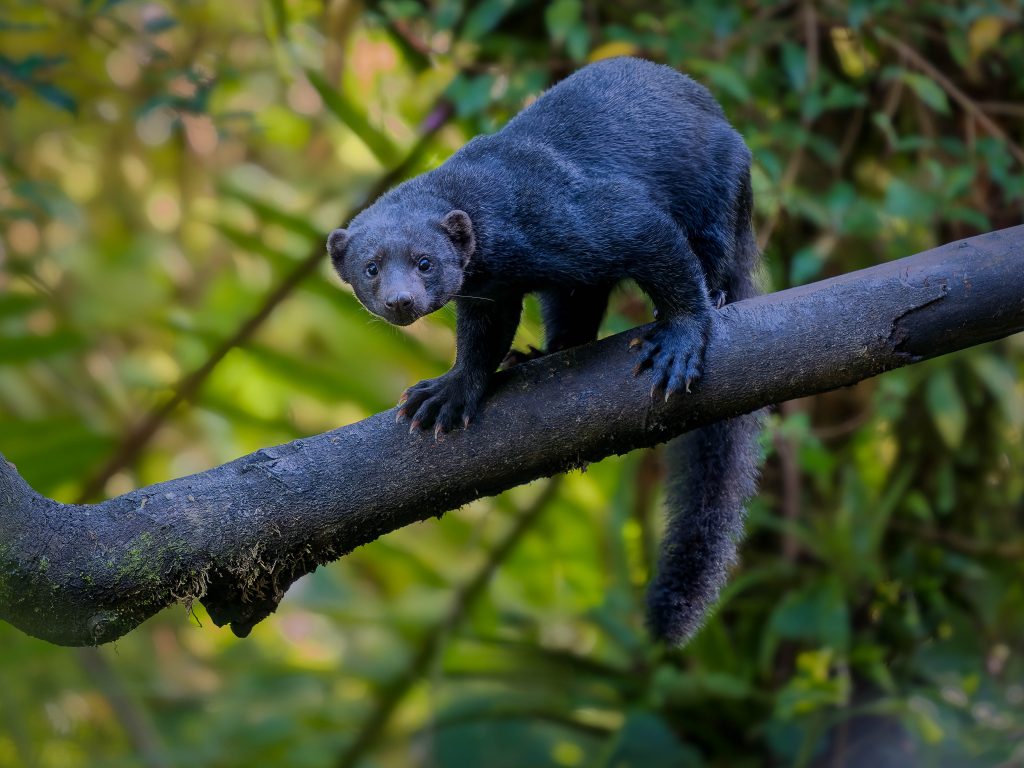
Tayra (Eira barbara). Photo Ignacio Yúfera
After dark Cacomistles are very common. Such a beautiful species. They were running around on the roof and along my balcony railing all night. We set up a light above the bananas which was perfect for photography.
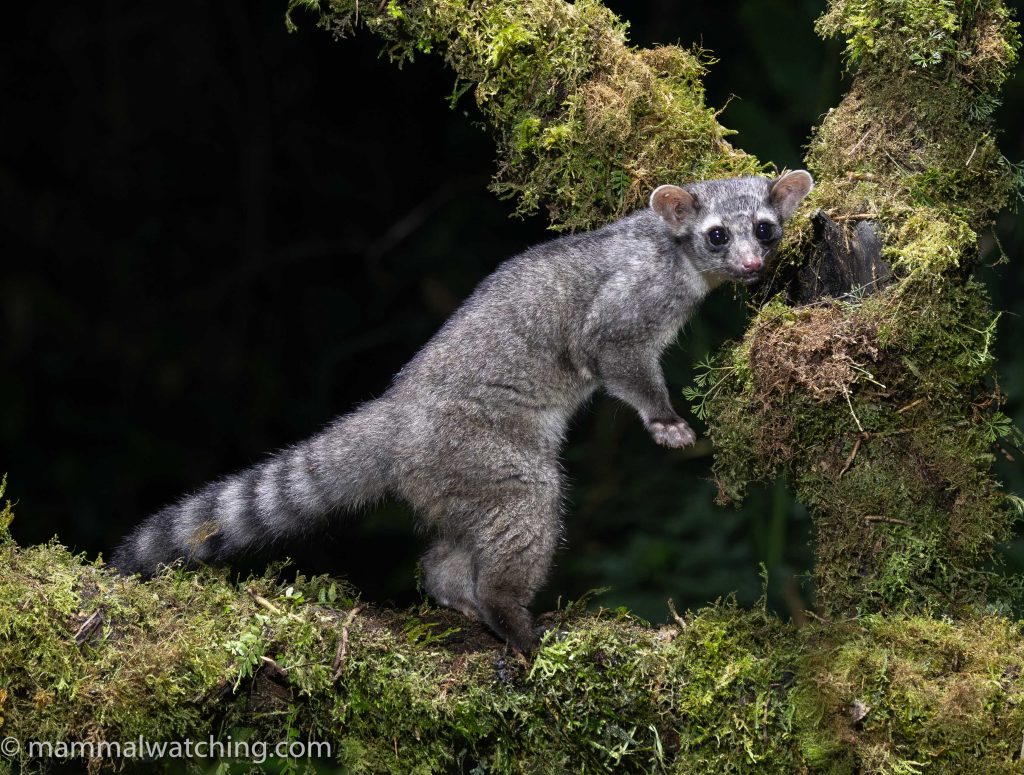
Cacomistle (Bassariscus sumichrasti)
I also saw a very pale Northern Black-eared (Common) Opossum (Didelphis marsupialis) around the lodge though I couldn’t get a photo.
During the afternoon a Long-tailed Weasel was a frequent visitor to the hide and it didn’t seem at all shy.
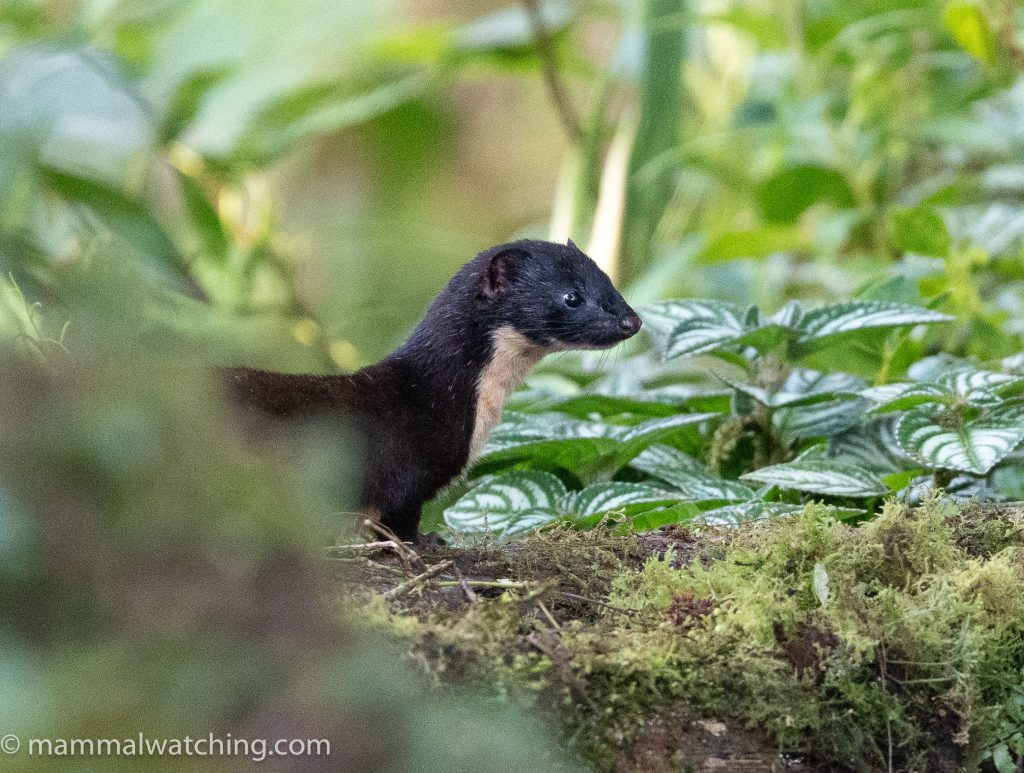
Long-tailed Weasel (Neogale frenata)
This too is a difficult animal to see. Particularly in cloud forest and they are much darker than the animals I had seen in California.
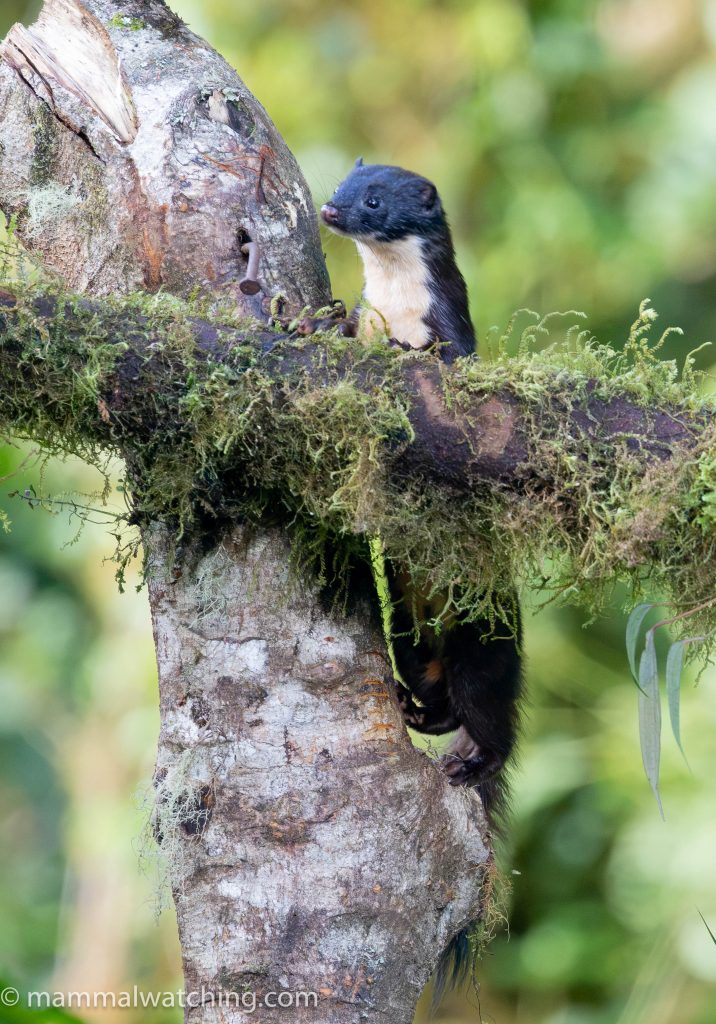
Long-tailed Weasel (Neogale frenata)
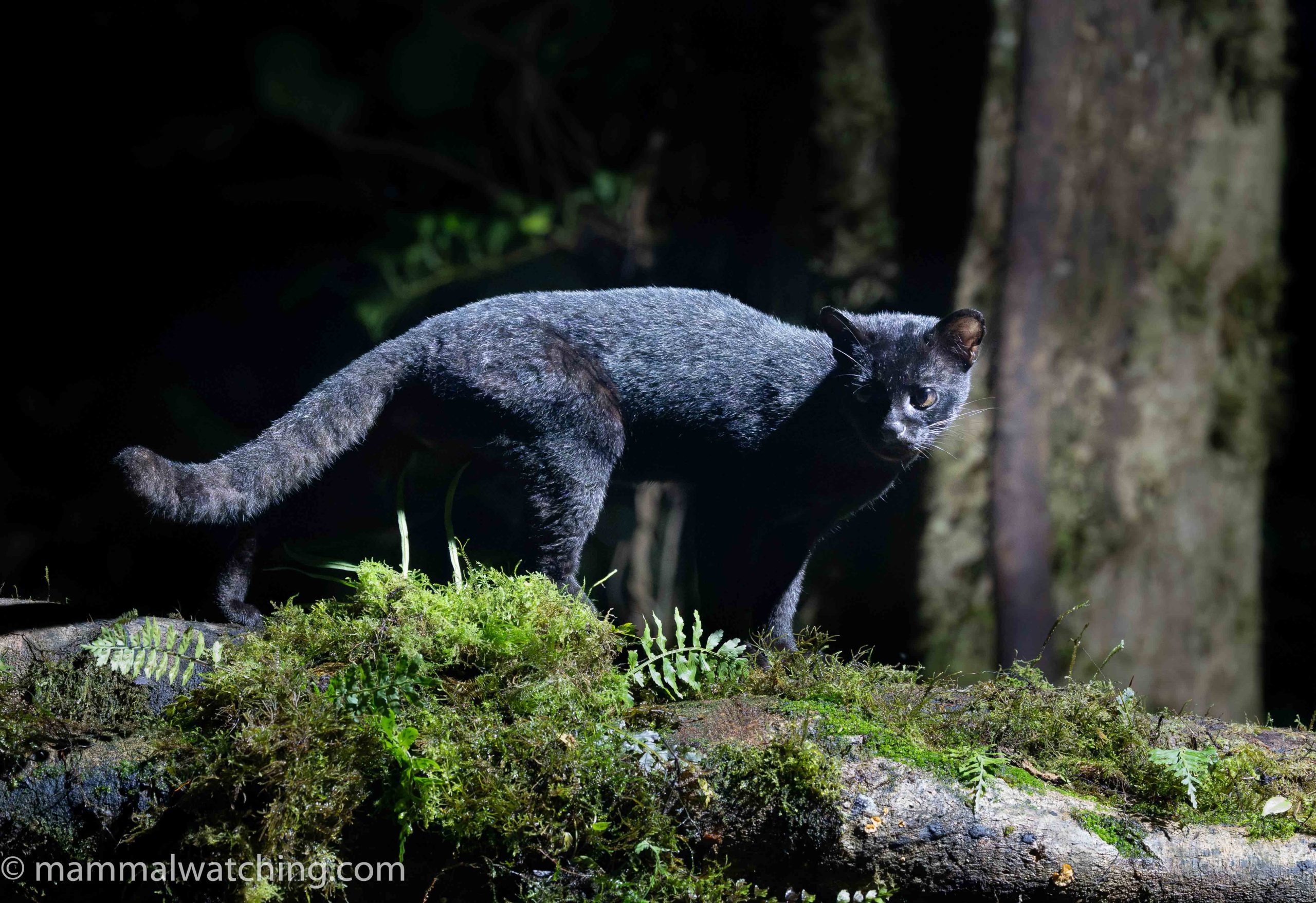
For most mammalwatchers I suspect the Clouded (Northern) Oncillas will be the main event. A melanistic animal is visiting daily at the moment, along with a shyer non-melanistic cat. And a third melanistic animal – possibly a cub – had recently been seen on their camera traps.
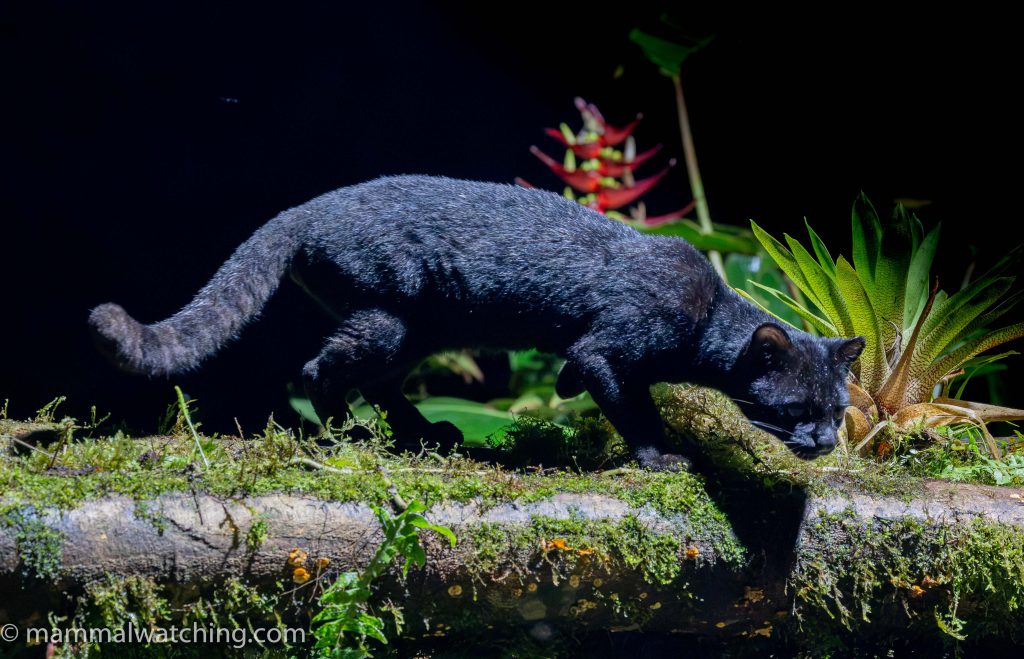
Clouded Oncilla (Leopardus pardinoides)
I only had one full night to look. Fortunately for my stress levels, an animal arrived just after dinner and visited repeatedly over the course of half an hour. Obviously a beautiful cat and a very difficult one to see, outside of Mirador el Roble in Colombia, though my understanding is that the cat there is often absent for weeks at a time.
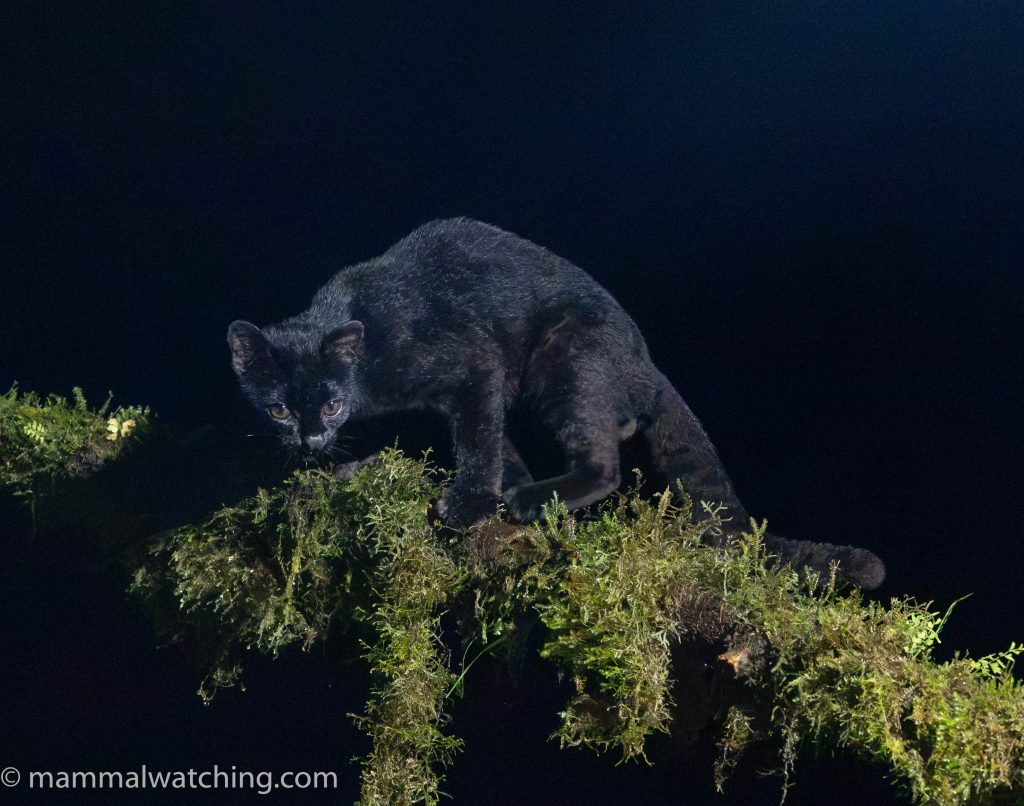
Clouded Oncilla (Leopardus pardinoides)
I was struck by how long-necked this cat is, as you can see in the photo below.
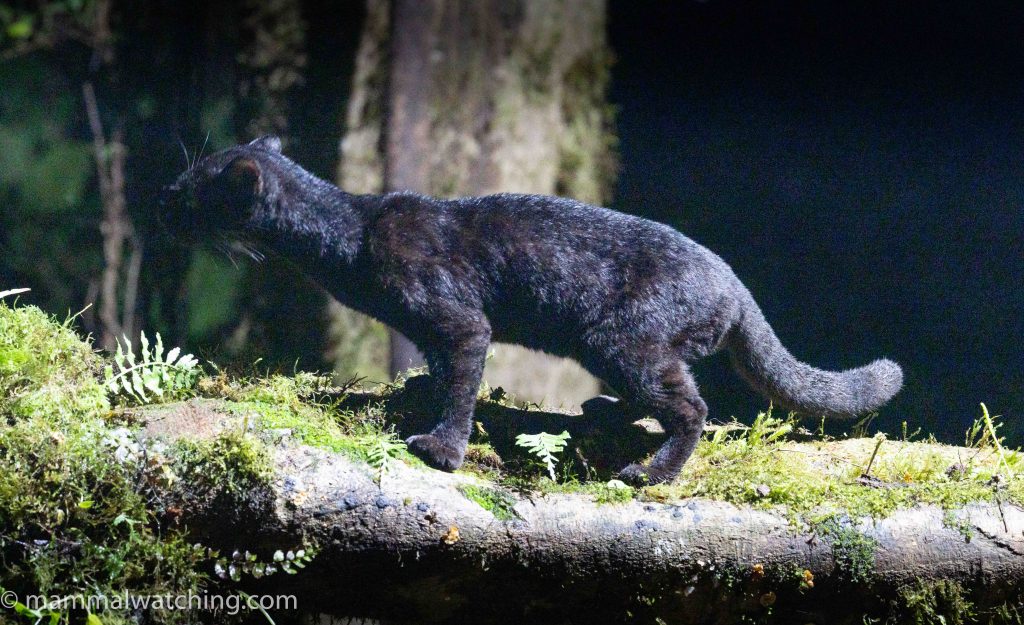
Clouded Oncilla (Leopardus pardinoides)
The area is a hotspot for small mammal diversity and I had caught several species before at Los Quetzales next door.
On this visit we recorded Chiriqui Singing Mouse in the daytime.
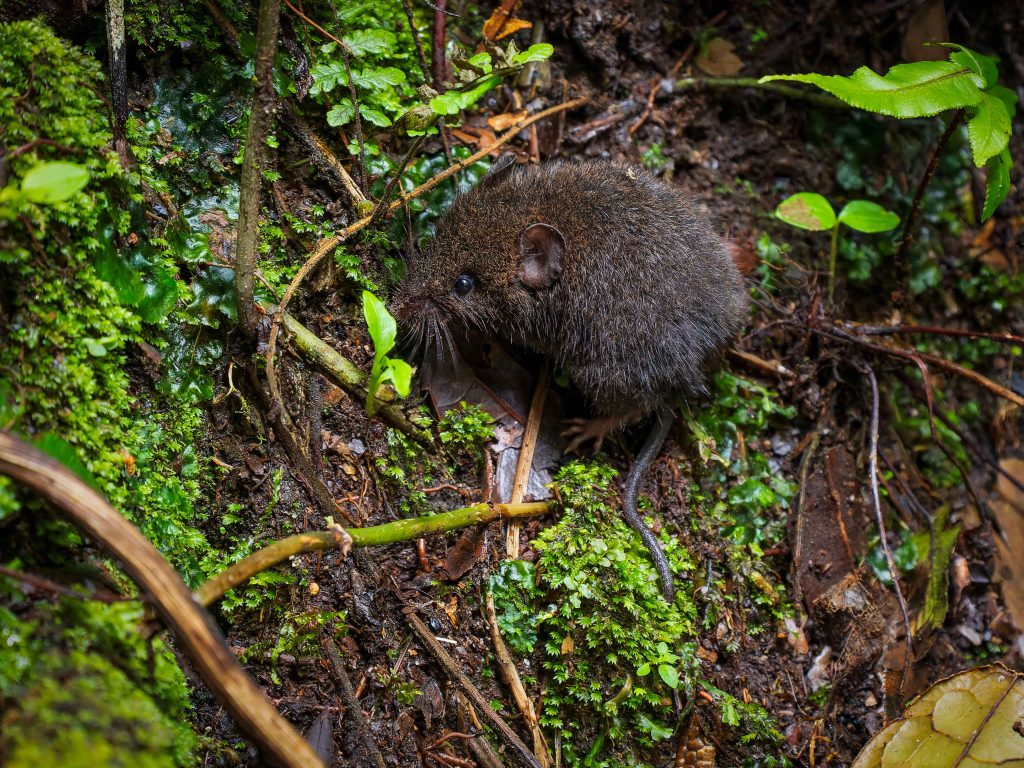
Chiriqui Singing Mouse (Scotinomys xerampelinus). Photo Ignacio Yúfera
Along with Desmarest’s Spiny Pocket Mouse at night feeding on bird seed.
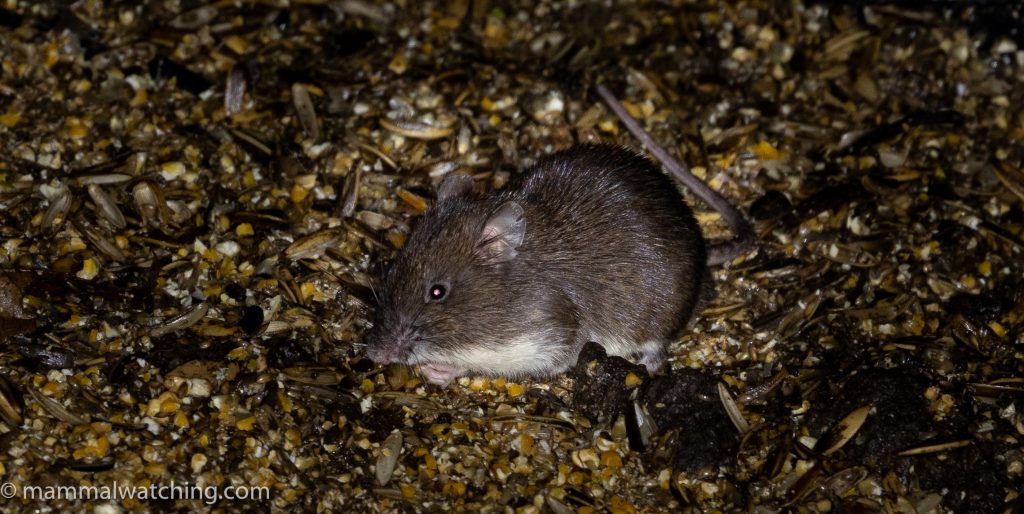
Desmarest’s Spiny Pocket Mouse (Heteromys desmarestianus)
As well as this Boquete Rice Rat caught in action near the pond.
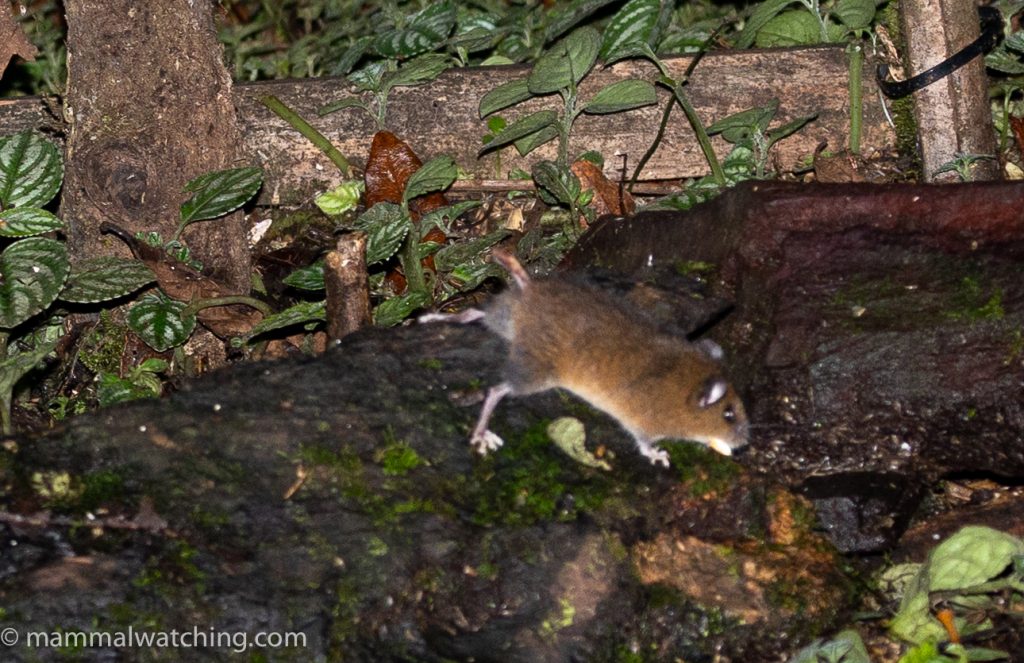
Boquete Rice Rat (Nephelomys devius)
I set a few traps and caught two rice rats along with Talamancan Deermouse (Peromyscus nudipes), and Talamancan Harvest Mouse (Reithrodontomys creper), all of which I had caught at Los Quetzales before.
Bats were hawking over the small pond near the lodge and I was abe to get a photograph of one in flight. A terrible photo but enough to identify this as the recently described Armién’s Myotis, a lifer for me (thank you Fiona Reid!).
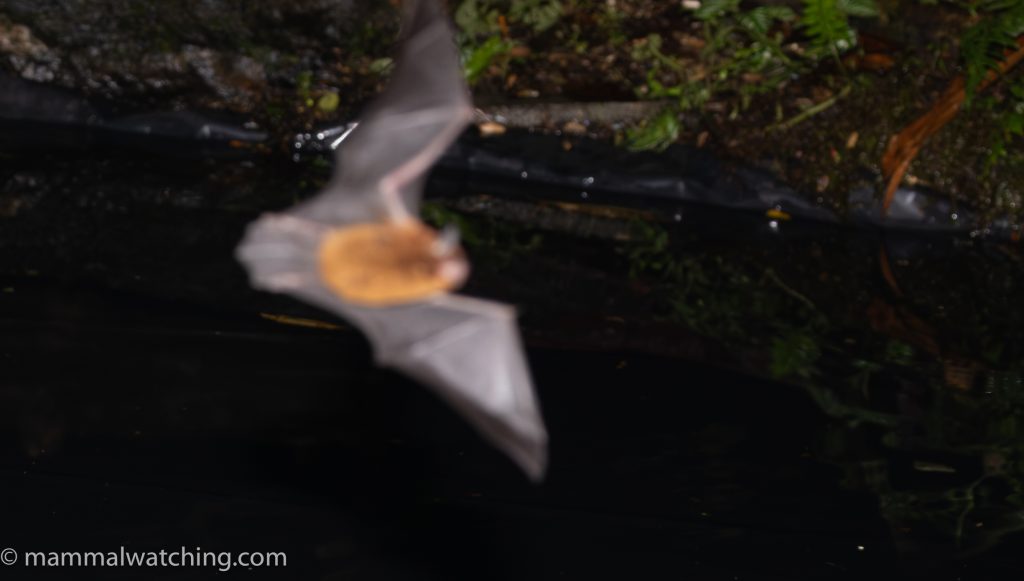
Armién’s Myotis (Myotis armiensis)
I had to leave early for my flight from David the next morning so I left the lodge about 9pm on my second night and slept in one of the cabins at the Tamandua Offices. A Mexican Porcupine was feeding on the other side of the river behind the hummingbird feeders at the offices. A final surprise after Ignacio and I had been discussing porcupines and how they ought to be around.
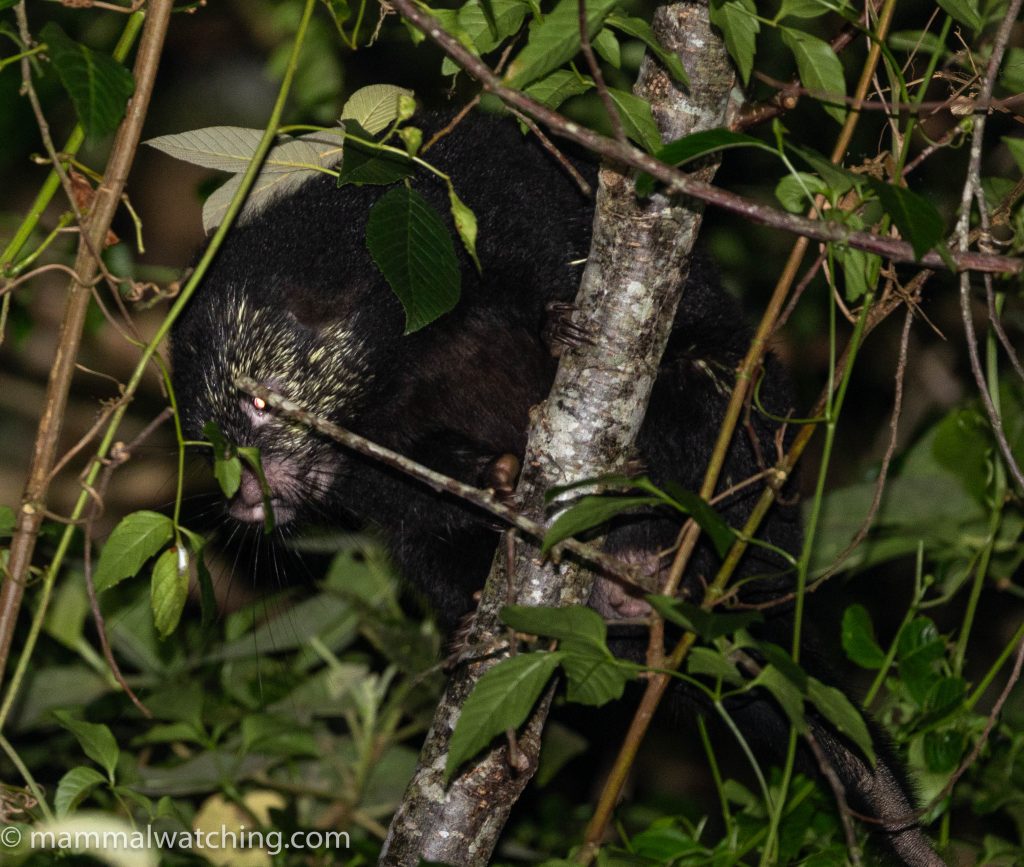
Mexican Hairy Porcupine (Coendou mexicanus)
Thank you
What a place! So many great species and such good views and photographic opportunities I am pretty sure this report will put the new lodge well on truly on the mammalwatching map. Between the top tier mammals and superb birding I can imagine that it is going to become popular.
Thank you of course to Ignacio for inviting me over and to all the team at Tamandua Tours especially Genover ‘Poto’ Jr for helping me and to his parents Katrina and Ito. Miguel the excellent chef also deserves a big gracias! Thank you too to Fiona Reid and Venkat Sankar for helping me with the small mammal IDs.
José Gabriel Martínez-Fonseca and I are discussing with Ignacio about taking a group to Panama in June 2027 including several days here. We will look for all these species and want to prepare a full mammal inventory from the lodge. It should be mega. If you are interested in joining us please write to me and I can send details when they are ready.
Trip List
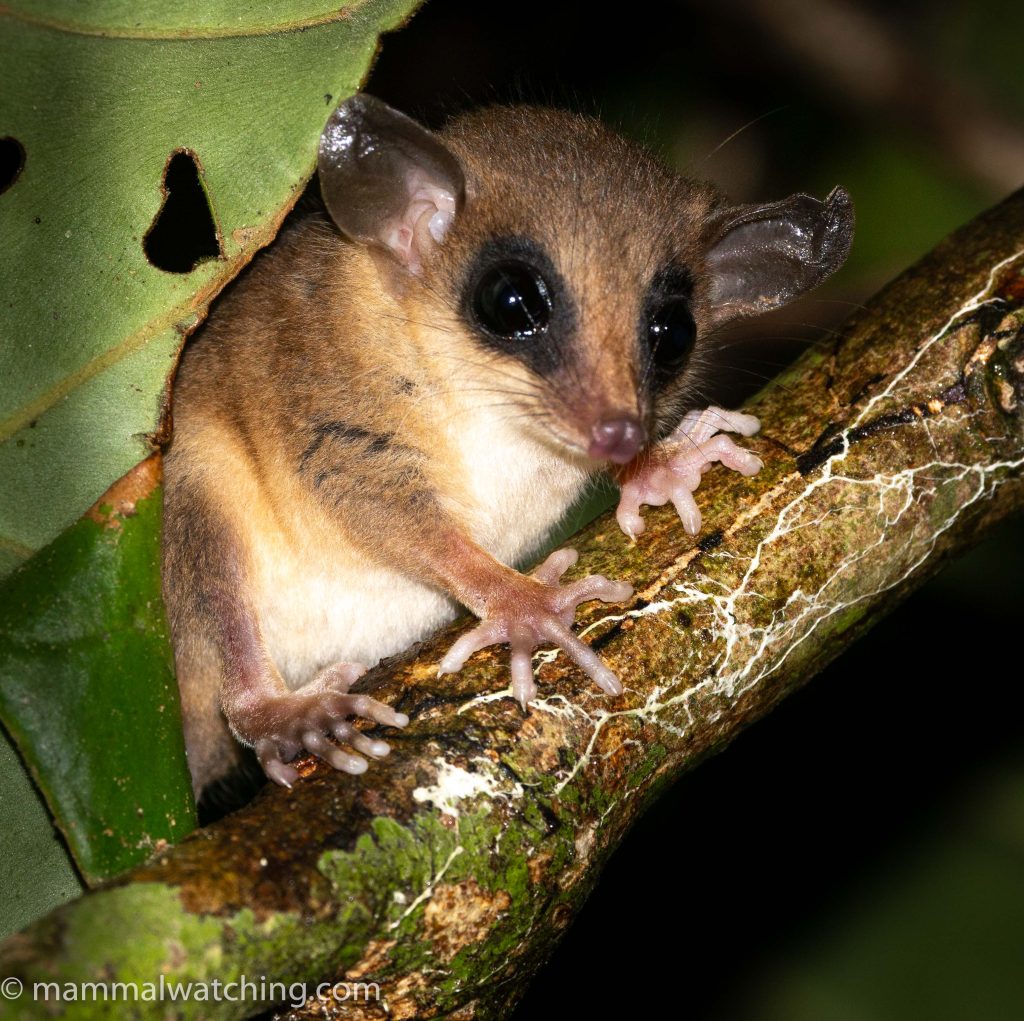
Panama Mouse Opossum (Marmosa isthmica)
Gamboa
Panama Mouse Opossum (Marmosa isthmica) – lifer
Central American Black Howler (Alouatta pigra) (Heard)
Central American Agouti (Dasyprocta punctata)
Jamaican Fruit-eating Bat (Artibeus jamaicensis)
Great Striped-faced Bat (Vampyrodes major)
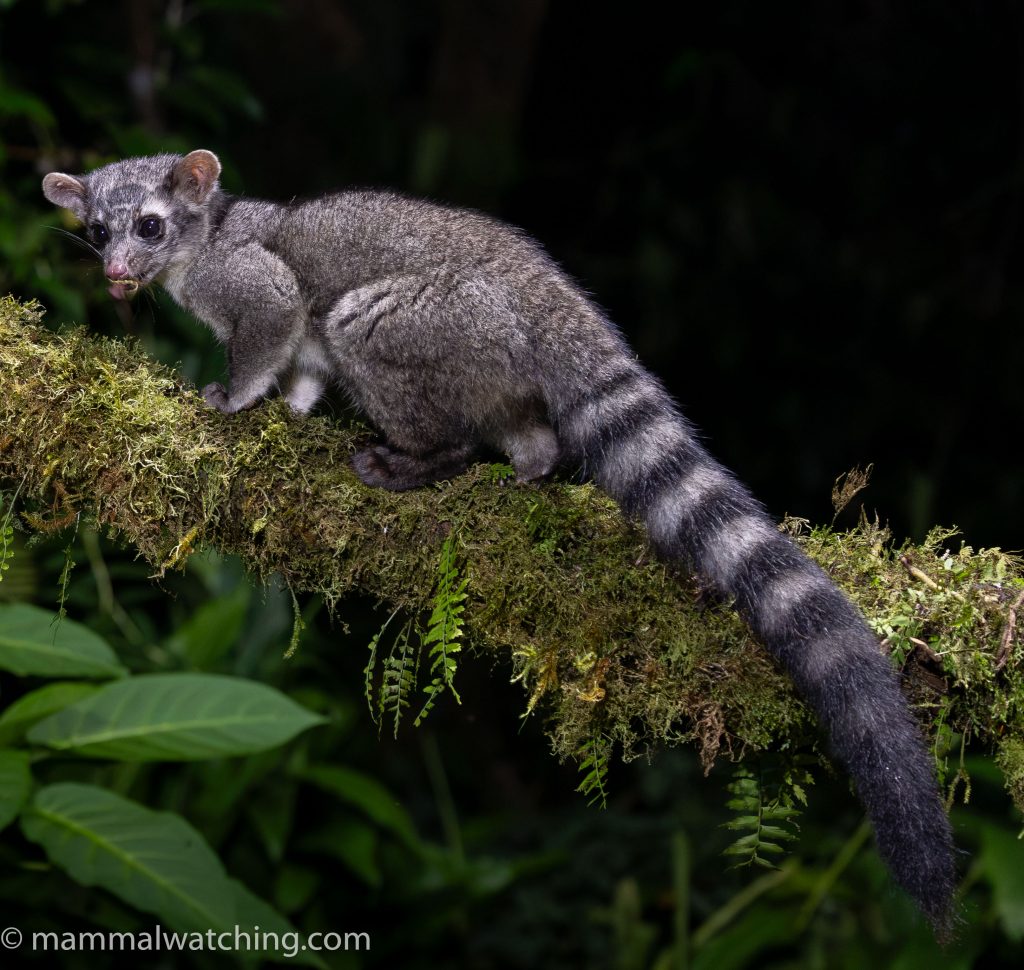
Cacomistle (Bassariscus sumichrasti)
Cerro Punta
Northern Black-eared Opossum (Didelphis marsupialis)
Mexican Hairy Porcupine (Coendou mexicanus)
Red-tailed Squirrel (Sciurus granatensis)
Bangs’s Mountain Squirrel (Syntheosciurus brochus) – first good view
Desmarest’s Spiny Pocket Mouse (Heteromys desmarestianus)
Long-tailed Singing Mouse (Scotinomys xerampelinus)
Talamancan Deermouse (Peromyscus nudipes)
Talamancan Harvest Mouse (Reithrodontomys creper)
Boquete Rice Rat (Nephelomys devius)
Armién’s Myotis (Myotis armiensis) – lifer
Tayra (Eira barbara)
Long-tailed Weasel (Neogale frenata)
Cacomistle (Bassariscus sumichrasti)
Clouded Oncilla (Leopardus pardinoides) – lifer
19 species and r.5 lifers

Post author
8 Comments
-
-
Sebastian Kennerknecht
Thanks for introducing us to this new place Jon.
I am curious, are the cats themselves baited as well? For a cat to come to a site every day is very unusual. Baiting in general is a topic I think we as the mammal watching community should have more of a discussion about. Especially considering where mammal watching is in its journey, we have a unique opportunity to set a standard across the industry that always puts the welfare of the animals first — something I think we can all agree on.
Would love to have an in depth conversation about this.
Thanks,
Sebastian-
Jon Hall
Thanks Sebastian. Those cats started coming because of the rodents I think but yes there is now food for them too sometimes now. I agree that it’s a good idea to talk about the pros and cons of feeding animals, so Charles and I will talk about it on a podcast soon as a way to get some discussion. Will let you know when that episode is out.
-
Sebastian Kennerknecht
Hey Jon, Glad to start the discussion! There are some biologists who have looked at this specifically, like Vincenzo Penteriani, with some excellent primary literature out there of why baiting, especially carnivores, is a very bad idea. They have found with scientific evidence that baiting and feeding of carnivores can food-condition animals, alter natural behavior, increase human–wildlife conflict, and elevate disease risk. This often means the animal ultimately pays the price — again a result I don’t think any of us should be remotely comfortable with. Let me know if you want links to some good papers. Thanks! Sebastian
-
-
Sebastian Kennerknecht
Hey Jon,
Here is a list of scientific papers that I think we as mammal watchers should read to make decisions on wildlife baiting.Orams, M.B. 2002. Feeding wildlife as a tourism attraction: A review of issues and impacts.
Dubois, S., Fraser, D., et al. 2017. A framework to evaluate wildlife feeding in research, wildlife management, tourism and recreation.
Sorensen, A., van Beest, F.M., & Brook, R.K. 2014. Impacts of wildlife baiting and supplemental feeding on infectious disease transmission risk: A synthesis of knowledge.
Becker, D.J., Streicker, D.G., & Altizer, S. 2017. Wildlife health and supplemental feeding: A review and management recommendations.
Newsome, D., & Rodger, K. 2013. Wildlife tourism. (Chapter reviewing the ecological and behavioral consequences of wildlife feeding and provisioning.)
Burns, G.L., & Howard, P. 2003. When wildlife tourism goes wrong: A case study of dingo–human conflict on Fraser Island.
Behrendorff, L., et al. 2023. Food-related interactions between dingoes and people under contemporary management.
Rocha, D.G., Ramalho, E.E., & Magnusson, W.E. 2016. Baiting for carnivores might negatively affect capture rates of prey species in camera-trap studies.
Kubasiewicz, L.M., Bunnefeld, N., Tulloch, A.I.T., Quine, C.P., & Park, K.J. 2016. Diversionary feeding: An effective management strategy for conservation conflict?
Kelly, A., et al. 2019. Human–large carnivore interactions: A review of factors leading to attacks on humans.
Shimozuru, M., et al. 2020. Human habituation of brown bears increases human-caused mortality in subsequent generations.
Lafferty, D.J.R., et al. 2024. Bear baiting risks and mitigations.
Brown, R.D., & Cooper, S.M. 2006. The nutritional, ecological, and ethical arguments against baiting and feeding white-tailed deer.
Patroni, J., Simpson, G., & Newsome, D. 2018. Feeding wild fish for tourism: A systematic quantitative literature review of impacts and management.
Meyer, L., Barry, C., Araujo, G., et al. 2021. Redefining provisioning in marine wildlife tourism.
-
-
-
-


Leave a Reply
You must be logged in to post a comment.
Tina Greenawalt
This lodge sounds amazing!